Potential Block On EU Crypto Firms, France Calls For Central Regulator Control

bitcoinistPublicado a 2025-09-16Actualizado a 2025-09-16

Resumen

France is taking a firm stance on the regulation of cryptocurrency firms operating within its borders, signaling a potential move...

Trusted Editorial content, reviewed by leading industry experts and seasoned editors. Ad Disclosure

France is taking a firm stance on the regulation of cryptocurrency firms operating within its borders, signaling a potential move to block companies licensed in other European Union (EU) nations from conducting business domestically. 

This latest initiative, led by the head of France’s financial watchdog, Marie-Anne Barbat-Layani, is part of a broader push to shift regulatory oversight to the European Securities and Markets Authority (ESMA), based in Paris.

France Pushes For Centralized Crypto Oversight

According to an exclusive coverage made by Reuters on Monday, the urgency of this move stems from concerns that under the EU’s new regulatory framework, known as the Markets in Crypto-Assets (MiCA) regulation, crypto companies are gravitating towards jurisdictions with more lenient licensing processes.

Barbat-Layani emphasized that there are significant inconsistencies in how national regulators are applying the new rules, raising alarms about the potential for inadequate supervision of cross-border firms.

In a coordinated effort, France has joined Italy and Austria in advocating for ESMA to assume supervisory responsibilities over major crypto firms. This was outlined in a position paper shared with Reuters, highlighting a collective concern about the regulatory landscape.

The head of France’s financial watchdog warned that France would not shy away from employing what she termed an “atomic weapon”—the possibility of challenging the validity of licenses granted by other EU member states. 

This could disrupt the established “passporting” mechanism that allows companies approved in one country to operate throughout the European Union. 

Barbat-Layani also pointed out that some crypto platforms are engaging in “regulatory shopping,” seeking out jurisdictions with less stringent requirements to gain favorable licenses. 

France And Allies Seek Major Changes For MiCA Rules

The call for enhanced oversight comes after a review by ESMA, which found that certain national regulators, like Malta, faced scrutiny for their licensing processes. In some cases, the review indicated insufficient risk assessment when granting licenses to crypto firms. 

As part of this ongoing transition, crypto companies are in the process of applying for MiCA licenses, with jurisdictions like Luxembourg and Malta already granting approvals to prominent platforms such as Coinbase (COIN) and Gemini (GEMI). 

However, the French, Italian, and Austrian regulators are advocating for revisions to MiCA that would impose stricter rules on crypto activities outside the EU, enhance cybersecurity measures, and refine how authorities manage new digital asset offerings.

France has consistently championed the idea of expanding ESMA’s regulatory powers, a sentiment echoed by ESMA’s head, Verena Ross. However, this proposal faces resistance from certain EU member states, highlighting the challenges ahead in establishing a cohesive regulatory approach for the digital asset market. 

Crypto
The daily chart shows the market’s total capitalization at $3.9 trillion. Source: TOTAL on TradingView.com

Featured image from DALL-E, chart from TradingView.com

Editorial Process for bitcoinist is centered on delivering thoroughly researched, accurate, and unbiased content. We uphold strict sourcing standards, and each page undergoes diligent review by our team of top technology experts and seasoned editors. This process ensures the integrity, relevance, and value of our content for our readers.

Ronaldo is a seasoned crypto enthusiast with over four years of experience in the field. He is passionate about exploring the vast and dynamic world of decentralized finance (DeFi) and its practical applications for achieving economic sovereignty. Ronaldo is constantly seeking to expand his knowledge and expertise in the DeFi space, as he believes it holds tremendous potential for transforming the traditional financial landscape.

Lecturas Relacionadas

XRP enfrentará una dilución anual de oferta del 5.5 % en medio de un desplome del 81.6% en los ingresos de XRPL

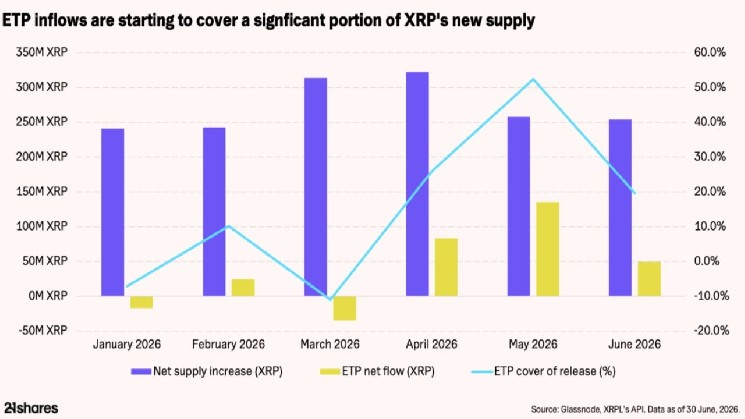
El suministro en circulación de XRP ha aumentado un 5,5% anual debido a emisiones mensuales desde fondos en custodia que superan las reintegraciones, según un análisis de 21Shares. Este incremento diluye el valor para los tenedores, resultando en una pérdida neta anual estimada del 5,5% con las tarifas actuales. Para compensar esta expansión, los ingresos de la red necesitarían multiplicarse aproximadamente 12.700 veces. Los productos cotizados (ETP) de XRP en EE.UU. absorbieron solo el 14,8% del nuevo suministro en el primer semestre de 2026. Aunque las compras cubrieron más de la mitad en mayo, sus entradas anuales (588 millones de dólares) representan solo una séptima parte de la emisión neta. La demanda futura depende de un uso más amplio, como en pagos corporativos o gestión de tesorería, pero su adopción en flujos de pagos tradicionales aún es incierta. Los ingresos de XRPL cayeron un 81,6% interanual en el primer semestre, a 1,18 millones de dólares, afectados por menores comisiones de swaps y regalías de NFT. Solo el 10,6% de estos ingresos benefician indirectamente a los tenedores mediante la reducción de oferta. Por otro lado, la stablecoin de Ripple, RLUSD, creció significativamente, con una oferta de 1.560 millones de dólares y un 52% alojado en XRPL, mejorando la liquidez institucional. Aviva Investors lanzó un fondo tokenizado en XRPL, sumándose a activos tokenizados por valor de unos 4.000 millones de dólares en la red.

cryptonews.ruHace 23 min(s)

XRP enfrentará una dilución anual de oferta del 5.5 % en medio de un desplome del 81.6% en los ingresos de XRPL

cryptonews.ruHace 23 min(s)

Trading

Spot
活动图片