Memecoins vs. Altcoins: Market Cap Ratio Signals Potential Reversal

bitcoinistPublicado a 2025-09-15Actualizado a 2025-09-15

Resumen

Memecoins have been under heavy selling pressure since December 2024, with many declaring the sector as good as dead. Prices...

Trusted Editorial content, reviewed by leading industry experts and seasoned editors. Ad Disclosure

Memecoins have been under heavy selling pressure since December 2024, with many declaring the sector as good as dead. Prices collapsed across the board, liquidity dried up, and retail enthusiasm that once fueled massive rallies seemed to vanish. For months, memecoins have trended lower, underperforming most of the broader crypto market and leaving investors skeptical about their long-term survival.

Yet, despite the gloom, some analysts argue that dismissing memecoins entirely may be premature. As the market prepares for a new phase driven by shifting liquidity flows, institutional positioning, and macroeconomic catalysts, speculation could once again find fertile ground in this volatile sector. Top analyst Darkfost has gone as far as to suggest that the time to take a fresh look at memecoins may have arrived. According to him, data shows that the market is entering an area where memecoin dominance has historically regained strength, often sparking sharp rebounds.

While risks remain high—memecoins are still among the most speculative assets in crypto—the potential for explosive gains continues to attract attention.

Memecoin Dominance Signals Possible Rebound

Darkfost highlights the importance of monitoring the Memecoin Dominance in Altcoin Markets chart, which compares the market capitalization of key memecoins against that of established altcoins. This ratio offers valuable insight into whether memecoins are gaining or losing influence relative to the broader altcoin sector.

Since the massive rush that peaked at the end of 2024, memecoins have been in a prolonged decline, steadily losing both valuation and investor interest. The frenzy that once drove parabolic gains gave way to exhaustion, with most of the sector retracing sharply.
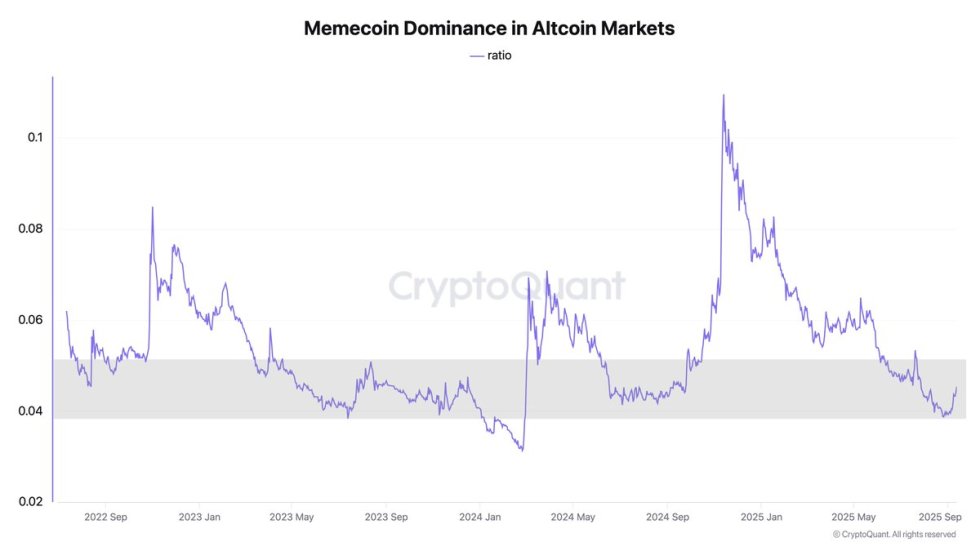
Memecoin Dominance in Altcoin Markets | Source: Darkfost

Investors in memecoins understand the unique challenge of this asset class. Unlike Bitcoin or Ethereum, memecoins often lack fundamental backing, making them highly speculative. As a result, timing entries and, more importantly, exiting positions quickly to secure profits are essential strategies. Hesitation can easily turn short-term gains into significant losses.

Despite this, Darkfost observes that the memecoin dominance chart is signaling a potential turning point. The ratio has entered an area where memecoins have historically regained strength, marking the beginning of sharp rebounds. Early signs of reaction suggest that market sentiment may be shifting, with speculative capital slowly re-entering the space.

If the trend persists, the conditions could align for a renewed memecoin mania. While it may not replicate the extreme fervor of late 2024, a resurgence in speculative appetite could drive significant rallies. For traders watching closely, the data implies that memecoins may once again become a hot narrative in the crypto cycle, though managing risk remains paramount.

Market Cap Growth Analysis

The chart of the Memecoin Market Cap (Daily) shows how the sector remains highly volatile, reflecting speculative behavior that defines this corner of the crypto market. After rebounding strongly from the July lows near $64B, the market surged to a local peak above $88B in early September. However, that momentum quickly faded, with the cap now retracing toward $75B, down nearly 5% in the latest session.
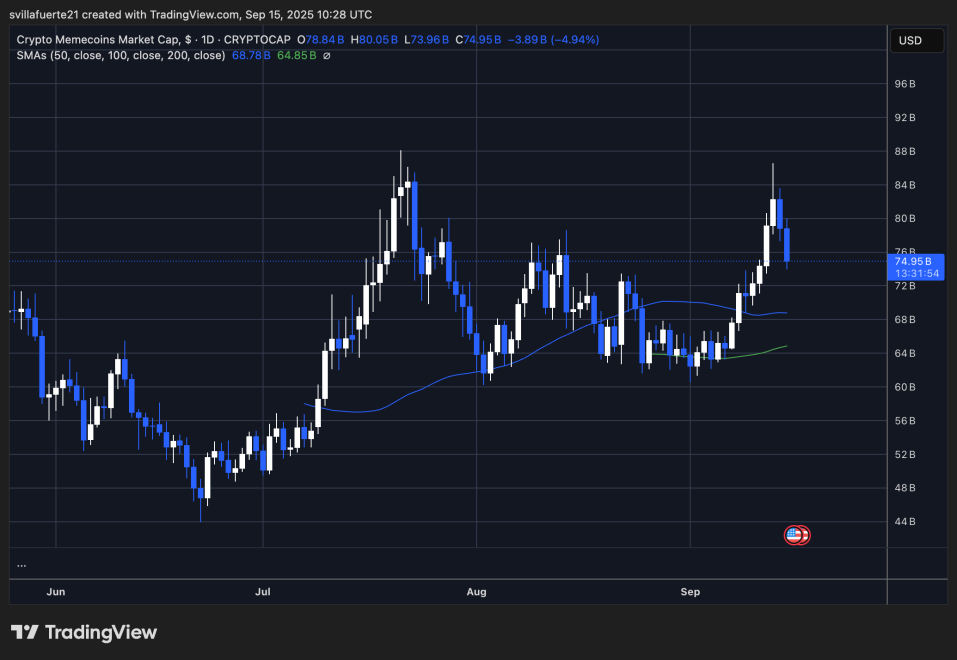
Crypto Memecoin Market Cap | Source: MEME.C chart on TradingView

The 50-day moving average at $68.7B has acted as a strong dynamic support throughout this recovery, showing that buyers continue to step in when valuations approach this level. Meanwhile, the sector’s ability to push above $80B and briefly test the $88B resistance highlights that speculative capital is still present, even if profit-taking remains aggressive.

For now, memecoins are consolidating after a sharp upswing, and the market appears to be searching for balance. If capitalization holds above the $72–74B range, a renewed attempt to reclaim $80B could follow, reigniting bullish sentiment. On the other hand, a breakdown below the 50-day average would suggest fading momentum and open the door for a deeper retracement. Ultimately, memecoins remain sensitive to liquidity flows and broader risk sentiment, making timing critical.

Featured image from Dall-E, chart from TradingView

Editorial Process for bitcoinist is centered on delivering thoroughly researched, accurate, and unbiased content. We uphold strict sourcing standards, and each page undergoes diligent review by our team of top technology experts and seasoned editors. This process ensures the integrity, relevance, and value of our content for our readers.

Sebastian's journey into the world of crypto began four years ago, driven by a fascination with the potential of blockchain technology to revolutionize financial systems. His initial exploration focused on understanding the intricacies of various crypto projects, particularly those focused on building innovative financial solutions. Through countless hours of research and learning, Sebastian developed a deep understanding of the underlying technologies, market dynamics, and potential applications of cryptocurrencies. As his knowledge grew, Sebastian felt compelled to share his insights with others. He began actively contributing to online discussions on platforms like X and LinkedIn, focusing on fintech and crypto-related content. His goal was to expose valuable trends and insights to a wider audience, fostering a deeper understanding of the rapidly evolving crypto landscape. Sebastian's contributions quickly gained recognition, and he became a trusted voice in the online crypto community. To further enhance his expertise, Sebastian pursued a UC Berkeley Fintech: Frameworks, Applications, and Strategies certification. This rigorous program equipped him with valuable skills and knowledge regarding Financial Technology, bridging the gap between traditional finance (TradFi) and decentralized finance (DeFi). The certification deepened his understanding of the broader financial landscape and its intersection with blockchain technology. Sebastian's passion for finance and writing is evident in his work. He enjoys delving into financial research, analyzing market trends, and exploring the latest developments in the crypto space. In his spare time, Sebastian can often be found immersed in charts, studying 10-K forms, or engaging in thought-provoking discussions about the future of finance. Sebastian's journey as a crypto analyst and investor has been marked by a relentless pursuit of knowledge and a dedication to sharing his insights. His ability to navigate the complex world of crypto, combined with his passion for financial research and communication, makes him a valuable asset to the industry. As the crypto landscape continues to evolve, Sebastian remains at the forefront, providing valuable insights and contributing to the growth of this revolutionary technology.

Lecturas Relacionadas

Empleados de Anthropic renuncian para emprender, valorados en 10,000 millones de dólares, también desarrollan «mejora autorrecursiva»

Empleados de Anthropic fundan Mirendil, una startup valorada en 10.000 millones de dólares que busca desarrollar IA con "mejora recursiva" Dos antiguos investigadores de Anthropic, Behnam Neyshabur y Harsh Mehta, han fundado Mirendil, una startup con una financiación inicial de 200 millones de dólares y una valoración de 10.000 millones. Su objetivo es crear herramientas para que científicos de campos como la medicina o la ciencia de materiales puedan desarrollar y entrenar sus propios modelos de IA, en lugar de depender de modelos generales de grandes tecnológicas. La compañía, cuyo nombre proviene del élfico de "El Señor de los Anillos" y significa "amigo de las joyas", cuenta con un equipo de 20 personas procedentes de Anthropic, xAI, Google DeepMind y OpenAI. Su financiación procede de Andreessen Horowitz, Kleiner Perkins y Nvidia. La visión de Mirendil es facilitar la "IA para la IA para la ciencia": una plataforma que permita a los laboratorios de investigación construir modelos de IA especializados y propietarios. Su enfoque técnico central es la "mejora recursiva" (recursive self-improvement), donde la IA optimiza continuamente su propio código y capacidades bajo supervisión humana. Los fundadores creen que existe una oportunidad en el mercado, ya que las grandes compañías de IA, como la propia Anthropic, utilizan sus modelos principalmente para acelerar su investigación interna y restringen su uso para entrenar productos competidores. Mirendil planea lanzar sus primeros productos en los próximos meses.

marsbitHace 16 min(s)

Empleados de Anthropic renuncian para emprender, valorados en 10,000 millones de dólares, también desarrollan «mejora autorrecursiva»

marsbitHace 16 min(s)

¿STRC cae por debajo de 80 dólares? ¿Los inversores conservadores aún pueden comprar en la caída?

STRC, la acción preferente perpetua de MicroStrategy (MSTR), cotiza con un fuerte descuento, por debajo de su valor nominal de 80 dólares, ofreciendo un rendimiento de dividendos aparente elevado (13-15%). El artículo analiza si esto representa una oportunidad de compra o un riesgo estructural. El núcleo del debate es si el modelo de financiación de MSTR (emitir valores como STRC para comprar más Bitcoin) puede sostenerse. El reciente descuento de STRC refleja la preocupación del mercado por: 1) la presión sobre el diferencial de precio de MSTR frente al valor de sus BTC (mNAV), 2) la interrupción de nuevas emisiones de STRC a valor nominal, 3) la competencia de productos similares como SATA, y 4) la venta simbólica de BTC por parte de MSTR para cubrir pagos de dividendos, lo que cuestiona el discurso de "solo comprar". STRC no es un esquema Ponzi, ya que está respaldado por las grandes reservas de BTC de MSTR. Sin embargo, su riesgo es la dependencia de un flujo continuo de financiación barata. Un "colapso" no sería una liquidación repentina, sino una erosión de la confianza: si BTC entra en un mercado bajista profundo, el mNAV de MSTR se contrae, STRC cotiza con un gran descuento permanente y los dividendos dependen cada vez más de la venta de BTC, la narrativa financiera se rompería. En resumen, STRC es una apuesta de alto rendimiento sobre la capacidad de MSTR para mantener su modelo de financiación basado en Bitcoin durante los ciclos bajistas. No es un activo de renta fija sin riesgo. Su atractivo depende de si el inversor apuesta a una recuperación técnica del precio hacia los 100 dólares o está dispuesto a asumir el riesgo de un rendimiento a largo plazo con posibles aplazamientos de dividendos y descuentos persistentes.

marsbitHace 44 min(s)

¿STRC cae por debajo de 80 dólares? ¿Los inversores conservadores aún pueden comprar en la caída?

marsbitHace 44 min(s)

¿Entrada para billones de fondos de pensiones? El ETF de reinversión de dividendos en Bitcoin de Franklin tiene un límite máximo de presión de venta

El gigante de inversiones Franklin Templeton ha solicitado autorización para lanzar dos ETFs que integran una exposición automática a Bitcoin. Estos fondos, llamados "ETF de reinversión de dividendos en Bitcoin", emplean la estrategia de "configuración por defecto" común en planes de pensiones 401(k). Inicialmente, asignarían un 95% a acciones y un 5% a Bitcoin, utilizando los dividendos de las acciones para comprar Bitcoin automáticamente. Sin embargo, el diseño incluye un mecanismo de rebalanceo trimestral que obliga a vender Bitcoin si su ponderación supera el 5%, reduciéndola al 4,5%. Además, establece un límite máximo del 20% para la exposición a Bitcoin. Según el análisis, el impacto de compra sería mínimo. Dadas las bajas tasas de dividendos de los índices subyacentes (aprox. 1% o 0,5% anual), la entrada anual de capital nuevo destinado a Bitcoin sería insignificante en comparación con el volumen diario del mercado. Paradójicamente, en un mercado alcista de Bitcoin, estos fondos se convertirían en vendedores netos programáticos debido al mecanismo de rebalanceo, creando potencialmente una presión de venta constante. El producto está dirigido principalmente a asesores financieros, permitiéndoles asignar Bitcoin de forma indirecta y "compatible" para sus clientes, ya que los fondos se presentan como productos de renta variable estándar. El artículo concluye que, aunque el modelo busca aprovechar la inercia y la configuración por defecto para atraer capital institucional (como se vio con los fondos de fecha objetivo), su diseño intrínseco limita severamente su capacidad para ser un comprador sostenido de Bitcoin y podría incluso actuar como un "techo" de presión vendedora durante rallies. Su éxito a gran escala dependería de que se incluyeran como opción por defecto en planes de pensiones, un proceso regulatorio que aún está en desarrollo.

Foresight NewsHace 52 min(s)

¿Entrada para billones de fondos de pensiones? El ETF de reinversión de dividendos en Bitcoin de Franklin tiene un límite máximo de presión de venta

Foresight NewsHace 52 min(s)

Trading

Spot
Futuros
活动图片