Cardano Founder Blasts Ghost Chain Critics: ‘Cavalry Is Coming’

bitcoinistPublicado a 2025-09-15Actualizado a 2025-09-15

Resumen

Broadcasting “from rough and rugged Wyoming” late on September 14, Cardano founder Charles Hoskinson delivered a forceful rebuttal to what...

Trusted Editorial content, reviewed by leading industry experts and seasoned editors. Ad Disclosure

Broadcasting “from rough and rugged Wyoming” late on September 14, Cardano founder Charles Hoskinson delivered a forceful rebuttal to what he called years of dismissive “ghost chain” narratives, arguing that the industry has “moved the goalposts” away from decentralization and toward VC-favored speed and token economics.

“It sucks to go to cryptocurrency Reddit and no matter what you say or do, you’re criticized and demeaned and attacked,” he said, after reading a community post lamenting the “overwhelming negative sentiment outside of our community.” Hoskinson’s message: Cardano will stick to its original brief—resilience, censorship resistance, and self-governance—and the payoff is near. “Keep the faith and don’t give up hope. The cavalry is coming. We are moving exactly as we need to,” he said.

Hoskinson Blasts Cardano Critics And ‘VC Chains’

The livestream’s central theme was a clash of first principles. Hoskinson traced early crypto’s mission to “disintermediation and decentralization,” saying the sector has since rewarded throughput and speculative manias—NFTs, GameFi, memecoins, and now RWAs—over credible neutrality. “The goalpost moved from disintermediation and decentralization to, well, let’s build high-performance systems and we don’t particularly care if those systems are resilient or decentralized,” he argued.

In his telling, Cardano’s refusal to compromise on those design goals explains both the network’s slower, research-driven cadence and its perceived under-appreciation in Web3 circles: “We’ve beat that drum and we’ve built protocol after protocol doing things the right way. Not the sexy way, not the VC-friendly way.”

Hoskinson framed the project’s past decade as an exercise in building durable primitives: the extended UTXO model for deterministic smart contracts; “liquid non-custodial staking”; the Ouroboros family of protocols; the Hard Fork Combinator for “telescoping” upgrades; end-to-end on-chain governance and treasury; and newer concepts such as isomorphic state channels, a partner-chains paradigm, and “Bitcoin DeFi” to align with what he called a principles-first ecosystem. “Every year, Cardano continues to get more decentralized, more resilient,” he said. “We’re able to take the best of all the ideas in the space, but never once have we compromised on who we are.”

On scalability, Hoskinson said Cardano is “on the dawn” of its next phase. He stated that “Leios is now in a SIP,” describing it as “the last stage before implementation” and “the foundation of a scalability agenda that is endless,” language he linked to a co-evolution with Hydra and advances in zero-knowledge cryptography. Taken together, he said, these efforts aim at “infinite scale just in time to absorb the needs of the economic, political and social systems abroad and at home.” He pointed to Hydra’s maturation—from a “toy” to demonstrations including a “vending machine” and tests he described as “a million transactions a second”—as a key pillar of the network’s L2 posture.

The founder set out a go-to-market plan that deliberately looks beyond crypto natives. “Less than 5% of the world is in the cryptocurrency space,” he said. “So why do we particularly care about a minority of a minority when there’s a big wide world out there?”

He urged “physicalizing Cardano,” citing Hydra-backed point-of-sale and ATM integrations, and stressed “rational privacy for all” through Midnight. He also cast Cardano as “the best place to launch a new blockchain,” linking that claim to the partner-chains initiative and what he called the “best AVS experience in the space.” Bitcoin remains the critical ally in this strategy, he said: “We have to partner with ecosystems that are principles first like Bitcoin… And we’re doing this with Bitcoin DeFi.”

Cavalry Coming?

Geographically, Hoskinson highlighted Argentina and Africa. He said Input Output maintains the “largest cryptocurrency office” in Buenos Aires and hosts biweekly events, adding that Cardano “continues to grow throughout Latin America.” In Africa, he said the long-trailed identity push is “almost ready to roll out,” with 2026 targeted to “turn on the ability to bring economic identity to the millions eventually billions who don’t have it.” Throughout, he contrasted these efforts with what he characterized as short-lived hype cycles: “To be truly a visionary, you have to accept that you have to go alone sometimes into the wilderness… And we’ve done that for 10 years.”

Governance milestones formed another through-line. Hoskinson declared the project’s “Voltaire” era “mission accomplished,” citing a community-elected constitutional committee, “hundreds of DReps,” a ratified on-chain constitution, and an annual budget. “We’re already talking about the next constitution and an incredible suite of governance tools,” he said, arguing that this collective machinery lets the ecosystem “speak with one voice,” ratify upgrades, and “converge to a budget” without compromising liveness or safety. “We are the only chain in the history of the cryptocurrency industry to do this,” he asserted.

The address included rare self-critique. Hoskinson said he wished Cardano had “moved faster in certain areas,” made “slightly different decisions about the ordering of the roadmap,” and staffed partnerships more aggressively. He nonetheless credited the privacy-focused Midnight initiative with “more than a hundred partnerships,” positioning it as a commercial bridge that “will bring hundreds more, if not thousands.”

He also revisited longstanding allegations from rival communities, saying he is “still inundated” with claims he “stole $600 million,” and added that a “128-page” forensic audit “gave complete exoneration,” a result he said received little attention from crypto media. “The asymmetries of information sting long, hard, and unfortunately take years or decades to undo,” he said.

Hoskinson closed by returning to community morale, urging Cardano’s governance participants to “forget the past and… look to the future,” redirecting energy toward entrepreneurs who can “bring in the countless millions to tens of millions to hundreds of millions of users.” The core bet, he said, is unchanged: that decentralization, credible governance, and research-led engineering will ultimately outlast every hype cycle.

“The next 24 to 36 months, Cardano will be in a position where it’s the fastest, most secure, and frankly speaking, best platform… to build anything at scale for anyone,” Hoskinson concluded, adding: “Cardano’s best days are ahead of it. I will always believe that. And that’s because Cardano has the best people.”

At press time, ADA traded at $0.89.
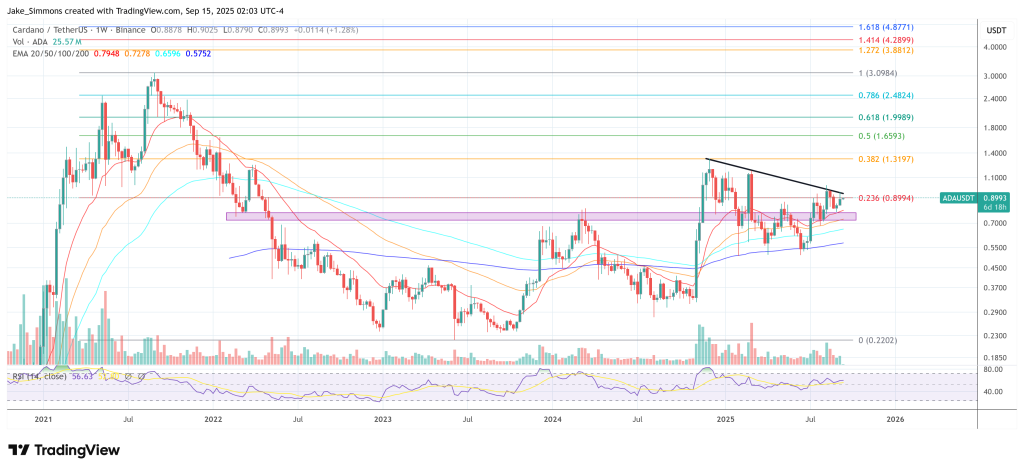
Cardano price
ADA bulls need to break the trendline, 1-week chart | Source: ADAUSDT on TradingView.com
Featured image created with DALL.E, chart from TradingView.com
Editorial Process for bitcoinist is centered on delivering thoroughly researched, accurate, and unbiased content. We uphold strict sourcing standards, and each page undergoes diligent review by our team of top technology experts and seasoned editors. This process ensures the integrity, relevance, and value of our content for our readers.

Jake Simmons has been a Bitcoin enthusiast since 2016. Ever since he heard about Bitcoin, he has been studying the topic every day and trying to share his knowledge with others. His goal is to contribute to Bitcoin's financial revolution, which will replace the fiat money system. Besides BTC and crypto, Jake studied Business Informatics at a university. After graduation in 2017, he has been working in the blockchain and crypto sector. You can follow Jake on Twitter at @realJakeSimmons.

Criptos en tendencia

Lecturas Relacionadas

Nunca imaginé que la primera aplicación práctica de la IA x Crypto sería la auditoría de seguridad

Según los datos, hasta junio de 2026, el TVL total en DeFi ha caído un 39% desde principios de año, mientras que los incidentes de seguridad se han intensificado, con un total de 121 ataques de hackers y pérdidas acumuladas de aproximadamente 942 millones de dólares. La rápida evolución de las herramientas de IA, especialmente tras el lanzamiento del modelo Claude Mythos por parte de Anthropic, ha reducido drásticamente los costes y la habilidad necesaria para encontrar vulnerabilidades en contratos inteligentes. Los atacantes pueden ahora escanear sistemáticamente miles de contratos, incluso descompilando bytecode, lo que ha acortado el ciclo de descubrimiento y explotación a minutos. Esto ha expuesto las deficiencias del modelo de auditoría tradicional, donde los informes tienen una validez limitada. Incluso protocolos auditados como Drift Protocol o KelpDAO han sido vulnerados mediante ingeniería social o fallos en la configuración operativa, mostrando que las auditorías de código ya no son suficientes. La industria se ve forzada a adaptarse: los proyectos requieren auditorías defensivas recurrentes bajo nuevos estándares, y las firmas de auditoría deben evolucionar de un modelo de informe puntual a servicios continuos de monitorización y verificación en tiempo real. Casos como la auditoría IA de Firepan para Curve Finance, que detectó una vulnerabilidad crítica pasada por alto en seis auditorías manuales, demuestran el potencial defensivo de la IA. En conclusión, la seguridad en DeFi ha dejado de ser un trámite previo al lanzamiento para convertirse en una infraestructura que requiere inversión continua, redefiniendo tanto las prácticas de los proyectos como el modelo de negocio de las auditorías.

marsbitHace 26 min(s)

Nunca imaginé que la primera aplicación práctica de la IA x Crypto sería la auditoría de seguridad

marsbitHace 26 min(s)

Nadie se lo esperaba: la primera aplicación real de IA x Crypto es la auditoría de seguridad

Los datos muestran que el valor total bloqueado (TVL) en DeFi cayó de aproximadamente 1150 mil millones de dólares a 700 mil millones en el primer semestre de 2026. Paralelamente, los ataques cibernéticos han causado pérdidas cercanas a los 942 millones de dólares en 121 incidentes, con el segundo trimestre siendo el más activo. La popularización de herramientas de IA de nueva generación ha reducido drásticamente el costo y la habilidad necesarios para encontrar vulnerabilidades en contratos inteligentes, desafiando el modelo tradicional de auditoría de seguridad. Los atacantes ahora utilizan IA para escanear miles de contratos, identificar patrones de vulnerabilidad y ejecutar exploits en minutos, lo que hace que los informes de auditoría tradicionales, con validez de meses, sean obsoletos. Incluso protocolos líderes y ampliamente auditados, como Drift Protocol y KelpDAO, han sufrido ataques que explotan fallas en la lógica de negocio, configuración de infraestructura o ingeniería social. Casos como la explotación de contratos históricos desplegados hace años demuestran que el período de protección de una auditoría puede haberse reducido a cero. En respuesta, las empresas de auditoría están desarrollando sistemas de auditoría asistidos por IA y evolucionando de un modelo de informe puntual a servicios de monitoreo continuo, verificación formal y detección de riesgos en tiempo real. Proyectos como Curve Finance y Zcash han beneficiado de auditorías con IA que descubrieron vulnerabilidades complejas pasadas por alto en revisiones humanas. En conclusión, la era de la "auditoría única para siempre" ha terminado. La seguridad debe ser una inversión continua. El sector de la auditoría está en transición de un modelo de bonanza a uno de competencia, donde los actores que se adapten e integren la IA en sus servicios de manera proactiva tendrán mayor probabilidad de sobrevivir.

链捕手Hace 33 min(s)

Nadie se lo esperaba: la primera aplicación real de IA x Crypto es la auditoría de seguridad

链捕手Hace 33 min(s)

¿Quién está pagando la fiesta de 64 mil millones de dólares en el papel?

**Resumen ejecutivo: ¿Quién pagará la factura del festín contable de 640.000 millones?** Bitcoin rompió el soporte clave de 60.000 USD, alcanzando su mínimo desde octubre de 2024. Las ballenas vendieron 45.000 BTC en una semana. El verdadero riesgo no es el precio, sino las empresas públicas (como Strategy/MicroStrategy, Metaplanet) que apalancaron sus balances con Bitcoin. **Principales afectados:** * **Strategy:** 847.000 BTC con un coste medio de 75.600 USD, ahora con >20% de pérdidas no realizadas. Su acción cotiza con un profundo descuento frente al valor de sus BTC. * **Metaplanet (Japón):** 40.000 BTC con coste medio de ~97.600 USD y >37% de pérdidas, agravadas por la debilidad del yen. * **Twenty One Capital (XXI) y Solmate:** Pérdidas masivas y conflictos internos tras apostar fuertemente por criptoactivos sin un negocio principal sólido. **El mecanismo falla:** No es una liquidación inmediata, pero el "vuelo financiero" se detiene. Estas empresas emitieron deuda (bonos convertibles, acciones preferentes) para comprar Bitcoin, vinculando su valor. En un mercado bajista, la nueva contabilidad (norma ASU 2023-08) obliga a registrar las pérdidas en la cuenta de resultados, lo que puede provocar su salida de índices bursátiles y ventas forzadas por fondos pasivos. **La crisis real se posterga:** El riesgo inmediato de liquidación es bajo debido al diseño de la deuda. Sin embargo, si Bitcoin no supera los ~75.000 USD en 12-24 meses, la ventana de recompra de bonos convertibles que se abre en **otoño de 2027** podría desencadenar una crisis de liquidez. Para pagar, las empresas podrían verse **forzadas a vender cientos de miles de Bitcoin**, creando una verdadera crisis de mercado. El modelo no evita la liquidación, solo la retrasa. La fecha clave no es un nivel de precio, sino el calendario de vencimientos de deuda en 2027.

marsbitHace 46 min(s)

¿Quién está pagando la fiesta de 64 mil millones de dólares en el papel?

marsbitHace 46 min(s)

Trading

Spot

Artículos destacados

Cómo comprar ADA

¡Bienvenido a HTX.com! Hemos hecho que comprar Cardano (ADA) sea simple y conveniente. Sigue nuestra guía paso a paso para iniciar tu viaje de criptos.Paso 1: crea tu cuenta HTXUtiliza tu correo electrónico o número de teléfono para registrarte y obtener una cuenta gratuita en HTX. Experimenta un proceso de registro sin complicaciones y desbloquea todas las funciones.Obtener mi cuentaPaso 2: ve a Comprar cripto y elige tu método de pagoTarjeta de crédito/débito: usa tu Visa o Mastercard para comprar Cardano (ADA) al instante.Saldo: utiliza fondos del saldo de tu cuenta HTX para tradear sin problemas.Terceros: hemos agregado métodos de pago populares como Google Pay y Apple Pay para mejorar la comodidad.P2P: tradear directamente con otros usuarios en HTX.Over-the-Counter (OTC): ofrecemos servicios personalizados y tipos de cambio competitivos para los traders.Paso 3: guarda tu Cardano (ADA)Después de comprar tu Cardano (ADA), guárdalo en tu cuenta HTX. Alternativamente, puedes enviarlo a otro lugar mediante transferencia blockchain o utilizarlo para tradear otras criptomonedas.Paso 4: tradear Cardano (ADA)Tradear fácilmente con Cardano (ADA) en HTX's mercado spot. Simplemente accede a tu cuenta, selecciona tu par de trading, ejecuta tus trades y monitorea en tiempo real. Ofrecemos una experiencia fácil de usar tanto para principiantes como para traders experimentados.

1.9k Vistas totalesPublicado en 2024.12.10Actualizado en 2026.06.02

Cómo comprar ADA

Discusiones

Bienvenido a la comunidad de HTX. Aquí puedes mantenerte informado sobre los últimos desarrollos de la plataforma y acceder a análisis profesionales del mercado. A continuación se presentan las opiniones de los usuarios sobre el precio de ADA (ADA).

活动图片