Tether And Circle Inject $12.75B To The Market In 30 Days – Details

bitcoinistPublicado a 2025-09-12Actualizado a 2025-09-13

Resumen

The stablecoin market is once again in the spotlight after Tether minted another $1 billion USDT just a few hours...

Trusted Editorial content, reviewed by leading industry experts and seasoned editors. Ad Disclosure

The stablecoin market is once again in the spotlight after Tether minted another $1 billion USDT just a few hours ago. This fresh injection of liquidity comes at a time when the crypto market is entering a volatile phase, with uncertainty surrounding both macroeconomic conditions and investor sentiment. Bitcoin and altcoins are beginning to show shifting dynamics, and stablecoin issuers like Tether and Circle are emerging as critical players in shaping these movements.

Large mints from Tether have historically coincided with aggressive price swings across the crypto market, as the arrival of new liquidity often fuels increased trading activity. Whether this supply is immediately deployed or gradually filters into exchanges, the effect on market psychology is significant. Traders and investors frequently view such events as early signals of potential inflows into risk assets.

With Bitcoin consolidating near key levels and altcoins attempting to recover from recent corrections, the timing of this mint underscores the importance of stablecoins in the broader ecosystem. As liquidity expands, the coming days could see heightened volatility, with the possibility of strong directional moves. For now, all eyes are on how this $1 billion issuance will ripple across the crypto landscape.

Tether and Circle Add Liquidity Into The Market

According to data from Lookonchain, Tether and Circle have minted a combined $12.75 billion in stablecoins over the past month, marking one of the most significant liquidity injections in recent cycles. This expansion underscores the crucial role stablecoins play in the crypto ecosystem, acting as the backbone of trading activity and serving as a bridge for capital flowing into risk assets.
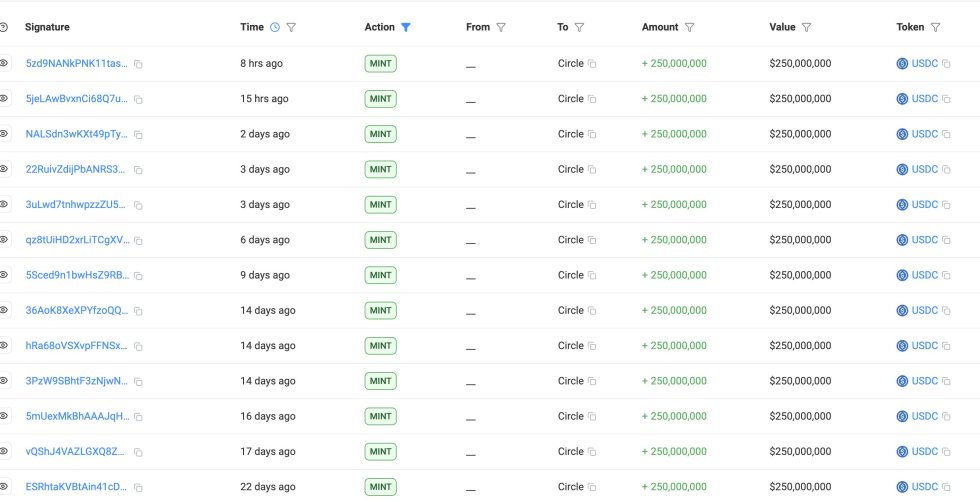
Tether and Circle Stablecoin Mints | Source: Lookonchain

The timing of this surge is notable. Bitcoin and Ethereum are consolidating near critical levels, and altcoins are beginning to show signs of renewed momentum. Historically, large stablecoin mints have preceded uptrends in crypto markets, as fresh liquidity provides the fuel for traders and institutions to deploy capital more aggressively. The $12.75B increase, therefore, reflects more than just stablecoin supply growth—it signals a market preparing for potential expansion.

Still, risks remain elevated. Some analysts caution that the broader economic environment is highly unpredictable, with lingering concerns over global growth, inflationary pressures, and liquidity conditions. The volatility of traditional markets often bleeds into crypto, making sudden swings a persistent threat.

All eyes are now on the US Federal Reserve, with investors widely anticipating a rate cut at next week’s meeting. Such a move would reinforce the bullish implications of the stablecoin surge, further boosting liquidity and supporting higher valuations across digital assets. Conversely, any hesitation or unexpected policy shift could magnify uncertainty, creating sharp volatility.

USDT Dominance Suggests Risk Appetite

Tether (USDT) dominance currently stands at 4.29%, showing a modest decline after testing resistance near 4.5%. The weekly chart reveals that USDT’s market share has been in a gradual downtrend since peaking above 9% in mid-2022. This decline reflects a healthier appetite for risk assets, as capital shifts out of stablecoins and into Bitcoin, Ethereum, and altcoins.
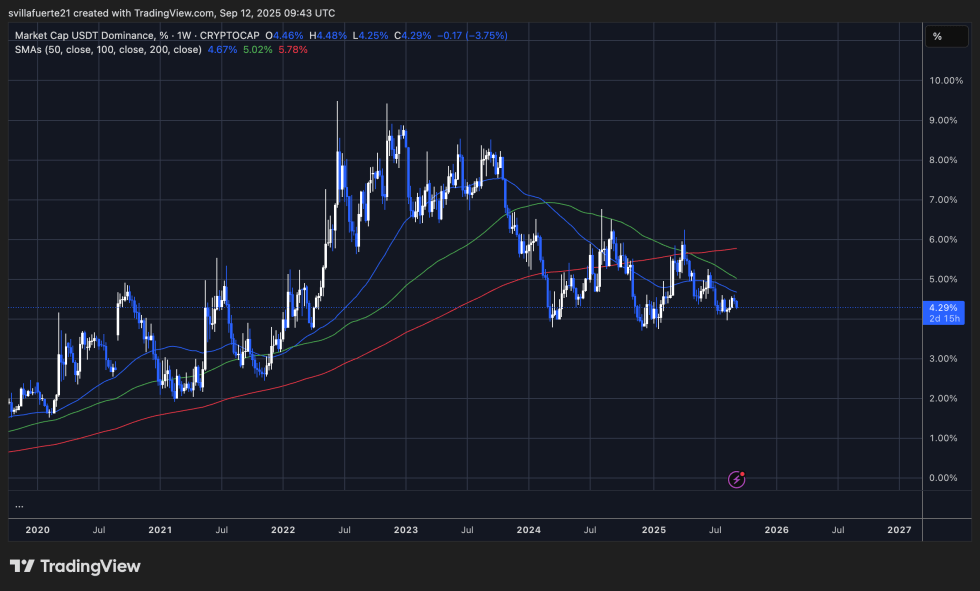
USDT Market Cap Dominance | Source: USDT.D chart on TradingView

The 50-week SMA at 4.67% and the 100-week SMA at 5.02% are both trending lower, confirming persistent weakness in dominance. Meanwhile, the 200-week SMA at 5.78% sits well above current levels, acting as a ceiling that reinforces the longer-term bearish structure for USDT’s market share. As long as USDT dominance remains below the 5% threshold, the market backdrop favors capital rotation into risk assets.

However, short-term support has emerged around the 4.2%–4.3% zone, where dominance has stabilized multiple times this year. A breakdown below this range would likely signal further risk-taking by investors, potentially fueling stronger rallies in crypto. Conversely, a bounce back toward 5% would indicate rising caution and renewed demand for stablecoins.

Featured image from Dall-E, chart from TradingView

Editorial Process for bitcoinist is centered on delivering thoroughly researched, accurate, and unbiased content. We uphold strict sourcing standards, and each page undergoes diligent review by our team of top technology experts and seasoned editors. This process ensures the integrity, relevance, and value of our content for our readers.

Sebastian's journey into the world of crypto began four years ago, driven by a fascination with the potential of blockchain technology to revolutionize financial systems. His initial exploration focused on understanding the intricacies of various crypto projects, particularly those focused on building innovative financial solutions. Through countless hours of research and learning, Sebastian developed a deep understanding of the underlying technologies, market dynamics, and potential applications of cryptocurrencies. As his knowledge grew, Sebastian felt compelled to share his insights with others. He began actively contributing to online discussions on platforms like X and LinkedIn, focusing on fintech and crypto-related content. His goal was to expose valuable trends and insights to a wider audience, fostering a deeper understanding of the rapidly evolving crypto landscape. Sebastian's contributions quickly gained recognition, and he became a trusted voice in the online crypto community. To further enhance his expertise, Sebastian pursued a UC Berkeley Fintech: Frameworks, Applications, and Strategies certification. This rigorous program equipped him with valuable skills and knowledge regarding Financial Technology, bridging the gap between traditional finance (TradFi) and decentralized finance (DeFi). The certification deepened his understanding of the broader financial landscape and its intersection with blockchain technology. Sebastian's passion for finance and writing is evident in his work. He enjoys delving into financial research, analyzing market trends, and exploring the latest developments in the crypto space. In his spare time, Sebastian can often be found immersed in charts, studying 10-K forms, or engaging in thought-provoking discussions about the future of finance. Sebastian's journey as a crypto analyst and investor has been marked by a relentless pursuit of knowledge and a dedication to sharing his insights. His ability to navigate the complex world of crypto, combined with his passion for financial research and communication, makes him a valuable asset to the industry. As the crypto landscape continues to evolve, Sebastian remains at the forefront, providing valuable insights and contributing to the growth of this revolutionary technology.

Lecturas Relacionadas

Los creadores de ChatGPT ya no usan ChatGPT para trabajar

Los creadores de ChatGPT ya no lo utilizan para trabajar. En su lugar, OpenAI ha adoptado de forma masiva el agente de IA "Codex", que ahora genera el 99,8% de los tokens de salida semanales de la empresa, frente a menos del 10% hace solo 10 meses. Codex, impulsado por GPT-5.5, ha evolucionado de una herramienta de codificación a un agente autónomo capaz de manejar flujos de trabajo completos y prolongados, desde tareas legales y financieras hasta ingeniería. El cambio, acelerado desde septiembre del año pasado, es generalizado: ingenieros (99% de tokens), así como departamentos legales, financieros y de recursos humanos (más del 85% cada uno) utilizan Codex como herramienta principal. Su adopción crece más rápido entre usuarios no desarrolladores. Codex permite delegar tareas que requieren desde 30 minutos hasta más de 8 horas de trabajo humano, y el 25% de las tareas que realizan con él profesionales no técnicos implican programación, desdibujando los límites tradicionales entre roles. La transformación clave es el cambio de paradigma: de la interacción de preguntas y respuestas con un chatbot a la delegación de tareas complejas y de larga duración a un agente autónomo. Los usuarios más intensivos llegan a generar más de 60 horas de trabajo de agente en un solo día. Codex optimiza incluso su propia infraestructura. El informe sugiere que la futura ventaja competitiva residirá en la capacidad de delegar flujos de trabajo cada vez más extensos y críticos a los agentes de IA.

marsbitHace 13 min(s)

Los creadores de ChatGPT ya no usan ChatGPT para trabajar

marsbitHace 13 min(s)

El auge de las stablecoins en América Latina no es, en esencia, una 'victoria de la criptotecnología'

El auge de las stablecoins en América Latina no es, en esencia, una "victoria de la tecnología cripto". Surge de una necesidad histórica y profundamente arraigada: enviar dinero a casa. Durante siglos, desde las "cartas de plata" de los inmigrantes chinos hasta las remesas modernas, la región ha buscado formas de mover valor a través de fronteras de manera confiable. Hoy, stablecoins como USDT o USDC llenan ese vacío. No son vistas como activos especulativos, sino como dólares digitales que resuelven problemas prácticos: evitar la inflación (Argentina, Venezuela), reducir costos y tiempo en las remesas (México, Centroamérica), o facilitar pagos transfronterizos para freelancers y comercio. Su adopción responde al fracaso de los sistemas financieros tradicionales, demasiado lentos, caros o inaccesibles. Sin embargo, el desafío real no está en la tecnología blockchain, sino en los extremos de la transacción: cómo convertir ingresos locales en stablecoins y, sobre todo, cómo convertirlas nuevamente en moneda local de forma rápida y segura, ya sea en una cuenta Pix (Brasil), SPEI (México) o en efectivo. El éxito dependerá de integrarse de manera invisible en infraestructuras de pago locales, cumplir con marcos regulatorios emergentes y, ante todo, ofrecer la certeza que millones de familias necesitan: saber que el dinero llegó.

marsbitHace 1 hora(s)

El auge de las stablecoins en América Latina no es, en esencia, una 'victoria de la criptotecnología'

marsbitHace 1 hora(s)

Trading

Spot
活动图片