Banks Won’t Trust Ripple And XRP, SWIFT CIO Says

bitcoinistPublicado a 2025-09-03Actualizado a 2025-09-03

Resumen

Ripple and XRP were thrust into the spotlight after SWIFT chief innovation officer (CIO) Tom Zschach delivered a pointed critique...

Trusted Editorial content, reviewed by leading industry experts and seasoned editors. Ad Disclosure

Ripple and XRP were thrust into the spotlight after SWIFT chief innovation officer (CIO) Tom Zschach delivered a pointed critique on LinkedIn—widely read as a jab at the company and its XRP token—over what actually constitutes “resilience” for banks and how institutional trust is earned.

The exchange began under a comment praising Ripple’s regulatory endurance, where Zschach countered bluntly: “Surviving lawsuits isn’t resilience. Neutral, shared governance is. Institutions don’t want to live on a competitor’s rails.” He followed by rejecting the notion that a single firm’s rapport with watchdogs equals compliance, writing: “And compliance isn’t about one company convincing regulators it should be allowed to operate. It’s about an entire industry agreeing on shared standards that no single balance sheet controls.”

Ripple Vs. SWIFT

Zschach then broadened the frame in a longer post about how banks actually adopt technology. “Every major shift in finance begins the same way. Technology lays the foundation but trust decides when the building opens.”

He recalled that previous “next big things” in finance stalled not on throughput, but on the absence of compliance and security. The parallel he drew to public blockchains in 2025 was explicit: they are becoming too consequential to ignore—“Tokenized treasuries. Collateral on-chain. Cross-border payments that actually settle”—yet raw technical performance is not the finish line.

They think the public chain itself is the solution. It isn’t,” he argued, calling public networks “the base environment for execution,” powerful for deterministic, programmable settlement but insufficient without the “trust layer” of legal enforceability, compliance, and privacy. Without that layer, he warned, a public chain is “a fast engine with no cockpit.”

Crucially, Zschach’s critique drew a governance boundary that cuts to the heart of Ripple’s pitch to banks without naming the company. He re-centered the conversation on neutrality and shared control, rather than on the courtroom durability or regulatory narratives of any single firm. In his words, institutions want “shared standards that no single balance sheet controls,” and they will resist depending on “a competitor’s rails.”

He extended the caution to consortia as well: “If a bank joins a chain owned or controlled by another bank then they are accepting someone else’s governance, incentives and rules of the game. In today’s environment is that a form of dependency that banks will be comfortable with?” The throughline is that institutional adoption hinges less on whether one vendor has outlasted enforcement actions and more on whether the infrastructure is credibly neutral, co-governed, and enforceable in law.

Zschach’s taxonomy of public chains as “substrate” underscores how he expects the industry to evolve. In biology, computing, and construction, a substrate is foundational; what matters for banks is what gets layered above it. He urged builders not to “fight the public chains” but to harness them while solving for compliance from day one and for privacy “without killing transparency.”

That is where he believes the “opportunity lies,” with finance ultimately “absorbing the best of public chains on its own terms.” The open question he posed back to the market—“When will banks and financial institutions truly trust public blockchains and at what pace will that trust build?”—puts the burden of proof on governance design and standards alignment, not on marketing milestones.

For Ripple and XRP, the implication is clear even if Zschach never typed the name in his critique: the bar for bank adoption isn’t surviving litigation or securing green lights for a specific product stack; it is convincing the industry that the rails they ride are neutral, shared, and not controlled by any single company’s balance sheet (like Ripple’s escrow still controlling more than 35% of all XRP). In that lens, resilience is measured in how power is distributed, how rules are enforced, and how privacy and compliance are engineered—precisely the dimensions Zschach says decide “when the building opens.”

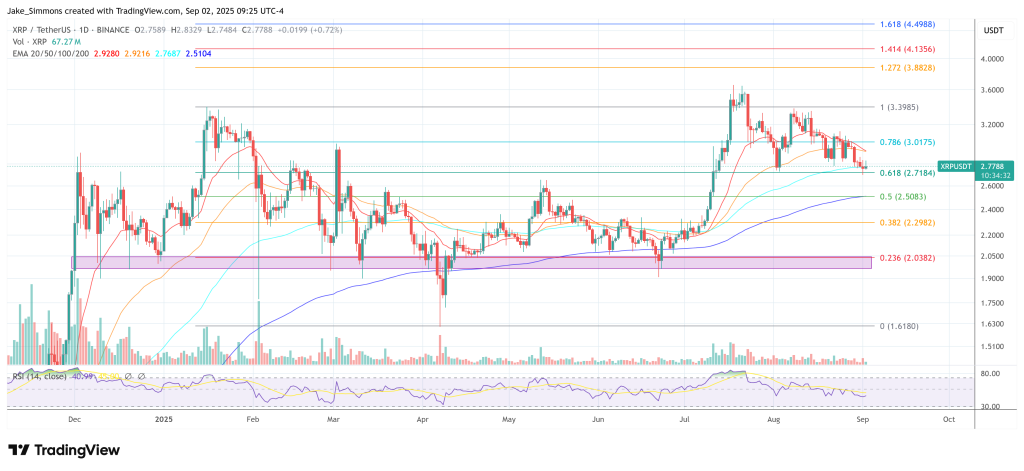
At press time, XRP traded at $2.77.
XRP price
XRP remains above the 0.618 Fib, 1-day chart | Source: XRPUSDT on TradingView.com
Featured image created with DALL.E, chart from TradingView.com
Editorial Process for bitcoinist is centered on delivering thoroughly researched, accurate, and unbiased content. We uphold strict sourcing standards, and each page undergoes diligent review by our team of top technology experts and seasoned editors. This process ensures the integrity, relevance, and value of our content for our readers.

Jake Simmons has been a Bitcoin enthusiast since 2016. Ever since he heard about Bitcoin, he has been studying the topic every day and trying to share his knowledge with others. His goal is to contribute to Bitcoin's financial revolution, which will replace the fiat money system. Besides BTC and crypto, Jake studied Business Informatics at a university. After graduation in 2017, he has been working in the blockchain and crypto sector. You can follow Jake on Twitter at @realJakeSimmons.

Criptos en tendencia

Lecturas Relacionadas

2028, llega la RSI

[Resumen en español] La cuenta atrás para la IA autorreplicante ya tiene fecha: 2028. Jack Clark, cofundador de Anthropic, estima con un 60% de probabilidad que para finales de 2028 la Inteligencia Artificial logrará la Mejora Recursiva Autónoma (RSI), creando sistemas más inteligentes que ella misma sin intervención humana directa. Esta predicción no es aislada. Demis Hassabis, CEO de Google DeepMind, confirma que todos los laboratorios líderes trabajan intensamente en RSI. Los datos muestran una aceleración alarmante: en Anthropic, más del 80% del código ya lo escribe Claude, multiplicando por 8 la productividad de los ingenieros. Pruebas como MirrorCode demuestran que IA como Claude Opus pueden reconstruir software complejo en horas, un trabajo que lleva semanas a humanos, e incluso programar de forma autónoma durante 19 días seguidos. La curva es exponencial. Si en 2024 un modelo manejaba tareas de 4 minutos, hoy supera tests de 16 horas, agotando la capacidad de medición humana. Sam Altman, de OpenAI, considera la RSI el mayor desafío de seguridad de la próxima década y sugeriría retrasar su mega-OPV de billones de dólares si la autonomía IA se acelera. El consenso entre los líderes de IA es claro: la mejora recursiva ya está en marcha, impulsando una carrera imparable. La pregunta clave ya no es *si* ocurrirá, sino cómo estará preparada la humanidad cuando, hacia 2028, la IA empiece a reescribir su propia evolución.

marsbitHace 3 hora(s)

2028, llega la RSI

marsbitHace 3 hora(s)

La 'Caída Abrupta' del CPO: ¿Cómo Opera Exactamente Glass Bridge? Explicación Oficial de Corning

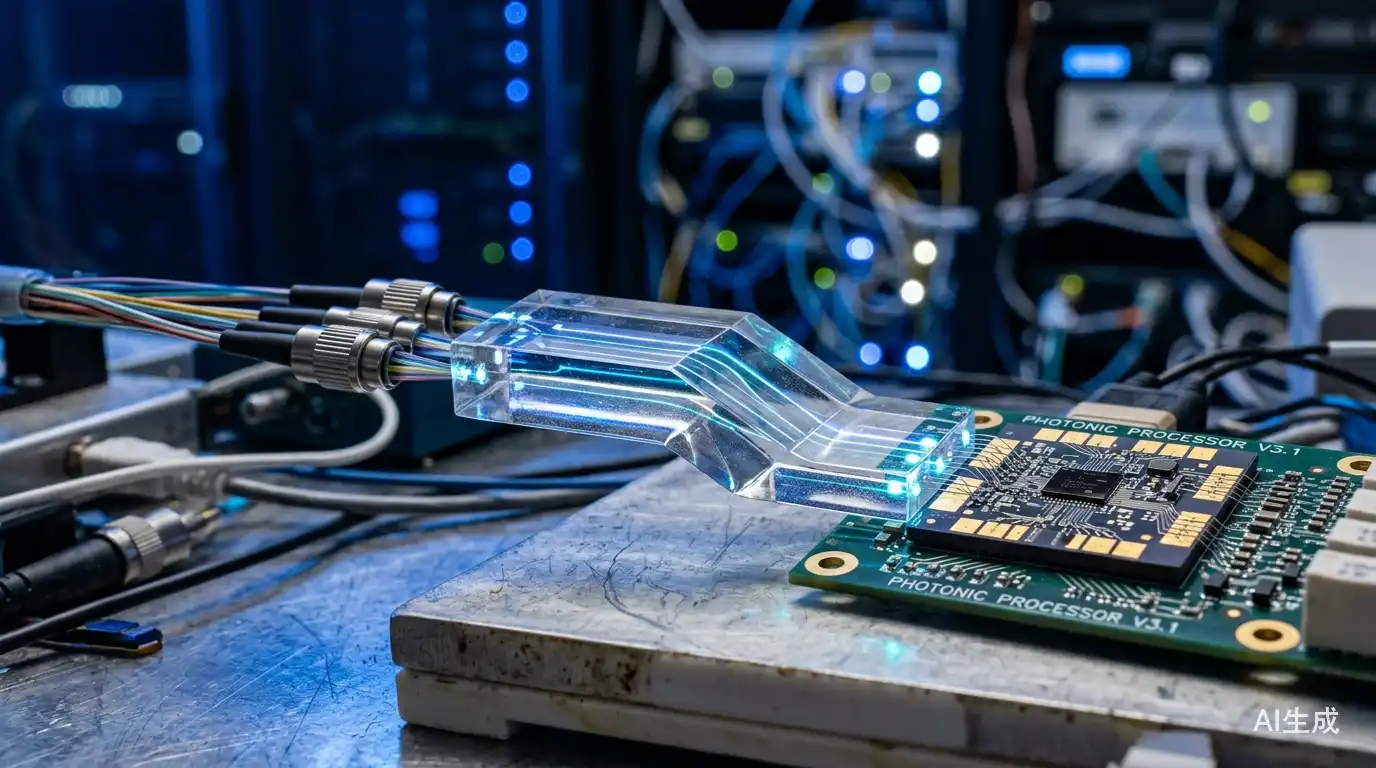
El 26 de junio, el sector CPO en el mercado A chino cayó abruptamente, con múltiples acciones como ZTT, FiberHome y Yongding tocando límite de pérdidas. La caída fue provocada por el lanzamiento de la plataforma de interconexión óptica "Glass Bridge" de Corning, presentada en una conferencia en Seúl. La tecnología utiliza guías de onda de vidrio fabricadas a nivel de oblea para lograr el acoplamiento pasivo entre fibras ópticas y chips fotónicos, simplificando significativamente la compleja alineación activa requerida en la arquitectura CPO tradicional. Esto generó preocupación en el mercado sobre una posible reducción futura en la demanda de componentes como las unidades de matriz de fibras (FAU), afectando a fabricantes intermedios. Mientras el sector CPO caía, acciones relacionadas con sustratos de vidrio, como China Glass, Dyer Laser y Red Star Development, subían fuertemente, lo que indica un desplazamiento del capital hacia la cadena de valor de materiales avanzados. Según documentos técnicos de Corning, Glass Bridge opera basándose en tres características principales: fabricación a nivel de oblea para consistencia en producción masiva, una interfaz de contacto físico TMT estandarizada y una arquitectura de conector desmontable de alta densidad. La empresa aclara que esta tecnología complementa, no reemplaza por completo, las soluciones FAU existentes, aunque está diseñada para escenarios de densidad extremadamente alta. Analistas señalan que los sustratos de vidrio son vistos como un material clave para el empaquetado avanzado de próxima generación, especialmente ante la creciente demanda de chips de IA. El evento ha desencadenado una revaluación de la cadena de valor en la interconexión óptica para IA, con el foco de la industria desplazándose gradualmente hacia los materiales especializados aguas arriba.

marsbitHace 3 hora(s)

La 'Caída Abrupta' del CPO: ¿Cómo Opera Exactamente Glass Bridge? Explicación Oficial de Corning

marsbitHace 3 hora(s)

Trading

Spot

Artículos destacados

Cómo comprar T

¡Bienvenido a HTX.com! Hemos hecho que comprar Threshold Network Token (T) sea simple y conveniente. Sigue nuestra guía paso a paso para iniciar tu viaje de criptos.Paso 1: crea tu cuenta HTXUtiliza tu correo electrónico o número de teléfono para registrarte y obtener una cuenta gratuita en HTX. Experimenta un proceso de registro sin complicaciones y desbloquea todas las funciones.Obtener mi cuentaPaso 2: ve a Comprar cripto y elige tu método de pagoTarjeta de crédito/débito: usa tu Visa o Mastercard para comprar Threshold Network Token (T) al instante.Saldo: utiliza fondos del saldo de tu cuenta HTX para tradear sin problemas.Terceros: hemos agregado métodos de pago populares como Google Pay y Apple Pay para mejorar la comodidad.P2P: tradear directamente con otros usuarios en HTX.Over-the-Counter (OTC): ofrecemos servicios personalizados y tipos de cambio competitivos para los traders.Paso 3: guarda tu Threshold Network Token (T)Después de comprar tu Threshold Network Token (T), guárdalo en tu cuenta HTX. Alternativamente, puedes enviarlo a otro lugar mediante transferencia blockchain o utilizarlo para tradear otras criptomonedas.Paso 4: tradear Threshold Network Token (T)Tradear fácilmente con Threshold Network Token (T) en HTX's mercado spot. Simplemente accede a tu cuenta, selecciona tu par de trading, ejecuta tus trades y monitorea en tiempo real. Ofrecemos una experiencia fácil de usar tanto para principiantes como para traders experimentados.

585 Vistas totalesPublicado en 2024.12.10Actualizado en 2026.06.02

Cómo comprar T

Discusiones

Bienvenido a la comunidad de HTX. Aquí puedes mantenerte informado sobre los últimos desarrollos de la plataforma y acceder a análisis profesionales del mercado. A continuación se presentan las opiniones de los usuarios sobre el precio de T (T).

活动图片