Cardano Under Fire: $600 Million IOG Audit Set For August, Says Hoskinson

bitcoinistPublicado a 2025-07-21Actualizado a 2025-07-21

Resumen

Cardano founder Charles Hoskinson has received the first draft of the long‑promised audit into Input Output Global’s (IOG) ADA holdings and says the...

Trusted Editorial content, reviewed by leading industry experts and seasoned editors. Ad Disclosure

Cardano founder Charles Hoskinson has received the first draft of the long‑promised audit into Input Output Global’s (IOG) ADA holdings and says the document is “shaping up quickly.” In a X post on 20 July he wrote, “I just received the first copy of the audit report. I requested a lot more detail and context in several areas, but it’s shaping up quickly… I believe we are on schedule for a mid‑August release, assuming the work continues at this pace and there are no delays.”

Why The Cardano Audit Is Needed

The audit is the centerpiece of Hoskinson’s effort to rebut accusations that IOG quietly commandeered roughly $600 million worth of ADA during the 2021 Allegra hard fork. The charge—first amplified in May by NFT artist Masato Alexander—claims Hoskinson used a “genesis key” to rewrite the ledger and move 318‑350 million unclaimed tokens into company‑controlled wallets.

Hoskinson has repeatedly rejected the story as a “lie,” insisting most of the disputed coins had already been claimed by their original buyers and that the remainder “was donated to Intersect” after a seven‑year dormancy period. “No matter how many times people lie, they cannot change reality,” he wrote on 6 May.

The episode escalated after social‑media headlines in late May suggested a $600 million “theft.” “I’m absolutely disgusted… The headlines I’ve seen are beyond damaging; they will require months if not years of work and millions of dollars to undo post‑audit,” Hoskinson posted on 20 May, pledging to pay for an independent review and to publish it in full.

IOG’s chief legal and policy officer Joel Telpner confirmed progress on the investigation in a parallel X update: “We are making good progress on the investigative and audit report that we promised to deliver. The law firm and audit firm are close to completing their work and we are hoping the report will be ready to release by the middle of August. I’ll continue to keep you updated.”

Hoskinson also signaled a legal counter‑offensive, telling followers he will meet “with the defamation law firm next week to discuss options and strategy,” a move he says is aimed at recovering what he characterizes as “hundreds of millions of dollars of brand damage” to Cardano.

The forthcoming report will be aired live: Hoskinson intends to read the entire document in a livestream and to host the PDF—along with “other historical artifacts from the sale”—on a dedicated website.

Market reaction has been restrained so far. ADA changed hands at roughly $0.84 when the latest update hit social media—flat on the day but still up 17 percent on the week.

At press time, Cardano traded at $0.889.
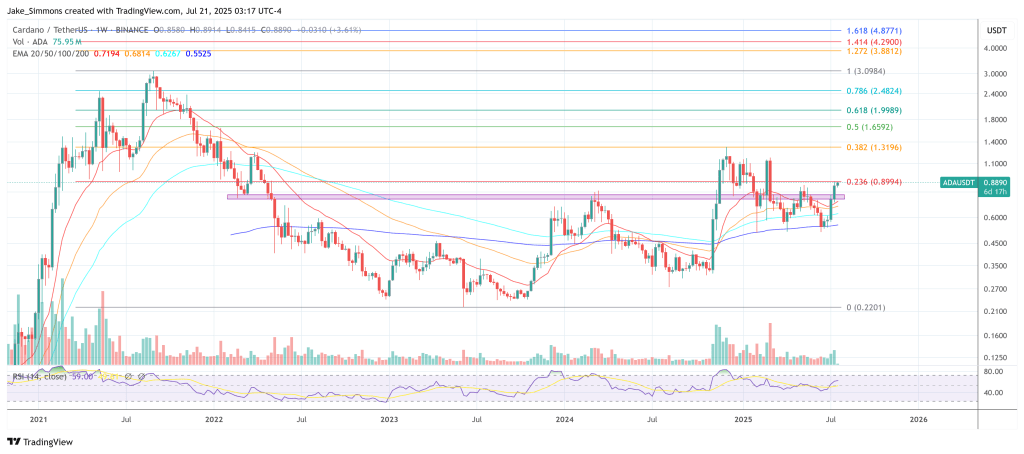
Cardano price
Cardano faces the 0.236 Fib, 1-week chart | Source: ADAUSDT on TradingView.com
Featured image created with DALL.E, chart from TradingView.com
Editorial Process for bitcoinist is centered on delivering thoroughly researched, accurate, and unbiased content. We uphold strict sourcing standards, and each page undergoes diligent review by our team of top technology experts and seasoned editors. This process ensures the integrity, relevance, and value of our content for our readers.

Jake Simmons has been a Bitcoin enthusiast since 2016. Ever since he heard about Bitcoin, he has been studying the topic every day and trying to share his knowledge with others. His goal is to contribute to Bitcoin's financial revolution, which will replace the fiat money system. Besides BTC and crypto, Jake studied Business Informatics at a university. After graduation in 2017, he has been working in the blockchain and crypto sector. You can follow Jake on Twitter at @realJakeSimmons.

Criptos en tendencia

Lecturas Relacionadas

El último artículo de Fei-Fei Li: Cuando la generación de vídeo, la robótica y NVIDIA se autodenominan modelos del mundo, necesitamos una taxonomía

El artículo de Fei-Fei Li clarifica el término "modelo del mundo", utilizado de manera confusa en IA, proponiendo una taxonomía basada en el ciclo POMDP (Proceso de Decisión de Markov Parcialmente Observable). Identifica tres categorías funcionales: 1) **Renderizador**: genera observaciones (píxeles) visualmente fieles para humanos, como los modelos de video Sora o Genie, pero sin comprensión física precisa. 2) **Simulador**: produce estados del mundo con precisión geométrica, física y dinámica, sirviendo tanto para visualización profesional como para entrenamiento de agentes (robots, vehículos autónomos). 3) **Planificador**: deduce acciones a partir de observaciones y objetivos, cerrando el ciclo percepción-acción, como los modelos de lenguaje-visión-acción (VLA). El artículo argumenta que el simulador es el componente clave y subestimado, pues proporciona la base estructural para la renderización y la planificación. Mientras los renderizadores tienen madurez comercial pero limitaciones físicas, y los planificadores son prometedores pero inmaduros para despliegues reales, los simuladores abarcan aplicaciones cruciales en robótica, diseño y digitalización. La tendencia actual es la fusión de estas categorías, impulsada por la idea de que comparten conocimiento subyacente. Modelos como Marble de World Labs ejemplifican esta convergencia, generando tanto representaciones visuales (splats gaussianos) como mallas para simulación física. La visión final es un **modelo del mundo unificado** capaz de alternar entre renderizar, simular y planificar según la necesidad, avanzando hacia una inteligencia espacial que permita a las máquinas entender e interactuar con el mundo físico.

marsbitHace 5 hora(s)

El último artículo de Fei-Fei Li: Cuando la generación de vídeo, la robótica y NVIDIA se autodenominan modelos del mundo, necesitamos una taxonomía

marsbitHace 5 hora(s)

Trading

Spot

Artículos destacados

Cómo comprar ADA

¡Bienvenido a HTX.com! Hemos hecho que comprar Cardano (ADA) sea simple y conveniente. Sigue nuestra guía paso a paso para iniciar tu viaje de criptos.Paso 1: crea tu cuenta HTXUtiliza tu correo electrónico o número de teléfono para registrarte y obtener una cuenta gratuita en HTX. Experimenta un proceso de registro sin complicaciones y desbloquea todas las funciones.Obtener mi cuentaPaso 2: ve a Comprar cripto y elige tu método de pagoTarjeta de crédito/débito: usa tu Visa o Mastercard para comprar Cardano (ADA) al instante.Saldo: utiliza fondos del saldo de tu cuenta HTX para tradear sin problemas.Terceros: hemos agregado métodos de pago populares como Google Pay y Apple Pay para mejorar la comodidad.P2P: tradear directamente con otros usuarios en HTX.Over-the-Counter (OTC): ofrecemos servicios personalizados y tipos de cambio competitivos para los traders.Paso 3: guarda tu Cardano (ADA)Después de comprar tu Cardano (ADA), guárdalo en tu cuenta HTX. Alternativamente, puedes enviarlo a otro lugar mediante transferencia blockchain o utilizarlo para tradear otras criptomonedas.Paso 4: tradear Cardano (ADA)Tradear fácilmente con Cardano (ADA) en HTX's mercado spot. Simplemente accede a tu cuenta, selecciona tu par de trading, ejecuta tus trades y monitorea en tiempo real. Ofrecemos una experiencia fácil de usar tanto para principiantes como para traders experimentados.

1.9k Vistas totalesPublicado en 2024.12.10Actualizado en 2026.06.02

Cómo comprar ADA

Discusiones

Bienvenido a la comunidad de HTX. Aquí puedes mantenerte informado sobre los últimos desarrollos de la plataforma y acceder a análisis profesionales del mercado. A continuación se presentan las opiniones de los usuarios sobre el precio de ADA (ADA).

活动图片