The European Union (EU) has imposed restrictive measures on several individuals and companies that interfered with elections and spread pro-Russia disinformation. The entities have reportedly used crypto to circumvent sanctions and accept donations.
Australian Influencer Sanctioned For Misinformation
On Tuesday, the European Union announced it had imposed sanctions on multiple entities and individuals using cryptocurrencies to evade restrictions, spread pro-Russia misinformation, and interfere with elections.
The EU sanctioned nine individuals and six entities, including pro-Kremlin Australian influencer Simeon Boikov, also known as “AussieCossack,” for disinformation. Boikov was reportedly involved in supporting policies of the Russian federal government that “undermine or threaten democracy, the rule of law, stability or security in the Union or in third countries.”
Notably, the influencer has allegedly planned, directed, engaged in, supported, and facilitated the use of coordinated information manipulation and interference, including propagating pro-Kremlin narratives and misinformation related to the COVID-19 pandemic and the Russian invasion of Ukraine.
Additionally, he was “implicated in spreading disinformation related to the 2024 U.S. presidential election, notably by paying an American influencer to post a Storm-1516 fabricated video falsely depicting voter fraud in Georgia.”
According to blockchain intelligence company TMR Labs, Boikov raised cash and crypto donations through multiple online channels. He has reportedly engaged directly with multiple high-risk, no-KYC (know-your-client) Russian exchanges, receiving funds via cash-to-crypto services and darknet markets, which were routed through intermediary addresses.

Direct and indirect flows into Boikov’s donation wallet. Source: TMR Labs
EU Targets Crypto-Linked Sanction Evasion
The EU also imposed restrictive measures against seven individuals and three entities for their actions aimed at “destabilising, undermining or threatening” the sovereignty, independence, democracy, rule of law, and stability of the Republic of Moldova.
The measure targets Ilan Shor’s associates, including leaders and members of successor entities of the banned ȘOR Party, a Moldovan pro-Russian populist political party founded by Shor that was declared unconstitutional in 2023.
Notably, Shor has already been designated by the EU due to his “involvement in illegal financing of political parties in the Republic of Moldova and for incitement to violence.” Among the listed entities, the European Council also designated A7, a company founded by Shor and previously listed by the United Kingdom.
The company has multiple ties to the Russian government and has been accused of influencing Moldova’s Presidential elections and the 2024 Constitutional referendum on EU accession.
AS TMR explained, A7 was conceived as a mechanism to facilitate cross-border trades due to the sanctions imposed after Russia invaded Ukraine. The company is linked to the ruble-backed stablecoin A7A5, which was used by sanctioned crypto exchange Garantex to transfer funds to Kyrgyz exchange Grinex.
A7A5 and Grinex both have been identified by TRM Labs as being part of a new nexus of Kyrgyzstan-registered entities with cryptocurrency connections to sanctions evasion and terrorist financing, and are also likely tied to the import of dual-use goods from China to Russia through Central Asia.
It’s worth noting that Russian companies started using Bitcoin and other cryptocurrencies in international trade to bypass sanctions. As reported by Bitcoinist, Russia’s Finance Minister Anton Siluanov revealed in December that companies had started officially using BTC and other cryptocurrencies for international payments following last year’s regulatory changes.
Siluanov affirmed that international payments in crypto represented the future of finance, adding that the government believes “they should be expanded and developed further.”
In April, he announced a plan to establish a dedicated exchange for “highly qualified investors” alongside the Bank of Russia (BOR), aiming to “legalize crypto assets and bring crypto operations out of the shadows.”
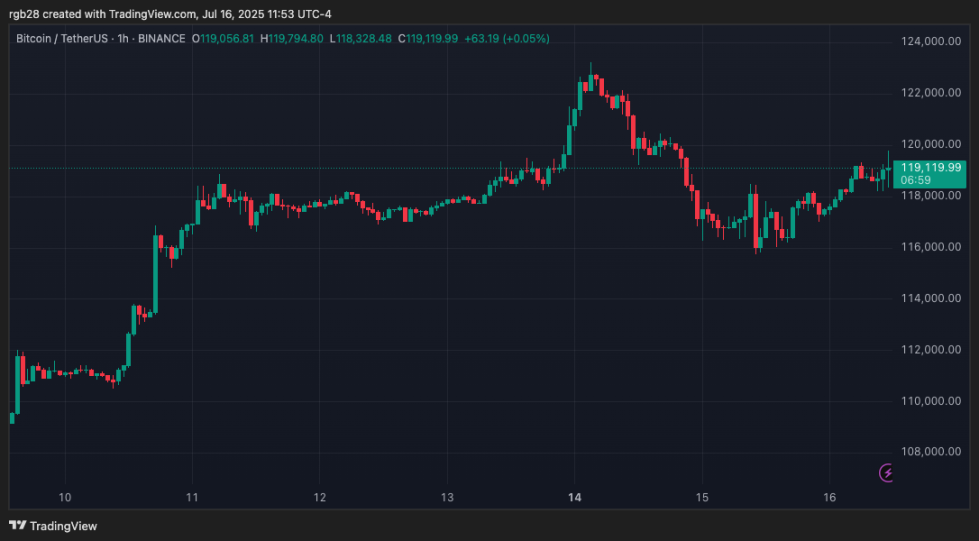
Bitcoin trades at $119,119 in the one-week chart. Source: BTCUSDT on TradingView

Related Posts