Tokenized RWA Just Flipped The Switch – Onchain Finance Narrative Back On

bitcoinistPublicado a 2025-07-13Actualizado a 2025-07-14

Resumen

The Real-World Asset (RWA) tokenization market is gaining strength as momentum builds across the crypto sector. With Bitcoin entering price...

Trusted Editorial content, reviewed by leading industry experts and seasoned editors. Ad Disclosure

The Real-World Asset (RWA) tokenization market is gaining strength as momentum builds across the crypto sector. With Bitcoin entering price discovery after breaking past $112K and altcoins showing signs of a sustained recovery, RWA tokens are emerging as one of the most promising sectors within the digital asset space. Recent data reveals that the market cap for RWA tokens has reached $60 billion, supported by rising trading volume and growing institutional interest.

This surge comes as investors increasingly seek exposure to blockchain-backed financial instruments that represent tangible assets, such as bonds, real estate, private credit, and commodities. The appeal lies in the ability to bring traditionally illiquid assets on-chain with greater transparency, efficiency, and accessibility.

With macro tailwinds favoring the development of alternative markets and demand for yield-bearing instruments rising, RWAs are poised to play a defining role in the next phase of crypto adoption. As capital rotates across sectors, many investors are watching the RWA sector closely for signs of explosive growth.

RWA Sector Breaks Out

As the digital asset ecosystem matures, RWAs are emerging as a practical and scalable bridge between traditional finance and blockchain innovation. Stablecoins themselves—backed by fiat currency or US treasury bills—can be viewed as the most widely adopted RWA use case, with trillions in annual settlement volume and growing integration across both DeFi and payment platforms.

According to the Real World Asset Watchlist, a leading media publication tracking tokenized assets, the RWA sector has just broken out from a long consolidation phase. A recently shared chart shows that the market cap has surged past the $60 billion mark, marking a clean technical breakout that signals renewed investor confidence and institutional participation. With rising trading volumes and momentum building across key protocols, the next logical target is the $80 billion milestone.
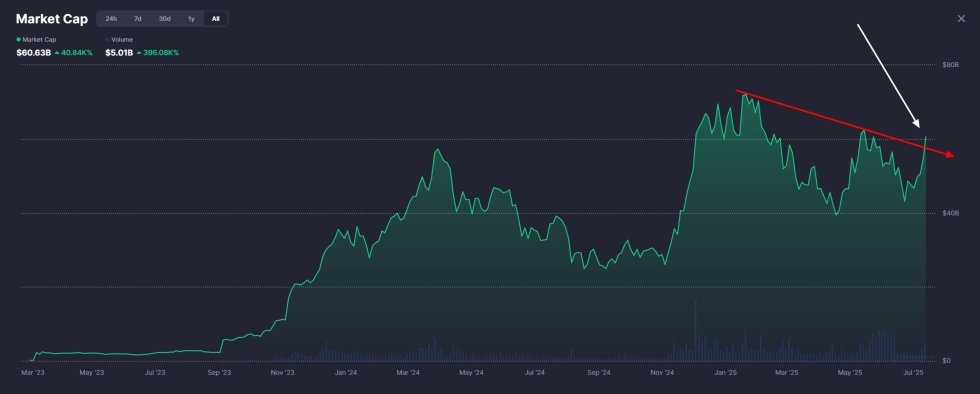
RWA Tokens Market Cap | Source: Real World Asset Watchlist on X

This surge is not only a price-driven movement—it’s underpinned by structural developments, regulatory clarity, and growing on-chain infrastructure that enables secure tokenization, compliance, and real-world adoption.

As capital rotates from highly speculative narratives to more fundamental and yield-generating sectors, RWAs are becoming the centerpiece of the next cycle. The current breakout could serve as a pivotal catalyst, triggering an influx of new products, capital, and participants into the space. If sustained, this could position RWA as one of the primary drivers of crypto’s transition from speculative to institutional-grade finance.

Altcoin Market Cap Surges As Breakout Gains Momentum

The total crypto market cap excluding Bitcoin and Ethereum (TOTAL3) has just posted a decisive weekly breakout, now sitting at $938.6 billion. This move represents an 11.19% gain from the previous week, marking one of the strongest weekly performances of the year for altcoins. Price has convincingly broken above the 50-week moving average (currently at $798B), reclaiming bullish structure and targeting previous cycle highs.
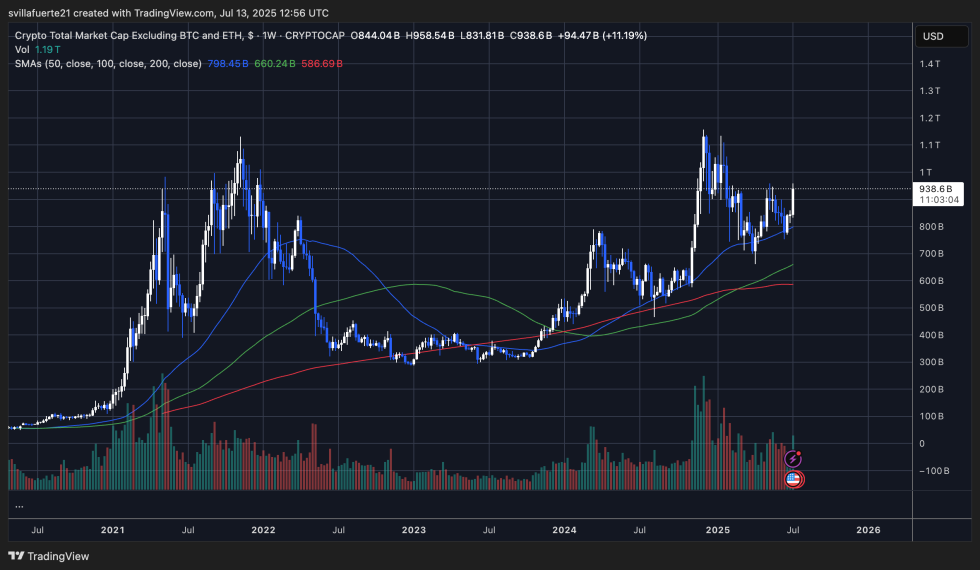
Crypto Total Market Cap excluding BTC and ETH | Source: TOTAL3 chart on TradingView
Crypto total market cap excluding BTC and ETH | Source: TOTAL3 chart on TradingView

This breakout occurs after months of consolidation above the 200-week and 100-week moving averages, both of which acted as key support levels. The surge in volume further confirms the strength of this move, suggesting growing participation from investors rotating capital into the altcoin space as Bitcoin leads the market into price discovery. The chart structure shows a pattern of higher lows, pointing to a potential macro uptrend resumption.

With key narratives like real-world asset tokenization (RWAs), DePIN, and Solana-based meme coin ecosystems gaining momentum, the TOTAL3 breakout could be signaling the start of a broader altcoin season.

Featured image from Dall-E, chart from TradingView

Editorial Process for bitcoinist is centered on delivering thoroughly researched, accurate, and unbiased content. We uphold strict sourcing standards, and each page undergoes diligent review by our team of top technology experts and seasoned editors. This process ensures the integrity, relevance, and value of our content for our readers.

Sebastian's journey into the world of crypto began four years ago, driven by a fascination with the potential of blockchain technology to revolutionize financial systems. His initial exploration focused on understanding the intricacies of various crypto projects, particularly those focused on building innovative financial solutions. Through countless hours of research and learning, Sebastian developed a deep understanding of the underlying technologies, market dynamics, and potential applications of cryptocurrencies. As his knowledge grew, Sebastian felt compelled to share his insights with others. He began actively contributing to online discussions on platforms like X and LinkedIn, focusing on fintech and crypto-related content. His goal was to expose valuable trends and insights to a wider audience, fostering a deeper understanding of the rapidly evolving crypto landscape. Sebastian's contributions quickly gained recognition, and he became a trusted voice in the online crypto community. To further enhance his expertise, Sebastian pursued a UC Berkeley Fintech: Frameworks, Applications, and Strategies certification. This rigorous program equipped him with valuable skills and knowledge regarding Financial Technology, bridging the gap between traditional finance (TradFi) and decentralized finance (DeFi). The certification deepened his understanding of the broader financial landscape and its intersection with blockchain technology. Sebastian's passion for finance and writing is evident in his work. He enjoys delving into financial research, analyzing market trends, and exploring the latest developments in the crypto space. In his spare time, Sebastian can often be found immersed in charts, studying 10-K forms, or engaging in thought-provoking discussions about the future of finance. Sebastian's journey as a crypto analyst and investor has been marked by a relentless pursuit of knowledge and a dedication to sharing his insights. His ability to navigate the complex world of crypto, combined with his passion for financial research and communication, makes him a valuable asset to the industry. As the crypto landscape continues to evolve, Sebastian remains at the forefront, providing valuable insights and contributing to the growth of this revolutionary technology.

Lecturas Relacionadas

OUSD, que hizo caer un 17% a Circle en un día, se ve envuelto en polémica de marketing

Un nuevo stablecoin, Open USD (OUSD), anunciado por la empresa Open Standard, generó gran expectativa al prometer características como acuñación y canje gratuitos, participación en los rendimientos de los activos de reserva y gobernanza colaborativa. Su lanzamiento se vio impulsado por una lista de más de 140 supuestos socios, incluyendo grandes nombres como Western Union, Ripple y MetaMask. Este anuncio tuvo un impacto inmediato en el mercado, provocando una caída del 17.55% en las acciones de Circle, el emisor de USDC. Sin embargo, la credibilidad de la lista de socios fue rápidamente cuestionada. Medios coreanos informaron que empresas como Samsung Electronics y Dunamu (matriz de Upbit) negaron haber mantenido negociaciones formales o dado su consentimiento para figurar como miembros de la alianza. Otras, como Shinhan Financial Group, admitieron solo haber recibido una consulta preliminar. Críticos acusaron a Open Standard de emplear tácticas de marketing engañosas, presentando contactos exploratorios como acuerdos firmes para generar legitimidad por asociación. Ante la polémica, Jeremy Allaire, CEO de Circle, cuestionó públicamente la sostenibilidad a largo plazo del modelo de OUSD, argumentando que características como los costes cero podrían comprometer la inversión en la infraestructura crítica necesaria para un stablecoin. A pesar de las controversias, algunas empresas como Stripe y Coinbase confirmaron su apoyo e integración planificada de OUSD en sus plataformas. El incidente deja una primera impresión negativa para OUSD en un sector donde la confianza es fundamental.

Foresight NewsHace 15 min(s)

OUSD, que hizo caer un 17% a Circle en un día, se ve envuelto en polémica de marketing

Foresight NewsHace 15 min(s)

Una década de cambio: El camino hacia la desaparición de las startups cripto

De 2017 a 2026, la industria cripto ha pasado de una era de baja barrera de entrada y experimentación anónima a un entorno altamente regulado con costes de cumplimiento prohibitivos. Antes, un whitepaper y un repositorio de GitHub bastaban para lanzar una startup mediante una ICO. Hoy, operar en mercados regulados como EE.UU., la UE o Asia requiere equipos legales, canales bancarios, licencias (como BitLicense o MiCA) y una inversión inicial que puede superar el millón de dólares. La inversión de capital riesgo se ha concentrado en empresas maduras, dejando a las startups tempranas con menos financiación. Los datos muestran que en 2026, el 57% de la inversión se destinó a etapas tardías, mientras que las rondas iniciales apenas captaron un 5.2%. Las fusiones y adquisiciones se han disparado, permitiendo a los grandes actores (como Coinbase y Ripple) adquirir rápidamente licencias y canales de distribución. La innovación técnica ya no es el factor clave; ahora, las ventajas competitivas son las relaciones bancarias, las licencias y la confianza institucional. Esto eleva la calidad y seguridad del sector, atrayendo capital institucional, pero también crea una barrera alta para nuevos emprendedores sin recursos o contactos. La industria, nacida para desafiar los monopolios financieros, parece estar siguiendo la misma curva de consolidación y concentración de poder que otros sectores regulados antes que ella.

Foresight NewsHace 31 min(s)

Una década de cambio: El camino hacia la desaparición de las startups cripto

Foresight NewsHace 31 min(s)

Robot aprende operaciones viendo videos: Berkeley logra por primera vez un enlace desde videos de Internet hasta la implementación en robots de manos hábiles reales

**Resumen: "Do as I Do" de UC Berkeley convierte vídeos humanos en instrucciones para robots** El equipo de UC Berkeley presenta "Do as I Do", un flujo de trabajo pionero que permite a robots con manos diestras aprender a realizar tareas observando únicamente vídeos RGB monoculares de personas en entornos cotidianos. **El problema:** Existen millones de vídeos de interacciones mano-objeto en Internet, pero su ruido, oclusiones y falta de información 3D los hacen inutilizables directamente para robots. Los métodos actuales de teleoperación o simulación no escalan. **La solución:** El sistema aborda dos retos clave: 1. **Reconstrucción 4D robusta:** Utiliza un modelo de difusión guiado (basado en SAM 3D) para rastrear de forma estable la forma y pose de objetos no rígidos a lo largo del vídeo, superando métodos anteriores como FoundationPose. 2. **Redireccionamiento de acciones a ruido:** Adapta el optimizador MPPI/SPIDER para manejar trayectorias de referencia ruidosas extraídas de los vídeos, introduciendo suavizado temporal, ajuste de contacto y replanificación. Esto eleva la tasa de éxito del 25% al 71%. **Resultados:** El método generó 500 trayectorias validadas para 20 acciones complejas (verter, batir, escribir, martillar, etc.). Diez de ellas se desplegaron con éxito en un robot real con dos brazos UR3e y dos manos diestras Sharpa Wave (22 DoF), controlado a 50Hz. **Conclusión:** La investigación demuestra por primera vez un pipeline completo que convierte vídeos online en trayectorias ejecutables para manos robóticas diestras, superando una barrera crítica para el aprendizaje robótico a gran escala a partir de la vasta biblioteca visual humana.

marsbitHace 1 hora(s)

Robot aprende operaciones viendo videos: Berkeley logra por primera vez un enlace desde videos de Internet hasta la implementación en robots de manos hábiles reales

marsbitHace 1 hora(s)

Trading

Spot
活动图片