Deaton Fights For The XRP Army—Again: New Legal Battle Begins

bitcoinistPublicado a 2025-07-10Actualizado a 2025-07-10

Resumen

XRP investors are at the centre of a securities-fraud class action that accuses former Linqto chief executive William Sarris of...

Trusted Editorial content, reviewed by leading industry experts and seasoned editors. Ad Disclosure

XRP investors are at the centre of a securities-fraud class action that accuses former Linqto chief executive William Sarris of secretly imposing mark-ups of up to 60 percent on pre-IPO Ripple shares and other highly sought-after private-company equity like Uphold and Kraken sold through special-purpose vehicles on the fintech’s platform.

The 61-page complaint—Maxwell v. Sarris, filed on 9 July 2025 in the US District Court for the Southern District of New York—alleges that Sarris and unnamed accomplices acted as unregistered broker-dealers, used misleading offering exemptions and failed to deliver legal title to any of the underlying shares.

XRP Army’s Legal Champion Is Back

According to the filing, would-be purchasers were told the SPVs “held the same equity that insiders owned,” yet Linqto neither transferred the stock nor disclosed the hefty mark-ups baked into the purchase price—conduct the plaintiffs say violates Section 10(b) of the Securities Exchange Act and FINRA Rule 2040. Linqto’s own bankruptcy papers, lodged a day earlier in the Southern District of Texas, concede “historical failures to follow US laws governing the sale and marketing of private-company interests.”

Lead counsel John E. Deaton—best known for representing XRP holders in SEC v. Ripple—contends that Sarris “damaged the mission of democratising access to Silicon Valley” and misled ordinary investors: “People believed they were buying shares of Ripple, shares of SpaceX, but that’s not what they were buying.”

Because Sarris is sued in his personal capacity, Deaton argues the litigation is not stayed by Linqto’s Chapter 11 petition of 8 July 2025. The company, now led by chief executive Dan Siciliano, has secured up to $60 million in debtor-in-possession financing and says court oversight is “the only way forward” to emerge as “a profitable, law-abiding organisation” while it cooperates with SEC and FINRA investigations.

Investor outreach has proved challenging. Deaton scheduled an X Spaces session for 7:30 p.m. EST on 9 July, but abandoned the effort after repeated crashes, posting instead: “The spaces keeps crashing. We will set up a conference call early next week via phone line. I won’t do a Zoom link again because it got bombed last time.” He also reassured international users: “Anything I do includes ALL Linqto customers, regardless of where you live.”

Meanwhile, restructuring jockeying has begun. Shareholder Sapien Group says it has marshalled a majority bloc of equity and may seek to dismiss the Chapter 11 case, while Deaton has signalled plans to engage the creditors’ committee—a move endorsed by forensic accountant Rob Loh, who wrote that the panel “will have real power in the bankruptcy process.” Deaton confirmed: “Rob is correct. We will have a real say in what happens in the bankruptcy.”

Regulatory pressure is mounting on multiple fronts: Linqto disclosed parallel probes by the SEC and FINRA, and former chief revenue officer Gene Zawrotny is pursuing a wrongful-termination claim in California state court, alleging retaliation for flagging compliance failures. Deaton is now also turning up the pressure on behalf of the XRP community—particularly those who believed they were purchasing legitimate pre-IPO shares of Ripple.

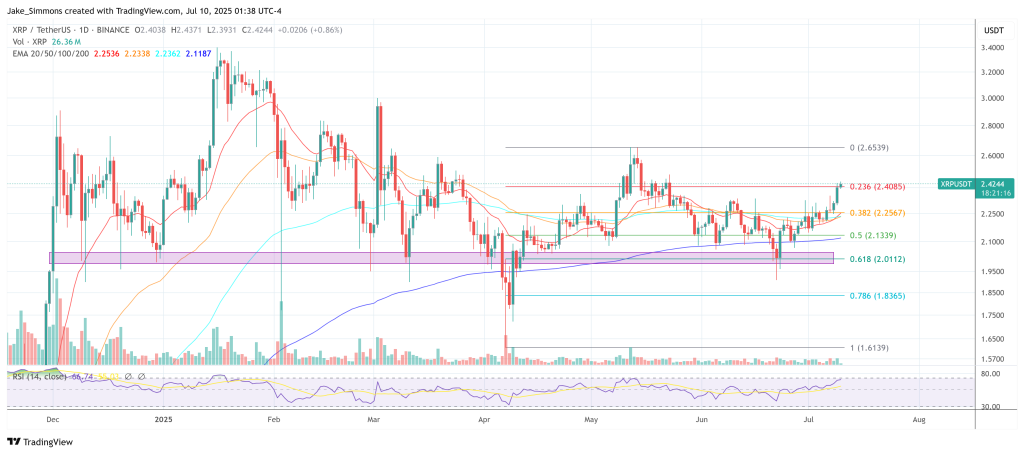
At press time, XRP traded at $2.42.
XRP price
XRP rises above the 0.236 Fib, 1-day chart | Source: XRPUSDT on TradingView.com
Featured image from YouTube, chart from TradingView.com
Editorial Process for bitcoinist is centered on delivering thoroughly researched, accurate, and unbiased content. We uphold strict sourcing standards, and each page undergoes diligent review by our team of top technology experts and seasoned editors. This process ensures the integrity, relevance, and value of our content for our readers.

Jake Simmons has been a Bitcoin enthusiast since 2016. Ever since he heard about Bitcoin, he has been studying the topic every day and trying to share his knowledge with others. His goal is to contribute to Bitcoin's financial revolution, which will replace the fiat money system. Besides BTC and crypto, Jake studied Business Informatics at a university. After graduation in 2017, he has been working in the blockchain and crypto sector. You can follow Jake on Twitter at @realJakeSimmons.

Lecturas Relacionadas

Cuenta atrás para el Día-Q: ¿La computación cuántica acabará con las criptomonedas?

**Resumen: Cuenta atrás para el Q-Day: ¿Pondrá fin la computación cuántica a las criptomonedas?** La computación cuántica supone una amenaza existencial para la criptografía de clave pública (como RSA y ECC) que sustenta Internet y las cadenas de bloques. El algoritmo de Shor podría romper estos sistemas de forma eficiente. El "Q-Day", el momento en que esto sea factible, se estima entre 2030-2045. La criptografía post-cuántica (PQC), con algoritmos basados en retículos (lattice, como ML-KEM/DSA) o hashes (como SLH-DSA), es la solución. Estándares como FIPS 203-205 ya están definidos. La migración es urgente según la "desigualdad de Mosca": el tiempo de vida de los datos más el tiempo de migración debe ser mayor que el tiempo hasta el Q-Day. Para el ecosistema blockchain, el riesgo no es uniforme. Los activos en riesgo son aquellos cuyas claves públicas ya están expuestas en la cadena (por ejemplo, antiguas direcciones BTC no gastadas). La amenaza es una prueba de presión para sus pilares: libro de contabilidad público, transferencias irreversibles y autogestión de claves. **Bitcoin** se enfrenta principalmente a un desafío de gobernanza y consenso social. Migrar requiere un soft fork y lidiar con UTXO heredados de alto valor. Las firmas PQC son mucho más grandes, lo que impacta en el tamaño de los bloques y las tarifas. **Ethereum** aborda el problema con una hoja de ruta "Lean" y agilidad criptográfica. Utiliza la abstracción de cuentas (AA) para migrar firmas de usuario de forma gradual, y explora reemplazos para las firmas BLS de consenso (como leanXMSS con compresión SNARK) y para los compromisos de datos (KZG). La ventana para una migración coordinada de todo el ecosistema (protocolos, carteras, exchanges) es de 5 a 8 años. La computación cuántica no es un "arma del juicio final", sino un catalizador para una reconstrucción criptográfica. El mayor cuello de botella no es técnico, sino la compleja coordinación y gobernanza necesarias para una transición a tiempo.

marsbitHace 56 min(s)

Cuenta atrás para el Día-Q: ¿La computación cuántica acabará con las criptomonedas?

marsbitHace 56 min(s)

Cuenta regresiva hacia el Q-Day: ¿Pondrá fin la computación cuántica a las criptomonedas?

**Q-Day Cuenta Atrás: ¿Pondrá la Computación Cuántica Fin a las Criptomonedas?** La computación cuántica representa una amenaza existencial para las criptomonedas, ya que el algoritmo de Shor podría romper los criptosistemas de curva elíptica (ECC/ECDSA) que protegen las claves privadas. El "Q-Day", el momento en que un ordenador cuántico a gran escala logre esto, se estima entre 2035-2045. El riesgo es particularmente grave para activos en cadena cuyas claves públicas están expuestas (como antiguos UTXO de Bitcoin), que podrían ser drenados. La migración a criptografía post-cuántica (PQC), como los algoritmos basados en retículos (ML-KEM/DSA) o hashes (SLH-DSA) estandarizados por NIST, es urgente pero compleja. **Bitcoin** enfrenta un enorme desafío de gobernanza: migrar mediante un *soft fork* a direcciones PQC, lidiar con la expansión de las firmas (de ~70 bytes a varios KB) y decidir el destino de los UTXO heredados inactivos, un dilema entre la inmutabilidad y la supervivencia. **Ethereum** sigue una hoja de ruta "Lean" más ágil, utilizando la abstracción de cuentas para la migración de usuarios y explorando firmas basadas en hash (leanXMSS) comprimidas con zkVMs para los validores, junto con la renovación de sus capas de datos y compromisos. La conclusión es clara: la computación cuántica no es un apocalipsis instantáneo, pero inicia una cuenta atrás crítica. La ventana de acción cómoda es de 5-8 años. El mayor obstáculo no es técnico, sino de coordinación de todo el ecosistema y de consenso social sobre la gobernanza de los activos heredados, poniendo a prueba los principios fundamentales de Web3.

链捕手Hace 1 hora(s)

Cuenta regresiva hacia el Q-Day: ¿Pondrá fin la computación cuántica a las criptomonedas?

链捕手Hace 1 hora(s)

Trading

Spot
活动图片