SEC Vs Ripple: Expert Breaks Down 10 Crucial Updates On Settlement Progress

bitcoinistPublicado a 2025-06-19Actualizado a 2025-06-19

Resumen

In a recent social media update, attorney Bill Morgan provided insights into the settlement process between Ripple Labs and the...

Trusted Editorial content, reviewed by leading industry experts and seasoned editors. Ad Disclosure

In a recent social media update, attorney Bill Morgan provided insights into the settlement process between Ripple Labs and the US Securities and Exchange Commission (SEC), bringing closure to a lengthy legal battle. 

Ripple And SEC Secure 60-Day Pause

Morgan detailed the timeline and procedural steps that have led to this pivotal moment noting that the settlement agreement was signed by Ripple parties on April 23, 2025, followed by the SEC’s endorsement on May 8, 2025. 

After years of contentious litigation, both parties filed a motion to hold their appeals in abeyance, which was granted for a period of 60 days, extending from April 16 to June 16, 2025. This pause allowed the parties to negotiate the terms of their settlement without the pressure of ongoing appeals.

On May 8, the parties filed a Rule 62.1 motion requesting an indicative ruling, but their initial effort was met with a procedural setback. Judge Analisa Torres denied the motion due to a failure to address Federal Rule 60, which governs exceptional circumstances for modifying judgments. 

Undeterred, both Ripple Labs and the regulator returned to court on June 12 with a revised joint motion focused on Rule 60, seeking clarity on the terms of their agreement.

Key Ruling Expected

As the proceedings progressed, the SEC updated the Court of Appeals, requesting that the timeline for the appeal and cross-appeal remain in abeyance until June 16, aimed to facilitate negotiations and avoid unnecessary litigation. The parties obtained an indicative ruling from Judge Torres regarding their second joint motion.

If this indicative ruling is granted, the next step would involve filing a motion with the Court of Appeals for a limited remand, allowing the trial court to address the terms agreed upon by both parties. 

The culmination of this legal journey hinges on Judge Torres dissolving the permanent injunction she imposed on August 7, 2024. This ruling would permit the release of escrow funds, crucial for the settlement’s implementation.

As reported by Bitcoinist, the SEC initially resisted this trajectory, rejecting the first indicative ruling on May 15 for not adequately addressing the exceptional circumstances mandated by federal rules. 

However, the parties returned with a comprehensive 52-page memorandum arguing that ongoing litigation would waste judicial resources. They emphasized that vacating the injunction was essential for the settlement and pointed to the SEC’s recent policy shift toward negotiated resolutions in the cryptocurrency sector.

The legal landscape surrounding Ripple highlights a significant moment not only for the company but also for the broader cryptocurrency market, which has considerably gained traction among US lawmakers. 

Should the settlement proceed as planned, Ripple and the SEC aim to dismiss both the SEC’s appeal and Ripple’s cross-appeal, potentially paving the way for a more collaborative regulatory environment in the future

Ripple
The daily chart shows XRP’s price consolidating between $2.05 and $2.30. Source: XRPUSDT on TradingView.com

Featured image from DALL-E, chart from TradingView.com

Editorial Process for bitcoinist is centered on delivering thoroughly researched, accurate, and unbiased content. We uphold strict sourcing standards, and each page undergoes diligent review by our team of top technology experts and seasoned editors. This process ensures the integrity, relevance, and value of our content for our readers.

Ronaldo is a seasoned crypto enthusiast with over four years of experience in the field. He is passionate about exploring the vast and dynamic world of decentralized finance (DeFi) and its practical applications for achieving economic sovereignty. Ronaldo is constantly seeking to expand his knowledge and expertise in the DeFi space, as he believes it holds tremendous potential for transforming the traditional financial landscape.

Lecturas Relacionadas

Zhipu, temiendo convertirse en el próximo MiniMax

"El año pasado, Zhipu AI era la empresa china más exitosa del sector de la IA, con una capitalización bursátil que superó el billón de HKD gracias al éxito de su aplicación 'Coding'. Sin embargo, tras la liberación de acciones y la fuerte caída en el valor de su competidor MiniMax, el fundador Tang Jie envió una carta interna titulada 'La ola gigante ha llegado'. En ella, evita casi por completo mencionar 'Coding', su principal motor de crecimiento. En su lugar, enfoca el discurso en conceptos a largo plazo como 'Long Horizon Task', 'Agent Autónomo' y 'AGI'. Esto no es solo un cambio técnico, sino una estrategia de narrativa para la valoración bursátil. Tang Jie teme que el mercado empiece a valorar a Zhipu con la lógica tradicional de una empresa SaaS o de internet, basada en métricas de ingresos recurrentes y crecimiento, como le sucedió a MiniMax. Su caída demostró que cuando una empresa de IA se juzga así, su valoración se desploma. Por ello, Zhipu busca reposicionarse como una 'empresa de AGI', comparable a OpenAI o Anthropic, cuyo valor se base en el potencial futuro y la proximidad a la inteligencia general, no en los resultados comerciales inmediatos. Anuncia el 'Plan Touch High', una inversión estratégica en I+D para los próximos dos años sin buscar rentabilidad a corto plazo. La industria china de los grandes modelos se bifurca: el camino de la monetización (como MiniMax) y el camino de la infraestructura/AGI (como Zhipu). Este último conlleva el riesgo de que los avances técnicos no se materialicen a tiempo. La carta de Tang Jie es una gestión de expectativas en un momento crítico, intentando ganar tiempo antes de que el mercado exija demostraciones comerciales concretas. La pregunta final es si Zhipu podrá alcanzar hitos técnicos lo suficientemente altos como para mantener su narrativa y valoración antes de que se agote la paciencia de los inversores."

marsbitHace 28 min(s)

Zhipu, temiendo convertirse en el próximo MiniMax

marsbitHace 28 min(s)

Operadores de Ethereum, observen ESTAS métricas mientras ETH alcanza una zona de acumulación inusual

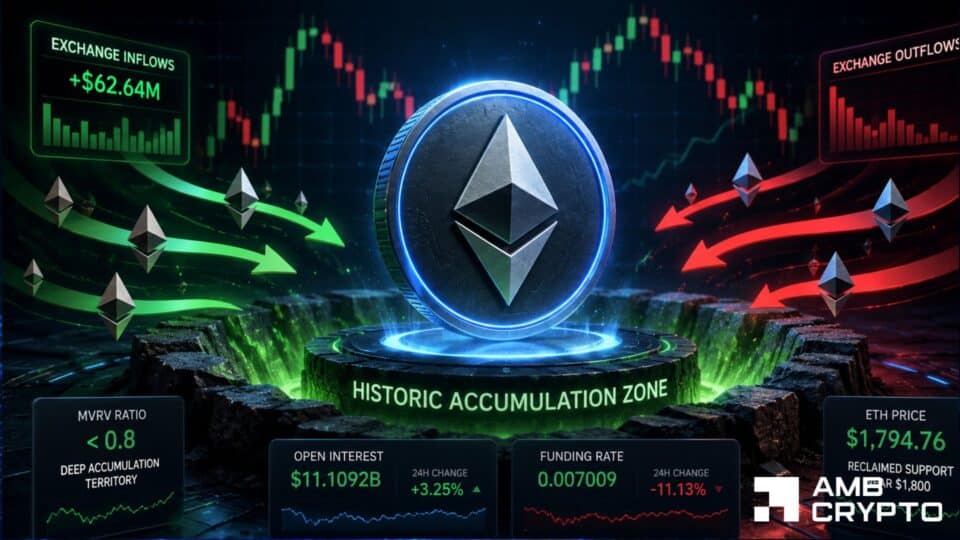
El ratio MVRV (Valor de Mercade a Valor Realizado) de Ethereum cayó por debajo del umbral crítico de 0.8, situando a la criptomoneda en una zona de acumulación históricamente rara. Esta métrica, que indicó que el ETH cotizaba por debajo de su valor realizado, ha aparecido en anteriores fondos de mercado importantes, como en diciembre de 2018, marzo de 2020 y junio de 2022. Aunque sugiere un agotamiento de los vendedores tras meses de debilidad, refleja valoración más que dirección futura del precio. Los datos de flujo neto en exchanges mostraron entradas de aproximadamente $62.64 millones, indicando que más ETH ingresó a plataformas de trading que salió, lo que señala preferencia por flexibilidad sobre acumulación a largo plazo. Mientras, el Interés Abierto en derivados subió un 3.25%, mostrando que los operadores aumentaron su exposición aunque las tasas de funding bajaron un 25.41%, reflejando un optimismo medido. En el plano técnico, Ethereum recuperó la zona de $1,800 y el RSI salió de territorio de sobreventa, situándose en 57.16. Mantenerse por encima de $1,800 es clave para conservar la estructura de mejora; de lo contrario, el foco volvería al soporte en $1,564. En resumen, las señales son contradictorias: una valoración atractiva históricamente se combina con un flujo de exchanges que sugiere cautela, mientras los derivados muestran participación sostenida pero no especulación agresiva.

ambcryptoHace 3 hora(s)

Operadores de Ethereum, observen ESTAS métricas mientras ETH alcanza una zona de acumulación inusual

ambcryptoHace 3 hora(s)

Trading

Spot
活动图片