For decades, philanthropy has been viewed more as a moral endeavor than a technological issue. But with the emergence of blockchain, that perception is quietly evolving.
From capital flow to cross-border donations, from transparency to trust, blockchain is no longer just the infrastructure of next-generation finance—it’s becoming a powerful catalyst for innovation in the global charity sector.
This transformation is not only technical; it represents a paradigm shift around trust, efficiency, and accountability.
I. The Three Structural Challenges of Traditional Charity: Trust Deficit, Inefficiency, and Supervision Blind Spots
Despite growing global donation volumes, traditional charity still faces deep-rooted structural challenges:
- Trust Deficit: Donors struggle to verify whether funds reach beneficiaries, while recipients lack effective feedback mechanisms;
- Low Efficiency: Cross-border transfers are complex, slow, and costly, limiting timely responses;
- Lack of Transparency: Project progress and fund utilization lack real-time public supervision.
The programmability and immutability of blockchain directly address these long-standing trust issues in philanthropy.
II. On-Chain Charity: Not Just a Ledger Revolution, But a Redefinition of Ethical Structure
Blockchain’s intervention in charity isn’t just about using a new payment method—it’s about rebuilding the trust foundation of the philanthropic mechanism.
- Traceability: Every stage from donation to disbursement is trackable on-chain, enhancing transparency;
- Disintermediation: Reduces reliance on intermediaries and establishes direct connections between donors and recipients;
- Efficient Fund Transfer: Crypto assets enable fast, low-cost cross-border transactions;
- Verifiable Data: Open data systems allow real-time monitoring and auditing of project implementation.
This shift turns charity from “promise-based output” into “structurally enforced execution.”
III. CoinEx Charity in Action: Building a Global Network of Real-World Impact
Since its launch in 2021, CoinEx Charity has executed educational, infrastructure, and aid programs across multiple countries. In 2024, it initiated the Starlink Program, bringing satellite internet to remote areas to help bridge the digital divide.
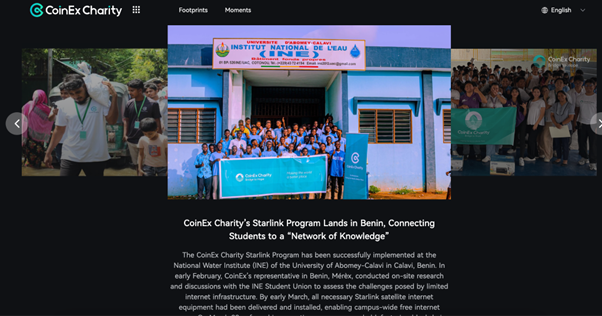
Rather than leaning on high-concept “on-chain governance,” CoinEx adopts a pragmatic, local-first, results-drivenapproach:
- Local Partnerships: Each project is carried out with schools, education institutions, or community partners to align with local needs;
- Visible Impact: CoinEx Charity documents the full project lifecycle through photos, videos, and community reports;
- Multi-region Synchronization: Programs can launch simultaneously in different countries, creating a sustainable global response network;
- Focus on Equity and Inclusion: With a mission of “connection,” CoinEx builds foundational access to the digital world—from internet access to educational devices.
CoinEx firmly believes that meaningful charity is not about technical spectacle—it’s about real-world change. Empowering more people with equitable access to the future is what truly matters.
IV. Industry Implications: From Donation to Ecosystem Co-Creation
The significance of blockchain for charity lies not only in process optimization, but in structural transformation. It brings three essential paradigm shifts:
- From One-way Giving → Co-governance: Beneficiaries become active participants in feedback and improvement;
- From Brand-based Trust → Protocol-based Trust: Execution is driven by rules, not promises;
- From Centralized Distribution → Distributed Collaboration: A decentralized philanthropic network enables optimal resource allocation.
This is Web3 philosophy in action:
Not just empowering individuals, but reshaping systems.
V. Conclusion: Long-termism as the Foundation of Crypto Philanthropy
The future of philanthropy won’t be defined by what organizations say—but by what everyone can verify.
Blockchain offers an open, verifiable, and auditable foundation of trust. It rebuilds every stage of philanthropy—from funding to impact.
Institutions like CoinEx Charity are proving that Web3’s power can reshape not just capital markets, but the very structure of public trust.
This may be one of the most meaningful ways the crypto industry contributes to global progress.

Related Posts