Societe Generale Adds Stablecoin to Solana: Solaxy Is the Best Crypto to Buy

bitcoinistPublicado a 2025-06-11Actualizado a 2025-06-11

Resumen

Societe Generale-FORGE (SG-FORGE), the digital-asset entity associated with the French Societe Generale, is set to launch USD CoinVertible (USDCV) on...

Trusted Editorial content, reviewed by leading industry experts and seasoned editors. Ad Disclosure

Societe Generale-FORGE (SG-FORGE), the digital-asset entity associated with the French Societe Generale, is set to launch USD CoinVertible (USDCV) on Ethereum and Solana.

The announcement came in a press release, where SG-FORGE explained that:

SG-FORGE will propose to its clients instant 24/7 conversion between fiat currencies and stablecoin, enabling immediate, around-the-clock transactions in both USD and EUR.

Societe Generale-FORGE, Press Release

The new USDCV will come approximately two years after the release of EUR CoinVertible (EURCV) in April 2023, the first institutional stablecoin, designed to ‘bridge the gap between traditional capital markets and the digital assets ecosystem.’

Both USDCV and EURCV will be available on exchanges to brokers, payment processors, retail clients, and institutional investors.

This announcement comes in a context where Solana is already experiencing increased market trust, and the charts are showing it.

$SOL Is Up in Charts as Solana ETFs Are Four Months Away for SEC’s Approval

$SOL is currently up by 6% over the past week and 4.80% in the past 24 hours, which shows a steady increase, rather than a passing chart bleep.

A welcome change after a sketchy start of the month, we think.
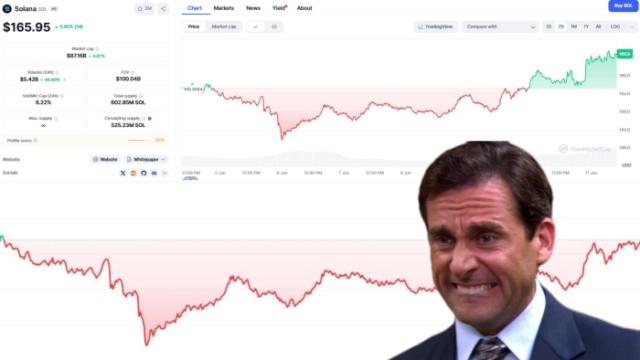
$SOL chart on CoinMarketCap

One of the main reasons why Solana is outdoing itself is the new Solana ETFs on the horizon.

The SEC has requested the issuers to update their S-1 fillings, which pushed back any decision by at least two to four months.

Bloomberg analyst James Seyffart believes that this makes a favorable SEC decision more than likely, stating that:

Delays on spot crypto ETFs are expected. A bunch of XRP ETPs have dates in the next few days.

If we’re gonna see early approvals from the SEC on any of these assets — I wouldn’t expect to see them until late June or early July at absolute earliest.’

James Seyffart, X Post

Seyffart’s previous predictions still stand, as he gave Solana’s ETFs a 90% approval chance in 2025.

2025 approval odds for crypto ETFs according to Bloomberg

The SEC’s response explains $SOL’s surge in the charts and shows that Solana is on its way to greener pastures. Especially with the new Layer 2 upgrade coming in the form of Solaxy ($SOLX), which aims to upgrade Solana’s ecosystem in 2025 and beyond.

Solaxy ($SOLX) – Solana’s Layer 2 Upgrade Brings Faster and Cheaper Transactions

Solaxy ($SOLX) is Solana’s first-ever Layer 2 upgrade that promises to fix Solana’s core issue: network congestion, which is currently responsible for a variety of blockchain-related problems.

This includes slow and even failed transactions, which ultimately translate into higher chain fees.
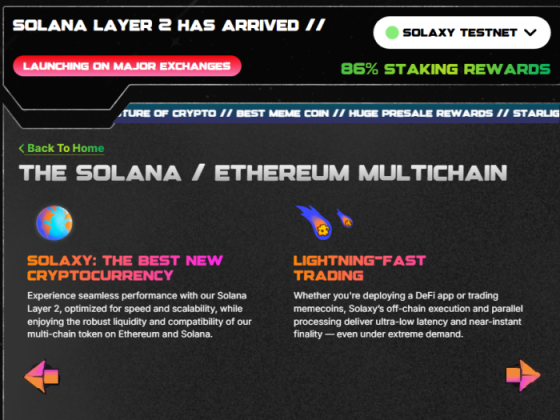
Solaxy presale page

Solaxy achieves this thanks to its off-chain execution, allowing for near-instant finality, while its parallel transaction processing ensures ultra-low latency. These are critical improvements, designed to improve the user’s experience during high-traffic hours.

Based on the project’s utility and roadmap, our analysts predict that $SOLX may reach $0.032 by the end of 2025. Given the token’s current price of $0.001752, we’re looking at a potential ROI of 1,726% if the token performs well.

Long-term, following successful implementation, widespread adoption, and continuous developmental support, $SOLX could reach as high as $0.2 by the end of 2026. In clear numbers, this translates to an ROI of 11,315%.

$SOLX’s presale is set to end in little over five days, so the window of opportunity to buy the token at its current presale price ($0.001752) is closing fast.

Solaxy has already accumulated over $47M so far, which makes this one of the best presales of 2025 and one of the cheapest crypto to buy at the same time.

You can buy your $SOLX today if you want to invest in the project early, which should improve your profits over the long term.

Is Solana in a Bullish Cycle?

Based on Solana’s latest chart performance and the SEC’s upcoming (hopefully) green light, we think Solana may be in a bull cycle.

And with Solana pumping, we also expect Solaxy ($SOLX) to make it big post-launch, which is just around the corner.

Based on the current context and Solaxy’s explicit utility within Solana’s ecosystem, $SOLX may see a massive post-launch pump. This means that, with five days left to the presale, you either buy now or go home.

Remember, this isn’t financial advice. Do your own research (DYOR), keep your FOMO in check, and invest wisely.

Editorial Process for bitcoinist is centered on delivering thoroughly researched, accurate, and unbiased content. We uphold strict sourcing standards, and each page undergoes diligent review by our team of top technology experts and seasoned editors. This process ensures the integrity, relevance, and value of our content for our readers.

As a crypto writer, Bogdan’s responsibilities are split between researching and writing articles and entertaining the team with his humor bordering on the politically incorrect, an aspiring Bill Burr, if you will. Thanks to his 12+ years of writing experience in just as many fields, including tech, cybersecurity, modelling, fitness, crypto, and other topics-that-shall-not-be-named, he's become a genuine asset to the team. While his position as a senior writer at PrivacyAffairs thought him valuable lessons about the power of self-management, his entire writing career was and is an exercise in self-improvement. Now, he's ready to sink his teeth into crypto and teach people how to take control of their own money on the blockchain. With fiat as an eternally devaluing currency, Bitcoin and altcoins seem like the best-fitting alternative for Bogdan. Bogdan’s biggest professional accomplishment, aside from securing a position as a main writer for Bitcoinist, was his 5-year run as a writing manager at Blackwood Productions, where he coordinated a team of four writers. During that time, he learned the value of teamwork and that of creating a working environment that breeds efficiency, positivity, and friendship.

Lecturas Relacionadas

Tiger Research: Zuckerberg comienza a apostar por los mercados de predicción, mientras que los países asiáticos aún los ven como apuestas

El artículo de Tiger Research explora el auge de los mercados de predicción, destacando que, tras años siendo solo un concepto, la industria despegó alrededor de 2020 con un volumen de negocios mensual que ahora supera los 140.000 millones de dólares. La entrada de Meta, con Mark Zuckerberg liderando el desarrollo de la aplicación Arena, se señala como prueba de que esta industria ha superado su fase experimental. El texto repasa sus orígenes, desde las apuestas políticas informales del siglo XVIII hasta el mercado académico de la Universidad de Iowa (IEM) y su similitud con las opciones binarias. Explica su funcionamiento actual: se negocian contratos binarios (sí/no) sobre eventos diversos, cuyos precios, determinados en un libro de órdenes, reflejan la probabilidad del resultado. Los "oráculos", descentralizados o centralizados, son los mecanismos que certifican el resultado final. Se argumenta que estos mercados han evolucionado hacia una infraestructura de "información financiera", superando a encuestas y pronósticos tradicionales porque los participantes arriesgan su propio dinero ("skin in the game"), lo que genera señales de precios más fiables y precisas, como se ha visto en predicciones de política monetaria o elecciones. Sin embargo, se subraya una gran divergencia regulatoria: mientras en EE.UU. los tribunales los han reconocido como instrumentos financieros legítimos, en las principales jurisdicciones asiáticas todavía se equiparan al juego de azar y están prácticamente ausentes del debate político. Esta postura, según el artículo, genera tres problemas: fomenta el arbitraje regulatorio y la fuga de usuarios a plataformas offshore sin supervisión; priva a los países de datos valiosos sobre el sentimiento social que se acumulan en el extranjero; y deja a los usuarios sin protección alguna. La conclusión llama a un cambio de perspectiva en Asia: en lugar de bloquear estos mercados, es necesario iniciar debates para integrarlos en el sistema formal, establecer mecanismos de supervisión transparentes y aprovechar los datos que generan como un activo para la sociedad.

marsbitHace 2 hora(s)

Tiger Research: Zuckerberg comienza a apostar por los mercados de predicción, mientras que los países asiáticos aún los ven como apuestas

marsbitHace 2 hora(s)

Solo 11 días: Claude reescribe millones de líneas de código, un proyecto épico de IA que provoca indignación

El mundo tecnológico se debate tras la controvertida decisión del equipo de Bun, un popular runtime de JavaScript/TypeScript, de reescribir en solo 11 días todo su código base (un millón de líneas) de Zig a Rust utilizando la herramienta Claude Fable 5 de Anthropic, con un coste estimado de 165.000 dólares en APIs. El motivo esgrimido son problemas de estabilidad y bugs de seguridad de memoria en la versión original de Zig, así como el veto de la comunidad Zig al código generado por IA, con la que Bun depende en gran medida. Esta decisión "épica" ha desatado una agria polémica, especialmente por la reacción del creador de Zig, Andrew Kelley, quien en un blog acusó al fundador de Bun, Jarred Sumner, de tener malos hábitos de ingeniería y generar "código basura". Kelley afirmó sentirse aliviado de que Bun abandonara Zig, por miedo a que dañara la reputación del lenguaje. La comunidad se divide entre quienes lo ven como una defensa necesaria de la calidad del código y quienes lo consideran una falta de profesionalidad. Las principales dudas giran ahora en torno al resultado: si bien el proceso fue rápido y relativamente barato, la nueva base de código en Rust, generada mayormente por IA mediante traducción directa, contiene 27.000 líneas de código "unsafe". Muchos expertos temen que esto pueda crear una enorme deuda técnica, haciendo el código difícil de mantener y entender para los desarrolladores humanos en el futuro, anulando así los ahorros iniciales. El proyecto se presenta como un hito ambivalente en la era de la IA, cuyo verdadero impacto solo el tiempo dirá.

marsbitHace 5 hora(s)

Solo 11 días: Claude reescribe millones de líneas de código, un proyecto épico de IA que provoca indignación

marsbitHace 5 hora(s)

Trading

Spot
活动图片