$100 Trillion Crypto Boom? Macro Experts Say It’s Closer Than You Think

bitcoinistPublicado a 2025-06-10Actualizado a 2025-06-10

Resumen

Global Macro Investor’s head of research Julien Bittel used a marathon X thread on 9 June to stitch together what...

Trusted Editorial content, reviewed by leading industry experts and seasoned editors. Ad Disclosure

Global Macro Investor’s head of research Julien Bittel used a marathon X thread on 9 June to stitch together what he calls “The Everything Code”―a demographic-debt-liquidity feedback loop that he believes will catapult the digital-asset complex from today’s roughly $3.5 trillion capitalization to $100 trillion within a decade.

Speaking against the backdrop of a crypto market that has already doubled since the start of 2024, Bittel lays the groundwork with a blunt diagnosis of the developed world’s labour market. “The labor force participation rate isn’t going to rise anytime soon – it’s set to keep declining over time. This is a structural problem,” he writes, adding that “humans are already being replaced by AI and robots at a staggering pace, and that shift is only just beginning. This is deflationary.” In his view, shrinking workforces meet unyielding entitlement promises in a cocktail that “reinforces the need for ongoing stimulus to keep the system afloat. Fewer workers. More tech. Same debts.”

Bittel’s next step is the fiscal arithmetic. With public and private liabilities already hovering near 120% of global GDP, “the only answer is more debt… That’s how the system survives,” he warns. Should growth sputter, “Debt-to-GDP is going to keep rising over time,” a trend he expects policymakers to absorb through monetary debasement rather than austerity.

Debasement, he reminds readers, is the hidden eight-percent annual loss of purchasing power that piles on top of headline inflation. “Cash has quietly become one of the riskiest assets out there,” Bittel argues, forcing savers to seek double-digit nominal returns simply to stand still.

The $100 Trillion Crypto Supercycle

From there the thread pivots to liquidity, the variable Bittel and GMI founder Raoul Pal have elevated to first-principles status. When GMI combines central-bank balance-sheet expansion with commercial-bank credit creation across major economies, the resulting “Total Liquidity” gauge explains about 90% of Bitcoin’s moves and 95% of the Nasdaq-100’s, he writes. “Fewer workers. More tech. Same debts,” means liquidity must keep rising to prevent a credit contraction, and that liquidity, in Bittel’s models, “is the tide that lifts scarce, risk-sensitive assets.”

Scarcity is the bridge to Bitcoin. “Bitcoin has been compounding purchasing power faster than any asset in human history—annualizing nearly 150 percent in excess of the debasement rate since 2010,” Bittel notes, while even the Nasdaq’s stellar 13 percent real return “is down 99.94 percent versus Bitcoin since the start of 2012. Shocking…” The superlatives serve a purpose: they frame Bitcoin as the only macro-scale antidote to the policy cocktail of demographic drag, rising leverage and forced liquidity.

All of that funnels into his headline projection. “We’re still in the early stages of a global race—a scramble by institutions, sovereigns, and individuals—to accumulate as much Bitcoin as possible,” Bittel writes. That scramble, he believes, will propel the crypto universe “from a $3 trillion asset class today to $100 trillion over the next seven to ten years.”
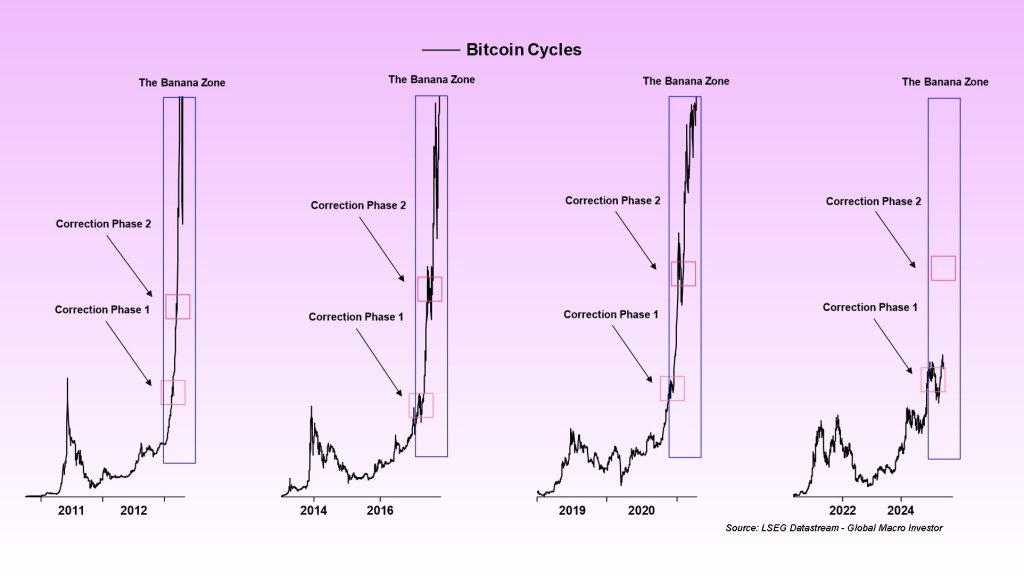
Bitcoin cycles
“The Banana Zone” | Source: X @BittelJulien

Doing the math, a jump from the current $3.55 trillion market capitalisation implies a 40% compound annual growth rate over a decade, or roughly 61% if the window compresses to seven years—both aggressive, but neither without precedent in earlier crypto cycles.

Bittel concedes the path will be “both incredibly challenging and unimaginably rewarding—the worst of times and the best of times,” but he insists Bitcoin is “part of the solution.” He and Pal have called the coming chase for scarce assets “the single greatest wealth-creation opportunity of our lifetimes,” and Bittel closes the thread by declaring that if GMI’s call plays out, it will be “remembered as the greatest macro trade of all time. This is The Everything Code.”

Pal, whose own presentation at Real Vision’s Sui Basecamp in May framed crypto as “a supermassive black hole that outperforms and sucks in every other asset,” reaches similar conclusions. He places Bitcoin in what he calls the “banana zone,” a reflexive phase in which expanding liquidity and herd behaviour interact to drive parabolic gains, with a cycle target of roughly $450,000 per coin. Pal’s estimates implies a Bitcoin capitalization only well above $40 trillion even without altcoins—complementing Bittel’s upper-bound scenario.

At press time, the total crypto market cap stood at $3.37 trillion.
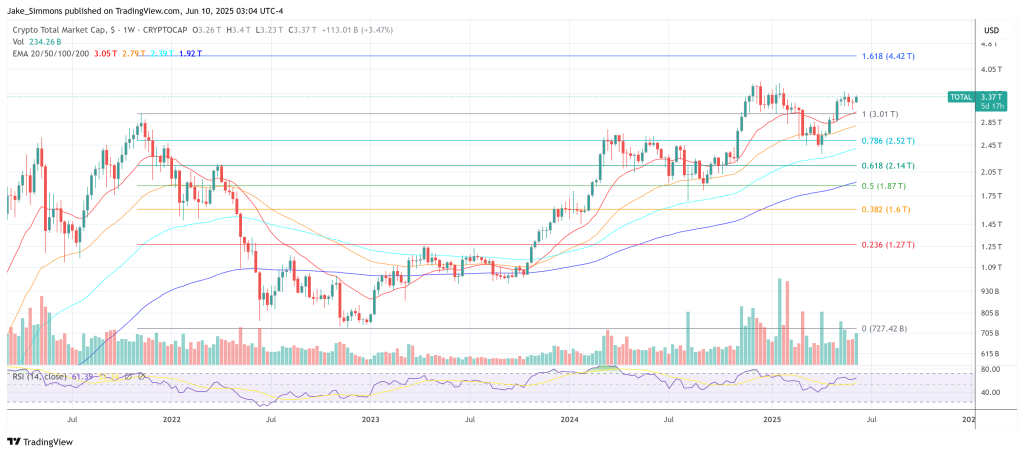
Crypto market cap
Total crypto market cap, 1-week chart | Source: TOTAL on TradingView.com
Featured image created with DALL.E, chart from TradingView.com
Editorial Process for bitcoinist is centered on delivering thoroughly researched, accurate, and unbiased content. We uphold strict sourcing standards, and each page undergoes diligent review by our team of top technology experts and seasoned editors. This process ensures the integrity, relevance, and value of our content for our readers.

Jake Simmons has been a Bitcoin enthusiast since 2016. Ever since he heard about Bitcoin, he has been studying the topic every day and trying to share his knowledge with others. His goal is to contribute to Bitcoin's financial revolution, which will replace the fiat money system. Besides BTC and crypto, Jake studied Business Informatics at a university. After graduation in 2017, he has been working in the blockchain and crypto sector. You can follow Jake on Twitter at @realJakeSimmons.

Lecturas Relacionadas

Tiger Research: Zuckerberg comienza a apostar por los mercados de predicción, mientras que los países asiáticos aún los ven como apuestas

El artículo de Tiger Research explora el auge de los mercados de predicción, destacando que, tras años siendo solo un concepto, la industria despegó alrededor de 2020 con un volumen de negocios mensual que ahora supera los 140.000 millones de dólares. La entrada de Meta, con Mark Zuckerberg liderando el desarrollo de la aplicación Arena, se señala como prueba de que esta industria ha superado su fase experimental. El texto repasa sus orígenes, desde las apuestas políticas informales del siglo XVIII hasta el mercado académico de la Universidad de Iowa (IEM) y su similitud con las opciones binarias. Explica su funcionamiento actual: se negocian contratos binarios (sí/no) sobre eventos diversos, cuyos precios, determinados en un libro de órdenes, reflejan la probabilidad del resultado. Los "oráculos", descentralizados o centralizados, son los mecanismos que certifican el resultado final. Se argumenta que estos mercados han evolucionado hacia una infraestructura de "información financiera", superando a encuestas y pronósticos tradicionales porque los participantes arriesgan su propio dinero ("skin in the game"), lo que genera señales de precios más fiables y precisas, como se ha visto en predicciones de política monetaria o elecciones. Sin embargo, se subraya una gran divergencia regulatoria: mientras en EE.UU. los tribunales los han reconocido como instrumentos financieros legítimos, en las principales jurisdicciones asiáticas todavía se equiparan al juego de azar y están prácticamente ausentes del debate político. Esta postura, según el artículo, genera tres problemas: fomenta el arbitraje regulatorio y la fuga de usuarios a plataformas offshore sin supervisión; priva a los países de datos valiosos sobre el sentimiento social que se acumulan en el extranjero; y deja a los usuarios sin protección alguna. La conclusión llama a un cambio de perspectiva en Asia: en lugar de bloquear estos mercados, es necesario iniciar debates para integrarlos en el sistema formal, establecer mecanismos de supervisión transparentes y aprovechar los datos que generan como un activo para la sociedad.

marsbitHace 2 hora(s)

Tiger Research: Zuckerberg comienza a apostar por los mercados de predicción, mientras que los países asiáticos aún los ven como apuestas

marsbitHace 2 hora(s)

Solo 11 días: Claude reescribe millones de líneas de código, un proyecto épico de IA que provoca indignación

El mundo tecnológico se debate tras la controvertida decisión del equipo de Bun, un popular runtime de JavaScript/TypeScript, de reescribir en solo 11 días todo su código base (un millón de líneas) de Zig a Rust utilizando la herramienta Claude Fable 5 de Anthropic, con un coste estimado de 165.000 dólares en APIs. El motivo esgrimido son problemas de estabilidad y bugs de seguridad de memoria en la versión original de Zig, así como el veto de la comunidad Zig al código generado por IA, con la que Bun depende en gran medida. Esta decisión "épica" ha desatado una agria polémica, especialmente por la reacción del creador de Zig, Andrew Kelley, quien en un blog acusó al fundador de Bun, Jarred Sumner, de tener malos hábitos de ingeniería y generar "código basura". Kelley afirmó sentirse aliviado de que Bun abandonara Zig, por miedo a que dañara la reputación del lenguaje. La comunidad se divide entre quienes lo ven como una defensa necesaria de la calidad del código y quienes lo consideran una falta de profesionalidad. Las principales dudas giran ahora en torno al resultado: si bien el proceso fue rápido y relativamente barato, la nueva base de código en Rust, generada mayormente por IA mediante traducción directa, contiene 27.000 líneas de código "unsafe". Muchos expertos temen que esto pueda crear una enorme deuda técnica, haciendo el código difícil de mantener y entender para los desarrolladores humanos en el futuro, anulando así los ahorros iniciales. El proyecto se presenta como un hito ambivalente en la era de la IA, cuyo verdadero impacto solo el tiempo dirá.

marsbitHace 5 hora(s)

Solo 11 días: Claude reescribe millones de líneas de código, un proyecto épico de IA que provoca indignación

marsbitHace 5 hora(s)

Trading

Spot
活动图片