Bitcoin Price Volatility Far Lower Than During COVID-19 Crash — What This Means

bitcoinistPublicado a 2025-04-12Actualizado a 2025-04-13

Resumen

Over the past few weeks, the cryptocurrency market has been overwhelmed by a high degree of uncertainty and volatility triggered...

Trusted Editorial content, reviewed by leading industry experts and seasoned editors. Ad Disclosure

Over the past few weeks, the cryptocurrency market has been overwhelmed by a high degree of uncertainty and volatility triggered by the constantly shifting global macroeconomics. This unsettled market condition saw the Bitcoin price dance between $74,000 and $83,000 in the space of a few days.

The price of BTC sank toward $74,000 at the start of the past week as crypto investors panicked after United States President Donald Trump announced new trade tariffs. On Thursday, April 10, the premier cryptocurrency reclaimed the $83,000 level after President Trump paused trade tariffs on all countries except China.

Is Bitcoin Now A ‘Mature Asset’?

The Bitcoin price has been quite reactive to virtually every piece of news in the global trade, demonstrating the highly volatile state of the cryptocurrency market. However, an on-chain analytics expert has explained that the volatility of the current Bitcoin market pales in comparison to past episodes.

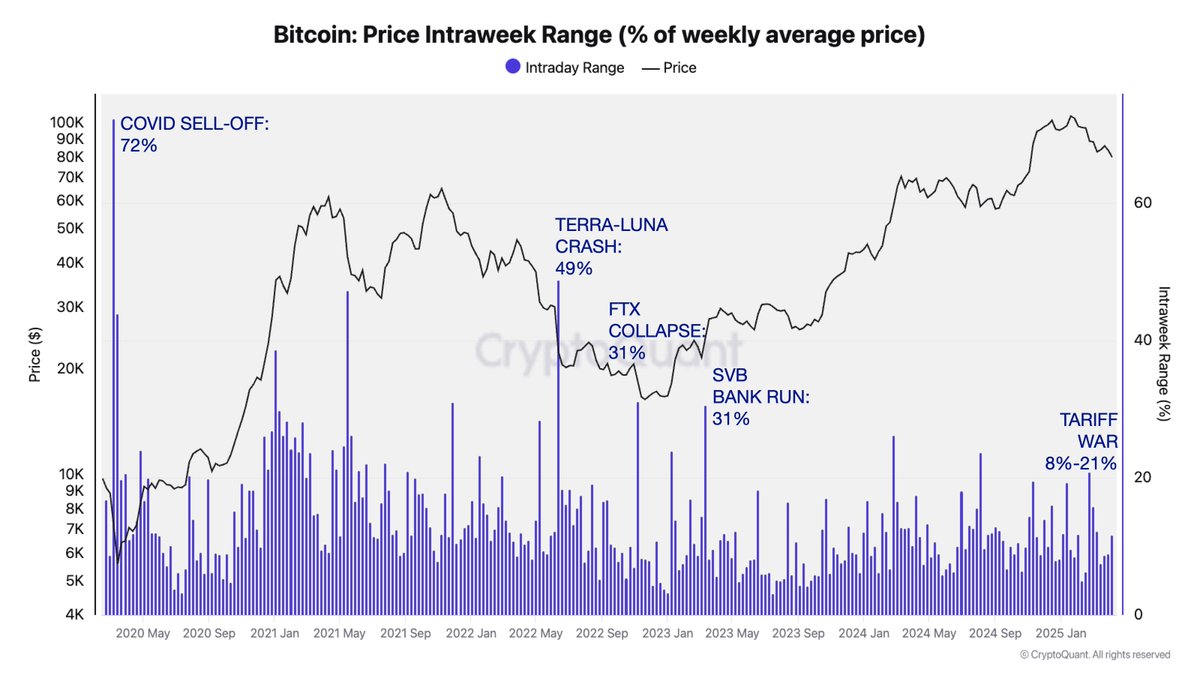
In a new post on the social media platform X, CryptoQuant’s head of research, Julio Moreno, revealed that the Bitcoin price volatility in the ongoing global trade drama has been “so far lower” than that from other past events, such as the COVID-19 crash, Terra-Luna collapse, FTX downfall, and the Silicon Valley Bank (SVB) bank run.

The relevant indicator here is the Price Intraweek Range metric, which estimates the percentage change in the average weekly price of Bitcoin. According to data from CryptoQuant, the Bitcoin Price Intraweek Range climbed to an all-time high of 72% during the COVID-19 market downturn in April 2020.
Bitcoin price

Source: @jjcmoreno on X

The chart above shows that the BTC Intraweek Range metric surged to 49% after the crash of the Terra Luna ecosystem in May 2022. Meanwhile, the indicator reached 31% following the collapse of the Sam-Bankman-Fried-led FTX exchange in late 2022 and the SVB bank run in early 2023.

With the escalating trade tensions between the United States and China, the Bitcoin Price Intraweek Range metric stands between 8% – 21%. This reduced volatility suggests that the premier cryptocurrency has matured as an asset, with deeper liquidity and a better market structure.

The relatively stable price action can be connected to the growing base of long-term holders and steady corporate adoption, as institutional players are beginning to view the world’s largest cryptocurrency less as a high-risk asset and more as a hedge against macroeconomic uncertainties.

Bitcoin Price At A Glance

As of this writing, the price of BTC stands at around $83,700, reflecting a 5% increase in the past 24 hours.

Bitcoin price

The price of BTC returns to above $83,000 on the daily timeframe | Source: BTCUSDT chart on TradingView

Featured image from iStock, chart from TradingView
Editorial Process for bitcoinist is centered on delivering thoroughly researched, accurate, and unbiased content. We uphold strict sourcing standards, and each page undergoes diligent review by our team of top technology experts and seasoned editors. This process ensures the integrity, relevance, and value of our content for our readers.

Opeyemi Sule is a passionate crypto enthusiast, a proficient content writer, and a journalist at Bitcoinist. Opeyemi creates unique pieces unraveling the complexities of blockchain technology and sharing insights on the latest trends in the world of cryptocurrencies. Opeyemi enjoys reading poetry, chatting about politics, and listening to music, in addition to his strong interest in cryptocurrency.

Lecturas Relacionadas

Tiger Research: Primero, lleve la tokenización de RWA al extranjero

**Tiger Research: Lleva la tokenización de RWA al extranjero primero** El mercado de activos del mundo real tokenizados (RWA) está creciendo rápidamente, pero muchas jurisdicciones carecen de un marco regulatorio adecuado. Las instituciones financieras de estas regiones tienen tres opciones estratégicas: esperar legislación local, usar "sandboxes" regulatorios o ingresar directamente a mercados extranjeros ya regulados. La actividad RWA transfronteriza requiere una preparación meticulosa en seis áreas clave: elección de jurisdicción, licencias, definición del activo, perfil de inversor, y diseño de arreglos de liquidación y operación. El objetivo principal es acumular experiencia operativa real. Existen dos rutas principales: ingresar a jurisdicciones con marcos regulatorios maduros (como Hong Kong, Singapur o EE.UU.) o adoptar la ruta nativa "on-chain", utilizando plataformas con capacidades de cumplimiento integradas (ej. Ondo Global, Plume Nest) para una entrada más rápida y un mayor alcance, aunque con estructuras potencialmente más complejas. El proceso implica evaluar entidades locales existentes, seleccionar una plataforma o socio, diseñar la estructura del producto cumpliendo exenciones como la Regulation S, establecer acuerdos de custodia y operaciones "on-chain", y finalmente ejecutar y verificar la venta. La esencia del negocio no está en la tecnología, sino en completar con éxito todo el proceso de venta. No es necesario esperar a un marco regulatorio completo; la capacidad de trazar un camino viable rápidamente y acumular experiencia es crucial, ya que el mercado no esperará. El momento de actuar es ahora.

marsbitHace 11 min(s)

Tiger Research: Primero, lleve la tokenización de RWA al extranjero

marsbitHace 11 min(s)

5 años, 15,000 millones de dólares perdidos: el gigante de los juegos blockchain YGG se rinde

El 6 de julio, Yield Guild Games (YGG) anunció el cierre de su división de publicación de juegos, YGG Play, dando por terminada una apuesta lanzada en 2025. La plataforma, enfocada en juegos casuales web3, será desmantelada progresivamente antes del 31 de julio. A pesar de generar más de 9 millones de dólares en ingresos, con un pico en el primer trimestre de 2026 (876.000 dólares), sus fundadores alegaron que el deterioro del entorno macroeconómico, la falta de liquidez y la caída de confianza del usuario hicieron insostenible el negocio. Esta decisión marca un punto de inflexión para YGG, otrora gigante del modelo "play-to-earn" (P2E). Fundada en 2020, YGG alcanzó su cénit en 2021 como el gremio más grande de Axie Infinity, impulsada por la narrativa P2E y el mercado alcista. Sin embargo, el colapso del modelo económico de Axie en 2022, basado en un ciclo financiero especulativo que requería constante entrada de nuevos jugadores, sumió a la industria en una crisis profunda. El cierre de YGG Play refleja el declive estructural del sector de los juegos blockchain. Un informe de abril de 2026 señala que el 93% de unos 3.200 proyectos analizados están "muertos" o inactivos, con tokens del sector depreciados en un 95% desde máximos de 2022. La narrativa P2E, que sustentó la explosión inicial, demostró ser insostenible, llevando a una destrucción de capital estimada en 150.000 millones de dólares en cinco años. Ante esto, YGG anunció un cambio estratégico radical hacia la economía de datos para IA, abandonando efectivamente su núcleo histórico en el gaming.

Foresight NewsHace 30 min(s)

5 años, 15,000 millones de dólares perdidos: el gigante de los juegos blockchain YGG se rinde

Foresight NewsHace 30 min(s)

Trading

Spot
活动图片