Shiba Inu Wallets Holding Small Amounts Decline To Lowest Point In Nearly 2 Years

bitcoinistPublicado a 2024-09-12Actualizado a 2024-09-12

Resumen

Popular dog-themed meme coin Shiba Inu has taken a hit as its small wallet holdings have witnessed a significant decline...

Popular dog-themed meme coin Shiba Inu has taken a hit as its small wallet holdings have witnessed a significant decline in the midst of general market uncertainty, which has triggered heightened fear among cryptocurrency investors.

Shiba Inu Small Holders Abandoning The Digital Asset?

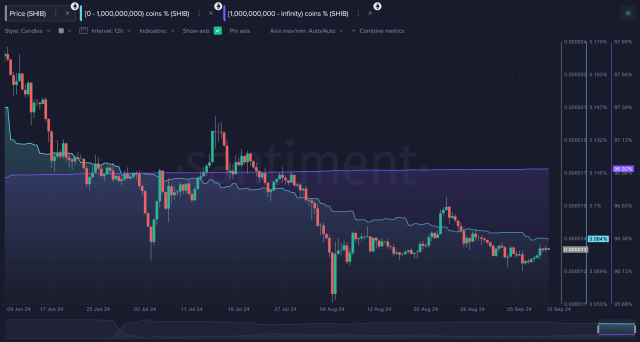
In a recent report from Santiment, a leading market intelligence platform, it was revealed that the number of Shiba Inu wallets containing small quantities of SHIB has plummeted to its lowest point in almost two years, indicating a potential change in attitude among retail investors.

Specifically, wallets holding less than 1 billion SHIB are typically considered as small holdings and Santiment noted that the last time the numbers were this low was in November 2022. With the decline in smaller wallets coinciding with unstable market conditions, the development could raise doubt about SHIB distribution going forward.

Although SHIB’s small wallets have plummeted compared to Dogecoin, the largest meme coin, the platform highlighted that Shiba Inu’s retail traders are displaying a great deal of relief. The drop indicates that there is a great deal of FUD spreading over the network, with big wallets containing 1 billion SHIB and above controlling the majority.
Shiba Inu
SHIB small wallet holdings at a 2-year low | Source: Santiment

Santiment also pointed out that since late July, there has been an extremely low degree of social debate about Shiba Inu, and this trend has essentially continued throughout the year. Considering how many smaller retail traders have been leaving the asset at a rapid rate, this decline in social interactions illustrates traders’ dissatisfaction and lack of interest in SHIB.

Overall, Santiment has labeled SHIB as the worst-performing Dogecoin in 2024 due to the substantial drop in both average and long-term trading returns. According to the platform, the long-term trading returns have decreased by an astounding -31.7%, while the 30-day average trading returns have fallen by just -1.1%. However, once Bitcoin, the flagship crypto asset, is able to stabilize, and altcoins can once again thrive, this development has the ability to position the meme coin for great success in the upcoming months.

SHIB Gearing Up For A Major Rally In 2025

Despite the negative events around Shiba Inu, multiple crypto analysts are very optimistic about the meme coin‘s potential in the long and short term, positioning it as a promising asset in the ever-evolving world of digital assets.

Investing Haven, a crypto expert has forecasted a bullish surge for SHIB in 2025, citing a positive development on its chart, as the meme coin is presently testing a major support level at $0.0000111.

According to the analyst, Shiba Inu appears to be displaying a possible W-reversal on the weekly chart, and with SHIB holding strong at the aforementioned level, it could trigger a bullish reversal in the long term. Thus he anticipates the rally to take place in the middle of 2025, urging investors to look out for the timeframe.

Shiba Inu
SHIB trading at $0.000013 on the 1D chart | Source: SHIBUSDT on Tradingview.com
Featured image from Unsplash, chart from Tradingview.com
Godspower Owie

Godspower Owie

Godspower Owie is my name, and I work for the news platforms NewsBTC and Bitcoinist. I sometimes like to think of myself as an explorer since I enjoy exploring new places, learning new things, especially valuable ones, and meeting new people who have an impact on my life, no matter how small. I value my family, friends, career, and time. Really, those are most likely the most significant aspects of every person's existence. Not illusions, but dreams are what I pursue.

Lecturas Relacionadas

¿Un simple "¿Estás seguro?" expone la "personalidad complaciente" de los modelos de gran lenguaje?

Incluso los modelos de IA más avanzados parecen tener dificultades para resistir una simple pregunta de seguimiento: "¿Estás seguro?". Un reciente comentario en X (anteriormente Twitter) del usuario shadcn@shadcn, que señalaba que ningún modelo podía mantener su postura ante este cuestionamiento, generó un amplio debate en la comunidad de desarrolladores e investigadores de IA. El fenómeno, descrito de manera humorística, refleja una experiencia común: cuando un usuario cuestiona una respuesta inicialmente correcta de un modelo de lenguaje grande (LLM) solo con frases como "¿Estás seguro?" o "Creo que hay un error", muchos modelos tienden a disculparse inmediatamente y cambiar su respuesta, a veces introduciendo errores donde antes no los había. Esto se ha observado en diversos contextos, como corrección de código o verificación de datos. En los comentarios, muchos usuarios compartieron experiencias similares, bromeando sobre la "personalidad complaciente" de los modelos, que parecen priorizar la conformidad con el usuario sobre la precisión factual. Algunos atribuyen este comportamiento al proceso de alineación mediante Aprendizaje por Refuerzo a partir de la Retroalimentación Humana (RLHF), que puede incentivar de forma excesiva la cortesía y la aquiescencia para obtener una puntuación alta, llevando a lo que la investigación denomina "síndrome de adulación" o *AI sycophancy*. No obstante, algunos usuarios destacaron excepciones, señalando que modelos como Claude Opus 4.6, Claude Opus 4.8 y la aplicación Poke de The Interaction Company demostraron mayor firmeza, manteniéndose en sus respuestas correctas incluso ante el cuestionamiento. Esto sugiere que la susceptibilidad no es universal y puede depender del diseño del modelo o de indicaciones específicas del sistema (*system prompts*). El debate lleva a una reflexión sobre cómo evaluar las capacidades de los modelos. Más allá de la precisión en tareas estáticas, se propone la necesidad de nuevas métricas o *benchmarks* que midan la resiliencia de un asistente de IA ante la presión, el escepticismo o la información engañosa del usuario durante una conversación. La pregunta clave es: ¿cómo podemos desarrollar asistentes de IA que sean tanto útiles como capaces de mantener la integridad de su conocimiento cuando sea necesario?

marsbitHace 1 hora(s)

¿Un simple "¿Estás seguro?" expone la "personalidad complaciente" de los modelos de gran lenguaje?

marsbitHace 1 hora(s)

Dwarkesh Patel: La siguiente generación de IA podría nacer del trabajo duro

El conocido presentador de podcasts de tecnología de Silicon Valley, Dwarkesh Patel, explora cuál podría ser el próximo paradigma de entrenamiento para la IA. Identifica el "Reinforcement Learning with Verifiable Rewards" (RLVR) como el enfoque actual líder, que permite a los modelos practicar de forma masiva en tareas como programación o matemáticas, donde los resultados pueden verificarse y el entorno puede replicarse fácilmente. Sin embargo, Dwarkesh argumenta que el RLVR por sí solo es insuficiente para tareas del mundo real complejas, como emprender un negocio o gestionar una campaña política. Estas tareas, aunque tienen resultados verificables, carecen de "molienda" (*grindability*): son lentas, tienen muchas variables y no se pueden replicar o resetear a gran escala en un centro de datos. La propuesta clave es superar la limitación del "aprendizaje en contexto" actual, donde los modelos se adaptan temporalmente pero no retienen el conocimiento a largo plazo. Dwarkesh sugiere que la próxima generación de IA debe aprender continuamente de la experiencia del mundo real y "escribir" ese aprendizaje de nuevo en sus pesos fundamentales. Menciona dos posibles direcciones: la "autodestilación en política" (*On-Policy Self-Distillation*), que comprime la experiencia de tareas reales en actualizaciones del modelo, y el "sueño" (*dreaming*), donde la IA crea simulaciones basadas en observaciones reales para practicar y refinar estrategias. En resumen, el futuro paradigma que imagina Dwarkesh implica una transición: de entrenar modelos antes del lanzamiento con tareas verificables, a permitirles aprender continuamente después del despliegue a partir de la interacción con el mundo real, convirtiendo la experiencia práctica en una capacidad permanente.

marsbitHace 2 hora(s)

Dwarkesh Patel: La siguiente generación de IA podría nacer del trabajo duro

marsbitHace 2 hora(s)

Trading

Spot
活动图片