Ethereum Merge a 'few months after' June: Dev clears up what’s going on

CointelegraphPublicado a 2022-04-14Actualizado a 2022-04-14

Resumen

The long-awaited Ethereum Merge is set for yet another delay, with developers working on the upgrade estimating a completion time a “few months after” June.

The long-awaited Ethereum Merge is set for yet another delay, with developers working on the upgrade estimating a completion time a “few months after” June.
Owing to the success of testing, there was a general expectation the Merge would go through mid year, however the latest setback is unsurprising given that Proof of Stake has been delayed constantly ever since it was first proposed.
That said, the signs are promising that the Ethereum mainnet will actually merge with the beacon chain to become a Proof-of-Stake (PoS) network this year. For real.
Ethereum developer Tim Beiko provided the updated timeline via Twitter yesterday, tentatively stating that the core devs are into the final stretch:
“It won't be June, but likely in the few months after. No firm date yet, but we're definitely in the final chapter of PoW on Ethereum.”
After noting that his comments caused a stir amongst Ethereum proponents and haters alike, Beiko followed up today by observing “that it can be hard to parse the progress on The Merge when you aren't deep in the process.”
To provide further context, Beiko published a blog post with a deeper rundown.
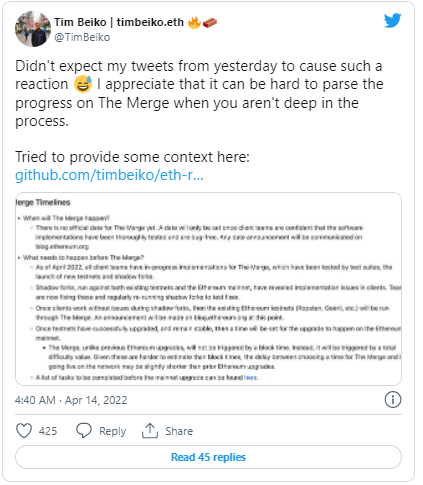
According to the developer, a specific date will not be set until “client teams are confident that the software implementations have been thoroughly tested and are bug-free.”
Central to these latter stages are the trial runs of public test nets such as Kiln, and the roll out of shadow forks which enable devs to test various merge/PoS-related implementations on the network.
Difficulty bomb ticking
Another important factor is the difficulty bomb (an automated increase in mining difficulty designed to make PoW mining less attractive), which Beiko says will start to be noticeable on Ethereum around May and make blocks “unbearably (read 15-20 seconds) slow by August.”
“If client developers do not think they can deploy The Merge to mainnet before block times are slowed too much, it will need to be delayed again,” he said.
Beiko put forward two ways in which the difficulty bomb could potentially be delayed to usher in the Merge upgrade beforehand, firstly combining a bomb delay with merge client releases to delay the “bomb at a certain block, restoring 13s block times, and then activate The Merge shortly after.”
Secondly to separate the bomb delay via network upgrade “which only delays the difficulty bomb” prior to the merge.
“The Merge, unlike previous Ethereum upgrades, will not be triggered by a block time. Instead, it will be triggered by a total difficulty value. Given these are harder to estimate than block times, the delay between choosing a time for The Merge and it going live on the network may be slightly shorter than prior Ethereum upgrades.”
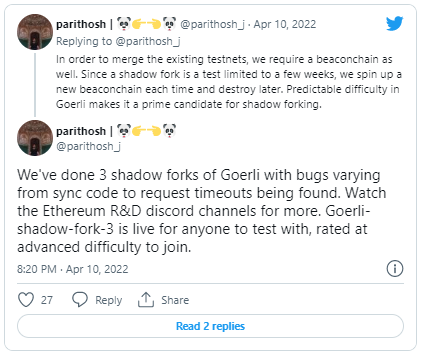
Earlier this week Ethereum Foundation developer Parithosh Jayanthi suggested there is still a fair amount of trial and error to go, after he noted that the testing of three shadow forks resulted in “bugs varying from sync code to request timeouts being found.”
Following the successful implementation of The Merge and transition to a PoS consensus mechanism, the final landmark on the road map for Ethereum (formerly known as Eth2) is the sharded chains upgrade slated to go live in early 2023. Until then however, the network will utilize Layer-2 networks like Polygon and Optimism to handle scalability and high transaction volumes.
The price of Ether (ETH) has seen a significant uptick over the past 30 days, gaining 20.5% to sit at $3,126 at the time of writing.


Lecturas Relacionadas

Anthropic lanza su OPI: ¿Milagro comercial o burbuja de valoración?

**Resumen:** Anthropic, la empresa de IA creadora de Claude, ha presentado en secreto su solicitud para una OPV (IPO), con el objetivo de cotizar en bolsa en octubre. Con una valoración actual cercana a los 965.000 millones de dólares tras una ronda de financiación de 650.000 millones, se espera que su valor supere el billón de dólares al debutar, pudiendo llegar incluso a 1,5 o 2 billones. Aunque algunos ven similitudes con la burbuja puntocom del año 2000, el artículo argumenta que existen diferencias fundamentales. A diferencia de las empresas de aquella época, que dependían de promesas sin ingresos, Anthropic presenta un crecimiento de ingresos sin precedentes (de 10.000 millones de dólares en ingresos anuales recurrentes a principios de 2025 a una proyección de 1 billón a finales de 2026), ya es rentable a nivel operativo y tiene una sólida cartera de clientes empresariales. Su alto valor se basa en métricas tangibles, como su ingreso por empleado (más de 10 millones de dólares), y un modelo de negocio SaaS predecible. El artículo concluye que este hito refleja una transición económica más profunda: el paso de una economía impulsada principalmente por el "carbono" (trabajo humano) a una economía dual "carbono-silicio", donde la inversión en capacidad de IA y potencia de cálculo se convierte en un motor clave de productividad y competitividad empresarial.

链捕手Hace 3 hora(s)

Anthropic lanza su OPI: ¿Milagro comercial o burbuja de valoración?

链捕手Hace 3 hora(s)

Senadores de EE.UU. presionan a los reguladores bancarios para obtener reglas de capital "justas" para las criptomonedas

Un grupo de senadores republicanos estadounidenses está presionando a los reguladores bancarios para que establezcan un marco de capital más claro y justo para las actividades con criptoactivos. En una carta dirigida a la Fed, la FDIC y la OCC, los legisladores, encabezados por la senadora Cynthia Lummis, criticaron los estrictos estándares de capital del Comité de Basilea, que asignan una ponderación de riesgo del 1250% a los criptoactivos, calificándola de "penalización general" que actúa como una prohibición efectiva. Los senadores elogiaron la guía interagencial reciente sobre valores tokenizados, que aclara que deben recibir el mismo tratamiento de capital que sus equivalentes no tokenizados, basándose en el riesgo del activo subyacente y no en la tecnología. Instaron a que este principio se aplique de manera consistente a otros activos digitales y a que se desarrolle un nuevo marco regulatorio, aprovechando también el progreso del proyecto de ley sobre estructura del mercado cripto. La solicitud coincide con el testimonio de los principales reguladores ante el Congreso, donde destacaron un cambio hacia una supervisión más "basada en el riesgo" y eficiente. El presidente de la FDIC, Travis Hill, y el interventor de la OCC, Jonathan Gould, subrayaron el papel del capital para la resiliencia del sistema y se comprometieron a facilitar la innovación responsable, revisando prácticas supervisoras pasadas e investigando denuncias de exclusión bancaria ("debanking").

bitcoinistHace 4 hora(s)

Senadores de EE.UU. presionan a los reguladores bancarios para obtener reglas de capital "justas" para las criptomonedas

bitcoinistHace 4 hora(s)

Trading

Spot
Futuros
活动图片