Coin price today June 21: Bitcoin hits $29,000, altcoins are in green while US stocks turn down

Tap Chi BitcoinPublicado a 2023-06-21Actualizado a 2023-06-21

Resumen

Bitcoin bounced more than 7% on the day, setting a local top at $29,088, its highest since early May.
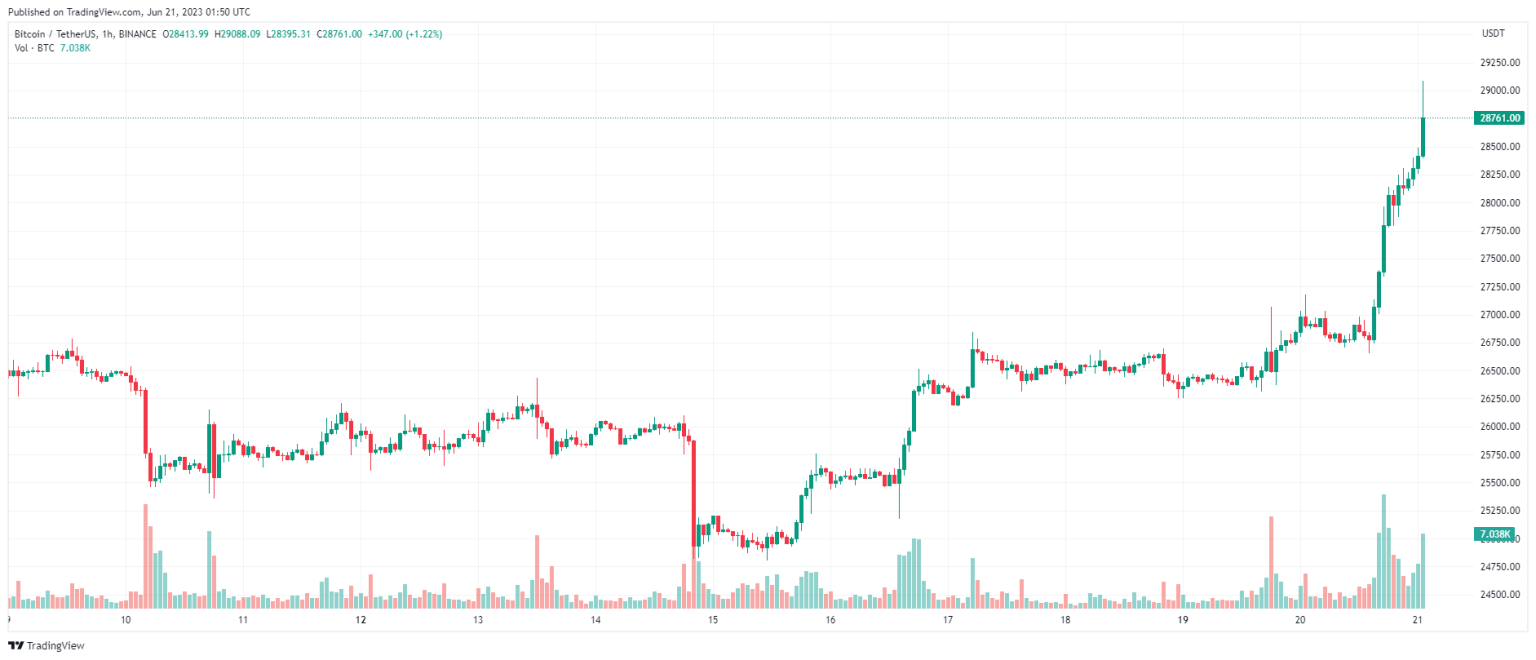
Bitcoin bounced more than 7% on the day, setting a local top at $29,088, its highest since early May.

BTC Price Chart – 1 hour | Source: TradingView

US Stocks

US stocks fell back on June 20 after a strong rally last week.

The Dow Jones Industrial Average fell 245 points, or 0.72%, to 34,053.87, the S&P 500 fell 0.47% to 4,388.71, and the Nasdaq Composite lost 0.16% to 13,667. 29 points.

The number of losers was higher than the number of advancers on the NYSE, with a ratio of 2.2:1 on June 20. Energy was the biggest loser in the S&P 500, with a drop of more than 2%. And Intel, Nike and Boeing dragged down the Dow Jones, with each share falling more than 3%.

Meanwhile, housing stocks outperformed on July 20 after a stronger-than-expected housing report. PulteGroup, DR Horton and Lennar are all up more than 1%. Meanwhile, Nvidia also bucked the trend, bouncing up more than 2%.

Prior to that, US investors had just had a strong week, with the S&P 500 hitting its highest level since April 2022. The S&P 500 and Nasdaq Composite posted their biggest weekly gains since March 2023, with gains of 2.6% and 3.25%, respectively. This is also the 5th consecutive week of gains for the S&P 500.

Meanwhile, gold prices fell on Tuesday (June 21) on strong US housing starts data and a stronger dollar, while investors awaited the US Federal Reserve Chairman's hearing. (Fed), Jerome Powell, at Capitol Hill looking for signals on the interest rate path.

At the end of the session, the spot gold contract fell 0.7 percent to $1,936.98 an ounce, after losing as much as 1% at the beginning of the session. Gold futures contract lost 1.2% to 1,947.7 USD/oz.

Bitcoin and Altcoins

Glassnode explained that Bitcoin investors may still have to wait 8 to 18 months before the market can establish a new ATH.

In the short-term, Bitcoin has shown strong upside momentum as it bounced near 7% on the day, hitting a local top just above the $29,000 region.

According to its latest weekly report, the on-chain analytics firm has been trying to estimate how the BTC cycle might play out. To figure this out, Glassnode identified the different phases of a cycle and compared the times of these phases between each cycle.

The first stage is the “bull market”. Glassnode has chosen the cycle bottom as the starting point for this period and the cycle top as the end point. The second phase will be a “bear market”, which starts at the top and ends at the next bottom.

Finally, there is the “transition” phase, which occurs during the transition period between the new low and high of the cycle. Currently, this is the stage that investors need to pay attention to.

The following chart shows how long each of the above periods has lasted for the last few Bitcoin cycles and what the current cycle looks like.
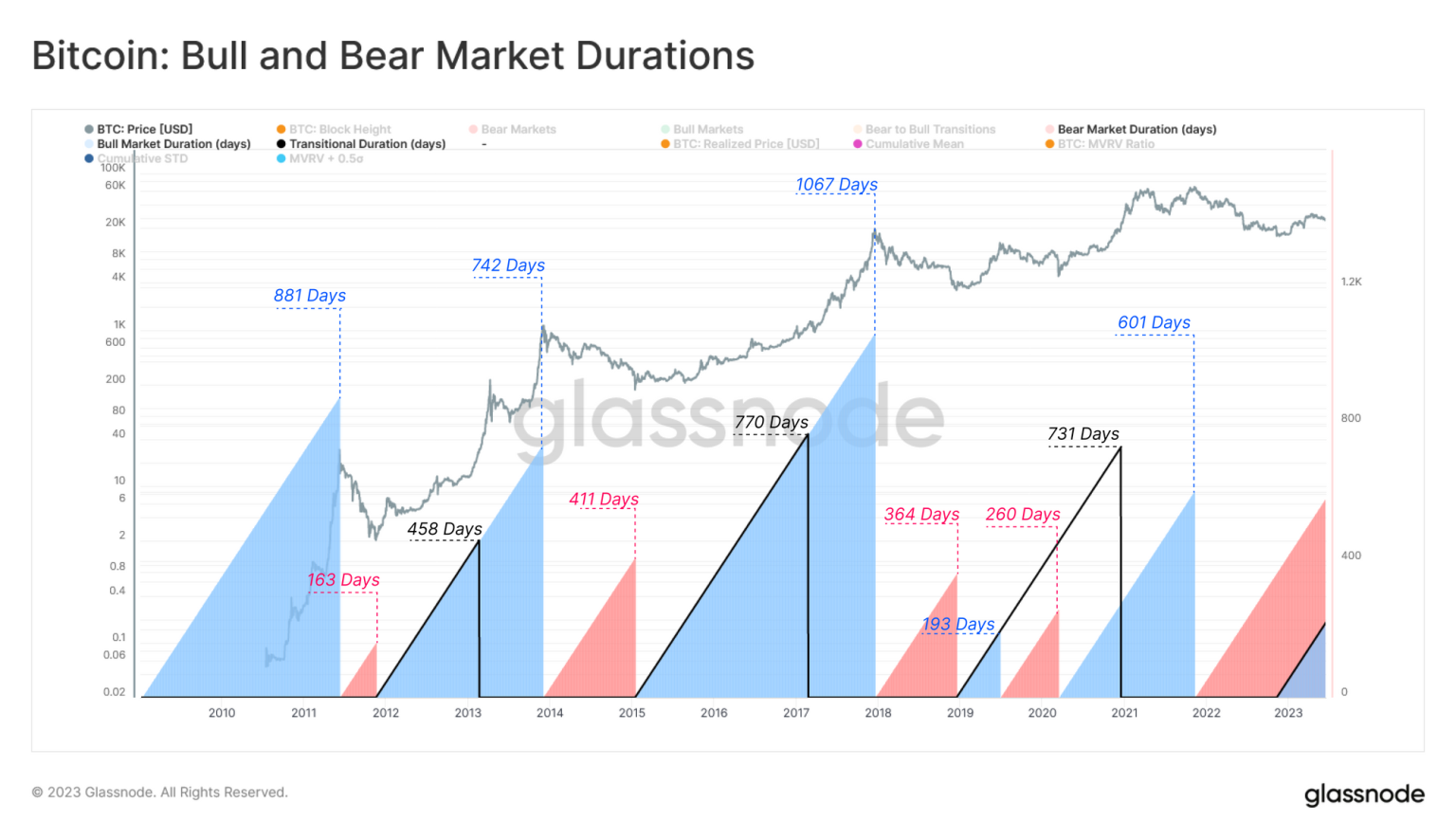
Source: Glassnode

The last three Bitcoin transition periods have different durations, with the first lasting 458 days, while the two more recent ones are 770 and 731 days, respectively.

Naturally, this means, cycles must go through this number of days after a bear market bottom is established before the price can reach a new ATH.

In the current cycle, it is still uncertain what stage the market is in. If counting from the low in November 2022 after the crash caused by the collapse of the FTX exchange, BTC will be in a transition phase at the moment.

So far, the cryptocurrency has spent about 221 days in the transition zone, much lower than the period in which similar periods of previous cycles have taken place.

If these transitions once lasted from 458 days to 770 days, the current market may still have another 8-18 months before the transition period ends and the price establishes a new all-time high.

Of course, this would only happen assuming that the market bottomed out in November 2022. Otherwise, the Bitcoin market will still be in a bearish phase.

The altcoin market bounced sharply in the short-term, as BTC hit the $29,000 mark.

Stacks (STX) is the project that recorded the highest profit in the top 100, when it bounced more than 20% during the day. On the weekly timeframe, this altcoin has bounced up to over 40%.

Followed by Conflux (CFX), Optimism (OP), Flow (FLOW), Injective (INJ), Pepe (PEPE), WOO Network (WOO) with over 10% growth.

Arbitrum (ARB), Kava (KAVA), Hedera (HBAR), Fantom (FTM), Dash (DASH), Synthetix (SNX)… also increased strongly from 6-9%.
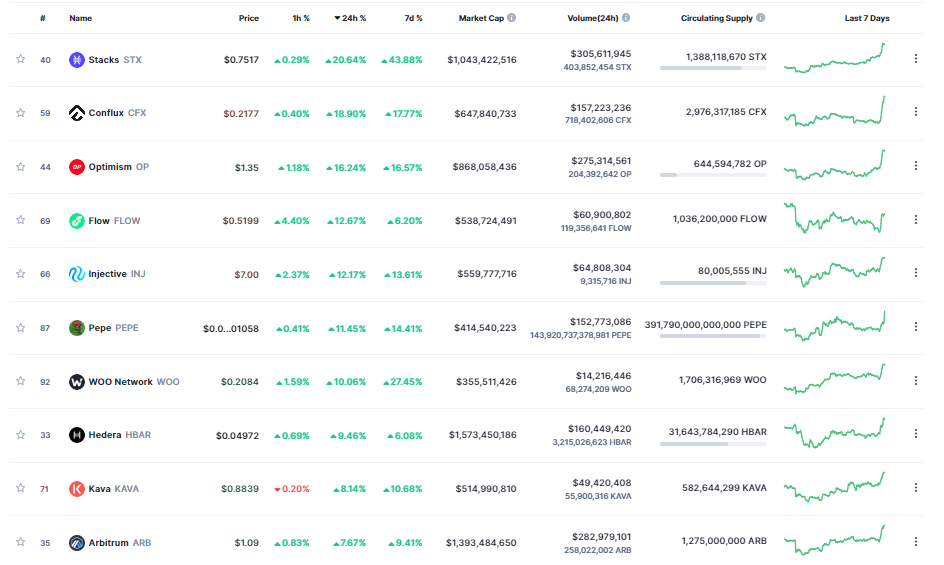
Source: Coinmarketcap

Ethereum (ETH) has also successfully reclaimed the $1,800 area, having established a local top at $1,828 and is currently trading around $1,807, up over 4% over the past 24 hours.
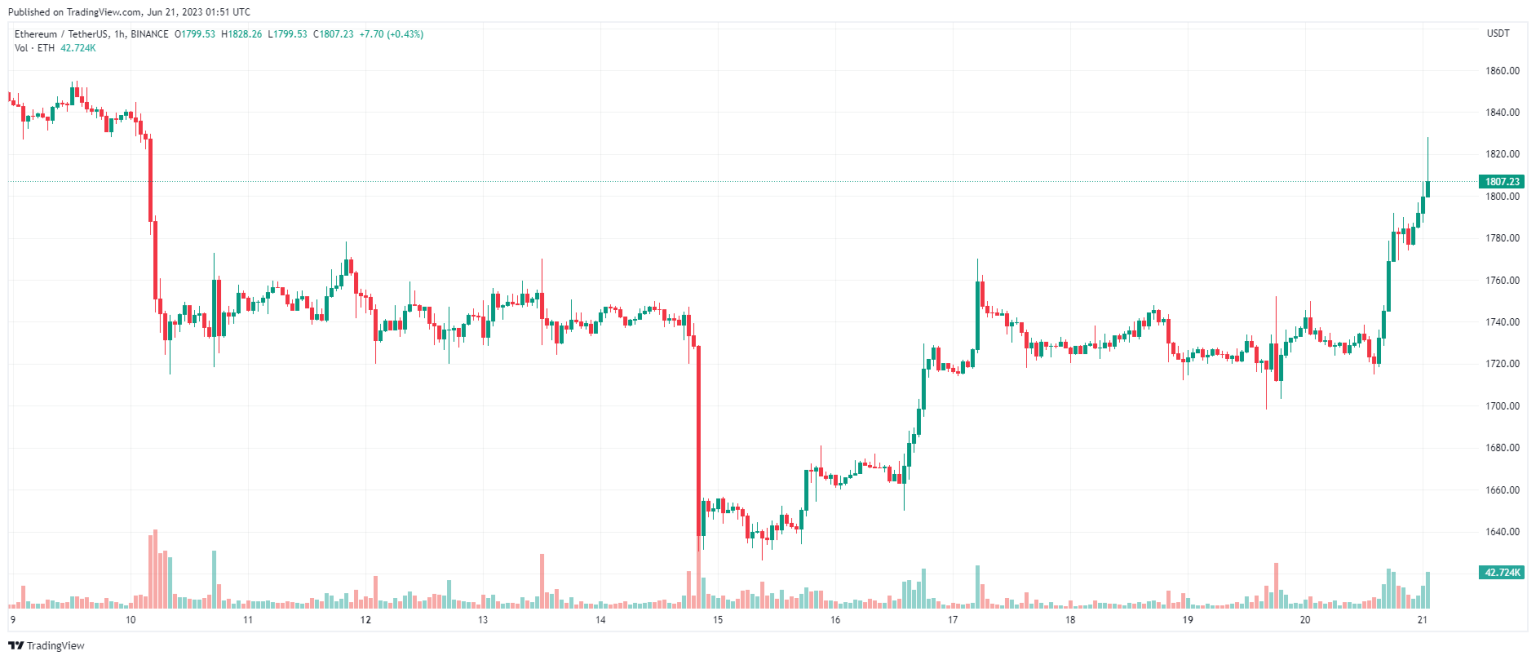
ETH price chart – 1 hour | Source: TradingView

Lecturas Relacionadas

Pronóstico del precio de Monero para 2026-2032: ¿Vale la pena comprar XMR ahora?

## Resumen del artículo sobre el pronóstico del precio de Monero (XMR) para 2026-2032: El artículo presenta un análisis y pronóstico alcista para Monero (XMR), destacando su enfoque en la privacidad y las transacciones descentralizadas como sus principales ventajas. **Conclusiones clave:** * Se proyecta que XMR alcance los **$825.20** para finales de 2026. * Su precio máximo podría llegar a **$1016.93** para finales de 2029. * Para 2032, el pronóstico sugiere un posible aumento hasta los **$1753.23**. **Análisis actual y contexto:** * Al momento de la publicación, XMR cotiza alrededor de $430.66, tras una corrección reciente. * El análisis técnico muestra sentimientos mixtos: el sentimiento general del mercado es alcista, pero indicadores a corto plazo sugieren cierta presión bajista tras no poder superar la resistencia de $450. * Se destaca el lanzamiento de nuevas versiones de software como Cuprate para mejorar el rendimiento de la red. **Perspectiva de inversión:** * Se presenta a Monero como una inversión atractiva a largo plazo debido a su tecnología de privacidad, oferta limitada y adopción creciente. * Sin embargo, se advierte sobre los riesgos regulatorios, la volatilidad del mercado y la competencia como factores que podrían limitar su crecimiento. * El artículo considera posible que XMR alcance los $1000, pero subraya que dependerá de las condiciones del mercado y el entorno regulatorio. **Pronóstico anual resumido (Precio promedio):** * 2026: $655.28 * 2027: $692.10 * 2028: $746.19 * 2029: $847.81 * 2030: $912.51 * 2031: $1046.57 * 2032: $1287.23 El artículo concluye recomendando a los inversores realizar su propia investigación y consultar a expertos antes de tomar decisiones en el volátil mercado de las criptomonedas.

cryptonews.ruHace 26 min(s)

Pronóstico del precio de Monero para 2026-2032: ¿Vale la pena comprar XMR ahora?

cryptonews.ruHace 26 min(s)

Los profesores de las 985 se lanzan en masa a emprender en inteligencia corporal, obteniendo más de 100.000 millones de yuanes en financiación este año

En 2026, el sector de la inteligencia artificial encarnada (IAE) en China ha experimentado una fiebre inversora desbordante, con rondas de financiación de miles de millones. Un fenómeno destacado es la irrupción masiva del "colegio académico": más de 70 empresas tienen profesores entre sus fundadores, y 18 cumplen criterios estrictos, como profesores en activo fundadores o empresas nacidas de laboratorios e institutos de investigación. Solo en los primeros ocho meses de 2026, estas 18 "empresas académicas" han recaudado aproximadamente 130.000 millones de RMB (unos 15.000 millones de euros). Se dividen en dos categorías principales: 1. **Profesores de élite (985) al frente de empresas:** Destacan **Xingdong Jiyuan** (Tsinghua), **Jiasu Jinhua** (Tsinghua), **Yinhe Tongyong** (Pekín), **Yun Shenchu** (Zhejiang), **Qiongche Zhineng** (Shanghai Jiao Tong), **Zhu Ji Dongli** (SUSTech), **Mou Shen Zhineng** (Fudan), **Youai Zhihe** (Xi'an Jiao Tong) y **Leju** (Harbin Tech). Cubren desde robots humanoides hasta algoritmos de "cerebro encarnado" y modelos comerciales ya rentables. 2. **Incubadoras de nuevos institutos de investigación:** Institutos como el AIR de Tsinghua, BIGAI, el Instituto Zhiyuan o la Universidad Westlake están creando empresas como **Qiuzhi Keji**, **Deta Zhineng**, **Xingyuan Zhi** o **Ling Cifang**. Suelen centrarse en nichos tecnológicos avanzados como modelos base, infraestructura de datos o algoritmos de agarre generalizado. **Tendencias clave:** * **Dominio del "sistema Tsinghua":** Tsinghua y sus institutos afines son una fuerza central, impulsando múltiples empresas gracias a un ecosistema completo de transferencia tecnológica. * **Capital universitario directo:** Las universidades y sus fondos invierten directamente, pasando de la mera transferencia de patentes a una participación accionarial profunda. * **Alta "concentración de profesores":** La experiencia de décadas en física, control y materiales de los académicos es crucial para superar las barreras del mundo físico en IAE, a diferencia de la anterior ola de IA centrada en datos. El desafío para estas empresas académicas es adaptar el ritmo académico al comercial, superando obstáculos en producción masiva y cadena de suministro. Este movimiento marca una evolución en la transferencia de conocimiento en China: de publicar artículos a crear empresas con el apoyo explícito y financiero de las universidades.

marsbitHace 58 min(s)

Los profesores de las 985 se lanzan en masa a emprender en inteligencia corporal, obteniendo más de 100.000 millones de yuanes en financiación este año

marsbitHace 58 min(s)

Los logros del Cheburnet: la proporción de internet móvil libre en la Rusia central se redujo al 30,5%

Los avances en el aislado "cheburnet" (Internet ruso) muestran una reducción significativa del acceso móvil libre en Rusia. En julio de 2026, solo el 30,5% de las sesiones móviles en el Distrito Federal Central eran sin restricciones; el resto utilizaba la "lista blanca" del Ministerio de Cifras, que incluye servicios y sitios web nacionales aprobados. El uso de esta lista ha crecido un 31% desde enero. La implementación es desigual: Moscú tiene un 49% de acceso libre, mientras que en regiones fronterizas como Bélgorod o Kursk la cifra cae al 12%. La medida solo afecta a Internet móvil, no a las conexiones fijas domésticas. La tendencia aislacionista se ve reforzada desde el exterior: el centro de certificación GlobalSign comenzó en junio a revocar certificados TLS para empresas rusas, afectando a miles de dominios, en cumplimiento de sanciones internacionales. En respuesta, el gobierno ruso promueve el uso del Centro Nacional de Certificación. Para proteger servicios críticos como atención médica o pagos, el gobierno ha encomendado al primer ministro y al FSB garantizar su funcionamiento durante interrupciones de Internet. Para los usuarios, especialmente en zonas fronterizas, esto significa una creciente dependencia de la lista blanca y los certificados nacionales. Analistas señalan el riesgo de que navegadores extranjeros, como en el caso de Kazajistán en 2019, dejen de confiar en los certificados rusos, lo que forzaría una elección entre software local con acceso completo o aplicaciones extranjeras con acceso limitado.

cryptonews.ruHace 1 hora(s)

Los logros del Cheburnet: la proporción de internet móvil libre en la Rusia central se redujo al 30,5%

cryptonews.ruHace 1 hora(s)

Trading

Spot
活动图片