Bitcoin Stuck In Historically Tight Range, Calm Before The Storm?

newsbtcPublicado a 2023-06-13Actualizado a 2023-06-13

Resumen

Data shows Bitcoin has been stuck in a historically tight range recently, something that could be a precursor for extreme volatility. Bitcoin 30-Day Price Range Has Compressed To Tight Values...

Data shows Bitcoin has been stuck in a historically tight range recently, something that could be a precursor for extreme volatility.
Bitcoin 30-Day Price Range Has Compressed To Tight Values
In a new tweet, the analytics firm Glassnode has looked into how volatile the asset has been recently. One way to quantify the volatility of Bitcoin is by taking the highest and lowest price points over a specific time period and calculating their percentage difference.
The timespan of interest in the context of the current discussion is the 30-day period, meaning that the volatility here is calculated by checking for the difference between the top and bottom registered during the last 30 days.
Naturally, whenever the value of this metric is high, it means that the cryptocurrency’s price has observed large fluctuations in the past month. On the other hand, low values imply that the asset has traded inside a narrow range.
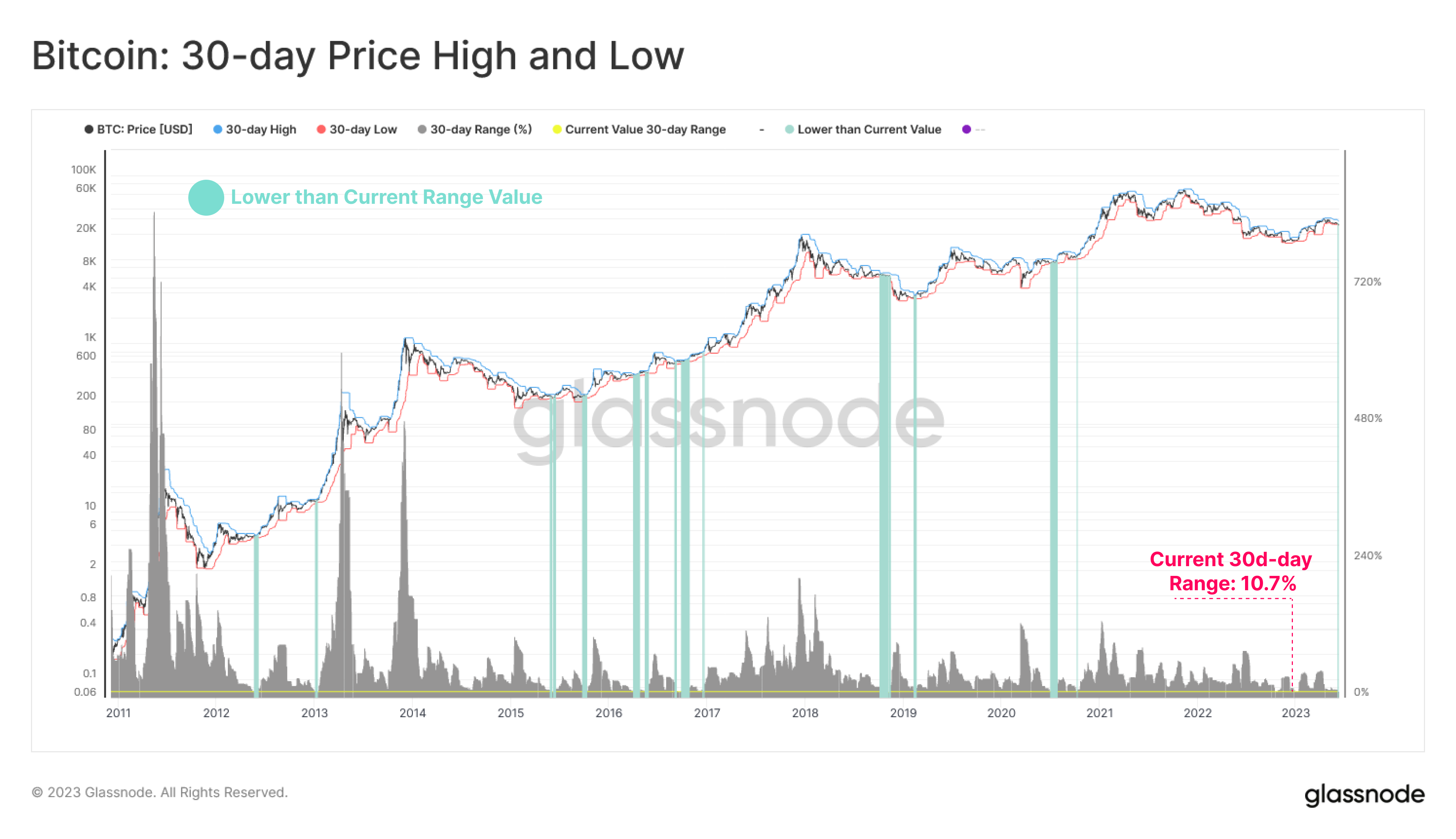
Now, here is a chart that shows the trend in the 30-day high and low, as well as the difference between the two (that is, the 30-day range), for Bitcoin over the entire history of the coin:
Bitcoin Volatility


The value of the metric seems to have been quite low in recent days | Source: Glassnode on Twitter
As displayed in the above graph, the Bitcoin 30-day range has had a value of 10.7% recently, meaning that the cryptocurrency’s price has fluctuated 10.7% between its top and bottom during the past month.
From the graph, it’s clearly visible that the current value of the indicator is very low when compared to the norm during the asset’s history. Interestingly, this is despite the fact that the BTC price has registered some fresh volatility recently due to FUD around Binance and Coinbase coming under regulatory pressure.
While the asset may have seen some short-term volatile price action following the emergence of this uncertainty in the market, Bitcoin has still overall only traded in a narrow range when looking at the grand scheme of things.

In the chart, the analytics firm has also highlighted the trading days that saw an even tighter 30-day range than the one being observed currently. As expected, it looks like there haven’t been that many instances where such a trend has taken place.
Curiously, following most of these occurrences, the Bitcoin price observed a burst of volatility as the narrow 30-day range decompressed. One prominent example of this would be the November 2018 crash, which was preceded by a period of the asset moving endlessly sideways inside a tight range. This crash occurred during the bear market of the previous cycle and lead to the formation of the cyclical bottom for it.
If the pattern followed by all these instances is anything to go by, Bitcoin may currently be approaching a narrow range that would only result in some extreme volatility for the asset in the near term.
At the time of writing, Bitcoin is trading around $25,900, down 3% in the last week.

Bitcoin Price Chart


Looks like BTC has been moving sideways since the plunge | Source: BTCUSD on TradingView
Featured image from iStock.com, charts from TradingView.com, Glassnode.com

Lecturas Relacionadas

Huang Renxun: El Prompt está quedando obsoleto, Loop es el nuevo paradigma

En el mundo de la IA, se está produciendo un cambio de paradigma: el "prompt" (instrucción directa) pierde relevancia frente al "loop" (bucle o ciclo). Según expertos como Jensen Huang (fundador de NVIDIA), Peter, Boris Cherny (creador de Claude Code) y Andrew Ng, la nueva tarea clave no es escribir prompts detallados, sino diseñar y gestionar loops. ¿Qué es un loop? Es un sistema automatizado donde la IA recibe un objetivo general, ejecuta tareas, las verifica automáticamente y, si no cumple los criterios, reintenta de forma independiente hasta completarlo o alcanzar un límite. Esto libera al humano de supervisar cada paso, transformándolo de "instructor" a "diseñador de reglas". Un loop no es lo mismo que un agente de IA: el agente ejecuta, mientras que el loop es el mecanismo que orquesta y automatiza su trabajo continuo sin intervención constante. Productos como Claude Code y OpenAI Codex ya implementan esta idea. Claude Code ofrece funciones como `/goal` (ejecución orientada a objetivos) y `/schedule` (tareas programadas), utilizando modelos separados para generar código (modelo principal) y para validarlo (modelo más pequeño como Haiku), asegurando una verificación objetiva. Codex emplea una "línea de ensamblaje automatizada" con múltiples subagentes que trabajan en paralelo. Boris Cherny describe cómo dirige cientos de pequeños agentes en loops automatizados que manejan desde issues de GitHub hasta fallos en CI, interviniendo solo en casos excepcionales. Para implementar loops efectivos, se recomienda: 1) Evaluar si la tarea es repetitiva, verificable automáticamente, con presupuesto de tokens viable y con herramientas adecuadas. 2) Comenzar con un loop mínimo viable (disparador, habilidad/Skill, archivo de estado STATE.md y compuerta/Gate de verificación). 3) Separar siempre la generación de código de su validación, usando agentes o modelos independientes para evitar sesgos. 4) Evitar errores comunes: establecer condiciones de parada claras (límites de tokens, iteraciones), persistir el estado en archivos, asignar solo tareas con criterios objetivos verificables por máquina (como corrección de Lint) y revisar los cambios (diffs) para mantener la comprensión del código. 5) Medir el éxito por el "costo promedio por modificación aceptada"; una tasa de aceptación inferior al 50% indica ineficiencia. Este enfoque representa la evolución natural en la ingeniería de IA: desde el "Prompt Engineering" (2023-2024, enfocado en redactar instrucciones), pasando por el "Context Engineering" (2024-2025, organizar la información de fondo), luego el "Harness Engineering" (2025-2026, crear entornos de ejecución con herramientas), hasta el actual "Loop Engineering". El nivel de control humano asciende desde frases específicas hacia el diseño de sistemas autónomos. Conceptos académicos como el marco ReAct (Reason+Act, 2022) de Shunyu Yao, que integra razonamiento y acción en un ciclo, sentaron las bases teóricas. A pesar del entusiasmo, expertos como Addy Osmani (Google) advierten sobre la etapa temprana de esta tecnología y los costos de tokens. Andrej Karpathy subraya una reflexión crucial: aunque la IA puede externalizar la ejecución, la comprensión profunda del problema sigue siendo responsabilidad humana. El loop marca un paso hacia una automatización más autónoma, pero su adopción requiere cuidado y criterio.

marsbitHace 1 hora(s)

Huang Renxun: El Prompt está quedando obsoleto, Loop es el nuevo paradigma

marsbitHace 1 hora(s)

Trading

Spot
Futuros
活动图片