June 6 Technical Analysis: SPX, DXY, BTC, ETH, BNB, XRP, ADA, Doge, SOL, Matic

Tap Chi BitcoinPublicado a 2023-06-06Actualizado a 2023-06-06

Resumen

Bitcoin and Altcoin have seen a sharp sell-off following news that the United States Securities and Exchange Commission (SEC) filed a lawsuit against Binance for violating securities rules.

Bitcoin and Altcoin have seen a sharp sell-off following news that the United States Securities and Exchange Commission (SEC) filed a lawsuit against Binance for violating securities rules.

This lawsuit could delay the recovery of Bitcoin (BTC) and most major Altcoin , as traders may want to stay on the sidelines until some clarity emerges. Another upcoming event that could worry investors is the Federal Reserve meeting on June 14.

While the short-term picture is uncertain, Glassnode data shows that the largest pool of Bitcoin whales, possessing at least 10,000 Bitcoins, has accumulated over the past few days. On the other hand, all other major groups are in the distribution phase.

Where are the key support levels that could start a rally on Bitcoin and major Altcoin ? Study the charts to find out.

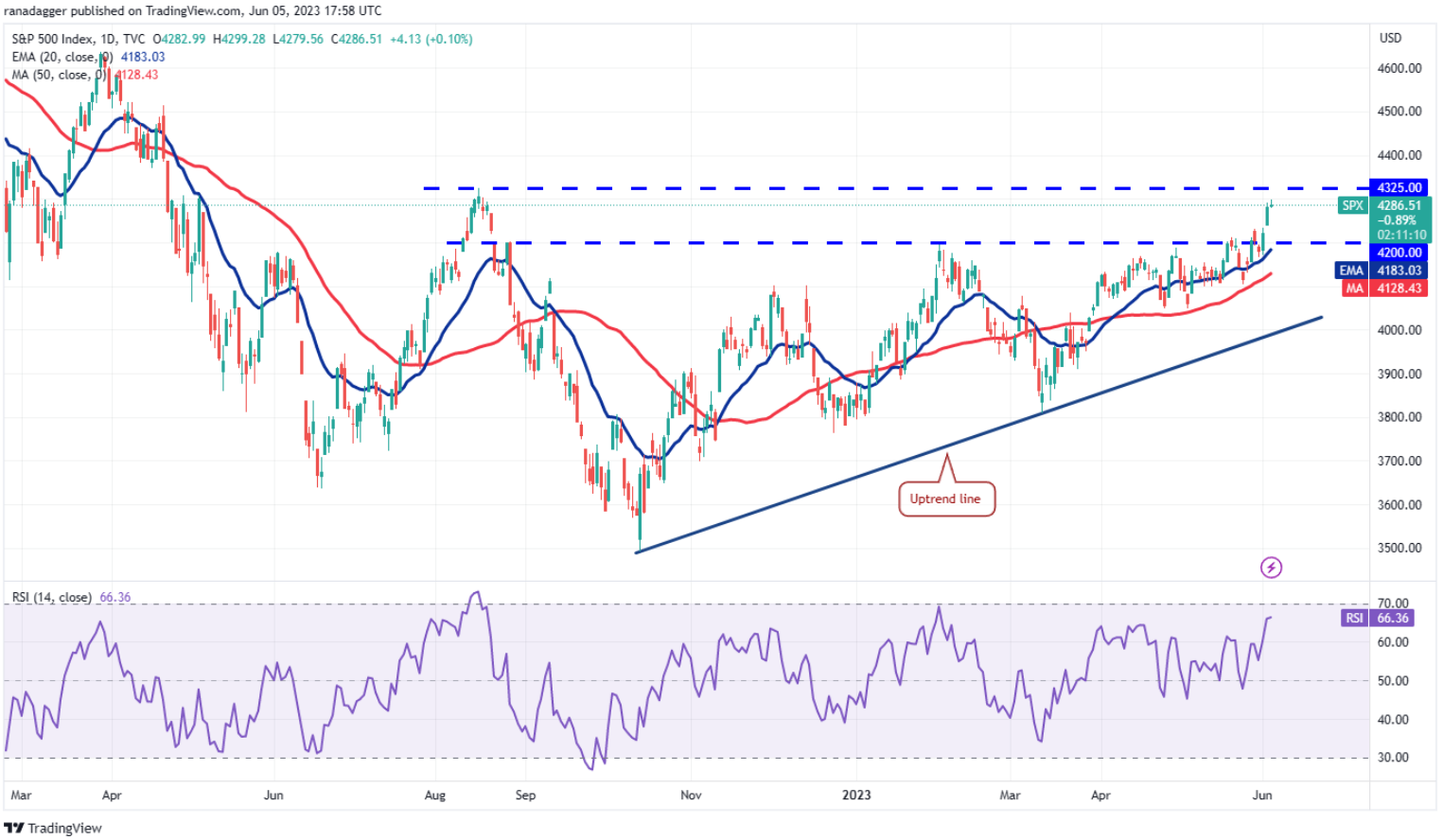
The S&P 500 Index (SPX) broke out and closed above the 4,200 resistance on May 26, completing an ascending triangle pattern.
SPX Daily Chart | Source: TradingView

The bears attempted to trap the aggressive bulls on May 30 and May 31, but the bulls actively bought in as the price dropped to the 20-day exponential moving average (EMA) at 4.183. The uptrend continued on June 1 and the bulls asserted authority on June 2.

There is a minor resistance at 4.325 where the bears will attempt to halt the upside momentum. On the way down, if the bulls fail to allow the price to slide below 4,200, it will raise the prospect of a move to the 4,500-4,600 zone.

Contrary to this assumption, if the price turns down and breaks below the 50-day simple moving average (SMA) at 4.128, it indicates that the recent breakout could be a bull trap. After that, the index might plunge to the uptrend line.

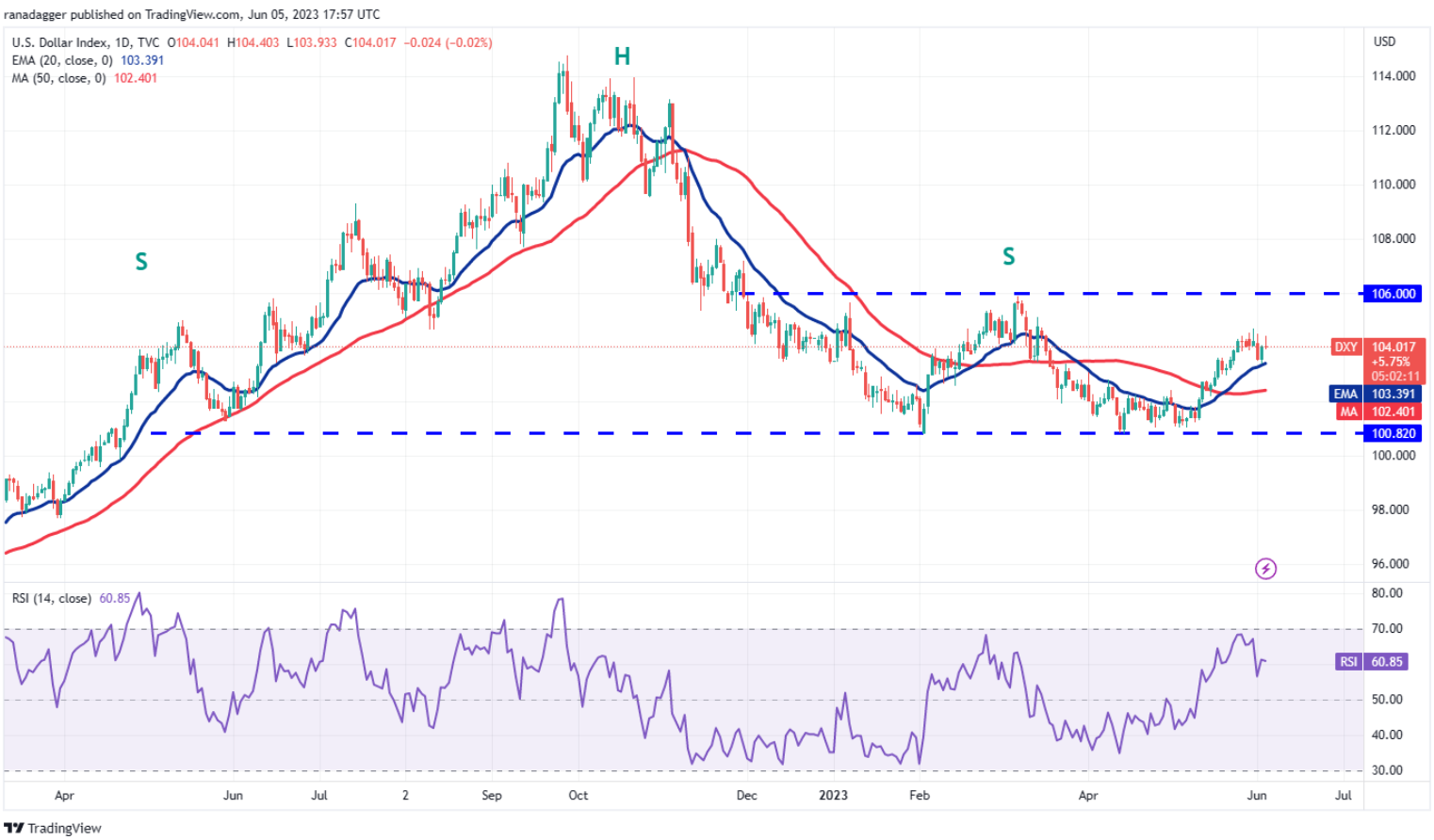
The US Dollar Index (DXY) bounced back from the 20-day EMA (103) on June 2, showing that sentiment has turned positive and the bulls are buying at the lows.
Daily DXY Chart | Source: TradingView

The bulls will attempt to push the price above the nearest resistance at 104.70. If they succeed, the index could reach as high as 106. This is an important level to watch as a break above it could start a new up move.

If the price turns down from 106 and breaks below the 20-day EMA, it shows that the index can extend its stay in the range for a few more days. The bears will have to drag the price below 100.82 to complete a bearish head and shoulders pattern.

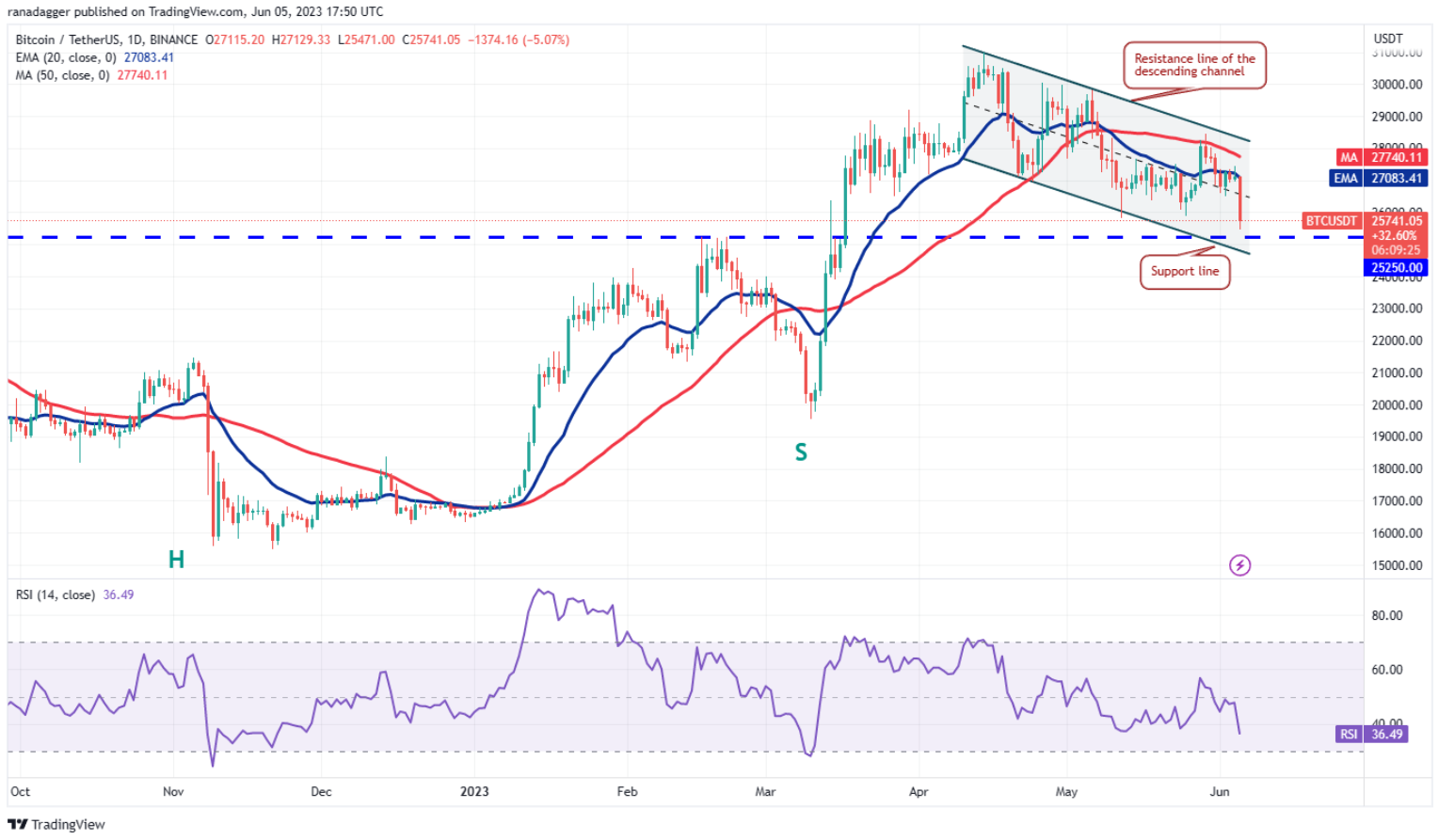
Bitcoin has been trading inside a descending channel pattern for the past few days. The bulls pushed Bitcoin above the 20-day EMA ($27.083) on June 4, but the long wick on the candlestick shows that the bears have sold on the rallies.
BTC/USDT Daily Chart | Source: TradingView

The price declined on June 5 and plummeted below the nearest support at $26,500. The selling momentum increased and the BTC/USDT pair dropped to the critical support area between $25,800 and $25,250.

Buyers are expected to aggressively defend this zone as a break below it could lead to the liquidation of long positions. After that, the pair can drop to $20,000.

The first strength will be a breakout and close above the descending channel. That could indicate the end of the correction period. After that, the pair can spike to $31,000.

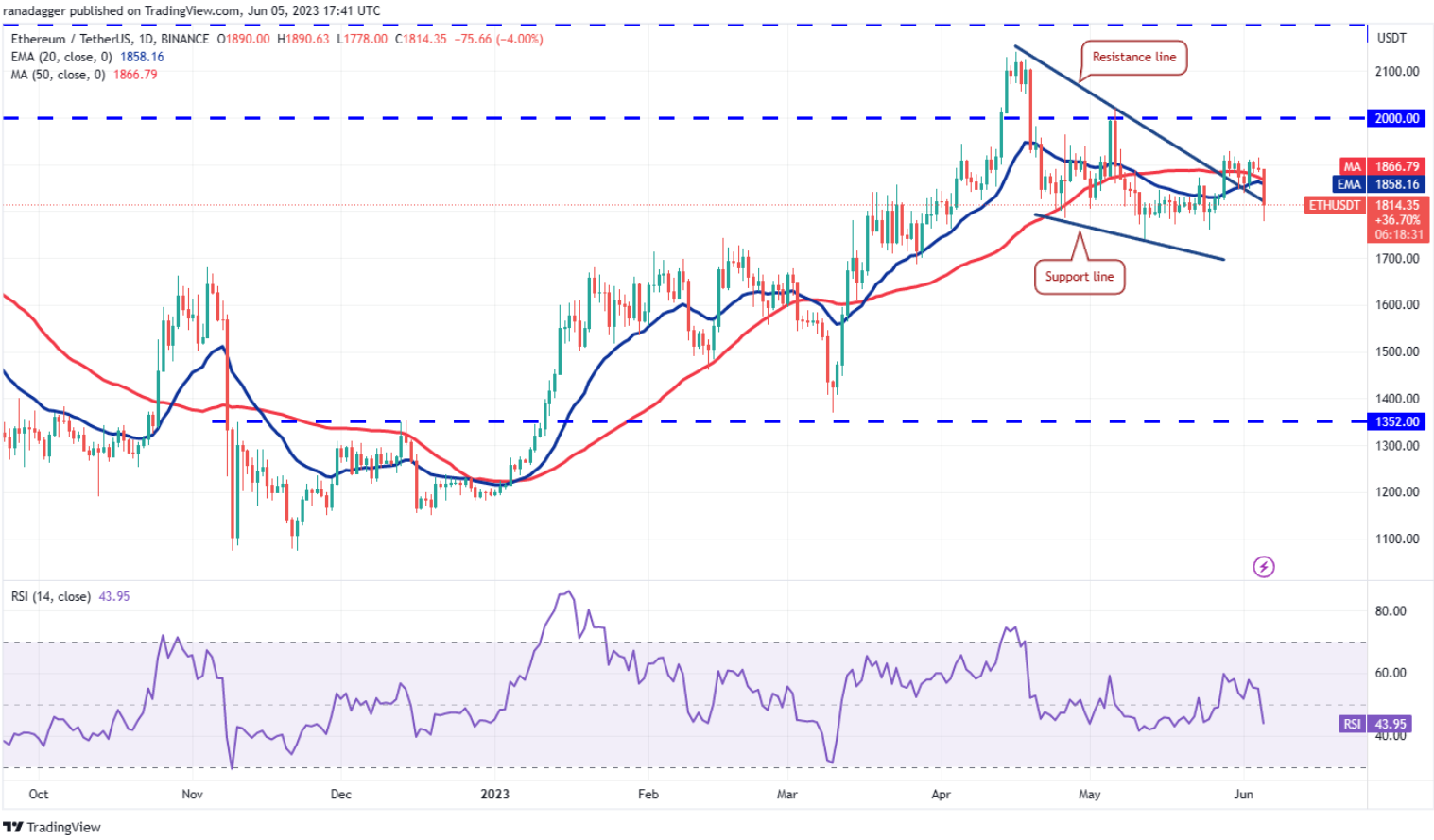
Ether (ETH) broke above a falling wedge on May 28 and confirmed it as support on June 1, but the bulls were unable to initiate a new upward move.
ETH/USDT Daily Chart | Source: TradingView

This has created an opportunity for the bears to turn around. Sellers dragged the price below the moving averages on June 5, which accelerated selling. The ETH/USDT pair has dropped to the resistance line of the wedge pattern. If this level fails to hold, the next stop could be at $1,740 and then the support line.

This negative view will be invalidated in the near term if the price rises and breaks above $1,928. The pair can then rally to $2,000 and finally to $2,200, where the bears can make a strong defense once again.

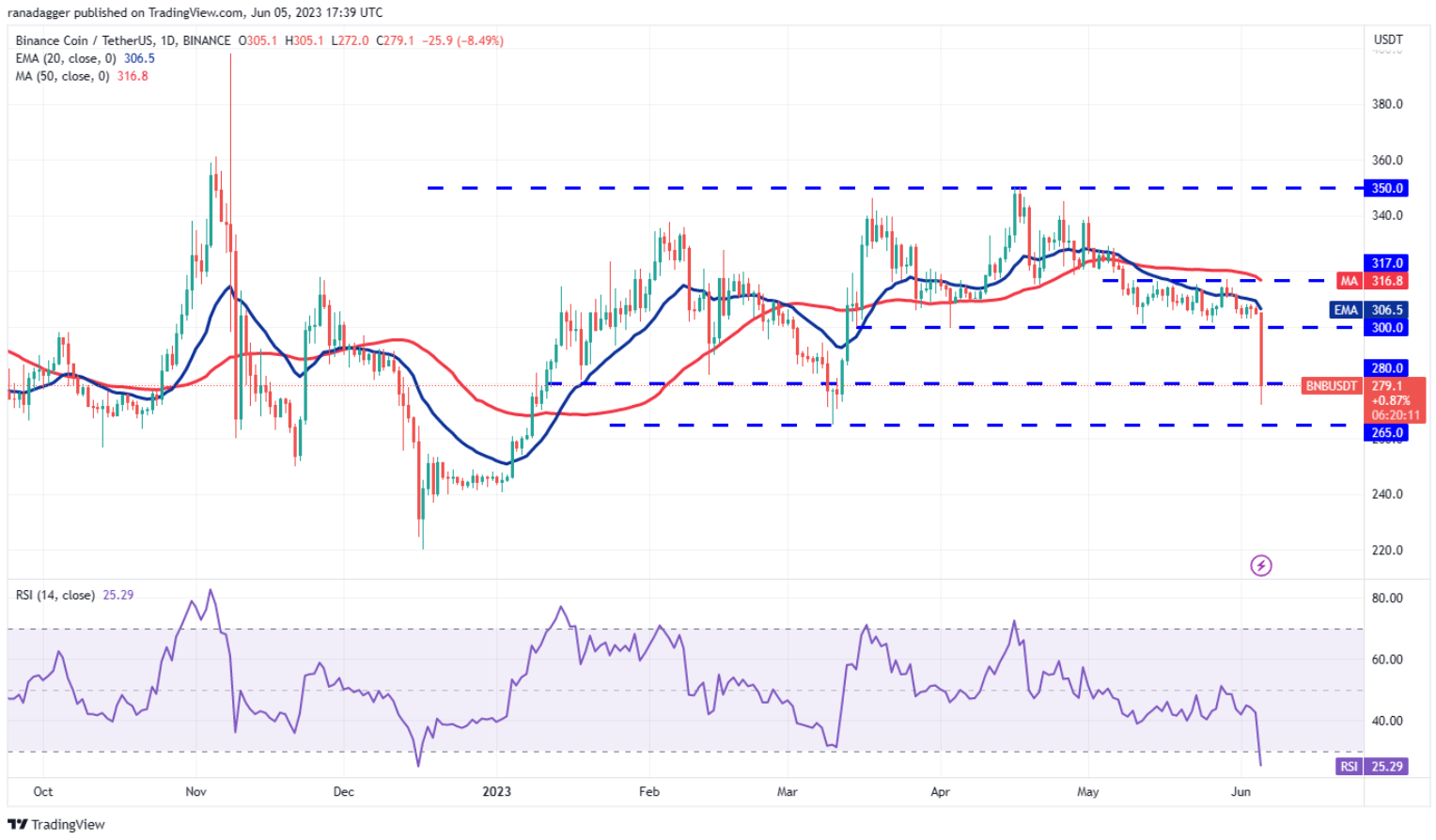
BNB 's (BNB) narrow range trading resolved to the downside on June 5. Strong selling pulled the price below $300 and the next support at $280.
BNB/USDT Daily Chart | Source: TradingView

The BNB/USDT pair can drop to $265, which is an important level to watch. If the price turns up from $265 and rises above $280, it shows strong buying at lower levels. The pair can then rally to the 20-day EMA ($306), where the bulls are likely to encounter strong selling by the bears.

On the downside, a break and close below the $265 support can start a new downtrend. The pair can drop to $240 and then to $220.

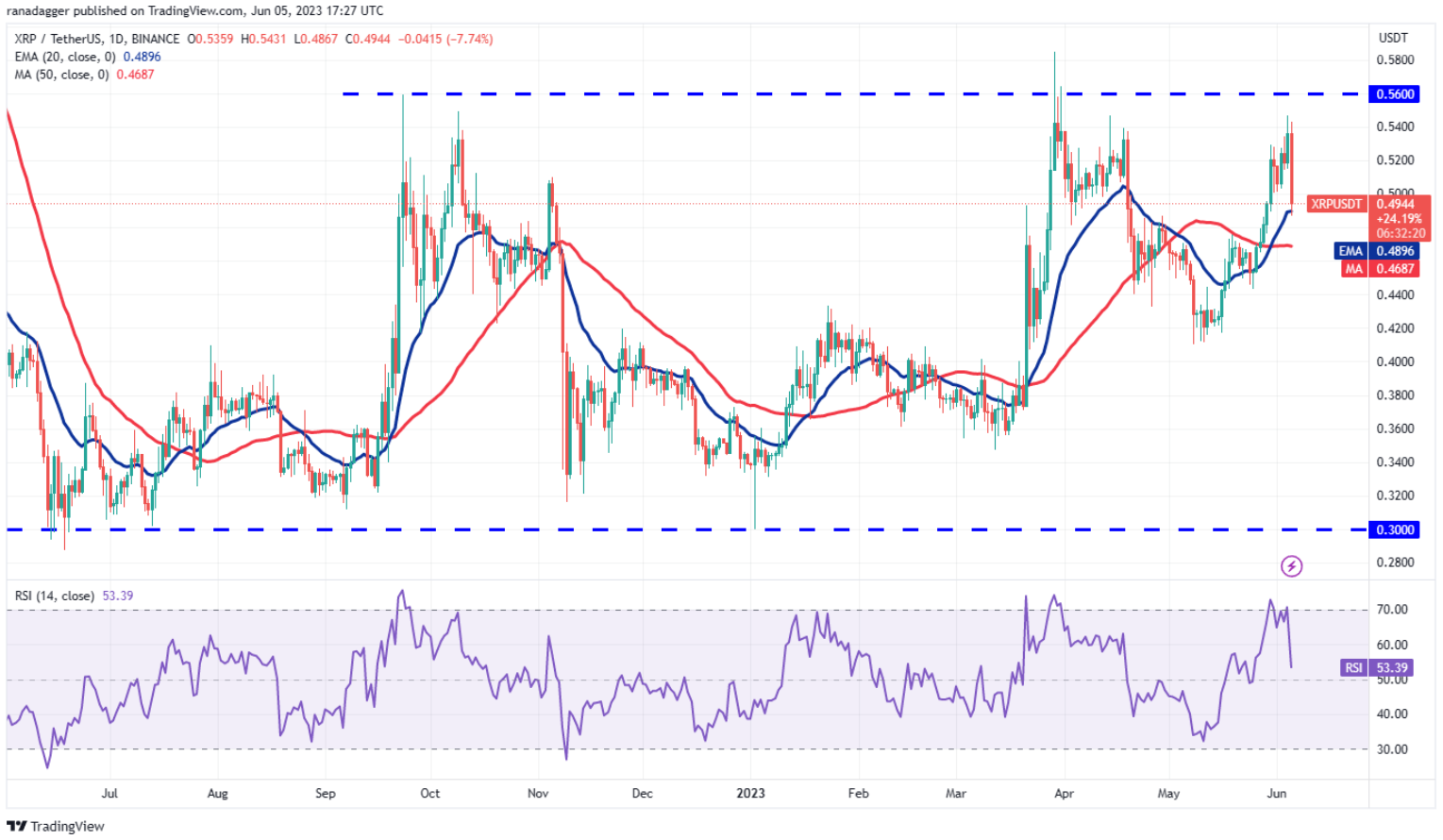
XRP (XRP) has been fluctuating in a large range between $0.56 and $0.30 for the past few months. In general, in such a well-defined range, traders typically buy at support and sell near resistance.
XRP/USDT Daily Chart | Source: TradingView

The XRP/USDT pair was rejected by overhead resistance on June 4, indicating profit-taking by the bulls and the opening of short positions by aggressive bears.

If the price turns up from the 20-day EMA ($0.49), it shows that sentiment has turned positive and traders are buying on a decline. The bulls will then make one more attempt to break through the overhead barrier.

Additionally, if the price drops below the moving averages, it suggests that the pair might remain range-bound for some time.

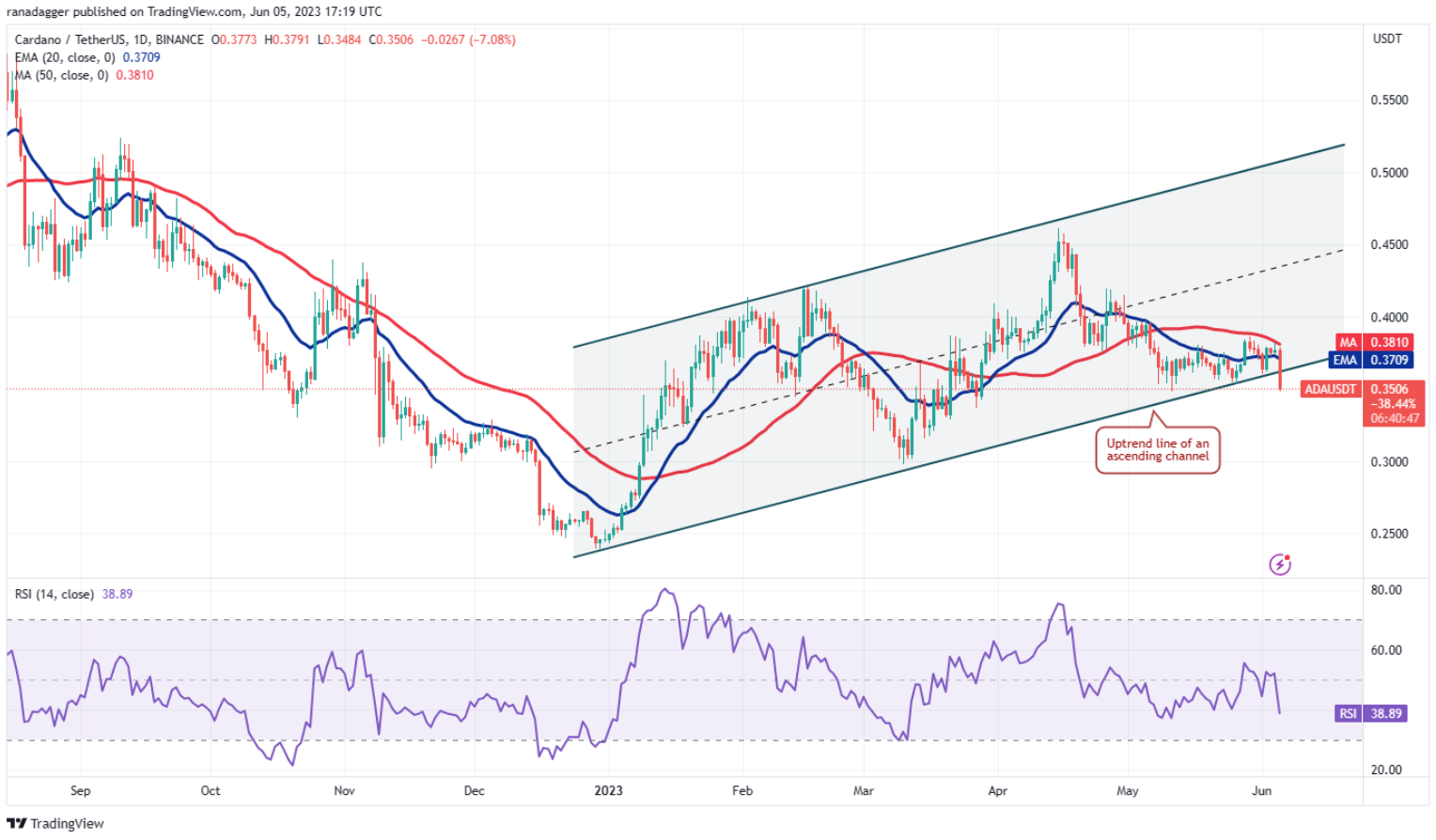
The long wick on the June 4 candle of Cardano (ADA) shows that the bears have successfully blocked a relief rally at the 50-day SMA ($0.38).
Daily ADA/USDT Chart | Source: TradingView

The ADA/USDT pair dropped on June 5 and plummeted below the ascending trendline of the ascending channel pattern. This move invalidated the bullish setup and the pair can drop to the critical support at $0.30.

If the bulls want to stop the downward move, they will have to quickly push the price back to the channel. Such a move would suggest that the pair rejected the lower levels. The upside momentum could pick up on a breakout above $0.39.

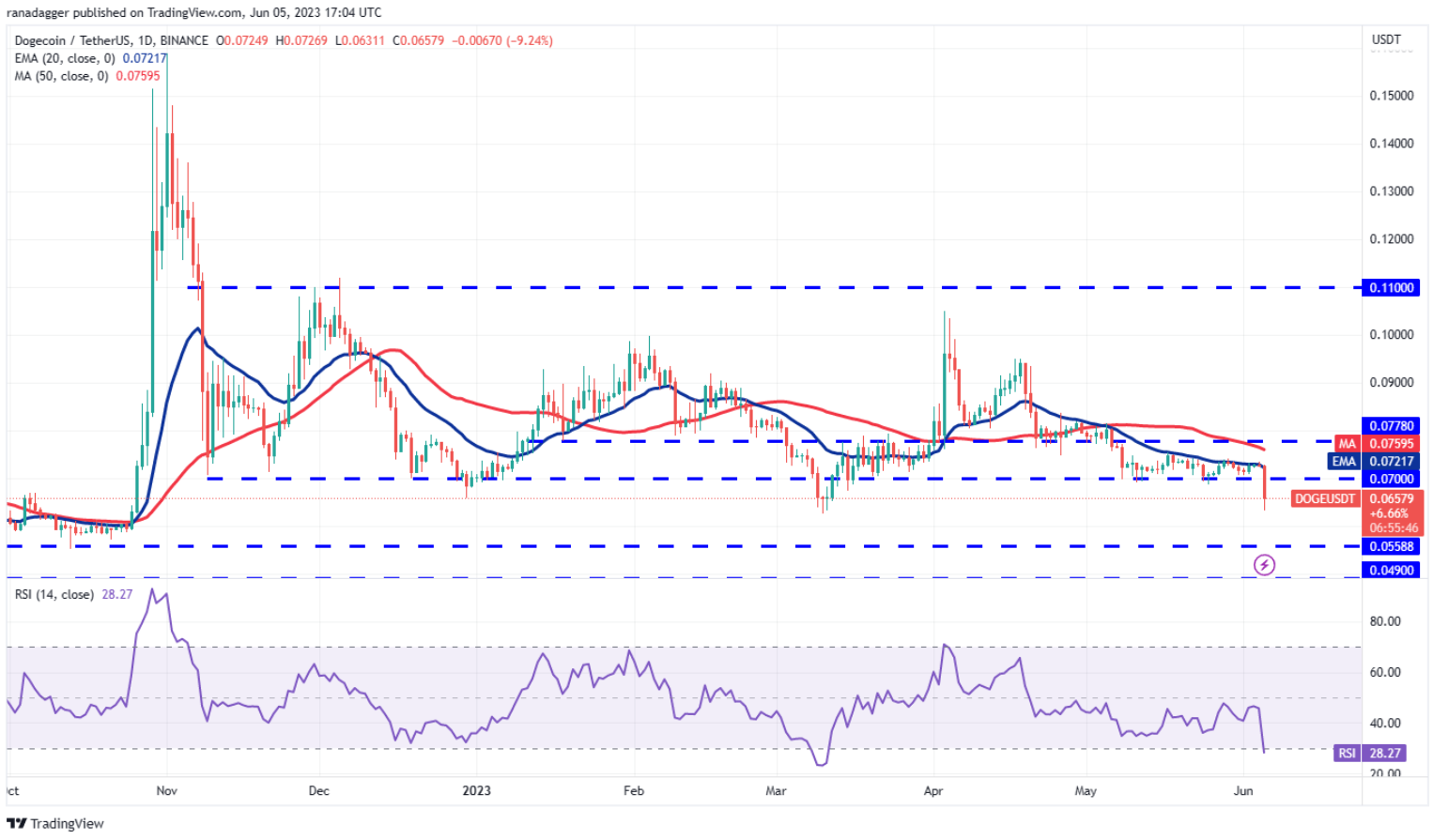
The bulls have repeatedly failed to push Dogecoin (Doge) above the 20-day EMA ($0.07) over the past few days, showing that the bears are fiercely defending this level.
Daily Doge/USDT Chart | Source: TradingView

Selling picked up momentum on June 5 and the bears dragged the price below the nearest support at $0.07. That may have hit a stop loss for some traders, opening the door for a further drop to $0.06. This level could attract strong buying by the bulls.

On the downside, $0.07 can now act as a stiff resistance on the rallies. The bulls will have to push and sustain the price above the breakdown of $0.07 to signal the start of a potential rally.

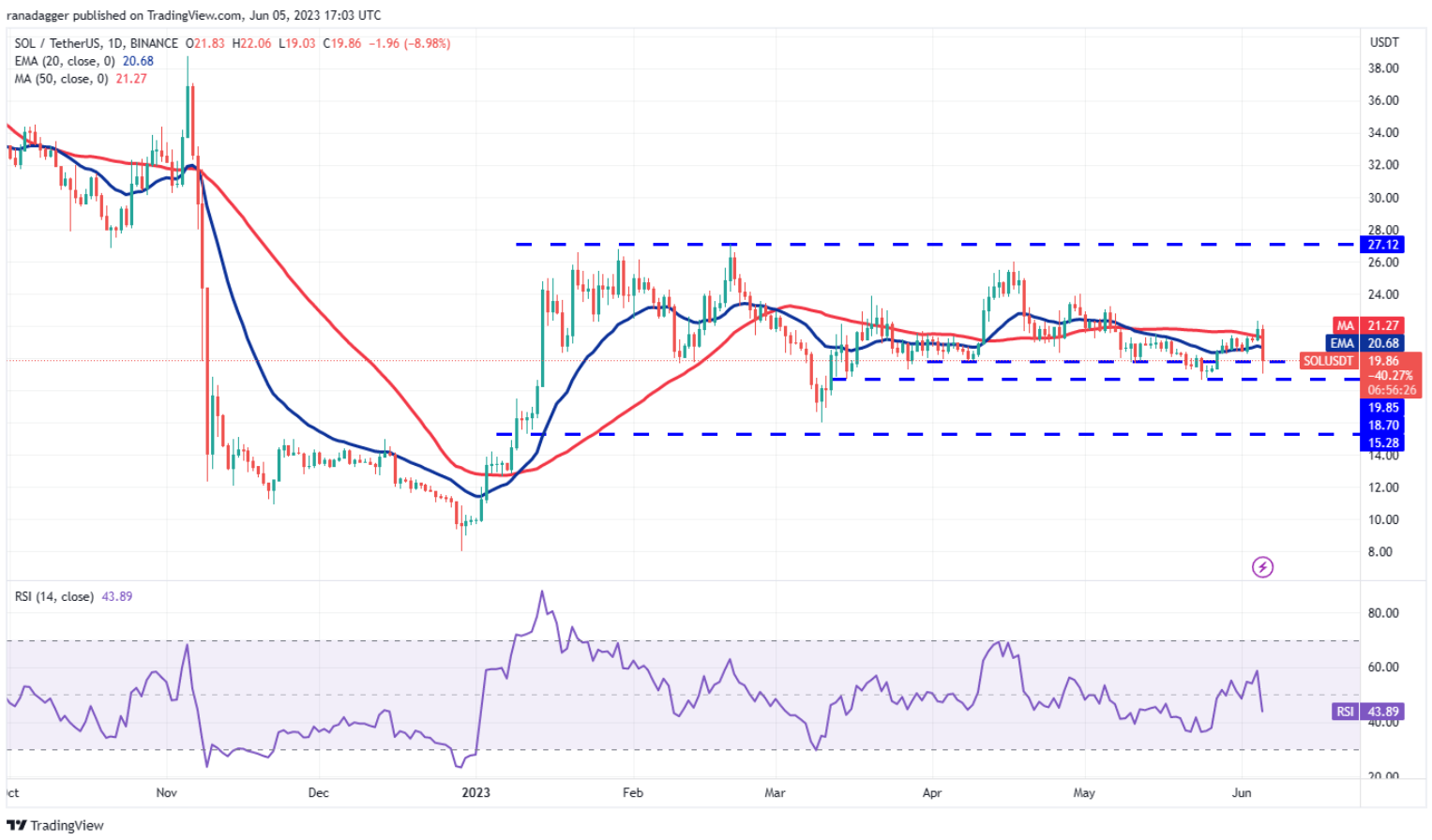
Solana (SOL) broke out above the 50-day SMA ($21.54) on June 4, but the bulls were unable to sustain the positive momentum. This indicates that demand dries up at a higher rate.
Daily SOL/USDT Chart | Source: TradingView

The bears sensed the opportunity and dragged the price below the moving averages. That may have trapped aggressive bulls, leading the price to drop to the strong support at $18.70. This is an important level to watch as a break and close below it opens the possibility of a drop to $15.28.

If the SOL/USDT pair bounces back from $18.70, the bulls will again attempt to break above the overhead barrier at the moving averages. A break and close above $22.30 can tilt the advantage in favor of the bears.

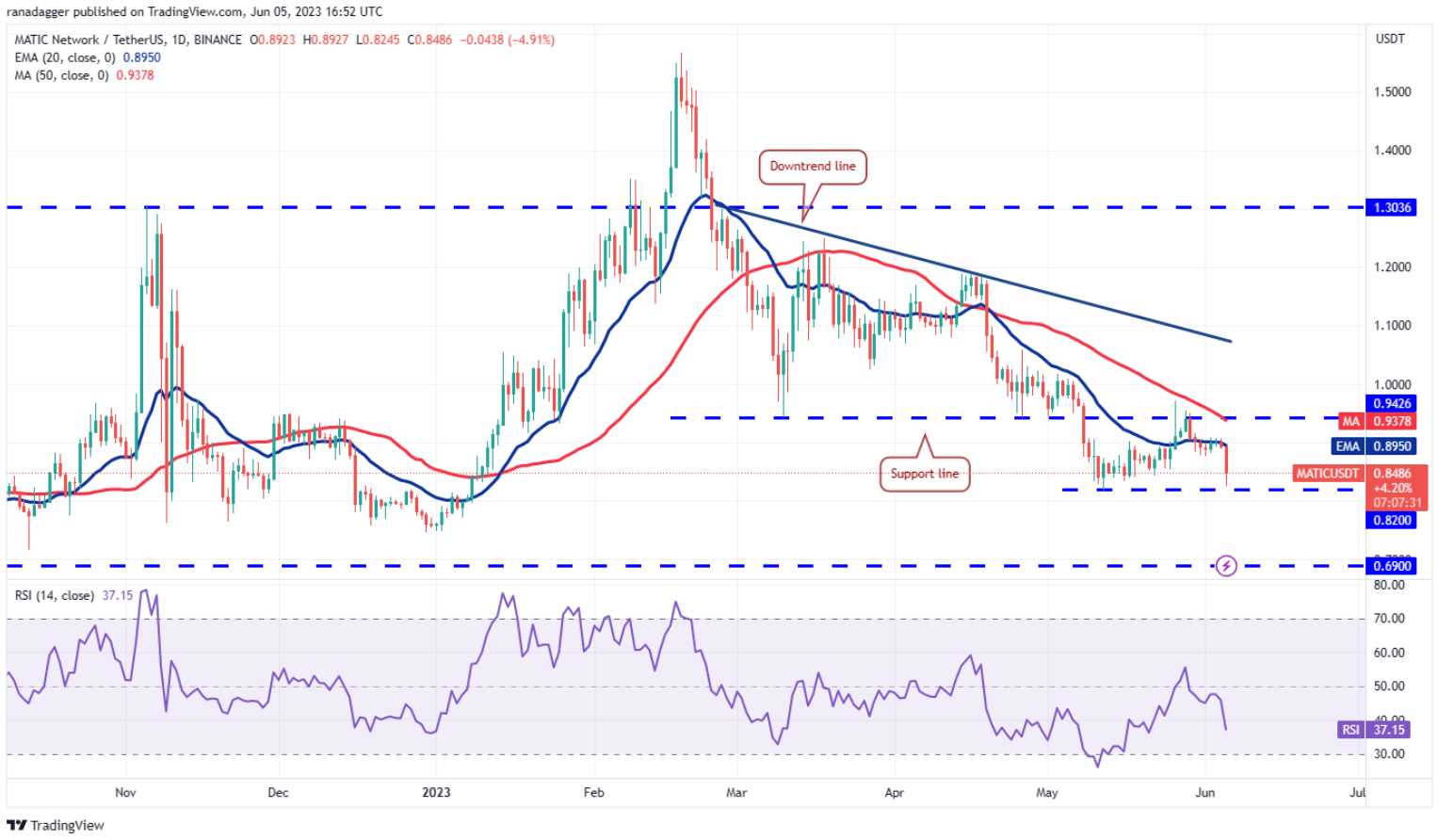
The bulls have been trying to push Polygon (Matic) above the 20-day EMA ($0.89) for the past few days, but the bears hold their ground.
Matic/USDT Daily Chart | Source: TradingView

Selling increased sharply on June 5 and the bears pulled the price towards the critical support at $0.82. Buyers are expected to defend this level aggressively. A strong bounce from this support would suggest that the pair might remain stuck between $0.82 and $0.94 for some time.

Conversely, if the support at $0.82 breaks, the Matic/USDT pair can start to decline to the next major support at $0.69. The bulls will have to push and sustain the price above the moving averages to signal the start of a sustained rally.

You can XEM the coin prices here .

Lecturas Relacionadas

Huang Renxun: El Prompt está quedando obsoleto, Loop es el nuevo paradigma

En el mundo de la IA, se está produciendo un cambio de paradigma: el "prompt" (instrucción directa) pierde relevancia frente al "loop" (bucle o ciclo). Según expertos como Jensen Huang (fundador de NVIDIA), Peter, Boris Cherny (creador de Claude Code) y Andrew Ng, la nueva tarea clave no es escribir prompts detallados, sino diseñar y gestionar loops. ¿Qué es un loop? Es un sistema automatizado donde la IA recibe un objetivo general, ejecuta tareas, las verifica automáticamente y, si no cumple los criterios, reintenta de forma independiente hasta completarlo o alcanzar un límite. Esto libera al humano de supervisar cada paso, transformándolo de "instructor" a "diseñador de reglas". Un loop no es lo mismo que un agente de IA: el agente ejecuta, mientras que el loop es el mecanismo que orquesta y automatiza su trabajo continuo sin intervención constante. Productos como Claude Code y OpenAI Codex ya implementan esta idea. Claude Code ofrece funciones como `/goal` (ejecución orientada a objetivos) y `/schedule` (tareas programadas), utilizando modelos separados para generar código (modelo principal) y para validarlo (modelo más pequeño como Haiku), asegurando una verificación objetiva. Codex emplea una "línea de ensamblaje automatizada" con múltiples subagentes que trabajan en paralelo. Boris Cherny describe cómo dirige cientos de pequeños agentes en loops automatizados que manejan desde issues de GitHub hasta fallos en CI, interviniendo solo en casos excepcionales. Para implementar loops efectivos, se recomienda: 1) Evaluar si la tarea es repetitiva, verificable automáticamente, con presupuesto de tokens viable y con herramientas adecuadas. 2) Comenzar con un loop mínimo viable (disparador, habilidad/Skill, archivo de estado STATE.md y compuerta/Gate de verificación). 3) Separar siempre la generación de código de su validación, usando agentes o modelos independientes para evitar sesgos. 4) Evitar errores comunes: establecer condiciones de parada claras (límites de tokens, iteraciones), persistir el estado en archivos, asignar solo tareas con criterios objetivos verificables por máquina (como corrección de Lint) y revisar los cambios (diffs) para mantener la comprensión del código. 5) Medir el éxito por el "costo promedio por modificación aceptada"; una tasa de aceptación inferior al 50% indica ineficiencia. Este enfoque representa la evolución natural en la ingeniería de IA: desde el "Prompt Engineering" (2023-2024, enfocado en redactar instrucciones), pasando por el "Context Engineering" (2024-2025, organizar la información de fondo), luego el "Harness Engineering" (2025-2026, crear entornos de ejecución con herramientas), hasta el actual "Loop Engineering". El nivel de control humano asciende desde frases específicas hacia el diseño de sistemas autónomos. Conceptos académicos como el marco ReAct (Reason+Act, 2022) de Shunyu Yao, que integra razonamiento y acción en un ciclo, sentaron las bases teóricas. A pesar del entusiasmo, expertos como Addy Osmani (Google) advierten sobre la etapa temprana de esta tecnología y los costos de tokens. Andrej Karpathy subraya una reflexión crucial: aunque la IA puede externalizar la ejecución, la comprensión profunda del problema sigue siendo responsabilidad humana. El loop marca un paso hacia una automatización más autónoma, pero su adopción requiere cuidado y criterio.

marsbitHace 51 min(s)

Huang Renxun: El Prompt está quedando obsoleto, Loop es el nuevo paradigma

marsbitHace 51 min(s)

GPT diseña GPT

OpenAI ha presentado su primer chip, Jalapeño, un cambio estratégico que va más allá de competir con Nvidia. La empresa busca controlar todo el proceso de producción de inteligencia artificial, desde los modelos hasta el hardware, la energía y los centros de datos. La brecha entre modelos líderes se está reduciendo, mientras que la ventaja competitiva se desplaza a capas más profundas: suministro de computación, costes de inferencia y eficiencia de sistemas. Cada token generado implica un costo, y OpenAI, con productos de gran consumo como ChatGPT, necesita reducir esta "tasa de inferencia" para fortalecer su rentabilidad y defensa competitiva a largo plazo. Jalapeño, un chip ASIC optimizado para inferencia de modelos de lenguaje, fue desarrollado en solo nueve meses con Broadcom. Este plazo résubevela la ventaja clave de OpenAI: utiliza su propio conocimiento interno sobre cómo se ejecutan sus modelos masivos en producción para guiar el diseño del hardware. Esencialmente, GPT ayuda a diseñar las máquinas que ejecutarán la próxima generación de GPT, creando un ciclo de retroalimentación potente. El enfoque en la inferencia es crucial porque, a diferencia del entrenamiento (una inversión puntual enorme), la inferencia consume el flujo de caja diario. Al optimizarla, OpenAI reduce costes operativos fundamentales para su escalabilidad comercial, especialmente con futuros agentes de IA que realizarán cadenas largas de razonamiento. Este movimiento refleja una ambición mayor: OpenAI no quiere ser solo un proveedor de modelos, sino construir un ecosistema integrado al estilo de Apple, donde el software, el hardware y la infraestructura se optimizan mutuamente en un ciclo cerrado. A corto plazo depende de Nvidia, pero al trazar su propia hoja de ruta de chips, emerge como un nuevo tipo de actor en la infraestructura de IA. En resumen, OpenAI ya no aspira solo a crear la inteligencia más avanzada, sino a controlar los medios completos de su producción.

marsbitHace 1 hora(s)

GPT diseña GPT

marsbitHace 1 hora(s)

La directora ejecutiva interina de la Fundación Ethereum alza la voz: ¿Cuál es nuestra misión?

El director interino de la Ethereum Foundation (EF), Aerugo, define la misión de la fundación: garantizar que Ethereum sea y siga siendo una infraestructura verdaderamente sin permiso, resistente a la censura, privada y segura, y que permita la coordinación a gran escala respetando la soberanía individual. El artículo detalla en qué **no** se centrará la EF: popularidad, atraer a grandes instituciones financieras o satisfacer a especuladores a corto plazo. Su propósito es **eliminar vulnerabilidades** en capas clave del ecosistema: * **Proceso de transacciones/MEV**: Combatir la extracción dañina de MEV, evitar monopolios en la construcción de bloques y garantizar la ejecución neutral. * **Privacidad**: Es fundamental. Un libro mayor público sin privacidad por defecto se convierte en una plataforma de vigilancia. * **Staking**: Debe ser accesible, privado y diverso para evitar puntos centralizados de control. * **Interfaces de acceso**: Facilitar que los usuarios (individuales e institucionales) interactúen con Ethereum de forma autónoma y resistente a la coerción. La EF también debe **aprovechar oportunidades**, como convertir a Ethereum en: * La primera infraestructura global resistente a ataques cuánticos. * Efectivo digital privado y una plataforma para la coordinación privada. * La base para carteras personales con agentes de IA controlados por el usuario. * Una opción competitiva y sin custodia para casos de uso institucional. Respecto a los cambios internos, el artículo confirma salidas de personal por ajustes estratégicos o de rol, pidiendo respeto y evitando el debate público sobre casos individuales. También anuncia que algunos trabajos se externalizarán en "empresas derivadas" (spin-offs). La EF solo financiará proyectos externos si son cruciales para su misión, evitando apoyar trabajos que se desvíen de sus principios fundamentales. La postura final es clara: La EF no es neutral respecto a la dirección de Ethereum. Su compromiso es con los principios de infraestructura sin permiso y neutral que respete la soberanía, y colaborará con quienes compartan este objetivo.

marsbitHace 1 hora(s)

La directora ejecutiva interina de la Fundación Ethereum alza la voz: ¿Cuál es nuestra misión?

marsbitHace 1 hora(s)

Habla el Director Ejecutivo Interino de la Fundación Ethereum: ¿Cuál es nuestra misión?

La Fundación Ethereum (EF) reafirma su misión fundamental: garantizar que Ethereum siga siendo una infraestructura verdaderamente sin permisos, resistente a la censura, de código abierto, privada y segura, que soporte la coordinación soberana a escala. La EF no existe para buscar popularidad, atraer a especuladores a corto plazo o promover cada aplicación. Su papel es fortalecer las defensas de Ethereum en todas las capas (protocolo, acceso, usuario, instituciones) para prevenir la extracción, el control por parte de cárteles o estados, y las herramientas de vigilancia. Esto implica abordar puntos débiles como el flujo de transacciones (MEV dañino), la privacidad (imprescindible por defecto), el staking (infraestructura de riesgo del protocolo) y las interfaces de acceso (para preservar la autonomía del usuario). La EF también actuará internamente, adoptando ETH y stablecoins nativas para pagos, alineándose con el sistema que busca mejorar. Paralelamente, la EF debe aprovechar oportunidades clave: preparar a Ethereum para ser resistente a la computación cuántica, lograr una pila de protocolo completamente autoverificable y privada, establecer a Ethereum como efectivo digital privado y digno, integrar agentes de IA en carteras personales soberanas, y demostrar que la infraestructura neutral puede manejar la coordinación a escala institucional de manera competitiva. Finalmente, la EF aborda cambios internos y proyectos derivados ("spinoffs"). Algunas salidas de personal son ajustes estratégicos o naturales. Los proyectos que dejan la EF serán evaluados para financiación externa basándose estrictamente en su alineación con la misión central: proteger y expandir la autonomía soberana dentro del ecosistema Ethereum, sin crear dependencias o desviar recursos de las prioridades fundamentales.

链捕手Hace 1 hora(s)

Habla el Director Ejecutivo Interino de la Fundación Ethereum: ¿Cuál es nuestra misión?

链捕手Hace 1 hora(s)

Trading

Spot
Futuros
活动图片