What’s Next For Ethereum Price As It Drops Below $2,000?

newsbtcPublicado a 2023-04-24Actualizado a 2023-04-24

Resumen

The price of Ethereum has fallen below $1,900, dropping from the $2,000 mark that was previously held by bulls. This has led to another sell-off and the bearish influence remains...

The price of Ethereum has fallen below $1,900, dropping from the $2,000 mark that was previously held by bulls. This has led to another sell-off and the bearish influence remains strong despite attempts at recovery.
In the last 24 hours, Ethereum has risen by only 1.2%, but on the weekly chart, the altcoin has seen a significant drop of over 10%. The technical outlook for Ethereum is also in favor of the bears, as demand and accumulation for the altcoin have decreased. In order for Ethereum to make a recovery, it is crucial for it to breach the immediate resistance strength from buyers.
Despite this, most altcoins, including Ethereum, have remained bullish on the higher time-frame structure. However, bulls must defend the following support line or supply zone for Ethereum to start its recovery.

With Bitcoin struggling under the $30,000 price mark, many altcoins are also experiencing difficulty in breaking through their immediate price ceilings. On the one-day chart, the decline in the market capitalization of Ethereum indicates a decrease in buyers.
Ethereum Price Analysis: One-Day Chart
Ethereum

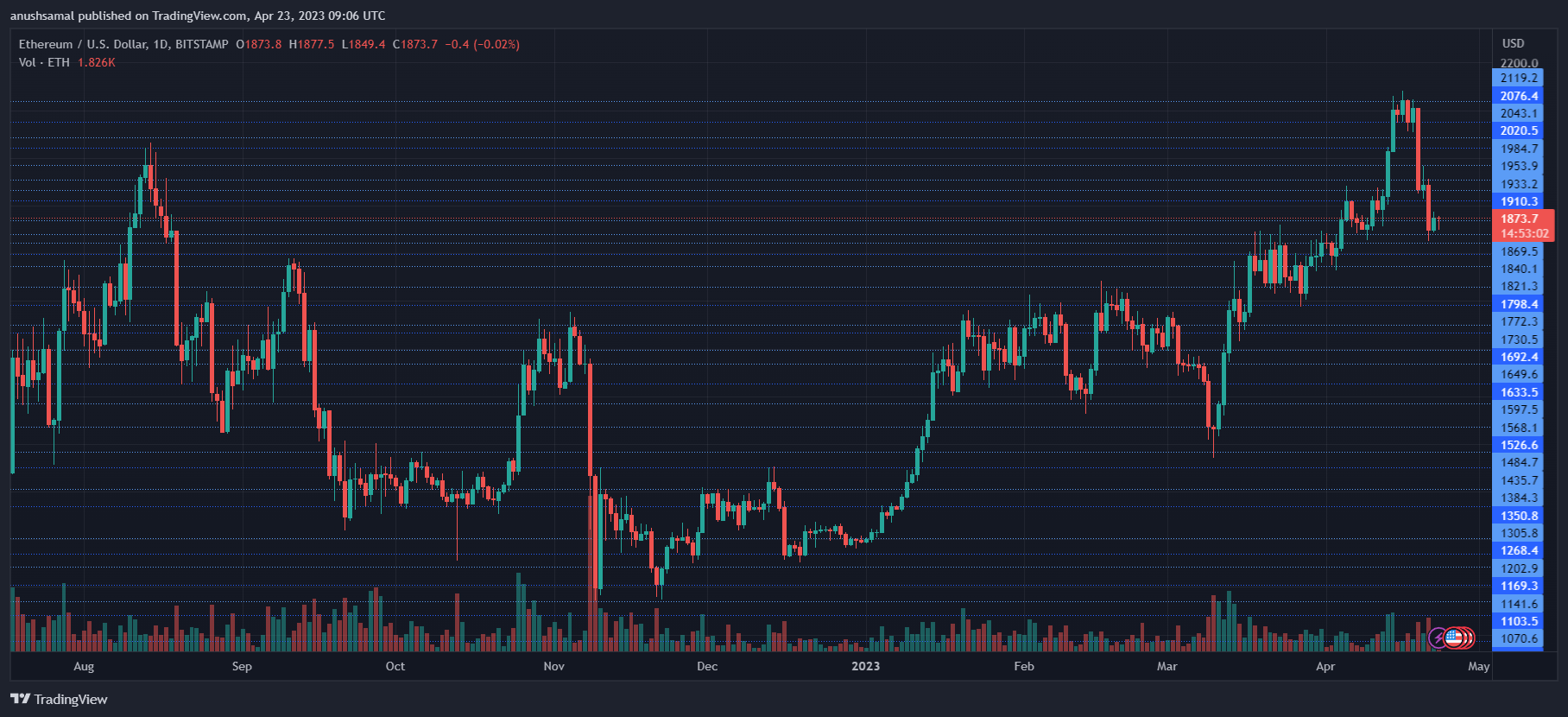
Ethereum was priced at $1,880 on the one-day chart | Source: ETHUSD on TradingView At the time of writing, ETH was valued at $1,880, having fallen below its bearish block ranging from $1,900 to $2,000. This drop in price is likely due to a routine price pullback, as Ethereum had traded above the $2,025 price mark after approximately eight months. However, as selling pressure increased, the bears have taken control.
The immediate overhead resistance for the altcoin is $1,910. A move above this level could potentially push ETH to touch $1,950, which may help to facilitate a price recovery. Conversely, the support levels for ETH are currently at $1,840 and $1,820.

During the previous session, the amount of ETH traded was in the red, indicating an increase in selling pressure.
Technical Analysis
Ethereum

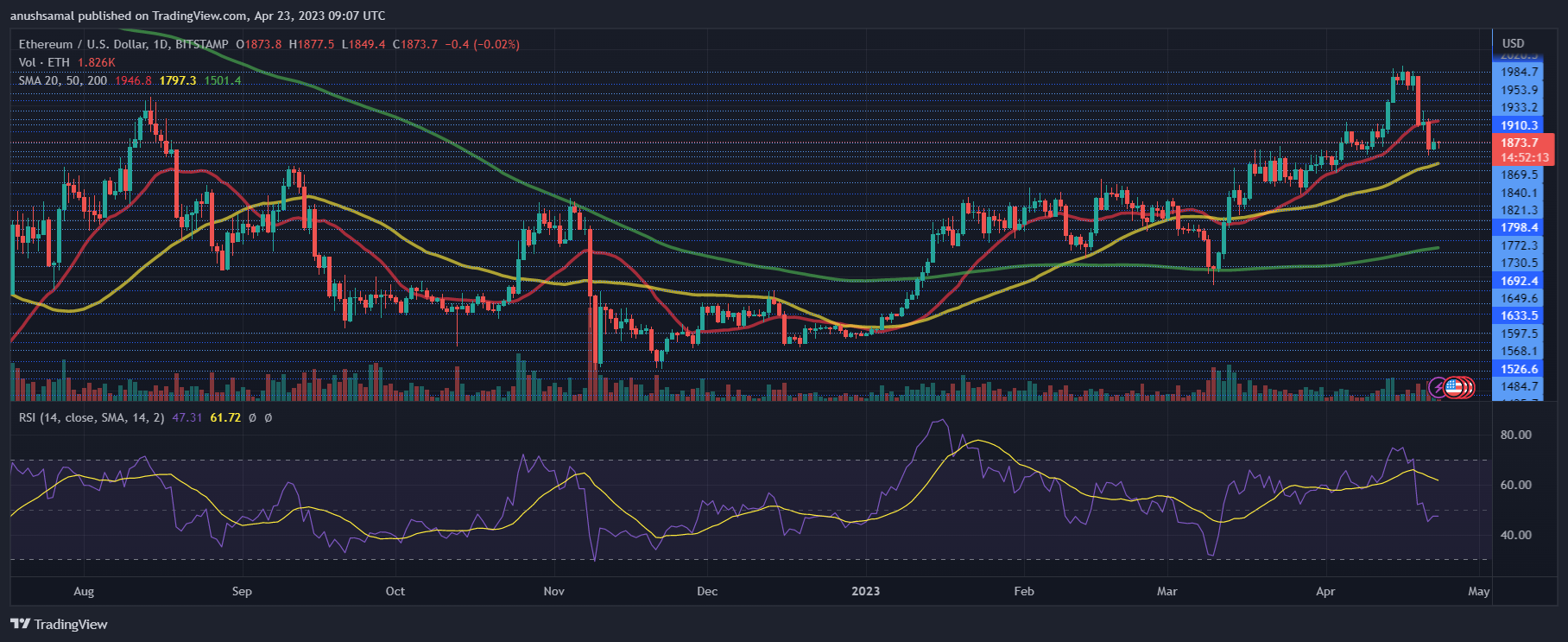
Ethereum registered a fall in buying strength on the one-day chart | Source: ETHUSD on TradingView As demand for ETH decreased, buyers also began to lose confidence in the asset. The Relative Strength Index showed that sellers outnumbered buyers on the one-day chart, as it was positioned just below the 50-mark.
Additionally, ETH dropped below the 20-Simple Moving Average line, indicating that sellers were in control and driving the price momentum in the market. However, with a slight increase in demand, ETH has the potential to trade above the 20-SMA line once again.


Ethereum

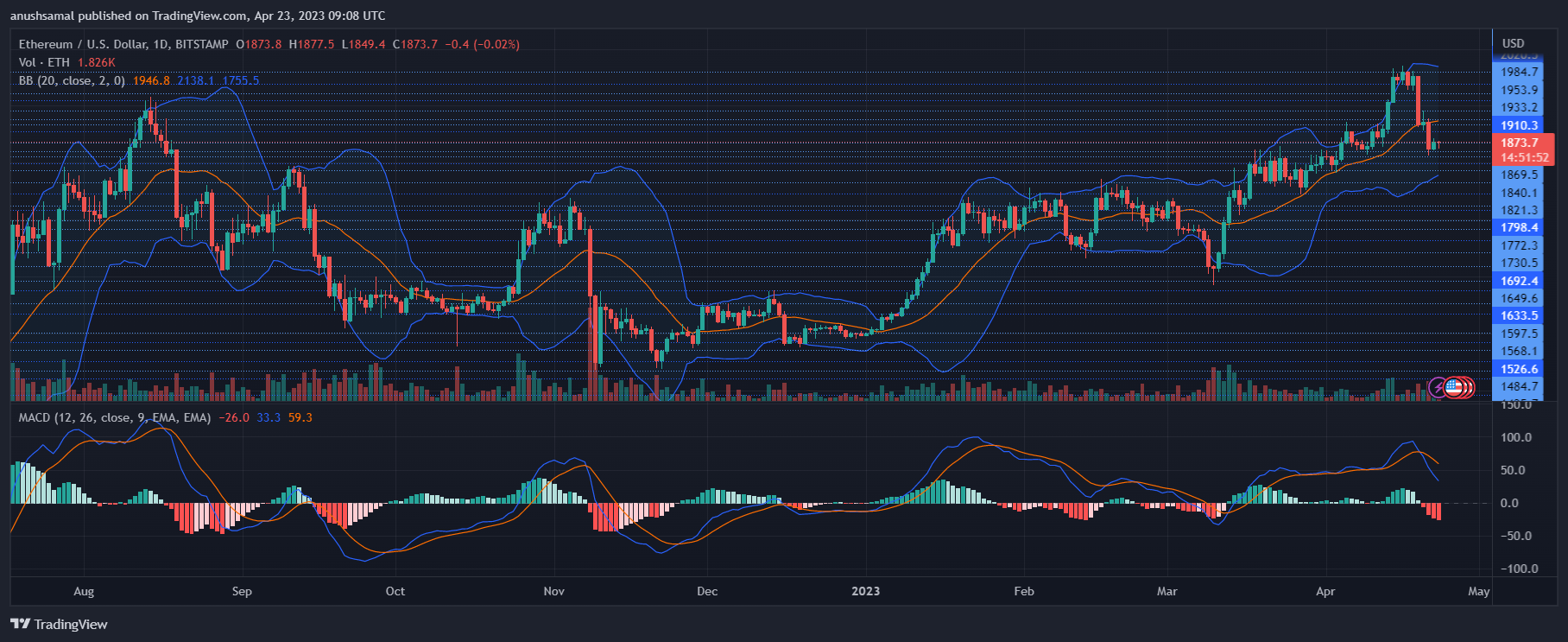
Ethereum started to display sell signals on the one-day chart | Source: ETHUSD on TradingView In line with other technical indicators, ETH began to exhibit sell signals on the one-day chart. The Moving Average Convergence Divergence, which measures price momentum and reversals, formed red histograms. This reading corresponds to sell signals for the altcoin.
Additionally, the Bollinger Bands, which gauge price volatility, were relatively far apart, but they have started to slightly converge. It suggested that ETH may trade within a specific price range over the coming trading sessions.



Lecturas Relacionadas

Las autoridades de una ciudad estadounidense prohibieron la minería de criptomonedas

Las autoridades de la ciudad estadounidense de Whiteville han prohibido la minería de criptomonedas. La prohibición, que entrará en vigor de inmediato, está prevista para durar un año, hasta el 25 de agosto de 2027, o hasta que el consejo municipal apruebe enmiendas a las normas de uso del suelo. Actualmente, la legislación de zonificación de Whiteville no cuenta con reglas específicas para regular los centros de datos y las granjas de minería. Durante la moratoria, las autoridades estudiarán el impacto de la minería en los recursos locales y la "salud pública", según declaró el alcalde Terry Mann. Se evaluará el consumo de agua para la refrigeración de los equipos, el uso de electricidad y la carga en la infraestructura urbana. Los funcionarios temen que la minería no regulada pueda provocar altas emisiones de gases de efecto invernadero, contaminación por generadores diésel, una cantidad excesiva de residuos electrónicos y una fuerte contaminación acústica perjudicial para la salud. Aunque no hay propuestas activas para construir centros de datos en Whiteville, la moratoria se aplica como medida preventiva. En el próximo año, las autoridades también planean aprender de la experiencia de otros municipios de Carolina del Norte en la regulación de instalaciones mineras. Según datos de CoinShares del año pasado, la minería de bitcoin en Estados Unidos se está volviendo menos rentable debido al aumento de los precios de la electricidad, la reducción de la recompensa por bloque a 3,125 BTC y el aumento de la dificultad de la red Bitcoin.

cryptonews.ruHace 54 min(s)

Las autoridades de una ciudad estadounidense prohibieron la minería de criptomonedas

cryptonews.ruHace 54 min(s)

Por qué cambiará el staking de Ethereum en 2026

Para los asesores financieros, el staking de Ethereum ya no es un tema de nicho, sino una herramienta práctica para gestionar ETH. Los grandes inversores utilizan cada vez más esta red, y las recompensas por participar en su mecanismo de Proof-of-Stake (PoS) están ganando relevancia en balances corporativos y estrategias de inversión. El staking implica bloquear ETH para actuar como validador de la red, confirmando transacciones y proponiendo bloques a cambio de recompensas. Se puede hacer de forma independiente (requiere 32 ETH y conocimientos técnicos) o a través de pools, exchanges o protocolos de staking líquido, que ofrecen mayor accesibilidad pero conllevan riesgos de contraparte. La rentabilidad, típicamente entre un 2% y un 5% anual, depende de factores como la cantidad total de ETH apostado y el método elegido. Para las instituciones, estas recompensas se están convirtiendo en una fuente de ingresos significativa, a diferencia de activos como Bitcoin que no generan yield de forma nativa. Se espera que en 2026, con la actualización "Glamsterdam", el staking de ETH adquiera un nuevo significado al mejorar la escalabilidad, resistencia post-cuántica y descentralización de la red, facilitando aún más la participación institucional. Los principales beneficios del staking son el ingreso pasivo y el apoyo a la red. Los riesgos incluyen penalizaciones técnicas, fallos de infraestructura, riesgos regulatorios y de seguridad de las plataformas. Antes de recomendar un producto, los asesores deben evaluar la responsabilidad ante penalizaciones, la solidez de la infraestructura, los modelos de liquidez, la composición de las recompensas y las soluciones de custodia. Temas clave a seguir incluyen la evolución regulatoria sobre la custodia de activos digitales, los avances en protección contra ataques cuánticos y los debates legislativos sobre criptoactivos. El staking de Ethereum está pasando de ser una apuesta especulativa a un componente fundamental de la infraestructura financiera con su propio perfil de riesgo y rentabilidad.

cryptonews.ruHace 56 min(s)

Por qué cambiará el staking de Ethereum en 2026

cryptonews.ruHace 56 min(s)

Trading

Spot
活动图片