VC Roundup: Web3 infrastructure developers attract major investors

CointelegraphPublished on 2022-03-08Last updated on 2022-03-08

Abstract

Venture capital from Pantera, Coinbase Ventures, Alameda Research, ConsenSys and Crypto.com is making its way to Web3 projects.

Venture capital from Pantera, Coinbase Ventures, Alameda Research, ConsenSys and Crypto.com is making its way to Web3 projects.

Despite extreme volatility in the price of crypto assets, venture funds continue to make strategic investments in the industry. In recent weeks, the focus has shifted to infrastructure developers in Web3, play-to-earn and GameFi — nascent industries that still have significant upside ahead.

Cointelegraph’s latest VC Roundup provides a rundown of funding stories that didn’t get front-page coverage but still generated significant interest from the venture capital realm.

Related: VC Roundup: Animoca leads NFT3 raise, Arca launches NFT fund and Alexis Ohanian broadens crypto exposure

Pantera leads $32.9M Subspace Labs funding round

Web3 infrastructure developer Subspace Labs concluded a $32.9 million funding round to advance its ongoing growth initiatives, including integrating with major blockchain networks Ethereum, Polkadot and Kusama. Subspace Labs is the creator of Subspace Network, a so-called fourth-generation blockchain that’s working to expand scalability and computing capacity without sacrificing decentralization. The network has prioritized development in the nonfungible token (NFT), GameFi and metaverse sectors. Venture firm Pantera Capital led the Subspace funding round, with additional participation from Coinbase Ventures, Crypto.com, Alameda Research, ConsenSys and many others.

Related: Cointelegraph Consulting: Exploring the DeFi components in GameFi

Jambo raises $7.5M to develop Africa's crypto economy

Web3 application developer Jambo has raised $7.5 million in seed funding to continue building its so-called “superapp” — a crypto-focused personal finance portal for the African economy. Jambo is being developed to bridge the gap between Africa and the Web3 economy that is being built on the blockchain. Jambo’s “superapp” is described as an all-in-one platform for education, play-to-earn games and personal finance. Some of blockchain’s biggest venture funds participated in the seed round, including Delphi Ventures, Coinbase Ventures, Three Arrows Capital, Alameda Research, Polygon Studios and Yield Guild Games.

Haruko closes $10M funding round

Crypto investment infrastructure provider Haruko has closed a $10 million seed round that was co-led by venture firms Portage Ventures and White Star Capital. Haruko provides technological solutions that allow hedge funds, crypto-native banks and other institutions to trade digital assets in a more familiar setting. The seed round will be used to finance the development of a back-end solution intended to bridge the gap between institutional capital and the crypto industry.

Gamepay earns pre-seed investment

Metaverse company Gamepay has raised $1.2 million in pre-seed capital to expand its presence in the play-to-earn NFT gaming sector. The funding round was led by venture firm Seier Capital, with additional participation from 8i Holdings. Gamepay has created a platform that allows developers to launch their own play-to-earn games using tools that can help them to grow and sustain their own digital communities. The platform is slated to release its own marketplace for NFTs and P2E game projects later this month.


Trending Cryptos

Related Reads

How Will Stablecoins Reshape the Corporate Payments Landscape in 2026?

In 2026, stablecoins are no longer a niche cryptocurrency topic but are being actively explored by enterprises to modernize cross-border payments. Traditional systems, burdened by slow settlement, high costs, and limited transparency, struggle to meet the needs of global digital commerce. Stablecoins, which combine the price stability of fiat currencies with the speed and programmability of blockchain, offer compelling business advantages. These include faster settlement (minutes vs. days), lower transaction costs by reducing intermediaries, greater transparency through immutable records, 24/7 availability, and global accessibility. Key enterprise use cases are emerging: cross-border supplier payments, treasury management, payroll for distributed teams, digital commerce, and B2B transactions. A transformative aspect is programmable payments via smart contracts, enabling automation of processes like subscription billing, escrow, and supply chain payments. Adoption hinges on robust security, compliance (AML/KYC), and regulatory clarity. Future trends like asset tokenization, embedded finance, and AI-driven financial systems are expected to accelerate integration. In conclusion, stablecoins are evolving from an alternative technology into foundational infrastructure for next-generation enterprise payments, offering efficiency, cost savings, and new capabilities for a connected global economy.

marsbit10m ago

How Will Stablecoins Reshape the Corporate Payments Landscape in 2026?

marsbit10m ago

In-depth Analysis of Trade[XYZ]: How Were 92 Markets and 98% of HIP-3 Trading Volume Established?

**Deep Dive into Trade[XYZ]: How It Built 92 Markets and 98% of HIP-3 Volume** This analysis explores Trade[XYZ], a deployment on Hyperliquid's HIP-3 framework, which now accounts for 98% of its transaction volume. It argues that Trade[XYZ] is not a threat to Hyperliquid but a validation of its strategy: providing open infrastructure for specialized teams to build deep liquidity markets. The report details the significant difficulty of building institutional-grade perpetual markets for real-world assets (stocks, indices, commodities). Trade[XYZ] succeeded by rapidly launching markets (median 3.3 days), attracting deep-making market makers, and implementing sophisticated risk mechanisms (like "Discovery Bounds") to maintain liquidity even when traditional hedges are unavailable (e.g., overnight, pre-IPO). Key findings include: * **User Acquisition:** ~97% of Trade[XYZ] volume trades through Hyperliquid's own front-end, bringing over 300,000 new wallets to the protocol. * **Fee Sharing:** Protocol fees are split 50/50 between Hyperliquid (for HYPE buybacks) and the deployer. The "Growth Mode" (low fees for RWA) is a strategy to build market share before potential monetization at standard rates, as evidenced by the GOLD market. * **Market Quality:** Trade[XYZ] has achieved tight spreads and significant open interest, led by commodities and indices. Its ongoing operational management of 92 markets is a full-time business. * **Strategic Fit:** Building these markets internally would expose Hyperliquid to regulatory risk and divert focus from its core infrastructure mission. HIP-3 allows expert deployers like Trade[XYZ] to handle complex operations while Hyperliquid benefits from network effects, fees, and users. The conclusion is that Trade[XYZ]'s dominance demonstrates the success of Hyperliquid's horizontal model: attracting the best operators to build winning verticals on its neutral, high-performance base layer.

marsbit19m ago

In-depth Analysis of Trade[XYZ]: How Were 92 Markets and 98% of HIP-3 Trading Volume Established?

marsbit19m ago

Aleo's First APAC Community Event to Land in Shanghai, Collaborating with OpenBuild to Build a Privacy Computing Developer Ecosystem

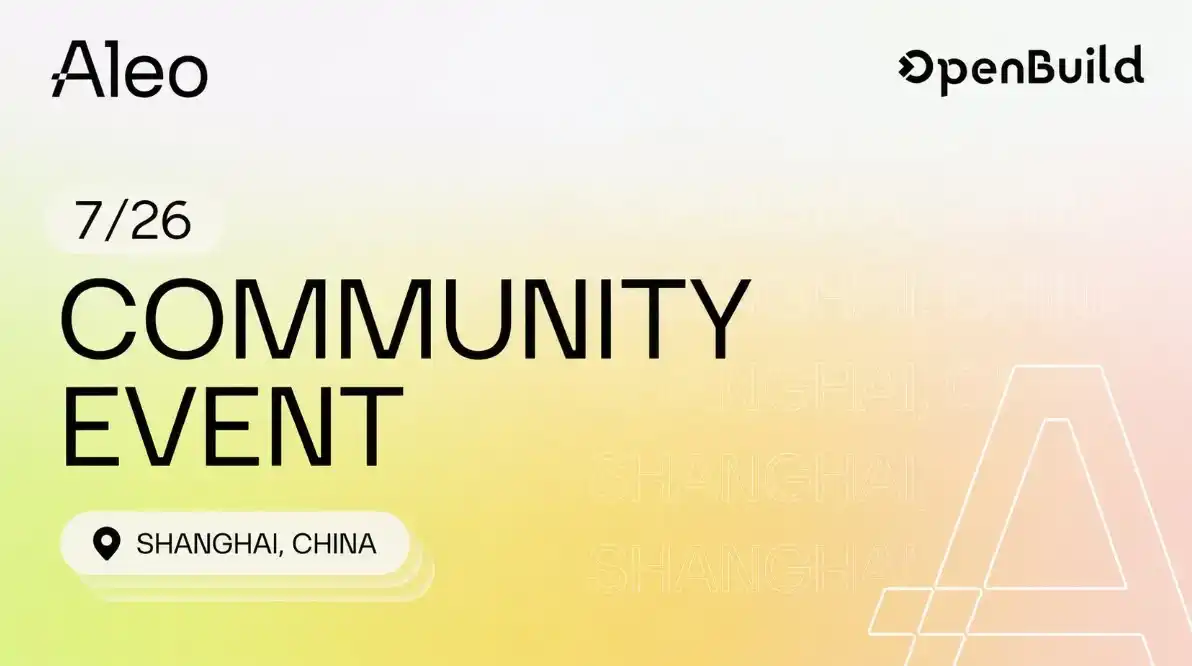
Aleo, in collaboration with the open-source developer community OpenBuild, will host its first Asia-Pacific (APAC) community event, "Aleo Shanghai Community Event," on July 26, 2026, in Shanghai. This event marks a key step in Aleo's APAC ecosystem expansion and aims to bring together developers, entrepreneurs, Web3 professionals, and AI enthusiasts to explore the trends in Zero-Knowledge (ZK) proofs, programmable privacy technology, and the innovative opportunities arising from the convergence of AI and privacy computing. Differing from traditional tech talks, the event emphasizes hands-on developer participation. Attendees will have the opportunity to experience Aleo's privacy infrastructure firsthand, engage in real on-chain interactions, and provide direct feedback to the Aleo team. The agenda will feature the official launch of Aleo's APAC Hackathon program, including details on competition mechanics, prizes, mentorship, and team formation. A core focus will be the theme "AI × Programmable Privacy," examining how privacy computing can serve as critical infrastructure for the next generation of the internet, particularly with the rise of AI Agents. A panel discussion titled "Do Agents Need Privacy by Default?" will delve into data security, identity privacy, and trusted interactions for AI Agents in future commercial applications. The event will also include product demonstrations, community networking, and free discussion sessions, designed to foster connections among local developers and advance the regional developer community. **Event Details:** * **Name:** Aleo Shanghai Community Event * **Date:** July 26, 2026 (Sunday), 13:30–18:00 * **Location:** Shengbang International Plaza, Shanghai * **Organizers:** Aleo × OpenBuild **About Aleo:** Aleo is a Layer-1 blockchain enabling programmable privacy, allowing developers to build decentralized applications that combine privacy with on-chain verifiability. It is backed by investors including a16z, Haun Ventures, Samsung Next, and SoftBank. **About OpenBuild:** OpenBuild is an open-source collaborative community for developers, focused on frontier technologies like Web3 and AI, supporting builders through the entire journey from idea to product realization.

marsbit47m ago

Aleo's First APAC Community Event to Land in Shanghai, Collaborating with OpenBuild to Build a Privacy Computing Developer Ecosystem

marsbit47m ago

Trading

Spot

Hot Articles

Discussions

Welcome to the HTX Community. Here, you can stay informed about the latest platform developments and gain access to professional market insights. Users' opinions on the price of ETH (ETH) are presented below.

活动图片