Blackrock Attracted $322.79 Million, While Bitcoin and Ether ETFs Brought in $424 Million

cryptonews.ruPublished on 2026-08-27Last updated on 2026-08-27

Abstract

Institutional interest in cryptocurrency ETFs continues for an eighth consecutive session, with Bitcoin and Ether ETFs collectively attracting $424 million in new inflows. BlackRock's IBIT Bitcoin ETF led with $200.76 million, while Grayscale's GBTC saw $50.39 million in outflows. Ether ETFs saw a strong $192.35 million inflow, led by BlackRock's ETHA. Beyond the majors, altcoin ETFs also saw significant activity. XRP ETFs attracted $28.14 million, and Hyperliquid ($HYPE) ETFs drew a notable $14.71 million relative to their market size. Solana ETFs attracted $9.14 million. Analysts note that capital is increasingly flowing beyond Bitcoin and Ether, with smaller ETF categories gaining significant weight relative to their underlying token markets. Despite the altcoin inflows, BlackRock's current spot ETF strategy remains focused solely on Bitcoin and Ether.

For the eighth consecutive session, institutional interest in cryptocurrency exchange-traded funds (ETFs) has remained consistently high.

Bitcoin and ether collectively attracted another $424 million, while demand for smaller cryptocurrencies on the market has intensified. $HYPE demonstrated a particularly strong session relative to its size, and $XRP funds continued their recent inflow streak.

Bitcoin ETFs attracted $232.12 million, with Blackrock's IBIT once again contributing the most. IBIT attracted $200.76 million. It was followed by Grayscale's Bitcoin Mini Trust with $46.83 million, and Fidelity's FBTC attracted $25.59 million.

Bitwise's BITB received $5.96 million, and Morgan Stanley's MSBT received $3.37 million. An outflow of $50.39 million from Grayscale's GBTC reduced the final total. The daily trading volume of Bitcoin ETFs reached $2.26 billion. The total net asset value at the close was $98.63 billion, remaining near the $100 billion mark.
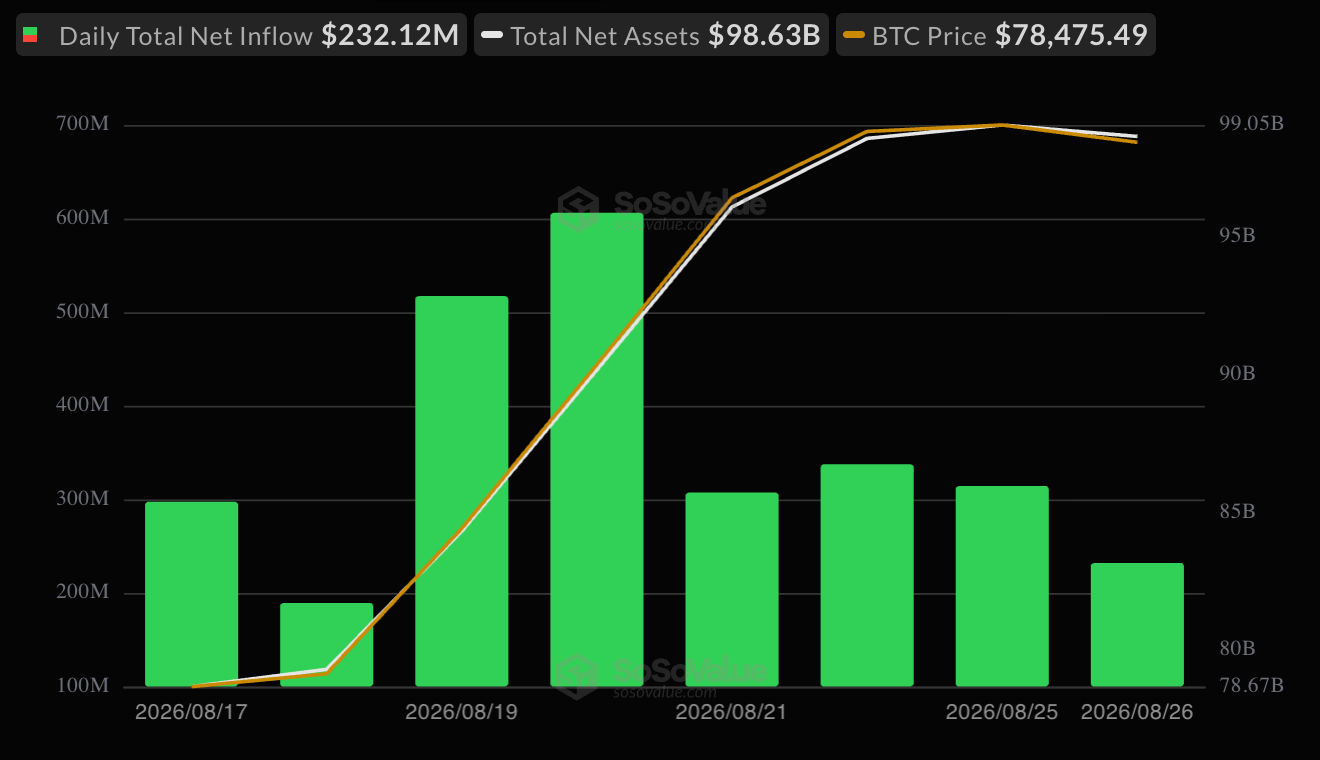
Eight sessions with inflows totaling $2.8 billion for Bitcoin ETFs. Source: Sosovalue

Ether ETFs demonstrated equally convincing results: the net inflow was $192.35 million, with no outflows reported. The leader was Blackrock's ETHA ETF with an inflow of $115.66 million. Grayscale's Ether Mini Trust attracted $34.67 million, and Fidelity's FETH attracted $32.01 million.

Blackrock's ETHB ETF received $6.37 million. TETH from 21Shares and EZET from Franklin Templeton attracted $2.71 million and approximately $937,000 respectively. The trading volume of Ether ETFs was $951.11 million, and net assets grew to $15.13 billion.

$XRP and $HYPE Attract More Funds from the Altcoin Segment

ETFs on $XRP recorded a net inflow of $28.14 million. The leader in inflows was Bitwise's $XRP fund, followed by XRPZ from Franklin Templeton and XRPC from Canary. Total assets at the end of the day were $1.40 billion.

ETFs on $HYPE attracted $14.71 million, a significant gain for a category with net assets of $419.48 million. Bitwise's BHYP fund attracted $9.57 million, Grayscale's HYPG attracted $3.73 million, and 21Shares' THYP attracted $1.41 million. $HYPE ETF assets currently account for approximately 2.35% of the token's market capitalization.

Solana funds attracted $9.14 million. The leader was Morgan Stanley's MSOL fund with $5.51 million, followed by Bitwise's BSOL with $2.65 million and Vaneck's VSOL with approximately $973,000. Net assets at the end of the day were $1.26 billion, corresponding to roughly 2.23% of Solana's market value.

Nate Geraci, President of ETF Store, stated that Blackrock's current strategy regarding spot cryptocurrency ETFs remains strictly focused on Bitcoin and Ether, despite the high returns of the IBIT, ETHA, and ETHB funds.

He argued that the company is effectively making a "market forecast that no other crypto assets possess sufficient value," while predicting that Blackrock will ultimately expand its lineup with additional spot cryptocurrency ETFs.

The capital flows recorded on Wednesday intensify this debate. Capital is increasingly moving beyond Bitcoin and Ether, and smaller ETF categories are beginning to gain significant weight relative to their underlying markets.


Trending Cryptos

Related Questions

QWhat is the total net inflow for Bitcoin and Ethereum ETFs combined as reported in the article?

AThe total net inflow for Bitcoin and Ethereum ETFs combined is $424 million.

QWhich specific BlackRock ETF contributed the most to the Bitcoin ETF inflows, and what was the amount?

ABlackRock's IBIT ETF contributed the most, with an inflow of $200.76 million.

QHow did the article characterize the performance of $XRP and $HYPE ETFs in the altcoin segment?

AThe article stated that $XRP and $HYPE ETFs attracted more capital from the altcoin segment, with net inflows of $28.14 million for $XRP and $14.71 million for $HYPE.

QAccording to Nate Geraci, what is BlackRock's current strategy regarding spot cryptocurrency ETFs, and what prediction did he make about their future?

ANate Geraci stated that BlackRock's current strategy is strictly focused on Bitcoin and Ethereum ETFs. He predicted that BlackRock will eventually expand its lineup to include additional spot cryptocurrency ETFs.

QWhat was the daily trading volume for Bitcoin ETFs mentioned in the article?

AThe daily trading volume for Bitcoin ETFs was $2.26 billion.

Related Reads

Two AI Giants Devour One-Third of Global New Computing Power, Nearing Half Next Year

Two AI giants, Anthropic and OpenAI, are projected to consume one-third of the world's new computing power this year, a share that could rise to nearly half by next year. By 2028, they may command the majority of the world's effective available AI compute, according to analysis by Dylan Patel of SemiAnalysis. This rapid growth is driven by soaring revenue per megawatt—Anthropic reportedly reaching up to $50 million per MW—which far exceeds the estimated $10-15 million cost. This creates a self-reinforcing cycle: higher earnings enable purchasing more advanced compute, leading to more powerful models and further revenue gains. While about 71% of AI compute is owned by major cloud providers, its usage is increasingly concentrated with these two labs. A significant portion of their compute (around 50%) is dedicated to research and experimentation rather than direct model training or inference. Looking ahead, Dylan suggests an increasing share of compute will be diverted from revenue-generating inference towards AGI research, despite potential investor pressure for returns. The massive capital expenditure—cumulatively around $11 trillion from 2024-2029—risks tightening global credit markets. Furthermore, government regulations, like withholding top-tier model releases or pausing data center tax exemptions, could disrupt the growth cycle by capping revenue-per-MW gains. The conversation highlights a concerning trend toward extreme centralization. As compute efficiency improves and costs drop, the "effective AI labor" controlled by a single leader could theoretically surpass the global human population within years. The core challenge is shifting from a race for AGI itself to a question of who will control it.

marsbit27m ago

Two AI Giants Devour One-Third of Global New Computing Power, Nearing Half Next Year

marsbit27m ago

QCP Capital: Bitcoin's Rally to $80,000 is Supported by Spot ETFs, Not Leverage

QCP Capital's report "Trial of Trust" analyzes Bitcoin's surge towards $80,000 ahead of the Jackson Hole Symposium, attributing it primarily to spot ETF inflows rather than leverage. The rally coincides with markets assessing the Federal Reserve's balancing act between persistent inflation and broader financial conditions, especially amid new pressure on the long end of the US Treasury yield curve. This pressure followed the US Treasury's August 19 announcement to at least double its buyback operations for 10-30 year bonds starting September 9, which lowered long-term yields and boosted assets like Bitcoin and gold. Meanwhile, inflation remains sticky, with July's core PCE at 3.3% year-on-year, keeping the Fed's September rate decision uncertain. The risk-on environment is also supported by the AI investment cycle, highlighted by Nvidia's strong earnings. However, this capital-intensive cycle contributes to demand for funding, influencing long-term bond yields. Crucially, Bitcoin's price increase from ~$63,5K to ~$80K occurred alongside eight consecutive days of net inflows (~$2.8B) into spot Bitcoin ETFs. Simultaneously, futures open interest declined and funding rates remained subdued, indicating the rally was driven by spot demand and short covering, not new leveraged long positions. The options market is now showing increased demand for calls. Bitcoin is approaching a supply zone of $81K-$86K. The key question is whether the uptrend remains supported by organic spot demand or becomes increasingly reliant on leverage. The market awaits Fed Chair Kevin Warsh's Jackson Hole speech for clues on the Fed's inflation framework and its view on long-term yield dynamics.

cryptonews.ru27m ago

QCP Capital: Bitcoin's Rally to $80,000 is Supported by Spot ETFs, Not Leverage

cryptonews.ru27m ago

Trading

Spot

Hot Articles

Discussions

Welcome to the HTX Community. Here, you can stay informed about the latest platform developments and gain access to professional market insights. Users' opinions on the price of ETH (ETH) are presented below.

活动图片