Original | Odaily Planet Daily (@OdailyChina)
Author | Wenser (@wenser 2010)
Last evening, the Ethereum Foundation's Protocol Support Team officially announced that the team has been formally dissolved. Previously, Wang Xiaowei, the co-executive director of the Ethereum Foundation, who was seen as "one of the representative figures of EF organizational reform," has also formally resigned. So far this year, at least 8 senior personnel have left the Ethereum Foundation.
On the other side of organizational and personnel changes are the encroachment and functional replacement of the Ethereum Foundation organization by non-profit independent institutions such as EthLabs and Ethereum Institutional; it is also technological progress like the recent adoption of AI agents for red-team testing of the ETH network by the Ethereum Foundation security team, which discovered real vulnerabilities.
As the ETH price faces wave after wave of industry scrutiny, what lies before the Ethereum Foundation are the more complex and diverse contradictions and tests following internal reforms. Related to this is the divisive transformation that Ethereum's leading body is now directly confronting.
The Era of Decline for the Ethereum Foundation: Rise of Contenders, Brain Drain, and the AI Shift
The Ethereum Foundation (hereinafter referred to as EF) has long been criticized for its rigid system, decision-making by a minority, organizational value, and market-influencing sell-offs. Criticisms within the Ethereum community are particularly fierce. Not long ago, Bankless founder David Hoffman even went so far as to "sell his last ETH holdings" to express his dissatisfaction with EF, calling on the Ethereum community to build the ecosystem in their own way.
Now, the formal dissolution of EF's Protocol Support Team has exposed the organization's internal conflicts and crisis of division like a thunderclap to all. It is noteworthy that this round of organizational changes is particularly different from the organizational changes initiated by Ethereum founder Vitalik last year—this is a thorough personnel purge, also seen as 'the largest round of layoffs since EF's founding,' rather than previous partial leadership changes.
When the Ethereum Ecosystem Leader Chooses to Sever Its Tail to Survive: The Whole Story of EF's Major Layoffs
Everything begins with the official announcement "New EF Structure" formally released by EF on June 23.
In this lengthy article spanning thousands of words, EF differentiated the new organizational structure into protocol layer, access layer, user layer, community layer, and institutional layer. It subsequently stated that "this organizational restructuring involves laying off 54 people, accounting for 20% of EF's members." What's even more disheartening is the beginning of the announcement: "Through this process, we have gained the structure, activities, and personnel needed to execute the critical tasks we will soon face." In other words, the laid-off personnel and departments were eliminated, unnecessary, and without value.
It must be said that EF, which has always presented itself as a research organization and ecosystem leader with a scholarly demeanor, has for the first time revealed the cold side of its organizational management.
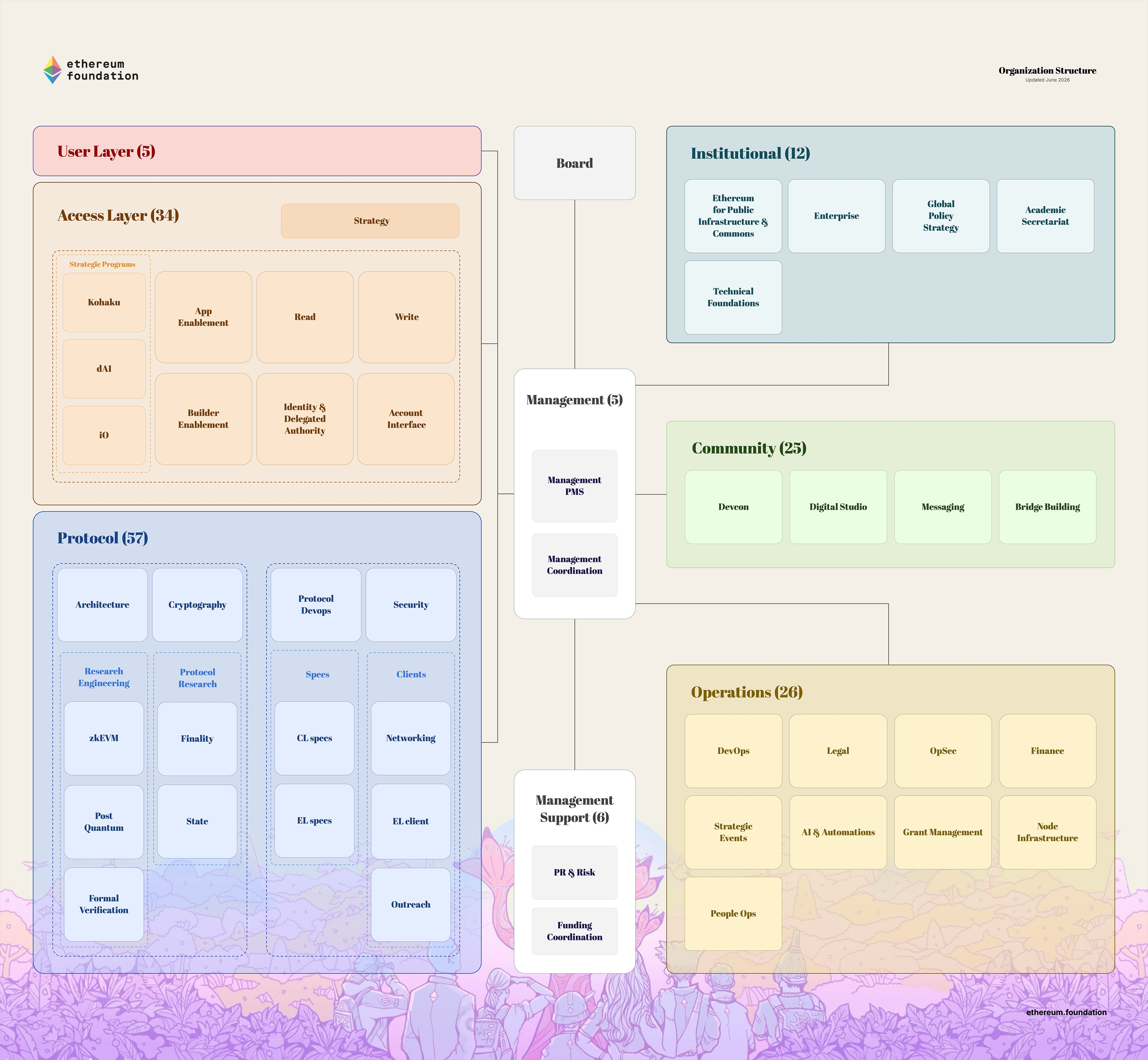
Schematic diagram of the new EF structure
The Dissolution of EF's Protocol Support Department Marks a Key Sign of EF's Organizational Split
It's worth mentioning that the work of EF's Protocol Support department leaned towards infrastructure construction, mainly responsible for coordinating the Ethereum protocol development process, including organizing and coordinating core developer meetings, tracking Ethereum network upgrades, supporting EIP advancement, and running the Ethereum protocol. Now, its main functions have been allocated to the protocol layer part of EF.
Coincidentally, on the same day EF announced its new structure, Ethlabs, a non-profit R&D lab co-founded by five former EF researchers, was officially announced. This organization aims to advance Ethereum as a settlement layer for the global economy and has received support from a series of investment institutions, Ethereum ecosystem projects, independent individuals, and EF foundation members, including Ethereum co-founder Joe Lubin (Chairman of Sharplink, founder of Consensys), ETH treasury company BitMine (Tom Lee's Ethereum treasury company), Sharplink, and crypto investment firm SNZ.
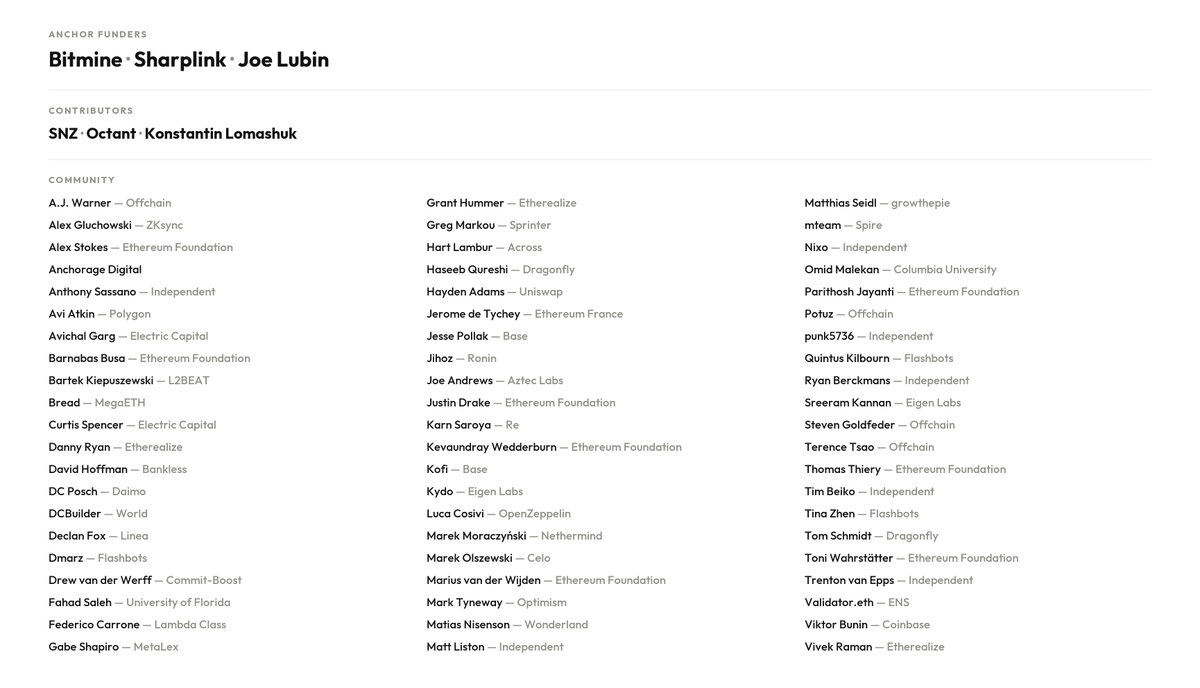
ETHLabs Community Participant List (Source: Official Account)
On July 1st, Ethereum Institutional, co-founded by former EF members David Walsh, Marius Smith, and Matthew Dawson, was officially unveiled.
This organization's main concept is "the institutional finance application plan for Ethereum," dedicated to promoting the institutionalization and institutional-grade application of Ethereum, its secondary nodes, applications, and the entire ecosystem. The organization also emphasizes collaboration with Ethlabs, Etherealize, and the Enterprise Ethereum Alliance, taking charge of institutional demand connection and explaining Ethereum's value proposition to banks; Ethlabs focuses on translating related demands into technical products. As a non-profit independent institution, Ethereum Institutional will provide free Ethereum application-related consulting to banks and asset management companies.
A week later, Ethereum Institutional announced the start of core team recruitment. In the coming weeks, the focus will be on hiring roles such as Institutional Business Development (Institutional GTM), Marketing & Community Operations, as well as technical positions like Solution Architect and Technical Project Lead.
Thus, the EF layoff storm officially concluded with the emergence of two major non-profit independent organizations and the dissolution of the Protocol Support department, drawing an imperfect full stop to the "internal organizational transformation" personally promoted by Vitalik last year. Beyond organizational-level fragmentation and the loss of high-level talent like Executive Director Wang Xiaowei, EF also faces the impact of AI technology.
The Era of AI Offense and Defense Begins, EF Security Team Upgrades Testing
Yesterday, researchers from the EF Protocol Security Team stated in a blog post that they have deployed a series of AI agents to test software relied upon by the Ethereum ecosystem, searching for vulnerabilities in cryptographic systems, protocol code, and smart contracts.
The vulnerabilities discovered by the AI agents include a remotely triggerable panic issue in the libp2p gossipsub peer-to-peer layer used by Ethereum consensus clients. This issue has been fixed and disclosed on GitHub as CVE-2026-34219.
The researchers stated that the AI agents were organized into specialized roles such as reconnaissance, search, patching, and verification, used to find potential attack paths, reproduce failures, and verify their applicability to production code. EF stated that AI has not replaced security researchers but has changed the way they work, enabling the team to cover a far greater scope than manual review. However, it requires researchers to make more cautious judgments on a large number of seemingly credible conclusions.
Considering today's news of the official launch of the GPT-5.6 model, subsequent maintenance of Ethereum protocol security may be jointly handled by AI models and EF security researchers. Moreover, although EF now mentions "AI has not replaced researchers," with the continuous development and evolution of AI models, personnel within the EF security team and perhaps the entire organization may be further reduced in the future. In other words, EF will also face the test of AI models on its organizational structure and the execution of its own functions.
Summary: EF Organizational Transformation Reaches a Staged Conclusion, May Become an Ecosystem Mascot in the Future?
In January of last year, we provided a systematic analysis of EF's organizational transformation in the article "Vitalik Fires the First Shot of 'Reform,' Where is the Ethereum Foundation Headed?" Back then, Vitalik was ambitiously and forcefully pushing for EF organizational change. In May this year, after more than a year of organizational innovation, Vitalik's tune changed, stating that "the Ethereum Foundation should not be the center of the ETH ecosystem and will shift towards a smaller, long-termism route."
It must be said that after ETH has grown into an asset with a market cap in the hundreds of billions, EF, the official ecosystem organization founded nearly a decade ago, has also entered the awkward situation of being "a large ship hard to turn." No wonder Vitalik previously even remarked—"I will no longer write regular blog posts, I have decided to try writing some science fiction on the topic of decentralized governance."
As former EF researcher and Ethlabs member Ansgar Dietrichs said on a podcast earlier this month, "After five years of failing to break through $5,000, ETH still lacks a clear value narrative."
Currently, it seems that EF is already struggling to shoulder the banner of "revitalizing the Ethereum ecosystem and driving ETH price breakthroughs." Future large-scale adoption and institutional investment may have to rely on organizations like Ethlabs, Ethereum Institutional, and Etherealize.
Perhaps, in the near future, playing the role of an "ecosystem mascot" would be more suitable for EF.
Recommended Reading
Ethereum Enters a "Mid-Life Crisis," Analyzing Development Performance from a Data Perspective
Given: ETH = Nokia, Find: Ethereum = iOS?
Ethereum Is "Sick," Are These Three Remedies Appropriate?
Where Lies the Path? A Brief Analysis of the Three Major Abstract Problems Facing the Ethereum Ecosystem Today
Enumerating the Seven Deadly Sins of Ethereum, Who Can Play Its "Salvation Oratorio"?
Where Lies the Orthodoxy of Ethereum? A Detailed Explanation of the "Cryptocurrency Masterpiece" in Vitalik's Heart
Ethereum's Tenth Anniversary: Revisiting ETH's Change of Ownership Journey, The Resurgence of Token Centralization
Are L2s a Detour for Ethereum?
Bankless Founder Liquidates ETH Holdings, Collective Disillusionment with Ethereum Faith