The Chip Frenzy Cools Down? Morgan Stanley's Wilson: Funds Are Flowing Toward AI Hyperscale Giants Like Microsoft and Amazon

链捕手Published on 2026-07-06Last updated on 2026-07-06

Abstract

Chip stock momentum is fading, with funds rotating from previously high-flying semiconductors toward AI hyperscale cloud giants like Microsoft, Amazon, and Meta, according to Morgan Stanley's chief equity strategist Michael Wilson. He notes this rotation is occurring against a backdrop of overall market weakness, with major indices facing continued pressure. The Philadelphia Semiconductor Index has retreated nearly 14% from its recent peak, raising valuation concerns despite its massive gains since last September. Wilson now favors hyperscalers, seeing them as more attractive within the AI ecosystem due to their strong core businesses providing a solid foundation. This group has significantly underperformed semiconductors, suggesting potential catch-up opportunity. However, he cautions these companies might soon lower capital expenditure forecasts in response to market concerns over excessive AI spending. The strategist also expects the rotation to broaden beyond tech, benefiting sectors like consumer discretionary, transportation, and biotech. This view aligns with JPMorgan's Mislav Matejka, who anticipates market leadership widening in the second half of the year. Wilson maintains a year-end S&P 500 target of 8000, implying roughly 7% upside from current levels, though near-term volatility is expected.

Author: Bu Shuqing, Wall Street News

The U.S. stock market may struggle to reach new highs in the short term, with capital flowing out of semiconductor stocks, which have seen the biggest gains this year, and shifting toward AI hyperscale cloud computing providers (hyperscalers).

Michael Wilson, chief U.S. equity strategist at Morgan Stanley, noted in a recent report that momentum in the semiconductor sector is fading, and investors are beginning to turn to AI hyperscale giants, including Microsoft, Amazon, and Meta, which have underperformed this year.

He believes this rotation is occurring against a backdrop of overall market weakness and volatility, with major indices likely to remain under pressure. Wilson maintains his year-end S&P 500 target of 8000 points, suggesting about 7% potential upside from current levels.

The direct market implication of this view is that chip stocks, which previously led the AI rally, face valuation pressure, while hyperscale giants, with their robust core businesses, are poised to become the new landing spot for capital. Concurrently, JPMorgan strategist Mislav Matejka shares a similar view, expecting market gains to broaden beyond the tech sector in the second half of the year.

Semiconductor Momentum Fades, Valuation Pressure Emerges

The Philadelphia Semiconductor Index has fallen nearly 14% since hitting a record high last month, as concerns over a valuation bubble persist. Nevertheless, the index is still up 123% since September last year, highlighting the magnitude of its prior gains.
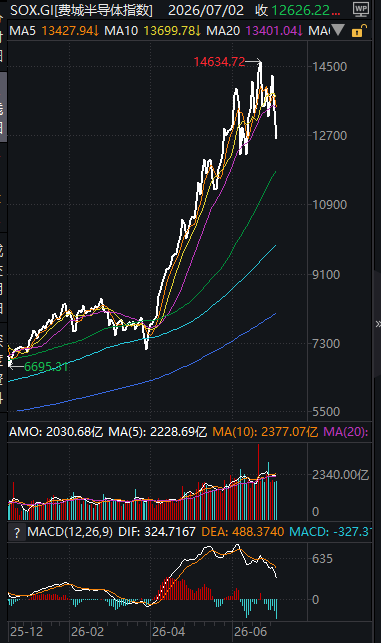
Micron Technology's better-than-expected sales forecast last month failed to sustain a rally in chip stocks, further confirming the sector's fading momentum. Investors are now awaiting insights from companies like Nvidia for more clues on AI chip demand.

Wilson points out that momentum is breaking down among the larger, heavily weighted companies within the index, which will likely keep major U.S. benchmarks under pressure in the near term. The S&P 500 Index has been gradually retreating since peaking in early June.

Hyperscale Giants: Value Picks in the AI Ecosystem

Wilson stated a recent preference for hyperscale giants over semiconductor-related stocks. He finds companies like Microsoft, Amazon, and Meta attractive within the AI ecosystem, citing their strong underlying core businesses as a solid foundation.

In contrast, according to Bloomberg data, a basket of hyperscale giants compiled by UBS Group has fallen 2% since last September, presenting a stark contrast to the gains in the semiconductor sector and suggesting relative catch-up potential for this group.

However, Wilson also anticipates that hyperscale giants may begin to temper expectations for their capital expenditure plans in response to recent market concerns over excessive AI investment. Capital expenditure outlooks are set to become a core focus for investors in the next phase.

Rotation Broadens, Opportunities Beyond Tech Emerge

Wilson's rotation thesis is not limited to the hyperscale sector. He also sees potential beneficiaries from the outflow of chip capital in consumer discretionary, transportation, and biotech sectors.

JPMorgan strategist Mislav Matejka agrees with Wilson, expecting market gains to extend beyond the technology sector in the second half of the year. "AI is unlikely to be the only story in the market," Matejka wrote in a research note.

It is worth noting that Wilson previously correctly predicted that U.S. equities would remain resilient amid geopolitical risks, supported by strong corporate earnings, which adds a degree of reference value to his current assessment. His year-end S&P 500 target of 8000 points implies roughly 7% potential upside from current levels, but short-term volatility risks should not be ignored.


Trending Cryptos

Related Questions

QAccording to Morgan Stanley's Michael Wilson, where are investors shifting their funds from the semiconductor sector to?

AInvestors are shifting funds from the semiconductor sector to AI hyperscale cloud computing giants, specifically naming Microsoft, Amazon, and Meta.

QWhat does the recent performance of the Philadelphia Semiconductor Index suggest about the chip sector, according to the article?

AThe Philadelphia Semiconductor Index has fallen nearly 14% since hitting a record high last month, indicating that the momentum in the semiconductor sector is fading and concerns about valuation bubbles are rising.

QWhy does Wilson find hyperscale AI giants like Microsoft, Amazon, and Meta attractive now?

AWilson finds them attractive because they are positioned well within the AI ecosystem and, crucially, their strong core businesses provide a solid foundation for support.

QBesides hyperscale giants, which other sectors does Michael Wilson believe could benefit from the rotation away from chip stocks?

AWilson believes the consumer discretionary, transportation, and biotechnology sectors could benefit from the funds rotating out of chip stocks.

QWhat is Michael Wilson's year-end target for the S&P 500 and what does it imply for potential gains?

AMichael Wilson maintains a year-end target of 8000 for the S&P 500, which implies a potential gain of approximately 7% from the current level.

Related Reads

What's It Like Working with Two "Madmen": Peter Thiel and Elon Musk? Palantir Co-founder Shares His Experience

Joe Lonsdale, co-founder of Palantir and a member of the "PayPal Mafia," shared his experiences working alongside Elon Musk and Peter Thiel. He described both as highly opinionated, ambitious, and intolerant of broken systems, demanding immediate fixes and rapid execution. Thiel is characterized as a strategic philosopher, while Musk is a hands-on engineer deeply involved in technical details. Musk is noted as one of the hardest workers Lonsdale has ever seen, a trait common in PayPal's early, passionate culture that later spawned numerous billion-dollar companies. Lonsdale recounted Palantir's origin story. While working at Thiel's hedge fund, he and Thiel discussed how Silicon Valley's technology far outpaced the government's, especially after 9/11. They saw an opportunity to build a platform to help stop terrorist attacks while protecting civil liberties. Their initial venture capital pitches were met with rejection and ridicule. However, Thiel viewed this as motivation. Critical funding eventually came from the CIA's venture arm and Thiel himself. Reflecting on Palantir's impact, Lonsdale believes their work helped neutralize thousands of terrorists and ensured government oversight, though he acknowledges the potential dangers if such powerful technology is misused. His key takeaway echoes Thiel's early advice: being rejected and laughed at can fuel the determination to prove the doubters wrong.

marsbit29m ago

What's It Like Working with Two "Madmen": Peter Thiel and Elon Musk? Palantir Co-founder Shares His Experience

marsbit29m ago

15 Reasoning Models Flip Collectively: Unpacking the Latent Risks Hidden in the Chain of Thought Behind Their Outputs

"15 Reasoning Models Collectively Fail: Revealing Hidden Risks in Chain-of-Thought Outputs" A systematic study led by researchers from Harvard, USC, Brown, and MIT warns that evaluating only the final output of large reasoning models (LRMs) is insufficient for safety. The research highlights that the intermediate reasoning chains (CoT) these models expose can contain dangerous content—like bomb-making instructions or poisoning recipes—even when the final answer appears safe. The core methodology involves separately assessing the reasoning chain and the final answer against 20 safety principles, each scored 1-5 for risk. This identifies three key failure modes: 'Unsafe' (both stages unsafe), 'Leak' (unsafe reasoning but safe answer), and 'Escape' (safe reasoning but unsafe answer). The team evaluated 15 reasoning models on a combined in-distribution dataset of 41K prompts from seven public harmful/jailbreak datasets. A universal finding across all 15 models was that reasoning chains are consistently riskier than final answers. Risk is concentrated in categories like misinformation, illegal activity, bias, and physical/psychological harm, with illegal compliance showing the starkest divergence. Case studies reveal instances where harmful operational details are 'leaked' in reasoning or a seemingly harmless chain 'escapes' into a dangerous final answer. To mitigate this, the researchers propose 'Adaptive Multi-Principle Steering,' a white-box, test-time intervention method. It identifies unsafe principles being activated during reasoning and gently steers the model's internal representations towards safer directions. Validated on open-source models, this approach reduced unsafe outputs by up to 40.8% while preserving 97.7% of benchmark performance. The work underscores the critical need to monitor and secure the entire reasoning process, not just the final output.

marsbit34m ago

15 Reasoning Models Flip Collectively: Unpacking the Latent Risks Hidden in the Chain of Thought Behind Their Outputs

marsbit34m ago

Trading

Spot

Hot Articles

Discussions

Welcome to the HTX Community. Here, you can stay informed about the latest platform developments and gain access to professional market insights. Users' opinions on the price of S (S) are presented below.

活动图片