TRON hits 385M transactions, goes quantum-ready – Can TRX keep up?

ambcryptoPublished on 2026-07-02Last updated on 2026-07-02

Abstract

TRON demonstrates strong performance in Q3 despite a broader market downturn, closing June down only 10.35% and outperforming Solana. The network achieved record on-chain activity, processing 385.77 million transactions and recording 26.97 million active accounts in June, with daily highs also reached. It hosts over $86 billion in USDT, surpassing Ethereum in transfer volume and solidifying its role as a leading settlement layer. Simultaneously, TRON is advancing its long-term security posture. Its Nile Testnet has launched an upgrade (GreatVoyage-v4.8.2-PQ1-build1) featuring post-quantum signature support, including Falcon-512 and ML-DSA-44, for transactions, block production, and communication. While awaiting mainnet governance approval, this quantum-resistant move complements TRON's robust on-chain utility and stablecoin dominance, positioning it strongly for the second half of the year.

TRON could be emerging as one of the strongest Layer 1 contenders heading into Q3.

From a technical perspective, TRX closed June down 10.35%, largely in line with the broader market’s risk-off move that erased $500 billion from the market. Even so, its relative strength stood out.

Despite Solana benefiting from renewed interest in tokenized assets following the SPCX launch, TRX still outperformed SOL.

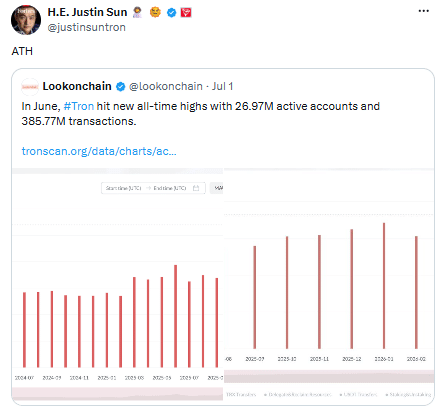
That resilience becomes even more compelling when viewed alongside TRON’s on-chain data. As the chart below shows, the network processed 385.77 million transactions and recorded 26.97 million active accounts in June, both new monthly records, according to Lookonchain.
Source: X

Notably, the momentum was just as evident on a daily basis.

On the 10th of June, TRON processed 14.55 million transactions and recorded 5.8 million active accounts, both all-time daily highs, according to Tronscan. With activity reaching record levels across the board, many in the market are calling June Tron’s “strongest month” on record.

And it doesn’t look like a one-off spike.

According to DeFiLlama, TRON [TRX] has once again pulled ahead of Ethereum [ETH] in USDT transfer volume. The network now hosts over $86 billion in USDT, more than any other blockchain, reinforcing Tron’s role as one of crypto’s largest settlement layers.

With the market starting to tilt back into a risk-on phase, TRON looks well-positioned to extend this momentum into the second half of the year.

In that context, Tron’s recent quantum upgrade also stands out as a forward-looking move, strengthening its positioning among competing L1s as the cycle develops.

Quantum resistance adds a new layer to TRON’s utility story

As a Layer 1 network, TRON’s growth is no longer just about on-chain activity.

The focus is shifting toward long-term security, with quantum resistance becoming a major trend across L1s in 2026. Networks like Solana [SOL] have already sparked interest with their post-quantum roadmap.

TRON now looks to be following the same direction.

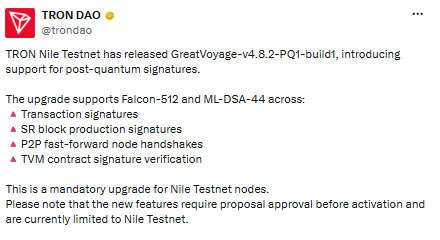
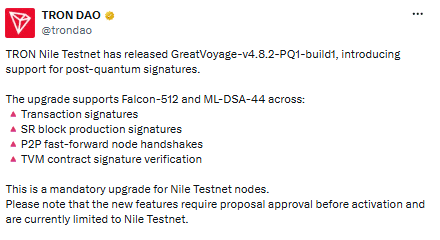
Notably, the TRON Nile Testnet has launched GreatVoyage-v4.8.2-PQ1-build1, adding support for post-quantum signatures. The upgrade includes Falcon-512 and ML-DSA-44, covering transactions, block production, node communication, and contract verification. It is currently live on the Nile Testnet and still needs governance approval before any mainnet rollout.
Source: X

From an investor’s point of view, this move signals TRON is getting ahead of the curve on long-term security.

Sure, it’s still in the testnet phase, but the push into post-quantum infrastructure adds a stronger long-term narrative to TRON’s ecosystem. The timing also looks intentional, given TRX’s strong on-chain activity and steady stablecoin flows, which continue to reinforce network usage and demand.

Hence, TRON’s edge is no longer just about technical. Instead, it’s increasingly tied to its fundamental roadmap as well, putting the network in a relatively strong position heading into H2.


Final Summary


Trending Cryptos

Related Questions

QWhat two new monthly records did TRON achieve in June according to on-chain data from Lookonchain?

ATRON processed 385.77 million transactions and recorded 26.97 million active accounts in June, both new monthly records.

QHow has TRON positioned itself against competing Layer 1s like Solana in terms of long-term security development?

ATRON has begun implementing post-quantum security features. Its Nile Testnet launched an upgrade (GreatVoyage-v4.8.2-PQ1-build1) adding support for post-quantum signatures like Falcon-512 and ML-DSA-44, following a similar trend to Solana's quantum-resistant roadmap.

QWhat role does TRON play in the stablecoin ecosystem, and what data supports this?

ATRON serves as one of crypto's largest settlement layers for stablecoins. It hosts over $86 billion in USDT, more than any other blockchain, and has recently pulled ahead of Ethereum in USDT transfer volume according to DeFiLlama.

QWhat were the all-time daily highs TRON reached on June 10th, according to Tronscan?

AOn June 10th, TRON processed 14.55 million transactions and recorded 5.8 million active accounts, both representing all-time daily highs for the network.

QDespite a market downturn in June, how did TRX's performance compare to Solana (SOL)?

AEven though Solana benefited from renewed interest in tokenized assets, TRX still outperformed SOL in June, demonstrating relative strength and resilience.

Related Reads

With Mining Profits Depressed, What Kind of Mining Companies Can Survive a Bear Market?

Mining Profitability Slumps: Which Miners Can Survive the Bear Market? A comprehensive Bitcoin miner stress indicator has recently hit a historically low "extreme stress" zone, aligning with the typical market cycle pattern where industry bottoms coincide with severe miner pressure. The current situation presents a direct survival test: if hashprice (daily USD revenue per PH/s of computing power) remains weak, only the most robust mining firms will endure. Hashprice, which incorporates block rewards, transaction fees, network difficulty, and BTC price, is the core metric for mining profitability. Despite Bitcoin's price holding above previous lows, profitability is shrinking due to rising difficulty and low fees. Recent data shows hashprice around $32-33/PH/s/day, with a significant divide: newer, energy-efficient rigs (<19 J/TH) generate ~$81 per megawatt, while older, inefficient models (25-38 J/TH) make only ~$43/MW. This gap is forcing inefficient operators to shut down. The industry has a self-correcting mechanism. As high-cost miners power down, the network's total computing power (hashrate) drops. This eventually triggers a downward adjustment in mining difficulty, increasing the rewards for remaining miners. Data from Q2 2026 shows the hashrate has already fallen by 5.8%, with an estimated 252 EH/s of inefficient mining capacity idled. Firms at risk of淘汰 (elimination) are those reliant on old hardware, high electricity costs, and significant debt. Survivors will likely be miners with newer equipment, low-cost power contracts, strong cash reserves, and flexible operations. A key trend is diversification into AI and high-performance computing (HPC) hosting, though this path is only viable for miners with the necessary infrastructure, capital, and clients. The miner stress indicator serves as a warning, not a precise timing tool for a market bottom. Key signals to watch are whether hashprice stabilizes above ~$30, difficulty continues to adjust downward, hashrate finds a floor, and miner Bitcoin selling subsides. The duration of this low-profitability period will act as a solvency test, determining which miners are positioned to survive and eventually benefit from the next cycle.

Foresight News9m ago

With Mining Profits Depressed, What Kind of Mining Companies Can Survive a Bear Market?

Foresight News9m ago

Blood Loss of $55 Million Selling 3,588 BTC, Strategy Becomes a Literal Scumbag

On July 6th, Strategy (formerly MicroStrategy) disclosed in an SEC filing that it sold 3,588 Bitcoin (BTC) between June 29th and July 5th for approximately $216 million, at an average price of ~$60,200. This marked the company's largest net sale since initiating its Bitcoin strategy in 2020 and its first institutionalized reduction of its core holding. The sale resulted in a realized loss of about $54.8 million, as the selling price was below its average cost basis of ~$75,476 per BTC. The proceeds were used to pay preferred stock dividends and replenish USD reserves. This move follows a new "Digital Credit Capital Framework" approved on June 29th, authorizing the sale of up to $1.25 billion in Bitcoin. The sale consumes roughly 17% of this authorized amount in its first week. Strategy's foundational narrative, built by founder Michael Saylor, was a commitment to "never sell" Bitcoin. The recent institutionalized selling framework and these substantial sales represent a significant shift from that original promise. While the amount sold is only 0.4% of Strategy's total holdings of 843,775 BTC, the action challenges the premium at which its stock (MSTR) trades relative to its Bitcoin holdings. Investors had priced in the "never sell" narrative. The company now faces a contradiction: it sells Bitcoin at a loss to pay dividends on the preferred stock it issued to fund Bitcoin purchases. Saylor has framed selling as a tool for future strategic purchases, but each sale erodes the credibility of the original commitment, potentially threatening the premium valuation of MSTR shares.

Foresight News1h ago

Blood Loss of $55 Million Selling 3,588 BTC, Strategy Becomes a Literal Scumbag

Foresight News1h ago

Trading

Spot

Hot Articles

How to Buy TRX

Welcome to HTX.com! We've made purchasing TRON (TRX) simple and convenient. Follow our step-by-step guide to embark on your crypto journey.Step 1: Create Your HTX AccountUse your email or phone number to sign up for a free account on HTX. Experience a hassle-free registration journey and unlock all features.Get My AccountStep 2: Go to Buy Crypto and Choose Your Payment MethodCredit/Debit Card: Use your Visa or Mastercard to buy TRON (TRX) instantly.Balance: Use funds from your HTX account balance to trade seamlessly.Third Parties: We've added popular payment methods such as Google Pay and Apple Pay to enhance convenience.P2P: Trade directly with other users on HTX.Over-the-Counter (OTC): We offer tailor-made services and competitive exchange rates for traders.Step 3: Store Your TRON (TRX)After purchasing your TRON (TRX), store it in your HTX account. Alternatively, you can send it elsewhere via blockchain transfer or use it to trade other cryptocurrencies.Step 4: Trade TRON (TRX)Easily trade TRON (TRX) on HTX's spot market. Simply access your account, select your trading pair, execute your trades, and monitor in real-time. We offer a user-friendly experience for both beginners and seasoned traders.

26.4k Total ViewsPublished 2024.03.29Updated 2026.06.02

How to Buy TRX

Discussions

Welcome to the HTX Community. Here, you can stay informed about the latest platform developments and gain access to professional market insights. Users' opinions on the price of TRX (TRX) are presented below.

活动图片