Video Edition Nano Banana Arrives: Built-in Gemini World Knowledge, Original Banana Generates Images in Just 4 Seconds

marsbitPublished on 2026-07-01Last updated on 2026-07-01

Abstract

Google has unveiled two new multimodal AI models: Gemini Omni Flash and Nano Banana 2 Lite. Gemini Omni Flash is a video generation and editing model that leverages Gemini's world knowledge. It allows for conversational video editing using natural language prompts, maintains scene consistency, and integrates text/graphics with video actions. Priced at $0.10 per second of output, its current limitations include a 10-second video cap. Nano Banana 2 Lite (gemini-3.1-flash-lite-image) is an optimized image generation model focused on speed and cost. It produces a 1K resolution image in about 4 seconds at a cost of roughly $0.034, making it significantly faster and cheaper than its predecessor. It retains strong text rendering capabilities. A key highlight is the combined workflow: users can rapidly generate images with Nano Banana 2 Lite and then seamlessly feed them into Gemini Omni Flash to create videos. Google demonstrated this with three application demos: "Anywhere" for creating travel videos from photos, "Space Lift" for generating interior design walkthroughs, and "Omni Product Studio" for automating e-commerce ad creation from product photos. The release underscores Google's strategic focus on advancing multimodal AI for practical, commercial applications in areas like marketing, design, and content creation, despite competitive pressures in other AI domains.

Although coding is still a mess, Google really has a knack for "multimodality".

The Gemini Omni Flash API is officially open, introducing the video edition Nano Banana.

Magical remakes of "Harry Potter" are no longer a dream. Just watch these four digital magic tricks performed by Gemini Omni:

It's insane. This level of consistency and text clarity makes green screens and special effects almost obsolete—just go live as Doctor Strange.

Meanwhile, the beloved "Banana" has welcomed a "lightspeed edition".

Nano Banana 2 Lite: The fastest, most cost-effective Gemini image model to date.

No exaggeration—it takes just 4 seconds to generate one image. A 1K resolution image costs about 20+ cents.
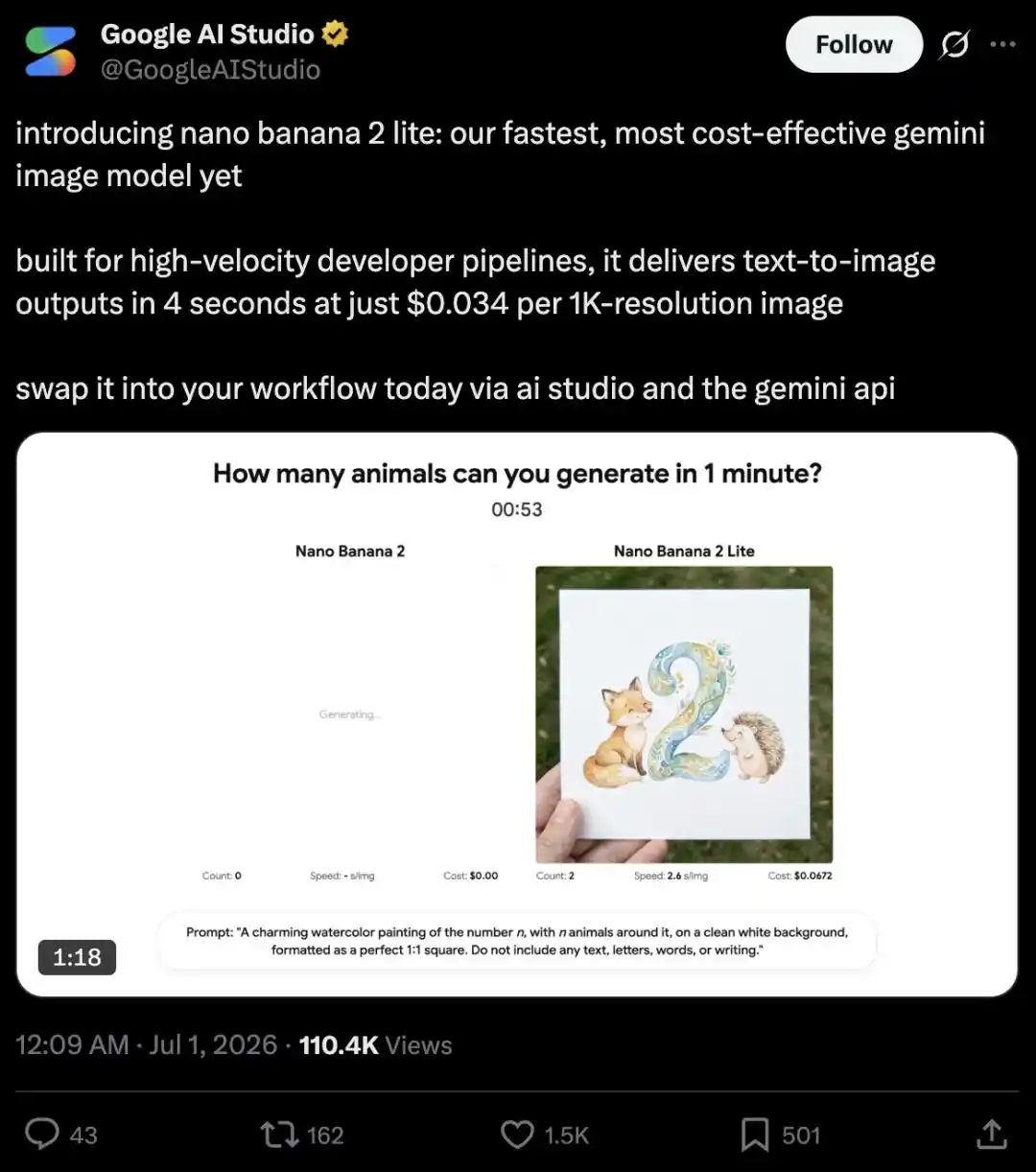
Compared side-by-side with Nano Banana 2, this speed is practically taking off.

Not to mention GPT Image 2, which takes 3 minutes for a single image generation...

No wonder Gemini 3.5 Pro hasn't been released yet—they probably spent all their time on their beloved multimodality, right, Hassabis!!

Gemini Omni Flash

First unveiled at Google I/O 2026, Gemini Omni Flash deeply integrates Gemini's multimodal reasoning capabilities with video generation and editing, garnering significant attention then.

Now, this model is officially available to developers via the Gemini API and Google AI Studio. It can easily generate and edit high-quality videos based on various inputs like text, images, and video.

Four key capabilities:

Conversational Video Editing: Modify and refine videos using natural language, just like editing a Lark document.

Multimodal Reference: Combine image, text, and video inputs to maintain scene control and consistency.

Real-World Knowledge: Leverage Gemini's knowledge in history, biology, narrative logic, etc., to construct videos, saving you from writing three pages of prompts to describe architectural styles.

Text and Action Synchronization: Connect text and graphics directly to video actions through simple prompts.
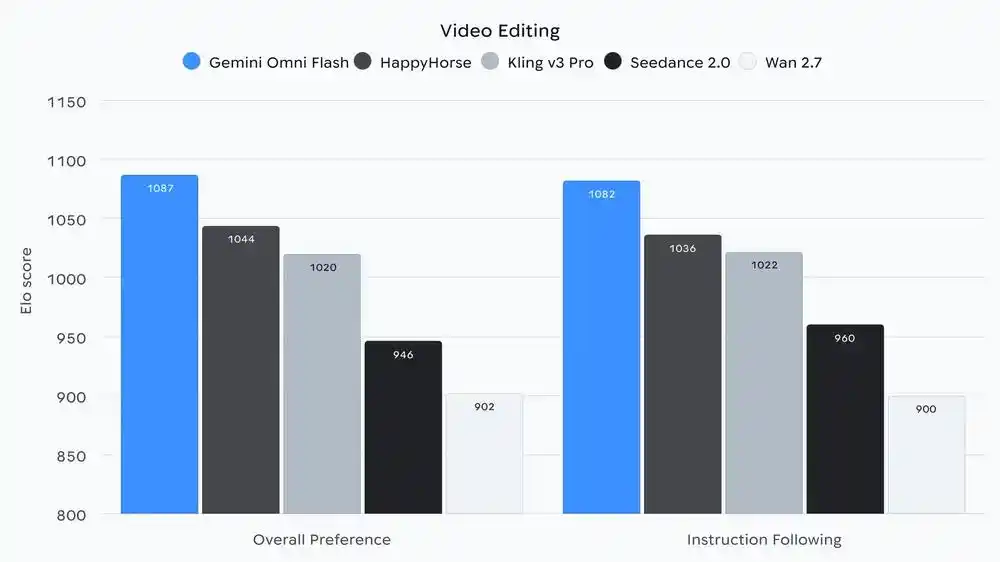
The pricing is also very competitive: $0.10 per second of video output, on par with Veo 3.1 Fast.

In terms of positioning, Omni Flash, also a lightweight video generation model, emphasizes Gemini's world knowledge and fully aligns with the Gemini ecosystem.

But Google is also quite candid, proactively listing a bunch of current limitations:

1. Currently only supports 10-second video generation; longer support will come later.

2. Does not yet support audio reference uploads or scene expansion.

3. The API supports video reference uploads up to 3 seconds, but the model currently cannot correctly process such inputs.

4. There are still limitations in character consistency during scene changes and camera movements.

Nano Banana 2 Lite

Nano Banana 2 Lite (also known as gemini-3.1-flash-lite-image) is designed specifically for high-speed processing.

Through targeted optimization, it aims at real-time application scenarios that are extremely sensitive to latency and require processing large volumes of images in a short time—such as bulk generation of e-commerce materials, rapid iteration of ad creatives, and automated content pipelines.

Two core selling points—

Lightspeed: Image generation latency is about 4 seconds, one-fifth of Nano Banana 2's (which is about 20 seconds).

Dirt Cheap: A 1K image costs about $0.034, half the price of Nano Banana 2 and one-quarter of Nano Banana Pro.

Speed and price are cut, but image generation and editing capabilities haven't noticeably shrunk. Nano Banana 2 Lite still maintains excellent text rendering effects, benchmarking on par with models like Grok.
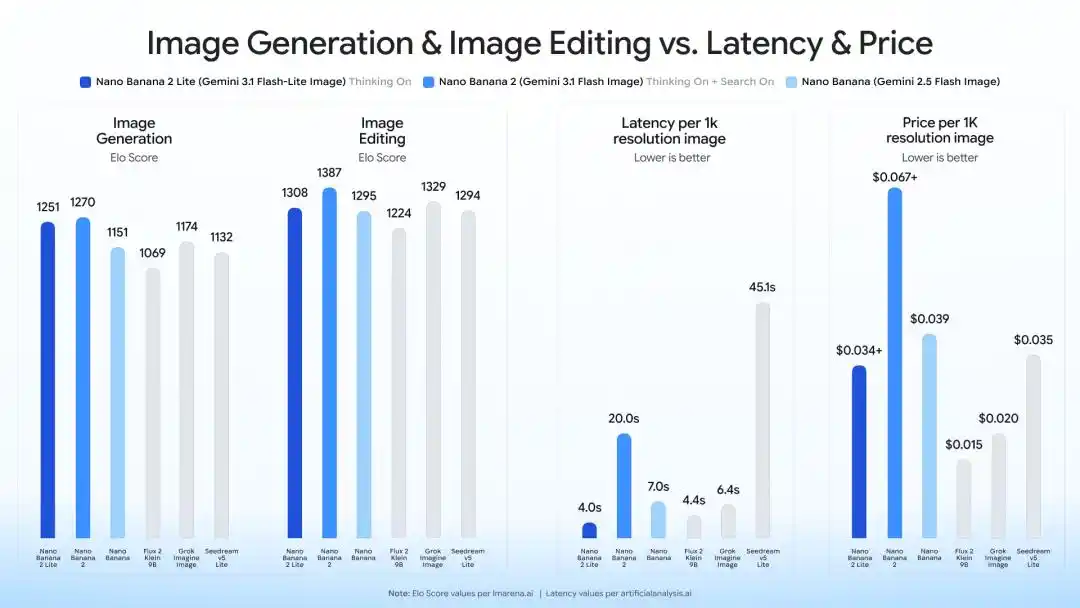
Therefore, Google's suggestion is: If you're still cheaping out with the first-gen Nano Banana, swap it now. The Lite version already comprehensively outperforms it in all key metrics.

Twin Blades United

Wait, hold on.

You might think this is just the parallel release of two models, but Google indicates there's more.

The real magic lies in chaining these models together.

As we all know, AIGC creation requires repeated iteration, and asset management can be quite troublesome.

Now, with these two models, you no longer need to repeatedly upload files—image generation and video creation are seamlessly connected.

Specifically, you can first use Nano Banana 2 Lite to generate images at high speed, then feed the generated images as reference material to Gemini Omni Flash to transform them into videos with one click.

To showcase this magical 1+1>2 workflow, Google even created 3 Demo APPs:

1、Anywhere

Take a selfie or upload a photo, and NB2 Lite instantly Photoshopped you into dozens of landmark scenes.

Then click on the image, and Omni Flash turns the static scene into a dynamic short video.

Cyber tourism, now also end-to-end.

2、Space Lift

This is a bit scary. Combined with the Genie world model in the future, it might threaten many traditional interior design SaaS companies.

Upload a photo of a room. NB2 Lite first generates various interior design styles. Find one you like, click the video button, and Omni can directly create a cinematic space walkthrough for you.

3、Omni product studio

A boon for cross-border e-commerce.

Take a white-background photo of a product. NB2 Lite generates various contextual product images. Omni Flash then turns the static images into e-commerce short videos.

From "product" to "advertising material", the entire chain runs automatically.

So, what's the use of multimodality anyway?

Google has surely been asked this countless times.

Especially in 2026, where Coding ability has become almost synonymous with model intelligence. Everyone is fiercely competing in Coding.

Obsessing over multimodality, for what?

Forget the whole AGI narrative for a moment. In the short term, Google's suite of multimodal models can indeed empower many of its products—Stitch is one, the built-in photo editing in Pixel is another, and the emergence of NotebookLM was quite impressive.

The two new models released this time reveal even more potential for multimodality to land in vertical scenarios. E-commerce, interior design, short videos... the demand in these businesses is real, and so is the money.

Plus, with the Android ecosystem supporting it, there's little worry about commercialization.

Google might not catch up in Coding for now, but at the multimodality poker table, Google might be the only player with a full deck.

But...

When is Gemni 3.5 Pro coming out already!!!

Reference:[1]https://blog.google/innovation-and-ai/models-and-research/gemini-models/gemini-omni-flash-nano-banana-2-lite/

This article comes from the WeChat public account "QbitAI", author: Following Cutting-Edge Tech

Trending Cryptos

Related Questions

QWhat are the two new Gemini models announced, and what are their primary functions?

ATwo new models are announced: Gemini Omni Flash and Nano Banana 2 Lite. Gemini Omni Flash is a multimodal video generation and editing model that can create videos from text, image, and video inputs. Nano Banana 2 Lite is an ultra-fast and cost-effective image generation model.

QWhat are the key features and performance claims for the Nano Banana 2 Lite image model?

ANano Banana 2 Lite is claimed to be the fastest and most cost-effective Gemini image model. It generates a 1K resolution image in about 4 seconds at a cost of approximately $0.034 per image. It maintains strong text rendering capabilities while being significantly faster and cheaper than its predecessor.

QHow does Gemini Omni Flash leverage its 'world knowledge' capability, and what is one of its stated limitations?

AGemini Omni Flash can call upon Gemini's knowledge in areas like history, biology, and narrative logic to inform video generation, reducing the need for detailed user prompts. One stated limitation is that it currently only supports generating videos up to 10 seconds in length, with longer support planned for the future.

QAccording to the article, how can the two models be used together in a workflow? Provide one example.

AThe models can be used in a seamless 'image-to-video' workflow. For example, you can first use Nano Banana 2 Lite to quickly generate an image (like a product scene). Then, you can feed that generated image as a reference directly into Gemini Omni Flash to create a video based on it, eliminating the need to manually upload files between steps.

QWhat is the article's perspective on Google's focus on multimodal AI compared to coding capabilities?

AThe article suggests that while Google may be lagging in the 'Coding' race (often used as a proxy for model intelligence), it is a strong contender in multimodal AI. It argues that multimodal models have clear, immediate commercial applications in fields like e-commerce and content creation, and Google, with its ecosystem, is well-positioned to capitalize on this.

Related Reads

MiCA is coming for DeFi vaults, but regulation will be difficult

The European Commission is exploring whether to extend the Markets in Crypto-Assets (MiCA) regulation to cover decentralized finance (DeFi) lending and borrowing, including lending vaults. These vaults, which channel billions into on-chain credit markets, present significant regulatory challenges because their decentralized structure doesn't map neatly onto existing financial frameworks. Their legal status is currently based on non-binding interpretations that they fall outside MiCA and EU fund rules. The article uses Morpho's decentralized lending protocol as an example, illustrating how responsibilities are divided among various participants (owner, curator, allocator, sentinel), making it difficult to identify a single "provider" to regulate. Experts warn that broadly categorizing "DeFi lending" could inadvertently capture vastly different structures. They argue that any regulatory approach should focus on the specific structure and control mechanisms of a vault, rather than using decentralization as a simple dividing line, and that DeFi lending may require a dedicated, carefully crafted framework distinct from traditional finance. The Commission's consultation closes on September 30, 2026. The core challenge for regulators is not just whether to regulate DeFi lending, but how to design rules that distinguish between different forms of on-chain lending and the entities that control them.

cointelegraph55m ago

MiCA is coming for DeFi vaults, but regulation will be difficult

cointelegraph55m ago

Grayscale Report: Financial Privacy in the AI Era, Why Zcash Should Not Be Overlooked?

Title: Grayscale Report: Financial Privacy in the AI Era – Why Zcash Should Not Be Overlooked The article argues that privacy is a fundamental, not niche, attribute of functional money. It highlights that technological shifts, like the rise of AI and stablecoins, are driving a new wave of public focus on financial privacy. Zcash, a decentralized digital currency similar to Bitcoin but with built-in privacy via zero-knowledge proofs, is positioned to address this need. Unlike transparent blockchains, Zcash offers users the option to conduct "shielded" transactions that hide sender, receiver, and amount while remaining verifiable. The report details Zcash's evolution, noting key upgrades that improved usability and security. It points to rising on-chain usage of privacy features as evidence of real demand. Currently, ZEC holds a minimal share (~0.4%) of the total crypto market cap. Grayscale suggests this reflects a market assumption that privacy is a marginal concern. The investment thesis hinges on a potential market re-evaluation: if privacy is recognized as a core monetary feature in an era of enhanced surveillance, Zcash's current valuation represents significant upside potential. Key risks discussed include regulatory challenges, historical trusted setup concerns for older pools (mitigated by newer protocols), quantum computing threats, and execution risks associated with future technical upgrades. The conclusion is that while the future scale of private digital currency is uncertain, the market currently prices in little chance of its value increasing substantially, presenting a potential opportunity for investors.

marsbit3h ago

Grayscale Report: Financial Privacy in the AI Era, Why Zcash Should Not Be Overlooked?

marsbit3h ago

Trading

Spot

Hot Articles

How to Buy 4

Welcome to HTX.com! We've made purchasing 4 (4) simple and convenient. Follow our step-by-step guide to embark on your crypto journey.Step 1: Create Your HTX AccountUse your email or phone number to sign up for a free account on HTX. Experience a hassle-free registration journey and unlock all features.Get My AccountStep 2: Go to Buy Crypto and Choose Your Payment MethodCredit/Debit Card: Use your Visa or Mastercard to buy 4 (4) instantly.Balance: Use funds from your HTX account balance to trade seamlessly.Third Parties: We've added popular payment methods such as Google Pay and Apple Pay to enhance convenience.P2P: Trade directly with other users on HTX.Over-the-Counter (OTC): We offer tailor-made services and competitive exchange rates for traders.Step 3: Store Your 4 (4)After purchasing your 4 (4), store it in your HTX account. Alternatively, you can send it elsewhere via blockchain transfer or use it to trade other cryptocurrencies.Step 4: Trade 4 (4)Easily trade 4 (4) on HTX's spot market. Simply access your account, select your trading pair, execute your trades, and monitor in real-time. We offer a user-friendly experience for both beginners and seasoned traders.

5.3k Total ViewsPublished 2025.10.20Updated 2026.06.02

How to Buy 4

Discussions

Welcome to the HTX Community. Here, you can stay informed about the latest platform developments and gain access to professional market insights. Users' opinions on the price of 4 (4) are presented below.

活动图片