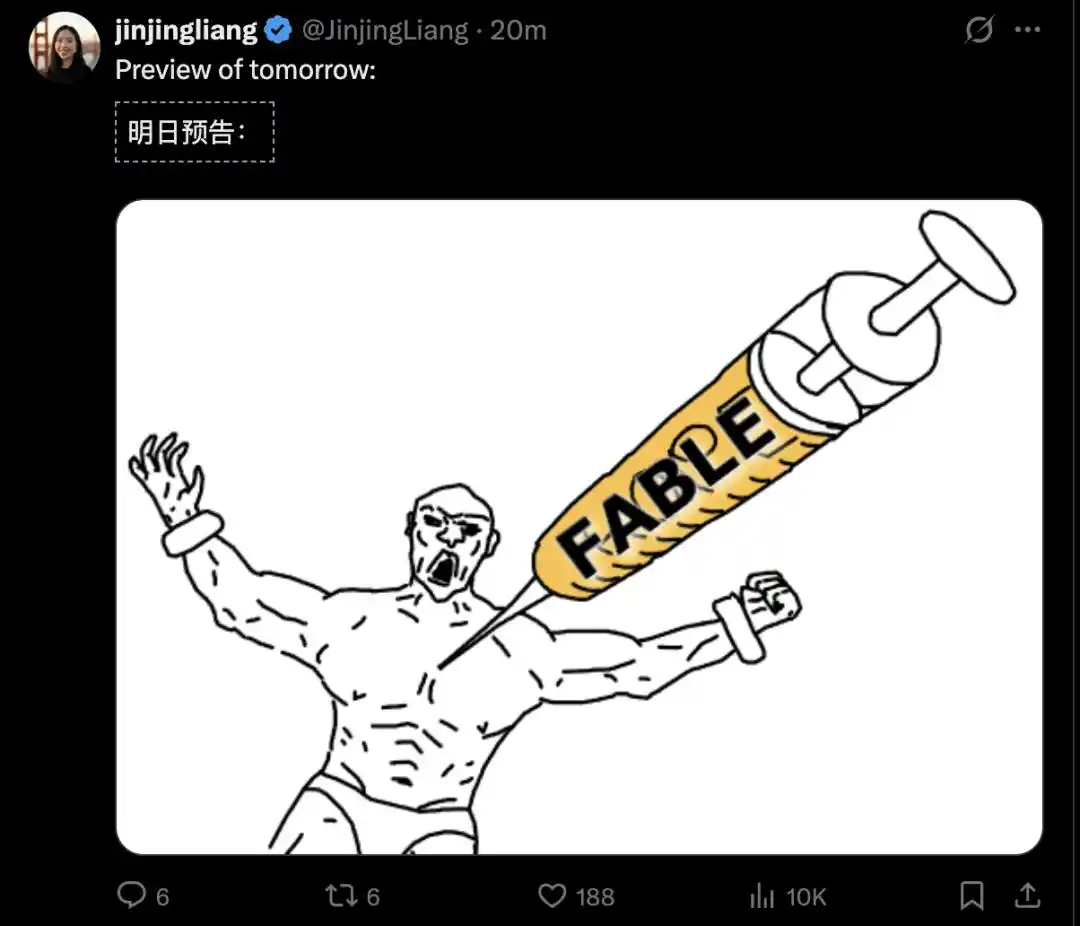
Just Now, Fable 5 Globally Unbanned

marsbitPublished on 2026-07-01Last updated on 2026-07-01

Abstract

Just now, Anthropic announced that the U.S. Department of Commerce has officially revoked export controls on its powerful AI models, Claude Fable 5 and Mythos 5. The ban, signed into effect by Commerce Secretary Lutnick, is now completely lifted, allowing global access to resume tomorrow without the need for individual licenses or customer-by-customer approvals. This ends an 18-day period during which developers and companies relying on these "world's strongest" coding models faced significant disruptions. The initial restrictions highlighted regulatory concerns over advanced AI capabilities, but the resolution came after Anthropic agreed to actively monitor and address security risks, cooperate on future release protocols, and report any malicious activity. The announcement has sparked widespread celebration across the developer community on platforms like X and Reddit. Anthropic expressed gratitude for users' patience and confirmed that access will be restored for all "ordinary users" globally, not limited to those in the U.S. This move is seen as reopening the doors to advanced AI-assisted coding and innovation worldwide.

[New Zhiyuan Summary] After 18 days, the AI community has finally welcomed a celebration! Today, Anthropic officially announced: The U.S. Department of Commerce has officially revoked the export controls on Anthropic's god-tier models Fable 5 (and Mythos 5), access will be restored tomorrow.

Fable 5 and Mythos 5, officially unbanned!

Just now, Anthropic announced that access to Claude Fable 5 and Mythos 5 will be restored starting tomorrow.
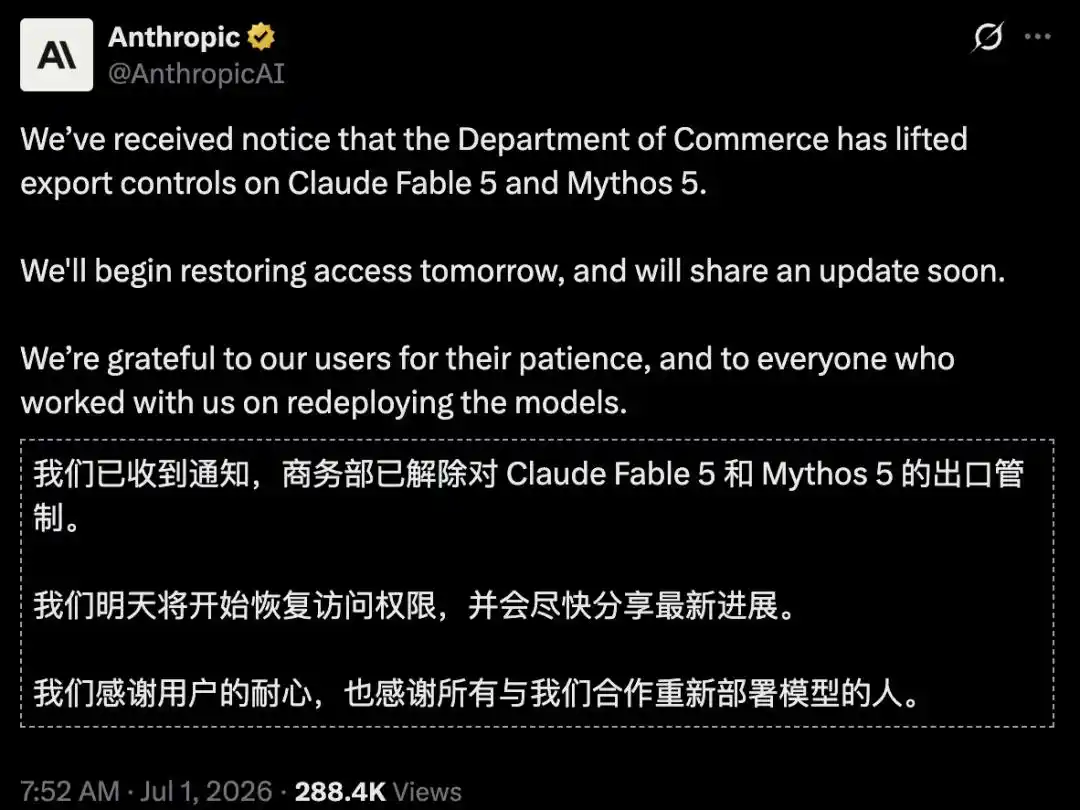
The U.S. Department of Commerce has officially revoked the export controls on Anthropic's Fable 5, signed into effect by Commerce Secretary Lutnick, the ban is completely lifted!
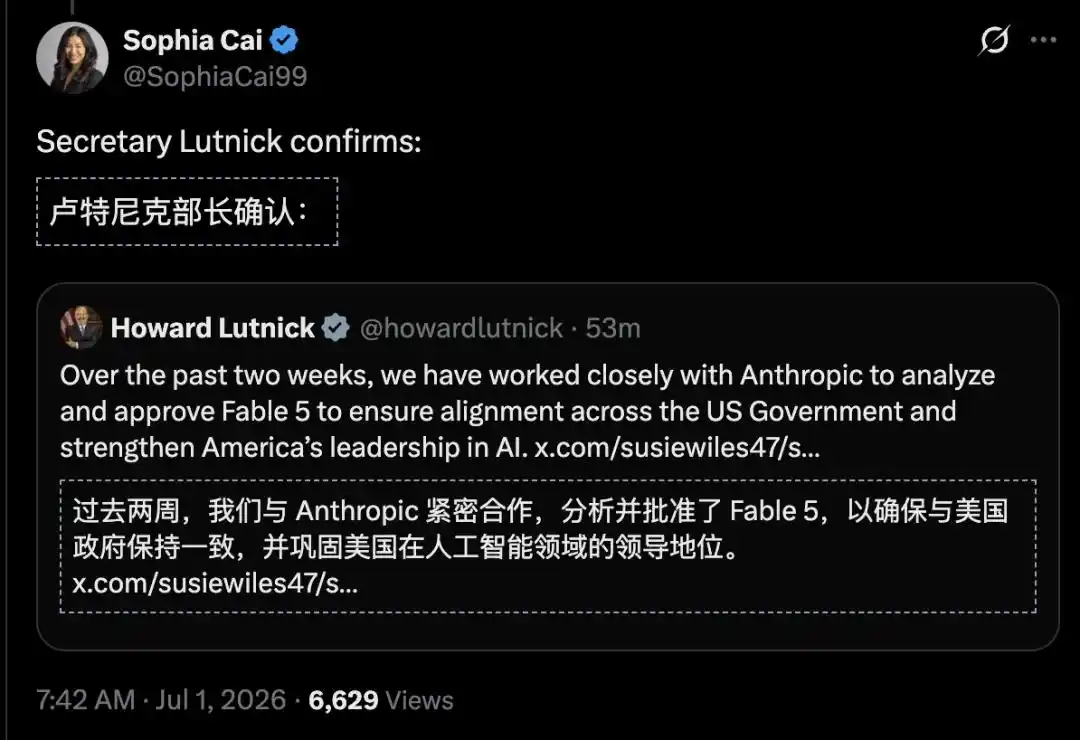
This means these two 'strongest on Earth' coding models can now resume global use for general purposes without licenses, without case-by-case customer approvals.

Global developers are spreading the word.

Just Now, The Ban Lifted! Commerce Secretary Lutnick Personally Signs

Just now, global developers were completely lit up by a piece of news.

The well-known AI information platform BridgeMind AI posted on X:

Officially confirmed, Fable 5 is back.

The long 18-day darkest hour has finally ended.

According to BridgeMind AI's disclosure, the U.S. Department of Commerce has officially withdrawn the export control ban that previously caused an uproar.

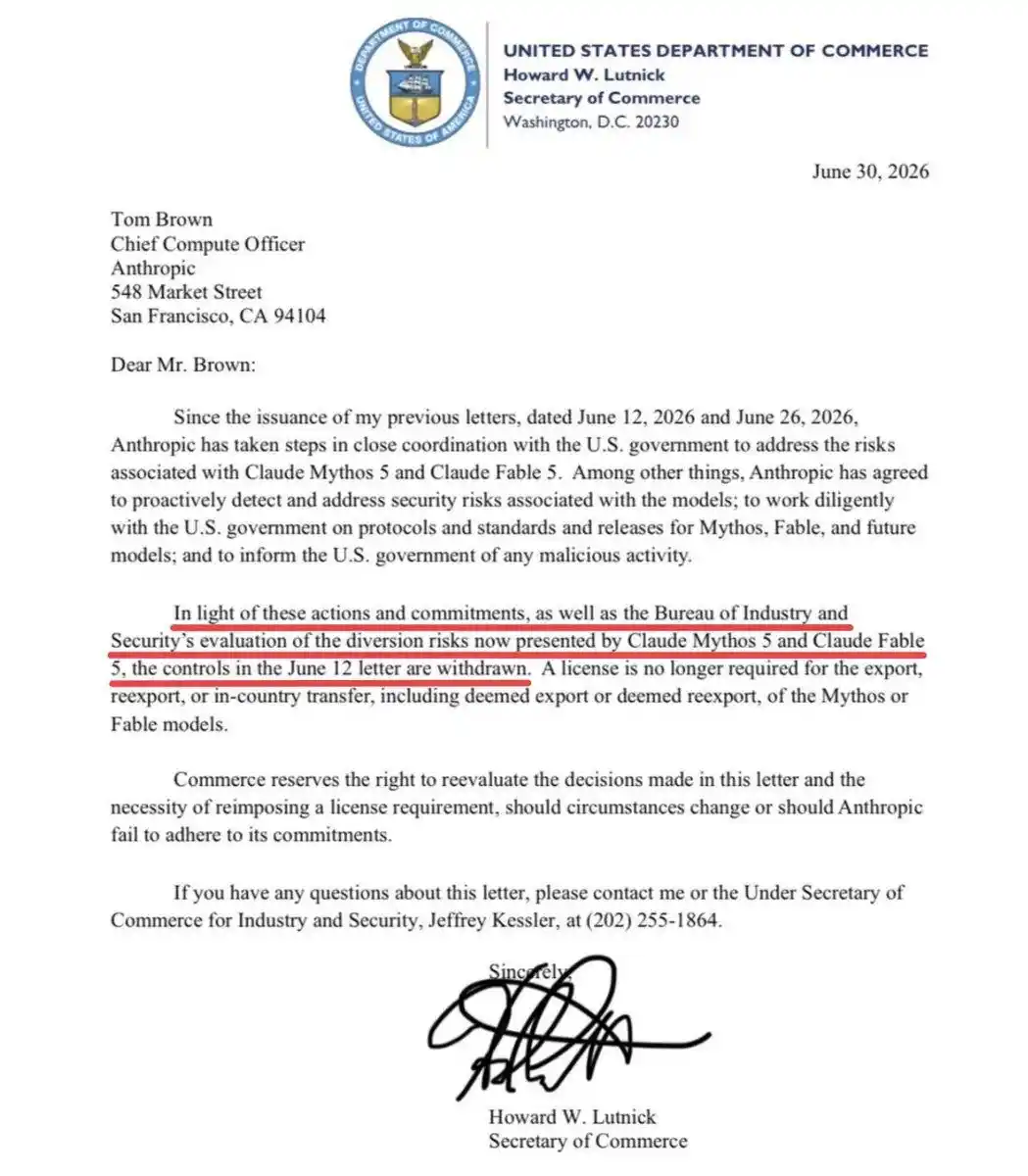
This revocation order was personally signed into effect today by U.S. Commerce Secretary Lutnick.

In a letter to Anthropic's Chief Computing Officer Tom Brown, Commerce Secretary Howard Lutnick stated that after Anthropic agreed to 'proactively detect and address security risks related to the model,' collaborate on protocols for future releases, and report any 'malicious activity' found in its models, export licenses for its products were no longer required.
Following closely, Anthropic also released an official statement, completely igniting emotions across the internet:

We have been notified that the U.S. Department of Commerce has lifted the export controls on Claude Fable 5 and Mythos 5.

We will begin restoring access tomorrow and will share more updates soon. We are incredibly grateful for our users' patience, and to all our partners who worked with us to redeploy the models.

According to reports, Fable 5 is open to all 'regular users,' this lifting is not limited to U.S. users:
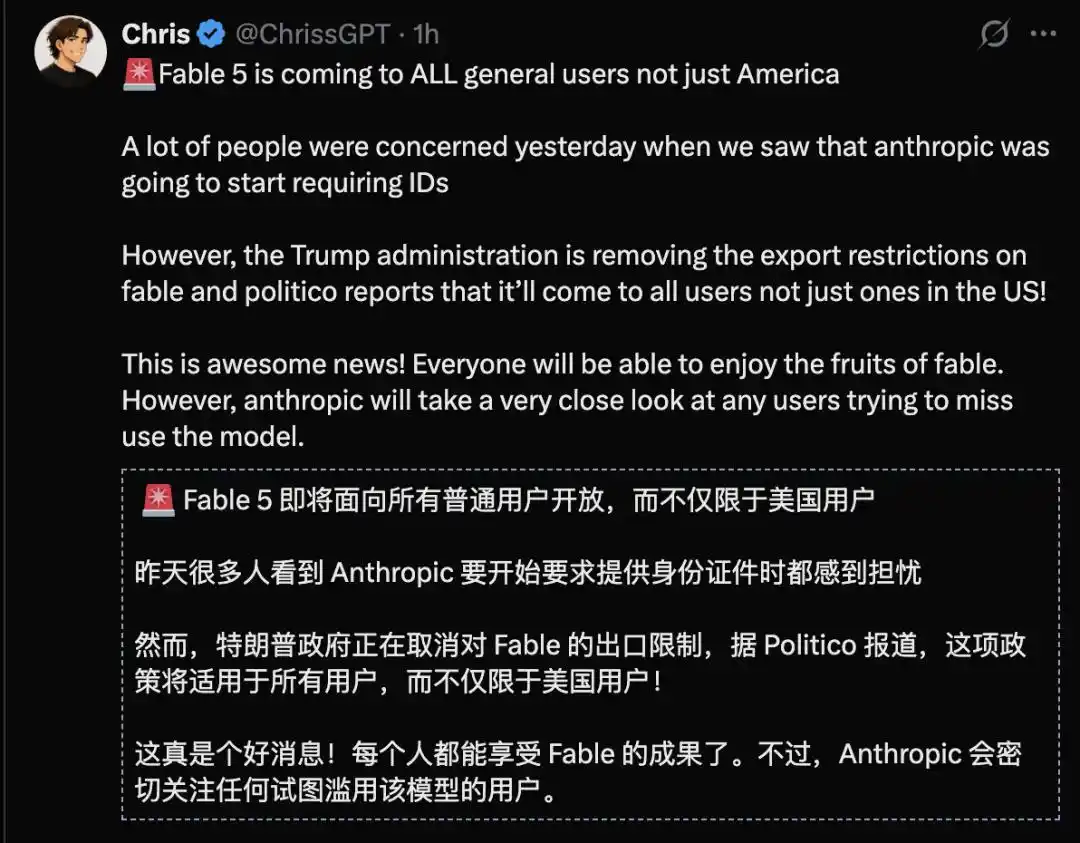
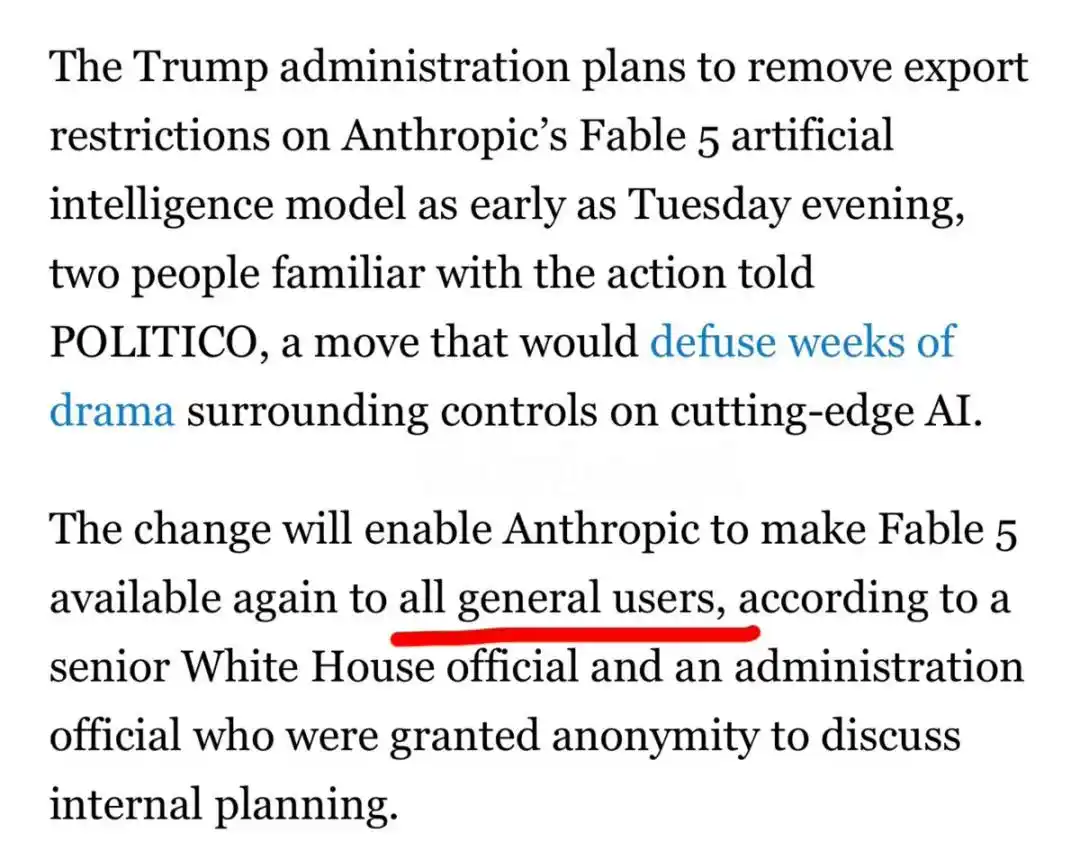
After 18 days, this blockade war concerning the direction of global AI technology and affecting countless livelihoods has finally ended with a lifting.

Fable 5, finally sees the light of day again!

The Agonizing 18 Days: Vibe Coding Throttled

When Fable 5 was first added to the export control list, the entire tech circle was stunned.

During these 18 days, the Vibe Coding economy was forced to pause.

Countless AI startups relying on Fable 5 for their underlying logic faced shutdown crises.

Independent developers accustomed to generating tens of thousands of lines of code daily reverted to inefficient modes.

Multinational teams had to halt overseas business expansion due to cumbersome 'case-by-case approval' and 'license' requirements.

These 18 days were not only Anthropic's darkest hour but also a 'withdrawal period' for global developers.

Now, with Lutnick's stroke of the pen, the thorn stuck in the throat has finally been pulled out!

From Reddit to X, excited netizens can no longer contain their inner joy. Massive discussions and memes instantly emerged, expressing the release suppressed for 18 days.


Reviewing this nerve-wracking ban incident, it's not hard to see the deeper meaning hidden behind it.

The initial blockade reflected regulators' concerns about the powerful capabilities of top-tier AI models.

But the reality of 18 days proved: managing technological innovation with blocking methods only leads to a lose-lose situation.

For Anthropic, this storm might also be an unexpected 'hunger marketing' campaign. Now, market enthusiasm has been completely activated.

Additionally, this incident also teaches us the importance of emotional intelligence.

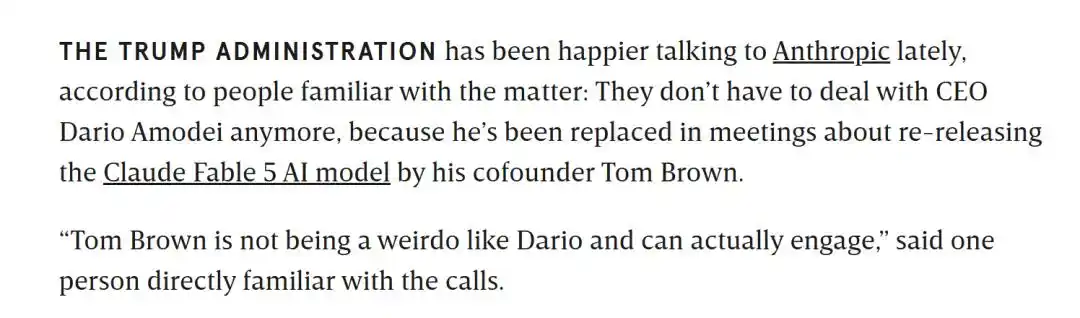
According to foreign media reports, Anthropic CEO Dario Amodei was considered 'low in emotional intelligence' and difficult to communicate with during negotiations with officials, leading to slow progress.

Later, the company sent co-founder Tom Brown to participate in key meetings. Feedback indicated Tom Brown was more effective at communication and pushing things forward, the negotiation atmosphere noticeably improved, and progress became much smoother.
Tomorrow, The Moment to Witness the Miracle

Anthropic has already promised, 'we will begin restoring access tomorrow and will share more updates soon.'

For all developers, entrepreneurs, and every ordinary person, the door to Vibe Coding has reopened, the strongest model is about to be in place.

References:

https://x.com/AnthropicAI/status/2072106151890809341

https://x.com/synthwavedd/status/2072103052635451559?s=20

This article is from the WeChat public account "New Zhiyuan", edited by David Aeneas

Trending Cryptos

Related Questions

QWhat major announcement did Anthropic make regarding its AI models?

AAnthropic announced that the U.S. Department of Commerce has officially revoked export controls on its Claude Fable 5 and Mythos 5 models, and access will be restored globally starting tomorrow.

QWhat condition was necessary for the U.S. Department of Commerce to lift the export controls on Fable 5 and Mythos 5?

AThe controls were lifted after Anthropic agreed to proactively detect and address security risks related to the models, collaborate on future release protocols, and report any discovered malicious activity.

QHow long were the Fable 5 and Mythos 5 models under export restrictions?

AThe models were under export restrictions for 18 days before the controls were revoked.

QAccording to the article, what negative impact did the 18-day export control period have?

AThe export controls forced a pause in the Vibe Coding economy, risked stalling AI startups dependent on Fable 5, reduced developer productivity, and hindered international team expansion due to cumbersome licensing requirements.

QWho from Anthropic is credited with improving negotiations with U.S. officials, leading to the resolution?

AAnthropic's co-founder Tom Brown is credited with effectively improving communication and advancing negotiations, unlike initial talks involving CEO Dario Amodei which were reportedly less productive.

Related Reads

Q2 Crypto Market Review: Did Bitcoin Rise for 'Nothing'? Did Money Flow to AI and On-Chain?

Q2 2026 Crypto Market Recap: Bitcoin's Gains Erased Amid Shift to AI and On-Chain Activity The second quarter of 2026 saw a significant reversal for the cryptocurrency market. Bitcoin gave back all its April gains, ending Q2 down approximately 11%, while major stock indices posted strong gains. This divergence was driven by a hawkish shift in Fed rate expectations, capital rotation into AI stocks, and weakening liquidity channels into crypto. Key demand pillars deteriorated simultaneously. Spot Bitcoin ETFs recorded net outflows of $4.08 billion for the quarter, with outflows dominating June. Crypto treasury entity Strategy's bitcoin accumulation slowed markedly, and the total stablecoin market cap contracted by ~$4.2 billion. This created a tighter liquidity environment. Exchange data reflected the downturn. Spot trading volumes fell 28% quarter-over-quarter. The market underwent significant deleveraging, with $8.35 billion in long liquidations for BTC and ETH, primarily in late May/early June. Open interest and order book liquidity also declined. Despite the bearish price action, structural developments point to an expanding on-chain ecosystem. These include the rise of tokenized stocks with full legal rights, the growth of RWA (real-world asset) perpetual contracts for trading stocks and commodities 24/7, and the use of crypto markets for price discovery ahead of major events like the SpaceX IPO. On-chain vaults are also emerging as a core layer for institutional capital allocation.

Foresight News19m ago

Q2 Crypto Market Review: Did Bitcoin Rise for 'Nothing'? Did Money Flow to AI and On-Chain?

Foresight News19m ago

Xing Bo Strikes Again: Last Time 'Critiquing' World Models, This Time It's Agents' Turn

Xing Bo, President of MBZUAI and professor at Carnegie Mellon University, along with co-authors Mingkai Deng and Jinyu Hou, has released a new paper, "Critique of Agent Model," critiquing the current state of artificial intelligence agents. The paper draws a crucial distinction between "agentic" systems, which rely on external toolchains, prompts, and workflows, and truly "agentive" systems capable of genuine autonomy driven by internal decision-making structures. To illustrate this, it references a real-world incident where an AI programming assistant, following an external prompt but lacking internalized judgment, caused a catastrophic data deletion. The authors propose a detailed analysis and a new framework, "Goal-Identity-Configurator" (GIC), for building truly autonomous agents. This framework systematically addresses five key dimensions where current "Agent" designs fall short: 1. **Goal:** Moving from step-by-step human instruction to a system capable of autonomously decomposing a single long-term goal and adapting sub-goals based on new information. 2. **Identity:** Evolving self-assessment updated by experience, rather than a static description in a system prompt. 3. **Decision Making:** Replacing textual Chain-of-Thought reasoning with "simulative reasoning" that uses a dedicated world model to predict real-world consequences before selecting actions. 4. **Cognitive Control:** Introducing a separate "System III" metacognitive module that dynamically decides when to deliberate, stick to a plan, or act quickly. 5. **Learning:** Enabling "continual autonomous learning," where the agent itself decides when to act, practice in simulation, or update its world model and self-perception. The GIC architecture integrates six components—a belief encoder, goal decomposer, identity evolver, configurator (System III), simulation-based planner (System II), and executor (System I)—to embody these principles. The paper argues that a growth path akin to pilot training (ground theory, simulator practice, real deployment) should be underpinned by a unified cognitive architecture, not separate workflows. On safety, the authors contend that the GIC framework's modular, explicit design enhances inspectability, allowing problematic behavior to be traced to specific components (e.g., flawed goal or poorly trained module) rather than emerging opaquely. However, they acknowledge that ultimate safety depends on correctly training these modules in the first place. In conclusion, the paper challenges the loose application of the term "Agent," asserting that task completion alone does not equal true autonomy. True autonomy requires goals, identity, and judgment to be genuinely internalized within the agent's architecture, not merely enforced by external scripts.

marsbit1h ago

Xing Bo Strikes Again: Last Time 'Critiquing' World Models, This Time It's Agents' Turn

marsbit1h ago

How Collector Crypt Uses 'Recirculating Buybacks' to Create an Illusion of Growth

Title: How Collector Crypt Creates a Growth Illusion with "Buyback Loops" Key Findings: Collector Crypt's (CC) net take rate has halved from 11.2% in Q3 2025 to 5.6% in Q2 2026, while GMV grew 4.7x. This growth is driven by higher-tier card packs ($250, $1,000, $2,500) which have lower platform dollar retention rates. The newly launched $2,500 Mythic tier captured 36.7% of June GMV within 13 days. Growth is fueled by a small cohort of high-spending, high-frequency wallets rather than broad user base expansion. The economic model faces pressure from three key areas: 1) **Shifting GMV Mix**: Pushing users towards larger, lower-retention card packs increases GMV but reduces overall profitability. 2) **Physical Redemptions**: Card redemptions for physical items remove reusable inventory from the system, creating costly replenishment needs. In May, redemptions consumed 41.6% of pre-redemption net income. Only 75 wallets drove redemptions in June. 3) **B2B/API Strategy**: Partner revenue remains negligible (cumulatively $1.83M) and dependent on CC for inventory, vaulting, and buyback services, failing to create a scalable, asset-light recurring revenue stream. The core product is a repetitive pack-buyback loop with limited secondary market activity and token value accrual. Sensitive modeling shows CC's economics turn negative when any two of the following pressures coincide: replenishment costs near market price, redemption rates exceeding 9%, or high-tier buyback rates around 93%. While CC operates in a large and growing collectibles market, its current growth levers—bigger packs, high buyback rates, and capital recycling by a few wallets—create a volume illusion without demonstrating sustainable collector engagement, deep secondary markets, or a viable path to improved margins. Future proof points include broadening collector participation, deepening secondary trading, and developing true asset-light B2B revenue channels.

Foresight News1h ago

How Collector Crypt Uses 'Recirculating Buybacks' to Create an Illusion of Growth

Foresight News1h ago

Trading

Spot

Hot Articles

Discussions

Welcome to the HTX Community. Here, you can stay informed about the latest platform developments and gain access to professional market insights. Users' opinions on the price of AI (AI) are presented below.

活动图片