The Entire Internet Hails Noam's Joining, But OpenAI's Loss Bill Just Got Thicker

marsbitPublished on 2026-06-19Last updated on 2026-06-19

Abstract

While the AI community celebrates Noam Shazeer, co-author of the "Attention Is All You Need" paper, joining OpenAI as Head of Architectural Research, the company's audited financials reveal a starkly different reality. In 2025, OpenAI reported $13.07 billion in revenue but a massive $20.92 billion operating loss. Even excluding a one-time accounting charge, the cash burn is severe, with $3.7 billion consumed in Q1 2026 alone. This high-profile hiring occurs against a backdrop of significant internal research talent drain, with key founders and researchers departing as the company's focus shifts from exploratory research to product iteration. Meanwhile, OpenAI's fundamental business model faces a deep crisis. It paid Microsoft $10.59 billion for compute in 2025, while its vast user base of 9 billion weekly actives includes only 50 million paying customers, making growth a direct driver of escalating costs. The article argues Shazeer's recruitment is less about technical necessity and more about crafting a compelling narrative for OpenAI's upcoming IPO, aiming to justify a rumored $1 trillion valuation to future public market investors. It contrasts OpenAI's strategy with Anthropic's reported path to profitability, which relies on a strong enterprise customer base and cost control, rather than star-powered narratives. Ultimately, the piece concludes that while Shazeer's architectural work may take 1-2 years to materialize, OpenAI's financial clock is ticking much faster, wit...

By | AI Chang Fan Tiao

Altman wrote on X: "Noam was one of the people I most wanted to work with when I started OpenAI. It only took 10 years. Worth it."

OpenAI's Chief Research Officer Mark Chen promptly announced: Noam Shazeer joins as Head of Architecture Research.
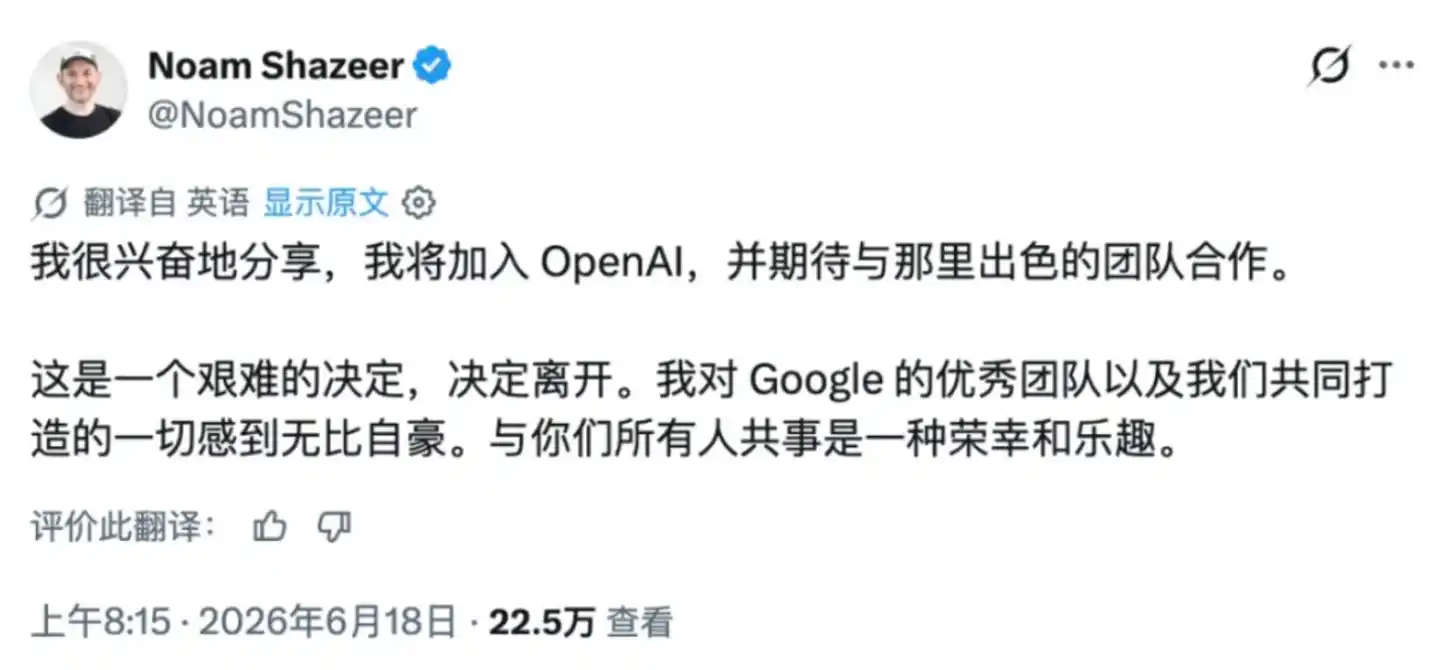
The entire internet lined up to cheer, "With the father of Transformer in charge, the next super-intelligence is guaranteed."

The same week, another document circulated within the industry: the first complete exposure of audited financial data shows OpenAI's 2025 revenue at $13.07 billion, with an operating loss of $20.92 billion. Including a one-time non-cash provision for restructuring, the net loss was nearly $39 billion. Even deducting that non-recurring accounting phantom loss, the real cash flow operating hemorrhage remains a bottomless pit. In Q1 2026, cash burn was $3.7 billion, exceeding half of the revenue for the same period.

So before hastily cheering that "OpenAI is steady," this isn't a technical success story at all—it's merely a check written on the back of $20.92 billion in operating losses. What OpenAI bought has nothing to do with the future; it's just a page in a story for the next round of investors.

Talent Is Leaking, Stars Are Filling In

Noam's resume is indeed dazzling. Core author of the 2017 paper "Attention Is All You Need," key contributor to Transformer, MoE, and T5. He left Google in 2021 to found Character.AI. In 2024, Google brought him back with a $2.7 billion technology licensing agreement, appointing him co-lead of Gemini. Less than two years later, he departed again.

Google proved one thing with $2.7 billion: Money can buy someone's time, but it can't buy the soil that makes them stay. Now OpenAI intends to try again with equity.

But OpenAI's soil isn't necessarily more suitable for pure research than Google's. Over the past three years, this company has been witnessing a talent swap: co-founder Karpathy left, Ilya Sutskever left, John Schulman left, and Jan Leike, head of the superalignment team, left. Large swaths of the core founding team have departed, leaving few in the core decision-making layer.

According to public industry data, research positions accounted for 23% of OpenAI's total hires in 2021 but dropped to 4.4% by 2024. Former internal researchers bluntly stated: The team's focus has shifted entirely from "exploratory research" to "product iteration." A few people jumping ship is just the surface. The truth that the research soil is being inch-by-inch squeezed out by product KPIs can no longer be hidden.

What he's facing is fundamentally not a lab starting from scratch. The system that Karpathy couldn't tolerate—and could only pursue "personal projects" within—is the mess Noam is inheriting. He's merely filling the hole left by the departure of Karpathy and others.

Sky-High Talent Buys Can't Save the Accounting Dilemma

Everyone is discussing what new architecture Noam can bring to OpenAI. But OpenAI's current predicament has nothing to do with "lacking someone who can write Transformer."

The financial figures are laid bare: In 2025 alone, R&D expenses included a $10.59 billion computing power leasing fee paid to Microsoft; total annual R&D cost was $19.18 billion; inference computing costs were $7.5 billion; and sales and marketing investments were $5.73 billion. On the other side are 900 million weekly active users, with only 50 million being paid users. Massive free traffic is a pure cost bottomless pit—the larger the user scale, the heavier the computing bill.

Even OpenAI itself is cutting costs: leaked documents show it has scaled back the Sora video model and trimmed non-core businesses to control costs. Cutting businesses to save money on one hand while spending exorbitantly to hire people on the other is anxious procurement.

The anxiety isn't unique to OpenAI; the industry wind has shifted long ago.

Microsoft's own Copilot Cowork has already abandoned the unlimited pricing model for a pay-per-use system due to high costs, and reportedly even considered integrating DeepSeek V4 as a cost-effective option. Even GitHub, under Microsoft, has turned to AWS for support due to AI computing shortages. If the financier's own computing pool isn't sufficient, who will foot OpenAI's astronomical computing bill next?

Cook publicly warned that the AI boom has driven storage chip prices up fourfold since 2024, a trend expected to continue until 2027, potentially increasing the price of the next iPhone by $270. These numbers serve more as industry indicators; the real hard math is inside OpenAI: computing hardware costs continue to climb, and efficiency gains from model architecture optimization simply can't keep pace with hardware price hikes. Noam can design more efficient model structures, but he can't fix the CFO's nightmare. Every additional free user adds another rigid computing bill.

The technical side offers no answers; the capital side must.

OpenAI is in a critical window of IPO preparation, with valuations touted as high as $1 trillion. Underwriters need sufficiently impactful stories to support the valuation. "The father of Transformer overseeing R&D" is exactly the kind of narrative material capital markets love most. The calculation for this investment isn't about how much model performance improved; the core question is whether it adds another highlight to the roadshow PPT.

Retail investors might get excited about "the father of Transformer joining," feeling the technical moat has thickened. But institutional investors, seeing the $20.92 billion operating loss in 2025, will only ask three practical questions:

Will this person suddenly make free users willing to pay?

Can he get Microsoft to discount the $10.59 billion computing bill?

Can he make departed research veterans return?

If the answer to all is no, then his value is merely a footnote in the valuation story. The biggest winners are always the early shareholders and underwriters. One more "genius in charge" story allows them to gracefully transfer the risk of $20.92 billion in operating losses to secondary market bag holders.

The Winner Between Two Paths Is Already Emerging

What is Anthropic doing during the same period?

In enterprise adoption rate statistics from multiple institutions, Anthropic's share has climbed to the 35%-40% range, significantly narrowing the lead with OpenAI and even surpassing it in some samples. More critically is its customer mix, with about 80% of revenue coming from enterprise clients; many Fortune 100 companies have already listed Claude on their procurement sheets. The company reportedly achieved its first profitable quarter in history and has confidentially filed for an IPO. Anthropic opens an office in Seoul, taking orders from NAVER and Nexon, earning real cash flow.

Anthropic didn't poach the "father of Transformer," nor does it rely on a single genius to prop up valuation. It relies on its enterprise-focused, compliant, neutral positioning, controllable token costs, and deep integration of Claude Code into development scenarios. What enterprise clients want has little to do with parameter counts; they want a "safety net that won't cause trouble" and a ledger that makes sense.

Google DeepMind's Hassabis hasn't moved in a decade, and Google didn't spend $2.7 billion to "redeem" him from outside. True innovative soil, which grows and retains research talent, cannot be bought annually for billions spent on external stars. The soil is only alive when it nurtures and keeps its own talent.

Anthropic has proven one thing: Profitability has little to do with individual genius; the foundation lies in the commercial soil.

OpenAI has also proven one thing: Individual genius cannot mask the hardening of commercial soil. Especially when you're buying talent at sky-high prices while watching your homegrown talent leave.

Conclusion

The next-generation architecture led by Noam will take at least 1 to 2 years to materialize. Yet, extrapolating from the Q1 2026 burn rate of $3.7 billion, annual cash consumption will not be less than $14.8 billion. This hasn't even accounted for the inevitably inflated marketing and compliance costs before the IPO.

Google spent $2.7 billion to rent one person for two years; OpenAI now intends to rent again using equity. The difference isn't the payment method. Google at least had its income statement to cushion it then; OpenAI's money for this is written on the back of $20.92 billion in operating losses, discounted by IPO valuation bubbles.

The ledger doesn't care about genius. The ledger only cares: How many quarters do you have left to wait?


Trending Cryptos

Related Questions

QWhat is the main argument of the article regarding OpenAI's hiring of Noam Shazeer?

AThe article argues that OpenAI's high-profile hiring of Noam Shazeer is primarily a strategic move to create a compelling narrative for its upcoming IPO and to appease investors, rather than a genuine solution to its deep-seated financial and structural problems. It suggests the company is using the 'Transformer co-inventor' story to divert attention from its massive operating losses and ongoing cash burn.

QWhat financial challenges for OpenAI are highlighted in the article?

AThe article highlights severe financial challenges: an operating loss of $20.92 billion in 2025, a net loss nearing $39 billion after accounting adjustments, and a cash burn of $3.7 billion in Q1 2026 alone. Key cost drivers include a $10.59 billion compute rental fee paid to Microsoft, $19.18 billion in total R&D costs, and the burden of serving a massive free user base (900M WAUs) with only 50M paying users.

QHow does the article contrast OpenAI's approach with that of its competitor Anthropic?

AThe article contrasts OpenAI's reliance on star hires and consumer-focused growth with Anthropic's business-oriented, sustainable model. Anthropic is reported to have reached profitability, with around 80% of its revenue from enterprise clients, focusing on compliance, controlled costs, and deep product integration (like Claude Code). This is presented as a more stable path compared to OpenAI's high-burn, narrative-driven strategy.

QWhat point does the article make about the 'research soil' or culture at OpenAI?

AThe article contends that OpenAI's internal 'research soil' has deteriorated, shifting from exploratory research towards product iteration and KPIs. This is evidenced by the exodus of founding researchers (like Karpathy, Sutskever) and a sharp drop in research hiring (from 23% of hires in 2021 to 4.4% in 2024). It suggests Noam Shazeer is entering a system that previously couldn't retain top research talent, questioning the long-term viability of a pure research role there.

QWhat is the article's view on the real value of hiring a top AI researcher like Noam Shazeer for OpenAI's core problems?

AThe article is skeptical, arguing that a brilliant architect like Noam Shazeer cannot solve OpenAI's fundamental business model flaws. His technical optimizations cannot significantly reduce the crippling compute costs, convert free users to paid ones, or lower Microsoft's bills. His primary value, according to the article, is as a 'footnote' in a valuation story to help justify a high IPO price and transfer financial risk to public market investors.

Related Reads

Xing Bo Strikes Again: Last Time 'Critiquing' World Models, This Time It's Agents' Turn

Xing Bo, President of MBZUAI and professor at Carnegie Mellon University, along with co-authors Mingkai Deng and Jinyu Hou, has released a new paper, "Critique of Agent Model," critiquing the current state of artificial intelligence agents. The paper draws a crucial distinction between "agentic" systems, which rely on external toolchains, prompts, and workflows, and truly "agentive" systems capable of genuine autonomy driven by internal decision-making structures. To illustrate this, it references a real-world incident where an AI programming assistant, following an external prompt but lacking internalized judgment, caused a catastrophic data deletion. The authors propose a detailed analysis and a new framework, "Goal-Identity-Configurator" (GIC), for building truly autonomous agents. This framework systematically addresses five key dimensions where current "Agent" designs fall short: 1. **Goal:** Moving from step-by-step human instruction to a system capable of autonomously decomposing a single long-term goal and adapting sub-goals based on new information. 2. **Identity:** Evolving self-assessment updated by experience, rather than a static description in a system prompt. 3. **Decision Making:** Replacing textual Chain-of-Thought reasoning with "simulative reasoning" that uses a dedicated world model to predict real-world consequences before selecting actions. 4. **Cognitive Control:** Introducing a separate "System III" metacognitive module that dynamically decides when to deliberate, stick to a plan, or act quickly. 5. **Learning:** Enabling "continual autonomous learning," where the agent itself decides when to act, practice in simulation, or update its world model and self-perception. The GIC architecture integrates six components—a belief encoder, goal decomposer, identity evolver, configurator (System III), simulation-based planner (System II), and executor (System I)—to embody these principles. The paper argues that a growth path akin to pilot training (ground theory, simulator practice, real deployment) should be underpinned by a unified cognitive architecture, not separate workflows. On safety, the authors contend that the GIC framework's modular, explicit design enhances inspectability, allowing problematic behavior to be traced to specific components (e.g., flawed goal or poorly trained module) rather than emerging opaquely. However, they acknowledge that ultimate safety depends on correctly training these modules in the first place. In conclusion, the paper challenges the loose application of the term "Agent," asserting that task completion alone does not equal true autonomy. True autonomy requires goals, identity, and judgment to be genuinely internalized within the agent's architecture, not merely enforced by external scripts.

marsbit7m ago

Xing Bo Strikes Again: Last Time 'Critiquing' World Models, This Time It's Agents' Turn

marsbit7m ago

How Collector Crypt Uses 'Recirculating Buybacks' to Create an Illusion of Growth

Title: How Collector Crypt Creates a Growth Illusion with "Buyback Loops" Key Findings: Collector Crypt's (CC) net take rate has halved from 11.2% in Q3 2025 to 5.6% in Q2 2026, while GMV grew 4.7x. This growth is driven by higher-tier card packs ($250, $1,000, $2,500) which have lower platform dollar retention rates. The newly launched $2,500 Mythic tier captured 36.7% of June GMV within 13 days. Growth is fueled by a small cohort of high-spending, high-frequency wallets rather than broad user base expansion. The economic model faces pressure from three key areas: 1) **Shifting GMV Mix**: Pushing users towards larger, lower-retention card packs increases GMV but reduces overall profitability. 2) **Physical Redemptions**: Card redemptions for physical items remove reusable inventory from the system, creating costly replenishment needs. In May, redemptions consumed 41.6% of pre-redemption net income. Only 75 wallets drove redemptions in June. 3) **B2B/API Strategy**: Partner revenue remains negligible (cumulatively $1.83M) and dependent on CC for inventory, vaulting, and buyback services, failing to create a scalable, asset-light recurring revenue stream. The core product is a repetitive pack-buyback loop with limited secondary market activity and token value accrual. Sensitive modeling shows CC's economics turn negative when any two of the following pressures coincide: replenishment costs near market price, redemption rates exceeding 9%, or high-tier buyback rates around 93%. While CC operates in a large and growing collectibles market, its current growth levers—bigger packs, high buyback rates, and capital recycling by a few wallets—create a volume illusion without demonstrating sustainable collector engagement, deep secondary markets, or a viable path to improved margins. Future proof points include broadening collector participation, deepening secondary trading, and developing true asset-light B2B revenue channels.

Foresight News30m ago

How Collector Crypt Uses 'Recirculating Buybacks' to Create an Illusion of Growth

Foresight News30m ago

Grayscale's Latest Research: What is Solana's Next Growth Engine?

Grayscale's latest report, "Solana: Crypto's Financial Bazaar," signals a shift in how the market views Solana, moving beyond its high-performance and meme-centric reputation. The report frames Solana as an evolving application platform for large-scale economic activity, akin to a bustling digital marketplace. The analysis highlights that public chain competition has moved past raw throughput (TPS) to focus on genuine economic activity—daily users, transaction volume, and real revenue. Solana's metrics, such as over 1,000 dApps, 100M+ daily transactions, and ~4.3M daily active users, showcase this shift toward application-layer prosperity. The report identifies three key growth drivers: 1. **Jupiter**: Evolving from a DEX aggregator to a core liquidity hub and comprehensive financial platform for Solana's DeFi. 2. **Pump.fun**: Demonstrates Solana's capacity for consumer-scale applications, attracting millions of users and generating significant, sustainable revenue, validating network stability under high load. 3. **Helium & DePIN**: Represents expansion into real-world infrastructure, connecting blockchain to physical resources like wireless networks and positioning services, opening new long-term use cases. Solana Foundation's recent focus aligns with this broader vision, emphasizing AI Agents (for machine-to-machine transactions), payments, stablecoins, and Real-World Assets (RWA) to build a sustainable growth model beyond cyclical trends. While challenges remain—such as value capture for SOL and maintaining ecosystem sustainability beyond hot trends—institutional interest is growing due to Solana's maturing application business models, expanding payment/stablecoin ecosystem, and persistent developer activity. The competition is no longer about speed alone, but about which network can foster the most vibrant and valuable digital economy.

marsbit51m ago

Grayscale's Latest Research: What is Solana's Next Growth Engine?

marsbit51m ago

Trading

Spot

Hot Articles

How to Buy BILL

Welcome to HTX.com! We've made purchasing Billions Network (BILL) simple and convenient. Follow our step-by-step guide to embark on your crypto journey.Step 1: Create Your HTX AccountUse your email or phone number to sign up for a free account on HTX. Experience a hassle-free registration journey and unlock all features.Get My AccountStep 2: Go to Buy Crypto and Choose Your Payment MethodCredit/Debit Card: Use your Visa or Mastercard to buy Billions Network (BILL) instantly.Balance: Use funds from your HTX account balance to trade seamlessly.Third Parties: We've added popular payment methods such as Google Pay and Apple Pay to enhance convenience.P2P: Trade directly with other users on HTX.Over-the-Counter (OTC): We offer tailor-made services and competitive exchange rates for traders.Step 3: Store Your Billions Network (BILL)After purchasing your Billions Network (BILL), store it in your HTX account. Alternatively, you can send it elsewhere via blockchain transfer or use it to trade other cryptocurrencies.Step 4: Trade Billions Network (BILL)Easily trade Billions Network (BILL) on HTX's spot market. Simply access your account, select your trading pair, execute your trades, and monitor in real-time. We offer a user-friendly experience for both beginners and seasoned traders.

1.6k Total ViewsPublished 2026.05.07Updated 2026.06.02

How to Buy BILL

Discussions

Welcome to the HTX Community. Here, you can stay informed about the latest platform developments and gain access to professional market insights. Users' opinions on the price of BILL (BILL) are presented below.

活动图片