Following US Ban on Fable 5, Zhipu AI's Stock Soars 47%

marsbitPublished on 2026-06-15Last updated on 2026-06-15

Abstract

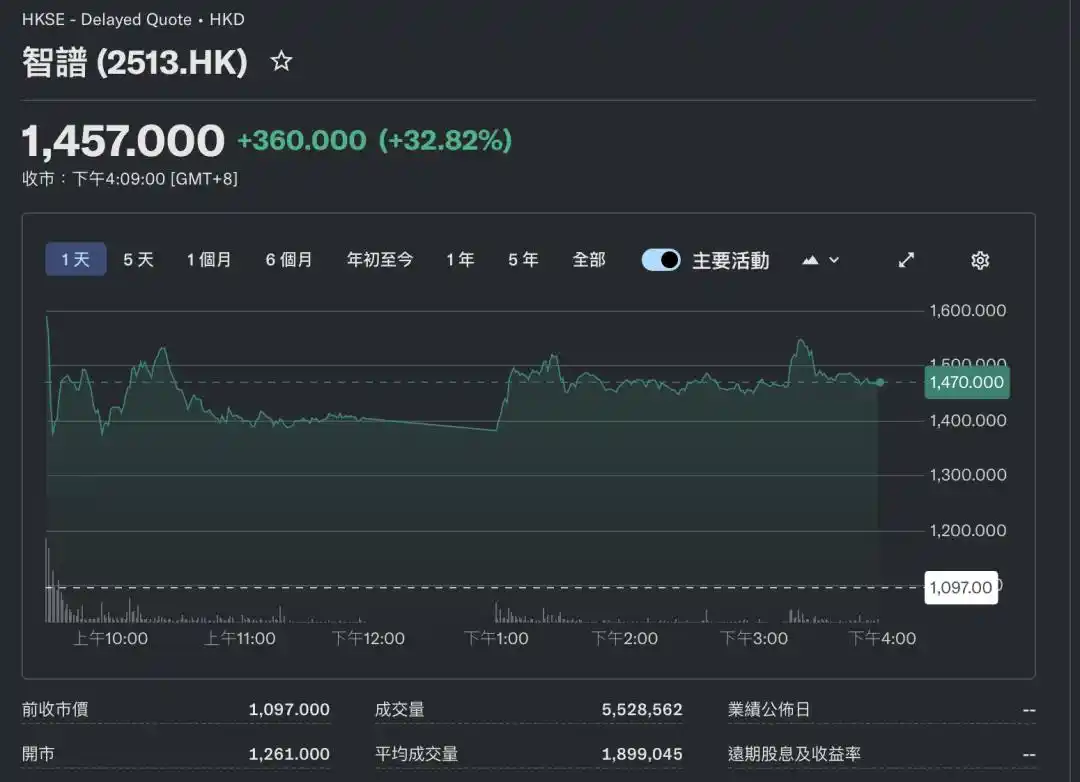
On June 15th, shares of Zhipu AI surged dramatically on the Hong Kong stock market, peaking at a 47.6% gain before closing 32.82% higher. This sharp increase was directly triggered by two recent industry events. On June 12th, Anthropic announced it was suspending global access to its latest flagship models, Claude Fable 5 and Claude Mythos 5, to comply with a U.S. government export control order. The next day, Zhipu AI announced it would open access to its latest open-source flagship model, GLM-5.2, under the permissive MIT license. The Anthropic incident highlighted a critical issue beyond raw model capability: the risk of sudden, unpredictable loss of access to advanced AI models, especially for developers and enterprises deeply integrated with them. This has shifted industry and market focus toward factors like stability, sustainable access, and controllability. Zhipu's move, promoting "frontier intelligence for all," positions its openly available model as a reliable and accessible alternative. The GLM-5.2 model emphasizes "Long Horizon Task" capabilities with a 1M context window, targeting complex, multi-step coding and engineering workflows where maintaining context is crucial. Analysts note this event exposes the risk of dependency on closed-source models subject to single jurisdictional controls, potentially accelerating a shift toward domestic base models and localized deployments. The market's reaction signals a new valuation dimension in AI: providers who can off...

On June 15th, when the Hong Kong stock market opened, Zhipu AI's stock price surged continuously, with an intraday peak increase of 47.6%, setting a new record for single-day trading volume since its listing. By market close, the gain had moderated to 32.82%, with the total market capitalization exceeding HK$649.6 billion.
The immediate trigger came from two industry news items two days earlier.

On June 12th, Anthropic suspended access to its latest flagship models Claude Fable 5 and Claude Mythos 5 for compliance with U.S. government export control requirements. A day later, Zhipu AI announced that its latest open-source model GLM-5.2 was made available to all Coding Plan users, with APIs and open-source model weights scheduled for release the following week under the MIT license.

When the Most Advanced Models Become 'Not Necessarily Available'

On June 12th, Anthropic issued an official announcement stating that the U.S. government, invoking national security authorities, had issued an export control directive requiring the suspension of access to Claude Fable 5 and Claude Mythos 5 for all foreign nationals. The restrictions applied to non-U.S. users both inside and outside the United States, even including foreign employees within Anthropic.

Limited by the technical inability to accurately distinguish user nationality in real-time, Anthropic ultimately chose to temporarily disable the two models for all global customers to ensure compliance. This occurred just three days after the models' official release. As of now, both models are marked as unavailable on Anthropic's website, with no clear timeline for restoration.

As top-tier closed-source models in terms of current performance, the Claude series is deeply integrated into the workflows of many developers and enterprises for long-context tasks, code development, and complex document processing. The sudden suspension directly impacted numerous teams, sparking heated discussions within the community about alternative solutions.

Just as discussions about the suspension were gaining momentum, on June 13th, Zhipu AI announced that its open-source flagship model GLM-5.2 was fully accessible to all Coding Plan users, covering Lite, Pro, Max, and Team editions. It also previewed that APIs and model weights would be launched the following week, open-sourced under the MIT license.

Over the past few years, competition in the large model industry has primarily revolved around capability.

Whose reasoning is stronger, whose coding ability is better, and who can first break through new capability boundaries have largely determined the choices of developers and enterprise customers.

However, the Anthropic incident exposed another, previously often overlooked issue: beyond capability, whether continuous and stable access to a model can be guaranteed.

In this Anthropic event, for many developers and enterprises relying on overseas models for R&D, even with accounts and paid subscriptions, they faced the risk of models suddenly becoming unavailable.

This is also why this incident sparked far more discussion in the developer community than typical product updates.

As AI gradually evolves from a chat tool into infrastructure for software development, enterprise operations, and even production processes, model stability, sustainability, and controllability are beginning to become metrics as crucial as model capability itself.

Zhipu AI stated in its announcement, "Cutting-edge intelligence should not belong only to a few, nor should it be subject to recall by a few rules at any time." This statement corresponds to the new reality facing the global AI industry today.

From 'Who is Stronger' to 'Who is More Accessible'

The rapid reaction of the capital market essentially represents an early pricing-in of changes in industry logic. Beyond the stock performance, the market is more focused on the signals released by GLM-5.2 itself.

According to information disclosed by Zhipu AI, GLM-5.2 is its most capable open-source model to date, supporting a 1M context window, with a particular focus on enhancing long-context coding task capabilities. Zhipu positions it as a "truly usable 1M context" model, aiming to address the issue of models forgetting context in prolonged, multi-step engineering tasks.

A core keyword here is "Long Horizon Task." As AI Agents evolve from conversational tools into execution tools, models need to continuously handle thousands of tool calls, tens of thousands of lines of code, and massive amounts of intermediate state information. The longer the context window, the stronger the model's ability to maintain project state and task continuity.

Current industry competition has shifted from "answering questions" to "continuous work." For developers, what truly matters is not parameter scale, but whether a model can maintain consistency and reliability over complex tasks lasting several hours or even days.

Judging by the market reaction, investors have clearly become aware of this shift as well.

Dongfang Securities noted in a research report that the Anthropic model incident exposed the risk of closed-source model access being subject to a single jurisdiction, which may drive more enterprises to shift core AI capabilities towards domestic foundational models and localized deployment. Meanwhile, GLM-5.2's open-sourcing under the MIT license further lowers the barrier for enterprise trial and integration.

Over the past year, capital market valuations for large model companies have been largely based on model capability and market share. Today, as the global regulatory environment intensifies, a new valuation dimension is emerging — who can provide developers and enterprises with AI capabilities that are stable, sustainable, and accessible in the long term.

When access to the world's most advanced models begins to be influenced by external factors, openness, accessibility, and autonomous controllability are becoming new bargaining chips in AI competition.

This article is from the WeChat public account "GeekPark" (ID: geekpark), author: Lian Ran, editor: Zheng Xuan


Related Questions

QWhat was the stock performance of Zhipu on June 15th?

AZhipu's stock surged significantly on June 15th. At its peak during the trading day, the increase reached 47.6%. By market close, the gains had moderated to 32.82%, pushing the company's total market capitalization above 649.6 billion Hong Kong dollars.

QWhat was the direct catalyst for Zhipu's stock surge according to the article?

AThe direct catalyst was two industry events. First, on June 12th, Anthropic suspended access to its latest flagship models, Claude Fable 5 and Claude Mythos 5, for non-U.S. persons due to U.S. government export controls. The next day, on June 13th, Zhipu announced the availability of its latest open-source model, GLM-5.2, to all Coding Plan users, with API access and model weights to be released the following week under the MIT license.

QWhat key concern did the Anthropic incident highlight for developers and enterprises using AI models?

AThe Anthropic incident highlighted the critical concern of access stability and sustainability. It demonstrated that even with accounts and paid subscriptions, access to advanced models can be suddenly revoked due to external factors like government regulations. For developers and businesses integrating AI into core workflows and infrastructure, this makes the reliability and continuous availability of a model as important as its raw capabilities.

QWhat is the key technical feature and focus of Zhipu's GLM-5.2 model mentioned in the article?

AA key technical feature of GLM-5.2 is its support for a 1 million token context window. The model is specifically focused on enhancing capabilities for 'Long Horizon Tasks,' such as complex, multi-step coding tasks, to solve the problem of models forgetting context during lengthy and complex engineering projects.

QHow does the article suggest the valuation criteria for AI companies might be changing?

AThe article suggests that valuation criteria are expanding beyond just model capability and market share. A new dimension is emerging: the ability to provide AI capabilities that are stable, sustainable, accessible, and autonomously controllable over the long term. As geopolitical and regulatory risks increase for closed-source models, attributes like openness, availability, and local control are becoming valuable new factors in competitive and financial assessments.

Related Reads

7 Key Questions Regarding 'DeepSeek Completes Over 50 Billion Yuan in Financing'

DeepSeek, the prominent Chinese AI company, has reportedly completed its first external funding round, raising over 50 billion RMB (approximately $6.9 billion USD), according to foreign media reports. This financing values the company at over $50 billion USD, a significant increase from a $10 billion valuation when the round began in April 2026. Founder Liang Wenfeng personally contributed 20 billion RMB, with other investors including Tencent, CATL (Contemporary Amperex Technology), JD.com, NetEase, and IDG Capital. Notably, the National Artificial Intelligence Industry Investment Fund also participated with a direct investment of 1 billion RMB. The funding round is distinctive for its structure. Most investors' capital is channeled into a limited partnership controlled by CEO Liang Wenfeng, rather than directly into DeepSeek. These investors face a five-year lock-up period, have no voting rights, but receive priority financial information and future investment rights. This arrangement is seen as a measure to ensure Liang's absolute control over the company's direction, aligning with its stated principles of prioritizing groundbreaking AGI (Artificial General Intelligence) research over short-term profitability. The report highlights strategic reasons for key investors. Tencent's involvement is viewed as a strategic alignment, building on existing collaborations. CATL's investment is linked to the critical energy and power infrastructure needed for AI data centers, a key growth area for the battery giant. The participation of a state-backed fund underscores the national strategic importance of AI development. Post-funding, DeepSeek is expected to accelerate infrastructure development, including building its own data centers, hire more talent, and release new model versions with enhanced capabilities like image and audio support. While this marks a major step, the company's long-term journey towards AGI remains a challenging path that will require balancing its foundational ideals with the expectations of its new investors.

marsbit4m ago

7 Key Questions Regarding 'DeepSeek Completes Over 50 Billion Yuan in Financing'

marsbit4m ago

The World Cup is Here: The Battle for Entry into Prediction Markets Has Begun

The 2026 FIFA World Cup has begun, and alongside the on-field competition, a new off-field battleground is emerging: prediction markets. These blockchain-based platforms, which convert crowd wisdom into tradable probabilities, are gaining significant traction. However, their complexity—involving wallets, gas fees, and smart contracts—has historically limited participation to crypto-native users. Centralized exchanges (CEXs), like Gate, are tackling this adoption barrier. By integrating with leading prediction market protocol Polymarket, Gate simplifies the user experience. Users can participate directly with their exchange account and USDT, bypassing complex Web3 steps. Gate offers a streamlined "Prediction Mode" for casual users and a professional "Trading Mode" with advanced tools. Key features include two-way trading (allowing users to buy or sell positions before event resolution), support for diverse markets (sports, crypto, macroeconomics), and a suite of information tools like a "Smart Money" leaderboard, wallet tracking, and AI-powered insights. For the World Cup, Gate launched a dedicated hub aggregating schedules, standings, and relevant markets. This allows fans to seamlessly follow games and trade on outcomes, transforming passive viewing into active participation where they can monetize their predictions and trade on shifting consensus throughout a match. The article argues that prediction markets have proven their value in event forecasting. The next challenge is mass adoption. The competition is shifting from building effective protocols to creating accessible user entry points. By lowering technical barriers and building a complete ecosystem for information and trading, platforms like Gate aim to transition prediction markets from a niche crypto tool to a mainstream platform for expressing and trading on collective intelligence.

Odaily星球日报14m ago

The World Cup is Here: The Battle for Entry into Prediction Markets Has Begun

Odaily星球日报14m ago

Spain Held to a Draw by Cape Verde, Jucom Prediction Market Witnesses Historic Upset

In a major upset at the 2026 FIFA World Cup, tournament favorites Spain were held to a surprising 0-0 draw by debutants Cape Verde in their Group H opener on June 16, Beijing time. Despite dominating possession (74%) and recording 27 shots with an expected goals figure of 2.16, Spain failed to break down a resilient Cape Verde defense, with their 40-year-old goalkeeper Vozinha making 7 saves to earn Man of the Match. Pre-match predictions on the Jucom prediction market had heavily favored Spain, assigning them a 92% win probability. The actual result, a goalless draw, triggered significant volatility across related prediction markets. This outcome forces a market-wide reassessment of several key probabilities, including Spain's likelihood of winning the group and the tournament itself, while Cape Verde's previously near-zero chance of advancing is now being re-evaluated. The event highlights both the efficiency and the inherent limitations of prediction markets. While prices aggregate known information, football's low-scoring, high-variance nature means unquantifiable in-game factors can lead to unlikely results. The core value of such markets lies not in perfect foresight but in their ability to dynamically reflect how new information is incorporated into collective expectations. Platforms like Jucom, which track outcomes from single matches to the final champion, provide a real-time lens into how global consensus evolves with each game.

链捕手18m ago

Spain Held to a Draw by Cape Verde, Jucom Prediction Market Witnesses Historic Upset

链捕手18m ago

Trading

Spot
Futures

Hot Articles

Discussions

Welcome to the HTX Community. Here, you can stay informed about the latest platform developments and gain access to professional market insights. Users' opinions on the price of S (S) are presented below.

活动图片