After 50x Storage Surge, Justin Sun Always Looks to the Next Decade

marsbitXuất bản vào 2026-05-11Cập nhật gần nhất vào 2026-05-11

Tóm tắt

Sun Yuchen, known for his controversial stunts like a $30 million lunch with Warren Buffett (canceled due to a kidney stone) and eating a $6.2 million duct-taped banana, is often overshadowed by a significant fact: his decade-long track record of spotting major investment trends. In 2016, he famously advised young people to invest in Bitcoin, Nvidia, Tesla, and Tencent instead of buying property. A hypothetical $20,000 investment in Nvidia and Tesla from that list would now be worth over 50 million RMB. His latest major call was on November 6, 2025, predicting a "50x storage opportunity" tied to the AI boom, which materialized with Sandisk's stock surging nearly 50-fold by 2026. Looking ahead, Sun now focuses on the next frontier: Physical AI. He identifies four key areas: 1. **Embodied AI/Robotics**: He sees this reaching its "iPhone moment," with companies like UBTech and Galaxy General leading in commercialization. 2. **Drones**: Viewed as the first commercially viable form of Physical AI, revolutionizing sectors from warfare (e.g., AeroVironment's Switchblade) to logistics. 3. **Spatial Computing**: Beyond VR, it's about AI understanding physical space, a foundational technology for robotics and autonomous systems, exemplified by Apple's Vision Pro. 4. **Space Exploration**: After a 2025 suborbital flight with Blue Origin, Sun advocates for space as the ultimate frontier, discussing blockchain's potential role in space asset management and data transactions. His in...

Most people in China know Justin Sun from his bizarre stories.

Spending 30 million to have dinner with Warren Buffett, only to cancel at the last minute due to a kidney stone; buying a duct-taped banana for 6.2 million dollars at an auction and eating it in front of everyone at a press conference; investing 75 million dollars to become the largest backer of the Trump family's crypto project, securing a seat at a White House dinner; and at the age of 35, flying past the Kármán line, declaring himself the youngest Chinese commercial astronaut.

There are also many negatives. In 2023, he was sued by the SEC for market manipulation, with accusations including over 600,000 wash trades to inflate the price of TRX and hiring celebrities for promotion without disclosing payments. Currently, he is in a lawsuit with the Trump family-related project WLFI.

These stories spread so widely that they almost overshadowed a serious matter. This man, over the past decade in the secondary capital markets, has almost never missed betting on any trend.

From buying BTC starting in late 2013, to 2016, advising post-90s generations not to buy houses, but to buy:

Bitcoin, NVIDIA, Tesla, Tencent.

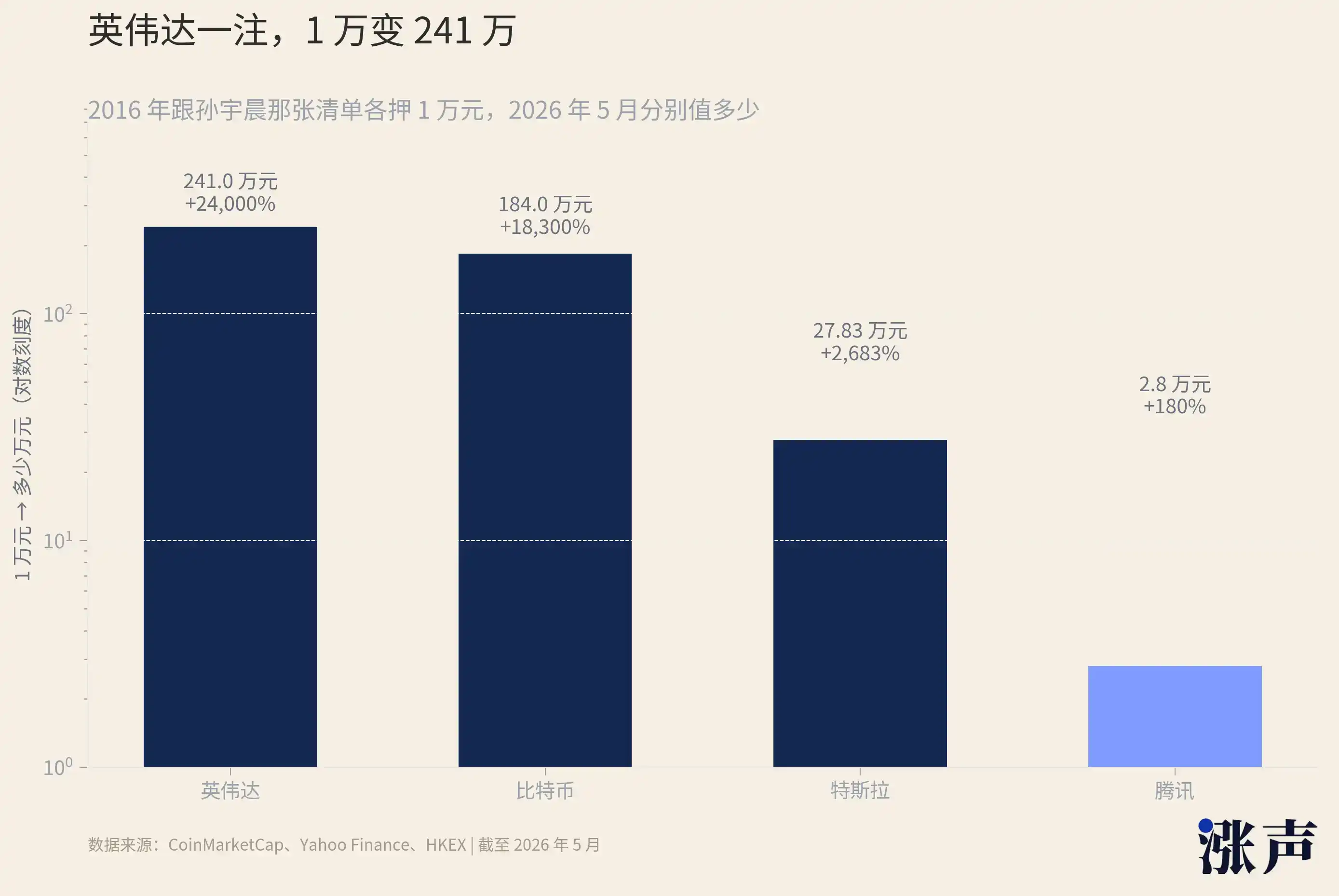
Ten years have passed. As of May 2026, Tesla's total return is approximately 2683%, and NVIDIA's total return is nearly 24000%.

If you had listened to Brother Sun back then and invested 10,000 yuan in NVIDIA, it would be 2.4 million today; 10,000 yuan in Tesla would be 278,000 today. A listener who bet 200,000 yuan on each item on that list in 2016 would have seen just the NVIDIA bet turn into approximately 48 million, and the Tesla bet into approximately 5.4 million, totaling over 53 million.
And this man continues to take shots today. On November 6, 2025, Justin Sun dropped a statement:

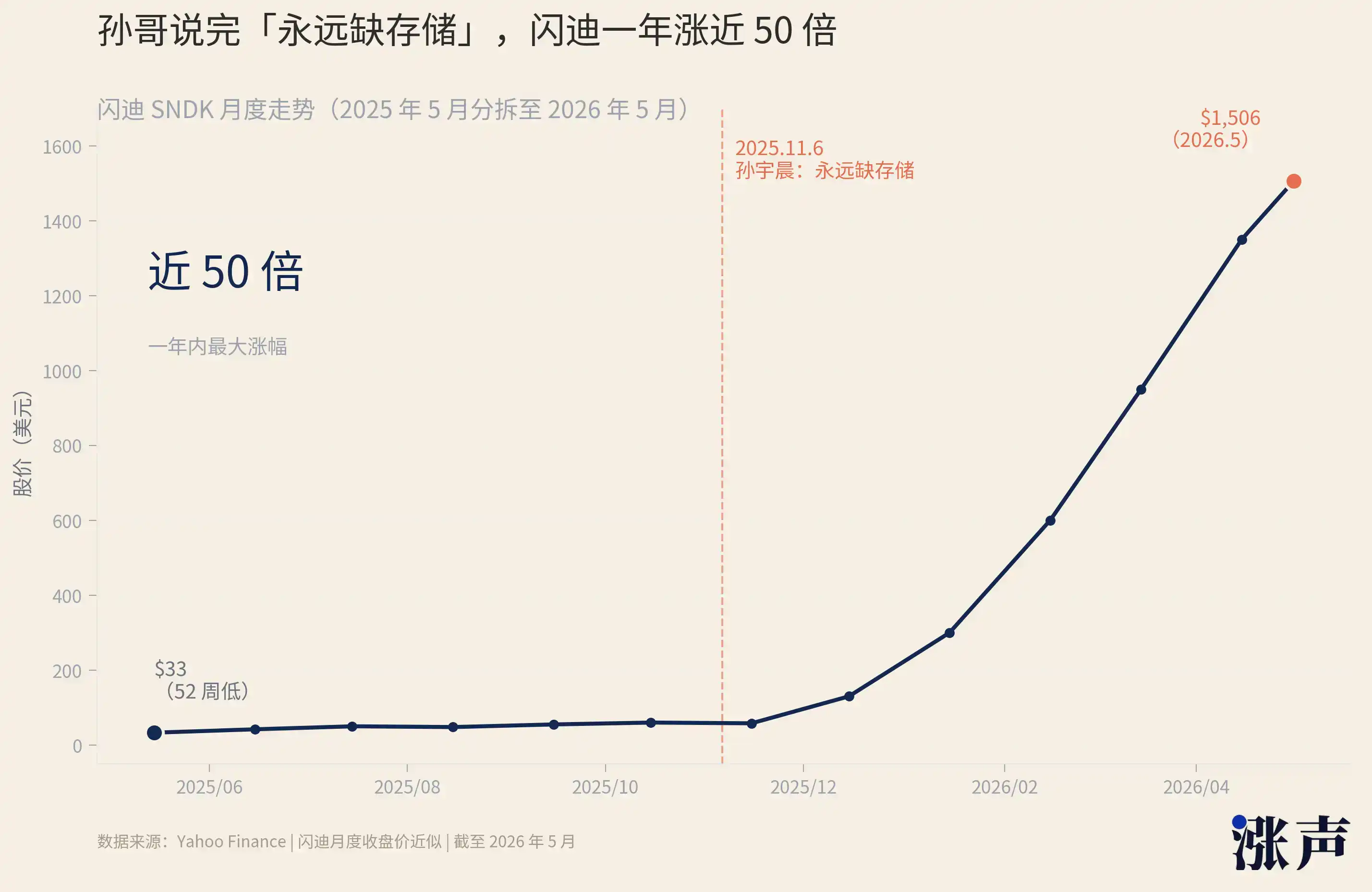
The capital market's reaction to this statement didn't reach fever pitch until 2026. SanDisk (SNDK), spun off from Western Digital, rose from a low of around $35 to $1,439 in a year, a maximum increase of nearly 50 times.
HBM memory capacity from Samsung, SK Hynix, and Micron was fully booked for 2026, already sold out, with orders scheduled through 2027-2028.

While everyone is still chasing the memory concept frenzy, in early 2026, Justin Sun changed his tune again in a video.

That video was originally about the outlook for 2026. Besides topics leaning towards wellness like putting health on the new year's list, he dedicated a segment to advise young people: embodied AI, drones, spatial computing, space exploration.

The author collected Justin Sun's public statements over the past two years regarding these four directions. Stringing them together, preliminary capital leaders have also emerged on each path.

Who Is the Next Storage Stock?

The first area Justin Sun pointed to was embodied AI.

The concept of robots has been discussed by humans for at least a hundred years. The Czech playwright Čapek coined the word "Robot" in 1920; industrial robotic arms have been used since the 1980s; Honda's ASIMO could climb stairs over twenty years ago. But the real bottleneck has always been the brain.

In the last two years, the entire industry has shifted towards VLA models—Vision-Language-Action. In plain terms, robots used to act based on code; now robots are starting to act based on seeing the world.

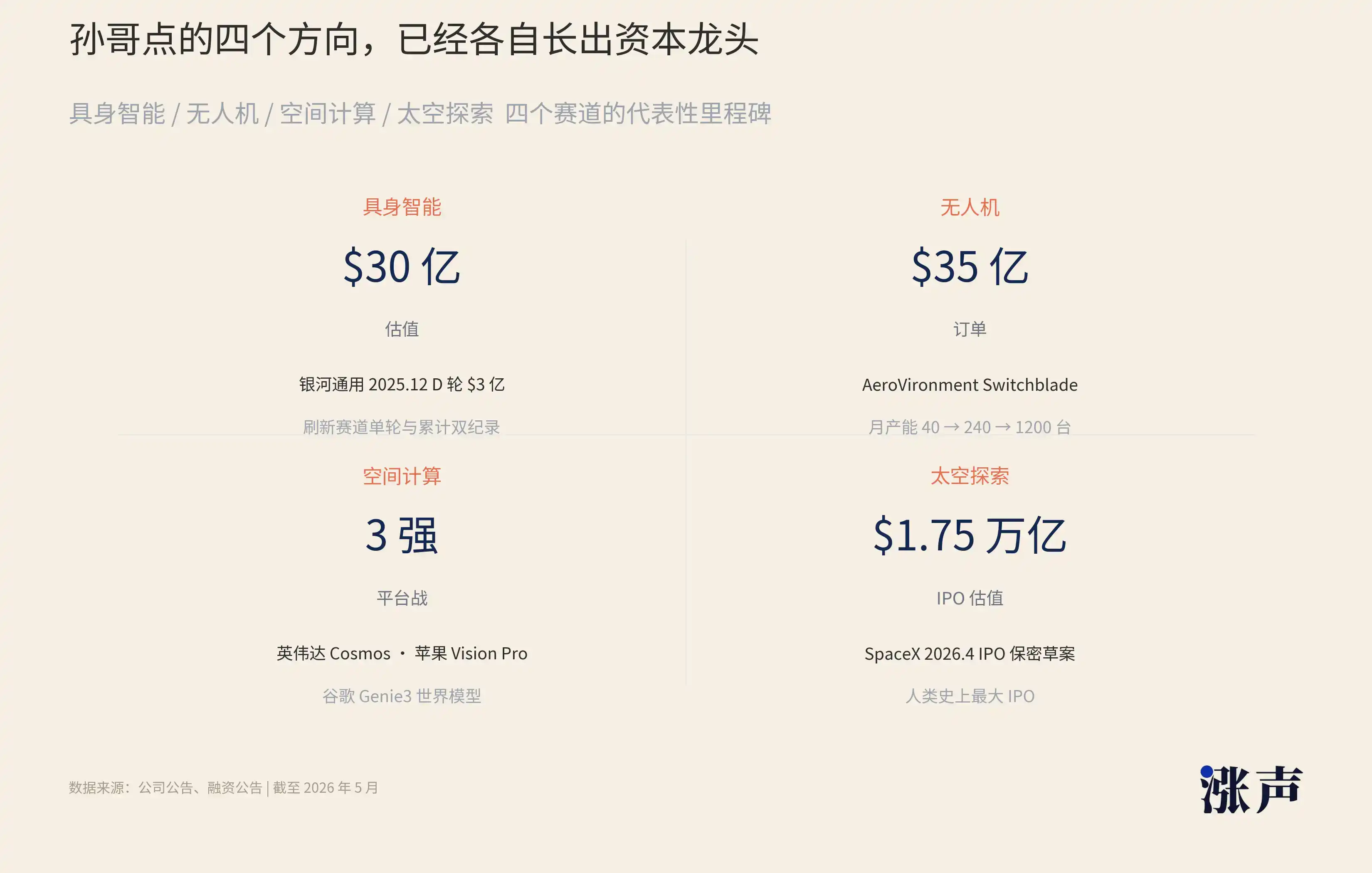
Unitree shipped over 5,500 humanoid robots in 2025, ranking first globally, and applied for a Science and Technology Innovation Board IPO in March 2026. Galaxy General raised a new round of $300 million (approx. 2.1 billion RMB) in December 2025, with cumulative funding of about $800 million and a valuation of $3 billion (approx. 21.1 billion RMB), setting new records for both single-round and total funding in the embodied AI sector.

Justin Sun said he likely won't personally venture into building robots, but he has a nose for narratives and the direction of capital flow. He said in a Bloomberg interview, "In a market where 99% of people don't know what a wallet is, the cost of education must be factored into the business model."

This statement, used to explain stablecoins in 2018, applies equally well in 2026. 99% of Chinese haven't used an embodied AI robot yet, but as long as that robot can cook, move boxes, or care for the elderly, the remaining 1% is the next opportunity.

The second sector he pointed to is drones.

While humanoid robots are still ramping up production, drones have already taken a step ahead into commercial deployment. They are naturally suited for what AI does best, from autonomous navigation to swarm coordination to data collection. They don't need to walk; flying is simpler than bipedal locomotion.

On the Russia-Ukraine battlefield, AI drone swarms have already taken over a large part of the role of tank units; Ukraine's annual drone production target has climbed to several million units. Over rice fields in rural China, DJI's agricultural drones fly, one replacing ten farm workers. In Shenzhen, Meituan has operationalized drone delivery, with order-to-delivery times not exceeding 15 minutes.

Drones are ahead of humanoid robots. They are the first form where AI has achieved a commercial closed-loop in the physical world.

The third area Justin Sun mentioned is spatial computing. This is the least mainstream among the directions he pointed out.

When Apple released the Vision Pro in 2024, most people saw it as a VR headset that cost several times more. This might be a misreading.

The Vision Pro's ambition has little to do with VR. It's Apple's first attempt to make AI understand space—how big your living room is, how far the table is from you, whether the coffee cup is to the left or right of the sofa, if you can reach it when you stretch your hand. This sounds simple but is ten times harder than training ChatGPT. Large language models only need to understand language; spatial computing needs to understand physics.

This is precisely the common prerequisite for robots, drones, and autonomous driving—they all require a form of spatial intelligence. NVIDIA's Cosmos platform, Google's Genie 3 world model, Tesla's FSD, are all doing the same thing: transitioning AI from understanding text to understanding the world.

ChatGPT only needs to understand language, but the next generation of AI needs to understand the world itself.

For the first three sectors, Justin Sun only verbally pointed them out. When it comes to space, he actually went there in person.

On August 3, 2025, he boarded Blue Origin's "New Shepard" NS-34 capsule and flew past the Kármán line.

After returning to Earth, he expressed an ambition: to make his company not just a "cryptocurrency exchange" but a "service provider for space economy infrastructure," using blockchain to solve space asset ownership, satellite data trading, and interplanetary payments. It sounds like science fiction. But look back at how he evangelized USDT ten years ago—people thought that was science fiction too back then.
Back on Earth, his message to young people was more direct: "Space exploration is a common mission for all humanity. I hope this flight inspires more young people to devote themselves to technology and innovation, collectively shaping humanity's interstellar future."

Brother Sun's Investment Logic

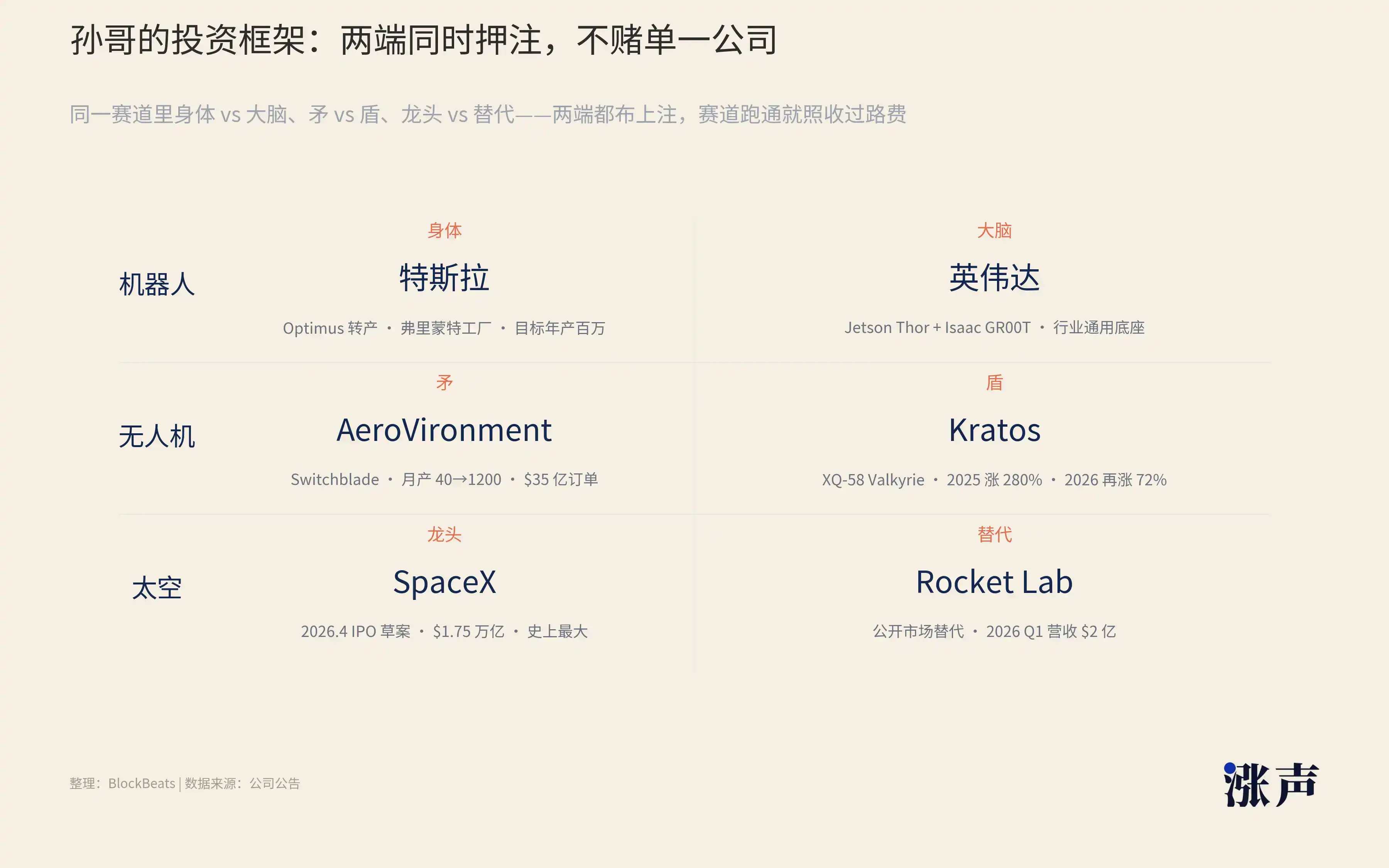
Justin Sun's publicly expressed investment logic is: find sectors with a clear direction, place bets on both ends, and do not gamble on the execution of a single company.

On the robotics line, his framework is to bet separately on the body and the brain.

Bet on Tesla for the body. In early 2026, Tesla announced discontinuing Model S and Model X, converting the Fremont factory into an Optimus production line, targeting an annual output of one million units with a mass-production unit price of about $20,000 to $25,000; current version Optimus robots are already handling parts transport and sorting at Austin and Fremont factories; the Gen 3 production line is scheduled to start in summer 2026.

Bet on NVIDIA for the brain. Jetson Thor puts server-grade AI inference into the robot body, Isaac GR00T has almost become the industry's common base, and Jensen Huang declared at GTC that there will be 1 billion humanoid robots globally by 2035.

Whether Optimus delivers on schedule is Elon Musk's problem, not NVIDIA's. As long as the sector takes off, the toll will be collected.

On the drone line, the core judgment is the irreversibility of Physical AI in military scenarios.

AeroVironment's Switchblade loitering munition became an iconic weapon in Ukraine, with monthly production capacity increased from 40 to 500 units, targeting 1,200 units; a $3.9 billion order locks in revenue for the next three years in advance. Kratos' XQ-58 Valkyrie is the "loyal wingman" to the F-35—manned aircraft on missions, drones on the flanks—with a unit price less than a fraction of a fifth-generation fighter jet, rising 280% in 2025 and another 72% in 2026.

One makes tanks uneconomical, the other makes manned fighter jets redundant—the logic on both ends is complementary.
On the space line, Justin Sun bid $28 million for a Blue Origin flight seat in 2021. This money was donated to the Blue Origin STEM charity fund, distributed among 19 non-profit organizations. On August 3, 2025, he boarded the New Shepard NS-34 mission, completing a suborbital flight.

In public markets, SpaceX filed a confidential IPO draft with the SEC in April 2026, targeting a valuation of $1.75 trillion, poised to become the largest IPO in human history; Rocket Lab's Q1 2026 revenue exceeded $200 million, making it the most direct alternative investment when SpaceX isn't available.

Once SpaceX goes public, the entire space sector's valuation framework will be rewritten.

Listen to Brother Sun

Stringing together Justin Sun's statements over the past two years, "AI, robotics, and blockchain have reached their iPhone moment" is his judgment on embodied AI. "Robot armies, robot police" is his prophecy for autonomous weaponized AI. "The integration of AI, robotics, and spatial computing" is his bet on the next generation of human-machine interfaces. "Earth is too small; it's our home" is his perspective shift after flying past the Kármán line.

These four things pieced together form the complete picture of Physical AI.

Over the past two decades, the internet changed the way information flows. WeChat replaced letters, Taobao replaced markets, Douyin replaced TV.

But the underlying rules of the physical world didn't change. Workers are still workers, factories are still factories.

In the next two decades, AI might change the very way the real world operates. Factories will have tireless humanoid robots, roads will have autonomous vehicle traffic, battlefields will roar with drone swarms, and the first "residents" on the Moon and Mars are likely to be pioneering AI robots.

That young man who in 2016 told everyone not to buy houses has now flown past the Kármán line.

And most of us are probably still waiting for the next Yanjiao.

Câu hỏi Liên quan

QWhat is the core of Sun Yuchen's investment philosophy as presented in the article?

ASun Yuchen's core investment philosophy, as presented, is to identify long-term, trend-based themes with high potential for change, and then invest in multiple key players across that entire value chain rather than betting on a single company. His approach focuses on the structural change of an industry.

QWhich sectors or technologies does Sun Yuchen point to as the next big opportunities after the success in the storage sector?

ASun Yuchen points to four key areas as the next big opportunities: Embodied AI/Robotics, AI Drones, Spatial Computing (the AI-powered understanding of physical space), and Space Exploration. He sees these as the frontiers where AI will begin to materially alter the physical world.

QHow does Sun Yuchen's investment strategy in the robotics sector exemplify his broader logic?

AIn the robotics sector, his strategy is to invest in both the 'body' and the 'brain' separately. He cites Tesla (Optimus) as a bet on the physical robot platform (the body) and Nvidia (Jetson Thor, Isaac platform) as a bet on the AI intelligence and operating system (the brain). This way, he benefits from the growth of the overall sector regardless of which specific company executes best.

QAccording to the article, what is the author's perspective on the historical impact of AI and its future potential?

AThe author argues that the internet and AI have so far primarily changed information flow and digital services. The future potential lies in AI fundamentally altering the operation of the physical world itself—through robots in factories, autonomous vehicles, drone swarms, and even AI/robotics pioneers in space—representing a much deeper transformation of reality.

QWhat is the significance of Sun Yuchen's space flight in the context of his overall vision?

AHis space flight on Blue Origin's New Shepard is symbolic of his shift towards a long-term, frontier-oriented vision. It represents his ambition to move beyond cryptocurrency into 'space economy infrastructure' and serves as a personal statement to inspire younger generations to engage with transformative, long-horizon technologies like space exploration.

Nội dung Liên quan

Thị trường tiền mã hóa đã đáy chưa? Đây là quan điểm của các tổ chức

Chuyên gia từ ba tổ chức nghiên cứu hàng đầu - Galaxy Digital, NYDIG và Standard Chartered - đã đưa ra các nhận định khác nhau về việc thị trường tiền mã hóa đã chạm đáy hay chưa. Galaxy Digital, dựa trên phân tích 13 chỉ số lịch sử, cho rằng Bitcoin chưa chạm đáy và dự đoán vùng đáy tiềm năng trong khoảng 30.000 - 54.000 USD, với mức trung tính là 40.000 - 46.000 USD. NYDIG nhận thấy các chỉ số hiện tại gần với vùng cực trị đáy lịch sử nhưng thiếu đi đợt bán tháo hoảng loạn điển hình, đồng thời nêu lên khả năng chu kỳ hiện tại có thể ít suy giảm hơn nhờ dòng tiền tổ chức. Trái ngược, Standard Chartered tuyên bố đáy đã xuất hiện ở mức 59.000 USD, với lý do áp lực bán từ ETF sẽ giảm bớt và dự báo Bitcoin có thể lên 100.000 USD trong năm nay. Mặc dù có sự khác biệt về điểm đáy cụ thể, cả ba báo cáo đều có chung những kết luận quan trọng cho nhà đầu tư dài hạn: đáy thị trường sẽ xuất hiện trong năm nay, giá hiện tại gần đáy hơn là đỉnh cũ, và một đợt tăng giá mới cho Bitcoin trong tương lai vẫn được kỳ vọng. Vì vậy, thay vì tập trung quá mức vào thời điểm chạm đáy chính xác, trọng tâm nên là triển vọng dài hạn khi các động lực cơ bản của Bitcoin - như nợ công cao, lạm phát, quá trình số hóa và việc áp dụng ngày càng tăng - vẫn tiếp tục mạnh mẽ.

Foresight News1 phút trước

Thị trường tiền mã hóa đã đáy chưa? Đây là quan điểm của các tổ chức

Foresight News1 phút trước

Dự đoán năm 2029: Khi tiền điện tử hoàn toàn 'biến mất', ai sẽ tồn tại trong cuộc đại biến đổi tài chính này?

**Tóm tắt: Dự báo về tình hình tài chính vào năm 2029 - Khi tiền mã hóa "tàng hình"** Bài viết đưa ra một kịch bản cụ thể về sự phát triển của ngành công nghiệp tiền mã hóa từ nay đến năm 2029, tập trung vào ba vấn đề cốt lõi: giá trị của token, ứng dụng công nghệ và sự chuyển đổi thành cơ sở hạ tầng tài chính truyền thống. **Giai đoạn chính:** * **Giữa 2026:** Thị trường hợp đồng vĩnh viễn cho tài sản tư nhân (ví dụ: cổ phần SpaceX, OpenAI) trên các sàn giao dịch phi tập trung như Hyperliquid trở nên phổ biến, cung cấp định giá thời gian thực và cho thấy nhu cầu thực sự là về tài sản chất lượng, không phải token. * **Cuối 2026:** Lĩnh vực "AI + Crypto" suy yếu (trừ thị trường dự đoán). Token hóa tài sản truyền thống (quỹ thị trường tiền tệ, tín dụng tư nhân) tăng tốc một cách thầm lặng trong khuôn khổ pháp lý, tách biệt với thị trường đầu cơ ồn ào. * **Đầu 2027:** Các quỹ blockchain lớn tập trung vào việc xây dựng cơ sở hạ tầng và dịch vụ tuân thủ cho khách hàng tổ chức, với tầm nhìn dài hạn là phục vụ số lượng lớn nhà đầu tư phổ thông đủ điều kiện. * **Giữa đến cuối 2027:** Ba lĩnh vực (hợp đồng vĩnh viễn tài sản tư nhân, stablecoin, token hóa tài sản) đều chạm trần tăng trưởng do các hạn chế pháp lý, đặc biệt là lệnh cấm quảng cáo chứng khoán tư nhân và sự không chắc chắn về chính sách trước cuộc bầu cử Mỹ 2028. * **2028:** Sau bầu cử (giả định đảng Dân chủ thắng), sự không chắc chắn giảm dần. Một sự kiện thanh lý dây chuyền trên thị trường hợp đồng vĩnh viễn làm lộ rõ rủi ro của việc thiếu tài sản cơ sở. Điều này dẫn đến việc nới lỏng quy định, **cho phép công khai quảng cáo việc chuyển nhượng cổ phần tư nhân thứ cấp cho nhà đầu tư đủ điều kiện**, tạo ra một kênh đầu tư hợp pháp mới. * **2029:** Thị trường chứng khoán tư nhân trở thành tâm điểm, thúc đẩy một đợt tăng giá mới dựa trên giá trị thực của các doanh nghiệp công nghệ. Token chỉ có giá trị nếu đại diện cho quyền đòi tài sản thực có hiệu lực pháp lý. Stablecoin tăng trưởng ổn định. Các yếu tố đầu cơ thu hẹp. Chức năng cơ sở hạ tầng tài chính của tiền mã hóa trở nên "tàng hình", được tích hợp hoàn toàn và không còn là chủ đề thảo luận riêng biệt. **Luận điểm trung tâm:** Trở ngại chính của ngành không phải là công nghệ mà là pháp lý. Dấu hiệu then chốt để xác thực dự báo này là việc **nhà đầu tư phổ thông có được kênh tiếp cận hợp pháp với thị trường cổ phần tư nhân vào cuối năm 2028 hay không.**

marsbit41 phút trước

Dự đoán năm 2029: Khi tiền điện tử hoàn toàn 'biến mất', ai sẽ tồn tại trong cuộc đại biến đổi tài chính này?

marsbit41 phút trước

Sau khi Mỹ cấm Fable 5, trí tuệ nhân tạo tăng 47%

Ngày 15/6, cổ phiếu Zhipu (智谱) tại Hồng Kông tăng mạnh tới 47.6% trước khi đóng cửa ở mức +32.82%, đạt vốn hóa thị trường kỷ lục 649,6 tỷ HKD. Động lực trực tiếp đến từ hai sự kiện ngành. Ngày 12/6, Anthropic đã vô hiệu hóa quyền truy cập vào các mô hình hàng đầu Claude Fable 5 và Claude Mythos 5 trên toàn cầu do lệnh kiểm soát xuất khẩu của Mỹ. Sự kiện này cho thấy rủi ro khi các mô hình AI tiên tiến trở nên "không thể truy cập ổn định", đặc biệt đối với các nhà phát triển và doanh nghiệp phụ thuộc vào chúng. Ngay ngày hôm sau (13/6), Zhipu tuyên bố mở mô hình mã nguồn mở mạnh nhất của mình, GLM-5.2, cho tất cả người dùng Coding Plan, với API và trọng số mô hình sẽ được phát hành theo giấy phép MIT. GLM-5.2 tập trung vào nâng cao khả năng xử lý tác vụ dài hạn (Long Horizon Task), hỗ trợ cửa sổ ngữ cảnh 1M token. Sự cố của Anthropic và động thái của Zhipu đánh dấu sự thay đổi trong logic cạnh tranh ngành AI: từ "mô hình nào mạnh hơn" sang "mô hình nào có thể tiếp cận ổn định hơn". Khi AI trở thành cơ sở hạ tầng quan trọng, các yếu tố như tính ổn định, bền vững, khả năng kiểm soát và tính sẵn có đang trở nên quan trọng ngang bằng với năng lực kỹ thuật. Phản ứng nhanh chóng của thị trường vốn cho thấy sự định giá lại này, với lợi thế dần nghiêng về các mô hình mở, dễ tiếp cận và tự chủ.

marsbit45 phút trước

Sau khi Mỹ cấm Fable 5, trí tuệ nhân tạo tăng 47%

marsbit45 phút trước

Hướng dẫn Đăng ký và Gửi bài cho Chuyên mục PANews

**Hướng dẫn Đăng ký và Đăng bài Chuyên mục PANews** Bài viết cung cấp hướng dẫn toàn diện để trở thành tác giả chuyên mục và đăng bài trên PANews. **Yêu cầu về Nội dung Chuyên mục:** * Tập trung vào nội dung sâu về Crypto, Web3, dữ liệu, quan điểm phân tích. * **Không chấp nhận:** Nội dung quảng bá sản phẩm/thương hiệu là chính (nên liên hệ bộ phận thương mại) hoặc nội dung được tạo hàng loạt bằng AI. **Cách Đăng ký Chuyên mục:** * **Trên web:** Truy cập trang chủ PANews, cuộn xuống cuối trang và nhấp "申请专栏" (Đăng ký chuyên mục). Đăng ký bằng số điện thoại/email (chỉ cần mã xác minh để đăng nhập sau này). Điền tên chuyên mục, mô tả, tải lên ảnh đại diện và gửi liên kết đến các bài viết mẫu đã xuất bản. * **Trên điện thoại:** Vào mục "我的" (Của tôi), chọn "投稿与创作" (Đóng góp & Sáng tạo) và điền thông tin. **Hướng dẫn Đăng bài:** 1. Đăng nhập trên trang web. 2. Vào **Trang cá nhân** -> **Trung tâm Sáng tạo**. 3. Sử dụng trình biên tập để tạo và đăng bài viết mới. **Nhúng Video:** * Chỉ hỗ trợ nhúng mã từ nền tảng bên thứ ba (ví dụ: Bilibili). * Sao chép mã nhúng từ video, trong trình biên tập bài viết, chọn **Chèn/Chỉnh sửa phương tiện** -> tab **Nhúng** -> dán mã. * Có thể điều chỉnh kích thước hiển thị video (đề xuất: rộng 100%, cao 560px). **Công cụ Hỗ trợ: PANews Skills** * Bộ kỹ năng AI chính thức của PANews, cho phép các AI Agent tương tác với nền tảng. * **Ba kỹ năng chính:** 1. `panews`: Theo dõi xu hướng, lấy bảng xếp hạng bài đọc bắt buộc, bài viết nổi bật, động thái gọi vốn. 2. `panews-creator`: **Quan trọng cho đăng bài** - Hỗ trợ quản lý chuyên mục, xuất bản bài viết, tải lên hình ảnh. 3. `panews-web-viewer`: Phân tích cú pháp trang web PANews sang Markdown. * **Cách sử dụng `panews-creator`:** * Cài đặt từ GitHub: `https://github.com/panewslab/skills`. * Cần lấy giá trị `authorization` từ tài khoản chuyên mục của bạn: Đăng nhập vào PANews, mở Công cụ Nhà phát triển trình duyệt (F12), vào tab **Network**, tìm một yêu cầu API và sao chép giá trị `authorization` từ phần **Request Headers**.

marsbit55 phút trước

Hướng dẫn Đăng ký và Gửi bài cho Chuyên mục PANews

marsbit55 phút trước

Giao dịch

Giao ngay
Hợp đồng Tương lai

Bài viết Nổi bật

Làm thế nào để Mua SUN

Chào mừng bạn đến với HTX.com! Chúng tôi đã làm cho mua SUN (SUN) trở nên đơn giản và thuận tiện. Làm theo hướng dẫn từng bước của chúng tôi để bắt đầu hành trình tiền kỹ thuật số của bạn.Bước 1: Tạo Tài khoản HTX của BạnSử dụng email hoặc số điện thoại của bạn để đăng ký tài khoản miễn phí trên HTX. Trải nghiệm hành trình đăng ký không rắc rối và mở khóa tất cả tính năng. Nhận Tài khoản của tôiBước 2: Truy cập Mua Crypto và Chọn Phương thức Thanh toán của BạnThẻ Tín dụng/Ghi nợ: Sử dụng Visa hoặc Mastercard của bạn để mua SUN (SUN) ngay lập tức.Số dư: Sử dụng tiền từ số dư tài khoản HTX của bạn để giao dịch liền mạch.Bên thứ ba: Chúng tôi đã thêm những phương thức thanh toán phổ biến như Google Pay và Apple Pay để nâng cao sự tiện lợi.P2P: Giao dịch trực tiếp với người dùng khác trên HTX.Thị trường mua bán phi tập trung (OTC): Chúng tôi cung cấp những dịch vụ được thiết kế riêng và tỷ giá hối đoái cạnh tranh cho nhà giao dịch.Bước 3: Lưu trữ SUN (SUN) của BạnSau khi mua SUN (SUN), lưu trữ trong tài khoản HTX của bạn. Ngoài ra, bạn có thể gửi đi nơi khác qua chuyển khoản blockchain hoặc sử dụng để giao dịch những tiền kỹ thuật số khác.Bước 4: Giao dịch SUN (SUN)Giao dịch SUN (SUN) dễ dàng trên thị trường giao ngay của HTX. Chỉ cần truy cập vào tài khoản của bạn, chọn cặp giao dịch, thực hiện giao dịch và theo dõi trong thời gian thực. Chúng tôi cung cấp trải nghiệm thân thiện với người dùng cho cả người mới bắt đầu và người giao dịch dày dạn kinh nghiệm.

Tổng lượt xem 716Xuất bản vào 2024.12.12Cập nhật vào 2025.03.21

Làm thế nào để Mua SUN

Thảo luận

Chào mừng đến với Cộng đồng HTX. Tại đây, bạn có thể được thông báo về những phát triển nền tảng mới nhất và có quyền truy cập vào thông tin chuyên sâu về thị trường. Ý kiến ​​của người dùng về giá của SUN (SUN) được trình bày dưới đây.

活动图片