Why Does Saylor Always Buy The Bitcoin Top? Expert Explains

bitcoinistPublished on 2026-03-30Last updated on 2026-03-30

Abstract

Michael Saylor's tendency to buy Bitcoin near local highs is not a timing mistake but a result of the pro-cyclical nature of the Bitcoin treasury model, explains Dylan LeClair of Metaplanet. Capital markets are most accessible when Bitcoin is strong, making it easier for companies like MicroStrategy to raise funds through equity issuance. LeClair clarifies that purchases occur when financing windows are open, not because of a desire to chase peaks. He highlights the growing use of alternative instruments like preferred equity (such as STRC) to raise capital regardless of market conditions, allowing continuous Bitcoin accumulation. Saylor is now seen as a major marginal buyer, acquiring more BTC than all ETFs combined, while also optimizing the company's capital structure.

Michael Saylor’s reputation for buying Bitcoin near local highs is less a timing flaw than a function of how the treasury model works, according to Metaplanet Director of Bitcoin Strategy Dylan LeClair. In an interview, LeClair argued that the apparent pattern reflects when capital markets are most open, not a deliberate effort to chase peaks.

Why Saylor Keeps Buying The Bitcoin Top

LeClair said the criticism misunderstands the mechanics behind Strategy’s buying. “The Bitcoin treasury model is very pro-cyclical,” he said. “So when times are good, generally over a four-year market or minute to minute, it’s easiest to raise capital. And so the capital markets are wide open when Bitcoin’s strong for common equity. But when it’s weak, they’re not.”

That dynamic, he said, helps explain why Strategy’s purchases often arrive when Bitcoin is already trading strongly. If the company’s stock is performing well and its enterprise value is rich relative to its Bitcoin holdings, it becomes easier and more attractive to issue equity and convert that capital into more BTC. “When we sell stock, we buy literally minute to minute,” LeClair said, referring to Saylor’s own description of the process. “So when a weekly purchase comes out, people are like, well, Strategy bought the range high again. Well, it’s like, no, the causality is reversed.”

In LeClair’s telling, Strategy is not buying strength because it wants to pay up. It is buying when its financing window is strongest. That distinction matters, especially for listed Bitcoin treasury companies whose capital-raising ability is tightly linked to sentiment, equity multiples, and market liquidity.

He said that model is now evolving. Where Strategy once relied primarily on common stock issuance and, at times, convertible bonds, LeClair pointed to the growing importance of preferred equity offerings, especially STRC, as a potential shift in how Bitcoin-linked firms fund purchases across different market regimes. The attraction is that preferreds may allow companies to keep raising capital even when Bitcoin is weak and common equity is less appealing to issue.

“The thing with STRC that’s really, really interesting is that they now have a mechanism to basically raise regardless of the market conditions,” he said. “So Bitcoin can be strong, Bitcoin can be weak. If STRC is at 100, they can raise a lot, a lot of money.” He added that Strategy had already used that structure aggressively, saying Saylor raised $1.2 billion in a week without selling MSTR.

LeClair framed that as more than a financing tweak. He described it as a new bridge between BTC exposure and pools of capital that cannot buy spot BTC or even ETFs directly. “There’s trillions of dollars of fixed income in the world that want low volatility, high yield,” he said. “And so Saylor says, okay, well, I’ll design, I’ll engineer security for you.”

That broader capital-markets angle ran through much of LeClair’s interview. While he said Metaplanet’s core BTC thesis has not changed despite the market drawdown, he acknowledged that execution has. In strong markets, treasury firms can lean on common equity fundraising. In weaker conditions, other instruments may matter more. “The ways that we navigate the capital markets have been tweaked a bit,” he said.

LeClair also suggested Strategy is becoming the marginal buyer of Bitcoin, arguing that Saylor is now purchasing more than the ETFs combined. At the same time, he said the company is improving its capital structure by issuing new securities while making its existing convertible debt less significant relative to the rest of the balance sheet. In his view, that combination is creating an increasingly powerful acquisition engine for BTC.

At press time, BTC traded at $67,639.
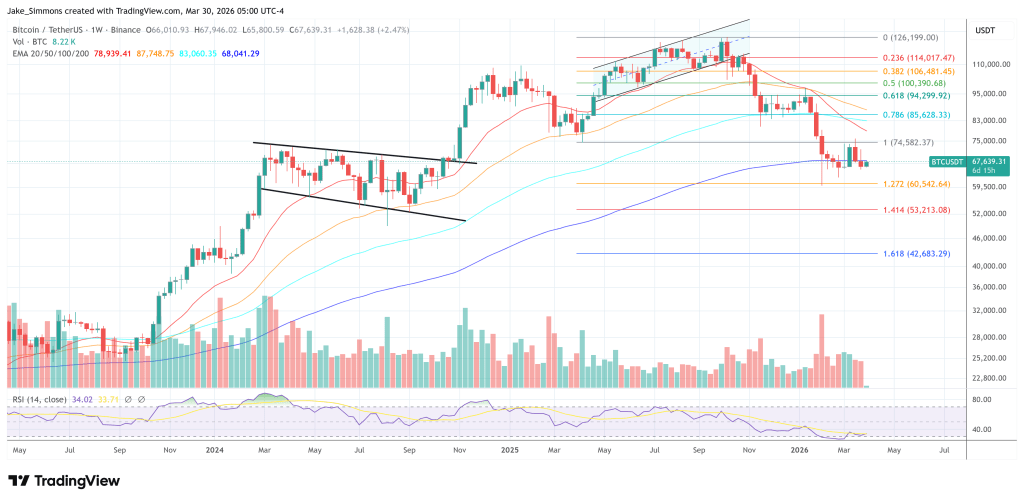
BTC must reclaim the 200-week EMA, 1-week chart | Source: BTCUSDT on TradingView.com

Featured image from YouTube, chart from TradingView.com

Related Questions

QAccording to Dylan LeClair, why does it appear that Michael Saylor's company, MicroStrategy, often buys Bitcoin at the top of the market?

AIt's not a deliberate effort to chase peaks, but a function of the pro-cyclical Bitcoin treasury model. Capital markets are most open and it's easiest to raise capital (through equity issuance) when Bitcoin's price is strong and the company's stock is performing well.

QWhat is the 'causality' that Dylan LeClair says is reversed in the common criticism of MicroStrategy's buying habits?

AThe causality is reversed because MicroStrategy is not buying Bitcoin *because* the price is high. Instead, the high Bitcoin price creates a favorable environment (strong equity multiples) that allows them to easily raise capital, which they then use to buy Bitcoin.

QWhat new financial instrument does LeClair point to as a potential shift in how Bitcoin-linked firms fund purchases in different market conditions?

ALeClair points to preferred equity offerings, specifically the STRC (Strategic Bitcoin-Linked Preferred Stock), which allows companies to raise capital regardless of whether the Bitcoin market is strong or weak.

QWhat broader pool of capital does LeClair suggest MicroStrategy's new securities are designed to attract?

AThey are designed to attract trillions of dollars in fixed income capital that seeks low volatility and high yield but cannot buy spot Bitcoin or Bitcoin ETFs directly due to regulatory or mandate restrictions.

QWhat two key roles does LeClair suggest MicroStrategy is now playing in the Bitcoin market?

ALeClair suggests MicroStrategy is becoming the marginal buyer of Bitcoin, purchasing more than all the ETFs combined, while simultaneously improving its capital structure to create a more powerful engine for BTC acquisition.

Related Reads

Solana Privacy Ecosystem Panorama: A Complete Privacy Stack from Compute to AI

**Title: The Solana Privacy Ecosystem: A Full-Stack View from Compute to AI** **Summary:** This article provides a comprehensive overview of the emerging privacy landscape on the Solana blockchain, characterizing it as still in early development. It identifies two primary verticals—Neobanks and Private DeFi—as key drivers, while noting gaps in tooling and user experience. The discussion centers on two main approaches to private computation: Arcium, which utilizes Multi-Party Computation (MPC) networks (Multi-Party eXecution Environments) to process encrypted data with final settlement on Solana; and Magic Block, which leverages Trusted Execution Environments (TEEs) via its Private Ephemeral Rollup (PER). Both enable confidential applications like dark pools and private DeFi with minimal code changes. Building on this infrastructure, projects are creating privacy-focused applications. Umbra, built on Arcium, offers Encrypted Token Accounts (ETAs) for private balances, transfers, and selective disclosure for compliance. Other wallets like Privacy Cash and Hush provide mixer-like functionality for SOL. For private trading, encifherio uses TEEs to encrypt swap details routed through Jupiter, while VanishTrade and Darklake focus on shielding transaction intent and liquidity routing, with Darklake introducing a "blind slippage pool" to prevent front-running. Further applications include private prediction markets (e.g., Melee Markets using Arcium's encrypted order books) and private AI. Loyal exemplifies the latter, using both Magic Block and Arcium to enable decentralized AI agents that store user data, conversations, and transactions confidentially on-chain. The article concludes by framing privacy not as a single technology but as an evolving "ultimate privacy stack," with experts like Helius's Mert envisioning a future combination of Fully Homomorphic Encryption (FHE) and Zero-Knowledge proofs (ZK). Helius Privacy itself is developing a ZK-based UTXO privacy layer for Solana.

Foresight News1m ago

Solana Privacy Ecosystem Panorama: A Complete Privacy Stack from Compute to AI

Foresight News1m ago

7 Key Questions Regarding 'DeepSeek Completes Over 50 Billion Yuan in Financing'

DeepSeek, the prominent Chinese AI company, has reportedly completed its first external funding round, raising over 50 billion RMB (approximately $6.9 billion USD), according to foreign media reports. This financing values the company at over $50 billion USD, a significant increase from a $10 billion valuation when the round began in April 2026. Founder Liang Wenfeng personally contributed 20 billion RMB, with other investors including Tencent, CATL (Contemporary Amperex Technology), JD.com, NetEase, and IDG Capital. Notably, the National Artificial Intelligence Industry Investment Fund also participated with a direct investment of 1 billion RMB. The funding round is distinctive for its structure. Most investors' capital is channeled into a limited partnership controlled by CEO Liang Wenfeng, rather than directly into DeepSeek. These investors face a five-year lock-up period, have no voting rights, but receive priority financial information and future investment rights. This arrangement is seen as a measure to ensure Liang's absolute control over the company's direction, aligning with its stated principles of prioritizing groundbreaking AGI (Artificial General Intelligence) research over short-term profitability. The report highlights strategic reasons for key investors. Tencent's involvement is viewed as a strategic alignment, building on existing collaborations. CATL's investment is linked to the critical energy and power infrastructure needed for AI data centers, a key growth area for the battery giant. The participation of a state-backed fund underscores the national strategic importance of AI development. Post-funding, DeepSeek is expected to accelerate infrastructure development, including building its own data centers, hire more talent, and release new model versions with enhanced capabilities like image and audio support. While this marks a major step, the company's long-term journey towards AGI remains a challenging path that will require balancing its foundational ideals with the expectations of its new investors.

marsbit47m ago

7 Key Questions Regarding 'DeepSeek Completes Over 50 Billion Yuan in Financing'

marsbit47m ago

The World Cup is Here: The Battle for Entry into Prediction Markets Has Begun

The 2026 FIFA World Cup has begun, and alongside the on-field competition, a new off-field battleground is emerging: prediction markets. These blockchain-based platforms, which convert crowd wisdom into tradable probabilities, are gaining significant traction. However, their complexity—involving wallets, gas fees, and smart contracts—has historically limited participation to crypto-native users. Centralized exchanges (CEXs), like Gate, are tackling this adoption barrier. By integrating with leading prediction market protocol Polymarket, Gate simplifies the user experience. Users can participate directly with their exchange account and USDT, bypassing complex Web3 steps. Gate offers a streamlined "Prediction Mode" for casual users and a professional "Trading Mode" with advanced tools. Key features include two-way trading (allowing users to buy or sell positions before event resolution), support for diverse markets (sports, crypto, macroeconomics), and a suite of information tools like a "Smart Money" leaderboard, wallet tracking, and AI-powered insights. For the World Cup, Gate launched a dedicated hub aggregating schedules, standings, and relevant markets. This allows fans to seamlessly follow games and trade on outcomes, transforming passive viewing into active participation where they can monetize their predictions and trade on shifting consensus throughout a match. The article argues that prediction markets have proven their value in event forecasting. The next challenge is mass adoption. The competition is shifting from building effective protocols to creating accessible user entry points. By lowering technical barriers and building a complete ecosystem for information and trading, platforms like Gate aim to transition prediction markets from a niche crypto tool to a mainstream platform for expressing and trading on collective intelligence.

Odaily星球日报57m ago

The World Cup is Here: The Battle for Entry into Prediction Markets Has Begun

Odaily星球日报57m ago

Spain Held to a Draw by Cape Verde, Jucom Prediction Market Witnesses Historic Upset

In a major upset at the 2026 FIFA World Cup, tournament favorites Spain were held to a surprising 0-0 draw by debutants Cape Verde in their Group H opener on June 16, Beijing time. Despite dominating possession (74%) and recording 27 shots with an expected goals figure of 2.16, Spain failed to break down a resilient Cape Verde defense, with their 40-year-old goalkeeper Vozinha making 7 saves to earn Man of the Match. Pre-match predictions on the Jucom prediction market had heavily favored Spain, assigning them a 92% win probability. The actual result, a goalless draw, triggered significant volatility across related prediction markets. This outcome forces a market-wide reassessment of several key probabilities, including Spain's likelihood of winning the group and the tournament itself, while Cape Verde's previously near-zero chance of advancing is now being re-evaluated. The event highlights both the efficiency and the inherent limitations of prediction markets. While prices aggregate known information, football's low-scoring, high-variance nature means unquantifiable in-game factors can lead to unlikely results. The core value of such markets lies not in perfect foresight but in their ability to dynamically reflect how new information is incorporated into collective expectations. Platforms like Jucom, which track outcomes from single matches to the final champion, provide a real-time lens into how global consensus evolves with each game.

链捕手1h ago

Spain Held to a Draw by Cape Verde, Jucom Prediction Market Witnesses Historic Upset

链捕手1h ago

Trading

Spot
Futures

Hot Articles

What is $BITCOIN

DIGITAL GOLD ($BITCOIN): A Comprehensive Analysis Introduction to DIGITAL GOLD ($BITCOIN) DIGITAL GOLD ($BITCOIN) is a blockchain-based project operating on the Solana network, which aims to combine the characteristics of traditional precious metals with the innovation of decentralized technologies. While it shares a name with Bitcoin, often referred to as “digital gold” due to its perception as a store of value, DIGITAL GOLD is a separate token designed to create a unique ecosystem within the Web3 landscape. Its goal is to position itself as a viable alternative digital asset, although specifics regarding its applications and functionalities are still developing. What is DIGITAL GOLD ($BITCOIN)? DIGITAL GOLD ($BITCOIN) is a cryptocurrency token explicitly designed for use on the Solana blockchain. In contrast to Bitcoin, which provides a widely recognized value storage role, this token appears to focus on broader applications and characteristics. Notable aspects include: Blockchain Infrastructure: The token is built on the Solana blockchain, known for its capacity to handle high-speed and low-cost transactions. Supply Dynamics: DIGITAL GOLD has a maximum supply capped at 100 quadrillion tokens (100P $BITCOIN), although details regarding its circulating supply are currently undisclosed. Utility: While precise functionalities are not explicitly outlined, there are indications that the token could be utilized for various applications, potentially involving decentralized applications (dApps) or asset tokenization strategies. Who is the Creator of DIGITAL GOLD ($BITCOIN)? At present, the identity of the creators and development team behind DIGITAL GOLD ($BITCOIN) remains unknown. This situation is typical among many innovative projects within the blockchain space, particularly those aligning with decentralized finance and meme coin phenomena. While such anonymity may foster a community-driven culture, it intensifies concerns about governance and accountability. Who are the Investors of DIGITAL GOLD ($BITCOIN)? The available information indicates that DIGITAL GOLD ($BITCOIN) does not have any known institutional backers or prominent venture capital investments. The project seems to operate on a peer-to-peer model focused on community support and adoption rather than traditional funding routes. Its activity and liquidity are primarily situated on decentralized exchanges (DEXs), such as PumpSwap, rather than established centralized trading platforms, further highlighting its grassroots approach. How DIGITAL GOLD ($BITCOIN) Works The operational mechanics of DIGITAL GOLD ($BITCOIN) can be elaborated on based on its blockchain design and network attributes: Consensus Mechanism: By leveraging Solana’s unique proof-of-history (PoH) combined with a proof-of-stake (PoS) model, the project ensures efficient transaction validation contributing to the network's high performance. Tokenomics: While specific deflationary mechanisms have not been extensively detailed, the vast maximum token supply implies that it may cater to microtransactions or niche use cases that are still to be defined. Interoperability: There exists the potential for integration with Solana’s broader ecosystem, including various decentralized finance (DeFi) platforms. However, the details regarding specific integrations remain unspecified. Timeline of Key Events Here is a timeline that highlights significant milestones concerning DIGITAL GOLD ($BITCOIN): 2023: The initial deployment of the token occurs on the Solana blockchain, marked by its contract address. 2024: DIGITAL GOLD gains visibility as it becomes available for trading on decentralized exchanges like PumpSwap, allowing users to trade it against SOL. 2025: The project witnesses sporadic trading activity and potential interest in community-led engagements, although no noteworthy partnerships or technical advancements have been documented as of yet. Critical Analysis Strengths Scalability: The underlying Solana infrastructure supports high transaction volumes, which could enhance the utility of $BITCOIN in various transaction scenarios. Accessibility: The potential low trading price per token could attract retail investors, facilitating wider participation due to fractional ownership opportunities. Risks Lack of Transparency: The absence of publicly known backers, developers, or an audit process may yield skepticism regarding the project's sustainability and trustworthiness. Market Volatility: The trading activity is heavily reliant on speculative behavior, which can result in significant price volatility and uncertainty for investors. Conclusion DIGITAL GOLD ($BITCOIN) emerges as an intriguing yet ambiguous project within the rapidly evolving Solana ecosystem. While it attempts to leverage the “digital gold” narrative, its departure from Bitcoin's established role as a store of value underscores the need for a clearer differentiation of its intended utility and governance structure. Future acceptance and adoption will likely depend on addressing the current opacity and defining its operational and economic strategies more explicitly. Note: This report encompasses synthesised information available as of October 2023, and developments may have transpired beyond the research period.

374 Total ViewsPublished 2025.05.13Updated 2025.05.13

What is $BITCOIN

Discussions

Welcome to the HTX Community. Here, you can stay informed about the latest platform developments and gain access to professional market insights. Users' opinions on the price of BTC (BTC) are presented below.

活动图片