Solana ETFs Are Green Despite Hawkish Fed: Promising Altcoins Like PEPENODE Amp Up

bitcoinistPublished on 2025-11-04Last updated on 2025-11-04

Abstract

What to Know: 1️⃣ The Federal Reserve’s hawkish tone led to roughly $360M in crypto fund outflows, but yield-oriented assets...

Trusted Editorial content, reviewed by leading industry experts and seasoned editors. Ad Disclosure

What to Know:

  • 1️⃣ The Federal Reserve’s hawkish tone led to roughly $360M in crypto fund outflows, but yield-oriented assets like Solana defied the trend with inflows exceeding $260M through the new Bitwise Solana Staking ETF (BSOL).
  • 2️⃣ BSOL’s 7% staking yield and $222M seed capital highlight growing institutional interest in Solana-based products amid broader risk-off sentiment.
  • 3️⃣ Investors are rotating profits from Bitcoin and Ethereum into assets offering yield and ecosystem exposure.
  • 4️⃣ PepeNode ($PEPENODE) gains traction with its gamified ‘mine-to-earn’ model, over $2M raised, and whale buys signaling strong presale momentum as it links meme trading with yield strategies.

The Federal Reserve recently delivered a 25 basis-point rate cut, bringing its target range to 3.75%–4.00%. However, the tone was noticeably more hawkish than markets anticipated, with Chair Jerome Powell stressing that further cuts are not guaranteed.

Despite the added uncertainty and ongoing weakness in major assets like Bitcoin and Ethereum, crypto capital flows are revealing a different picture. Traditional crypto funds have seen sizable outflows, but interest in staking-friendly networks is surging.

Solana (SOL) continues to stand out, with inflows into the new Bitwise Solana Staking ETF (BSOL) surpassing $400 million in its first week of trading, far exceeding early-day estimates around $70 million.

Meanwhile, ambitious altcoin projects, such as PepeNode, are beginning to attract heightened attention as investors shift their focus toward yield and utility.

Hawkish Fed, Risk-Off Mode

Last week, crypto investment products experienced approximately $360 million in net outflows, indicating that investors are becoming more cautious following the Federal Reserve’s latest comments. Chair Jerome Powell’s warning that further rate cuts are “not a sure thing” has clearly influenced sentiment.

The odds of another cut at the December meeting have eased slightly, now sitting near 65–70%, reflecting growing uncertainty over the Fed’s next move.
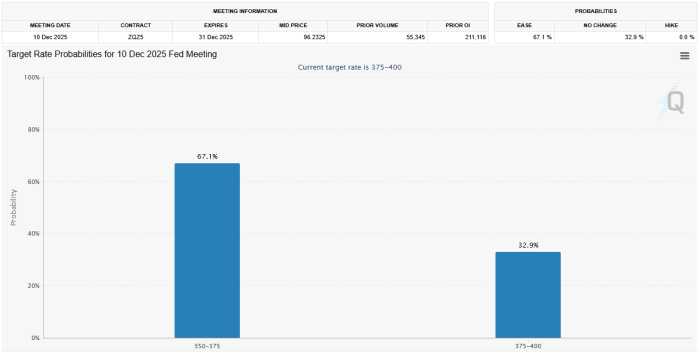
CME FedWatch odds for next meeting.

What’s driving the Fed’s more hawkish tone? Primarily macro headwinds – persistent data uncertainty, renewed concerns about a potential government shutdown, and shifting expectations around the pace and timing of future monetary easing.

Solana Stands Out

Against that backdrop of risk-off sentiment, Solana-based funds have surged. Since launching last week, Solana ETFs have attracted roughly $260 million in inflows.

The Bitwise Solana Staking ETF (BSOL) debuted with approximately $222 million in seed assets, offering investors exposure to Solana’s staking rewards, estimated at around 7% annually.
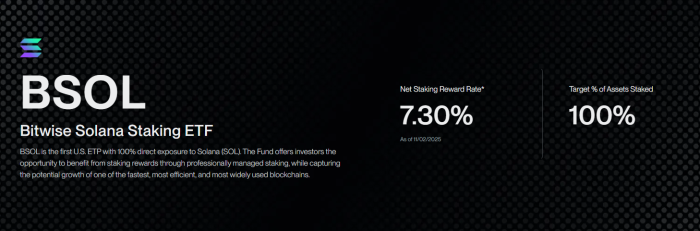
BSOL, the Bitwise Solana Staking ETF.

What’s fueling Solana ETF inflows? In part, profits from recent Bitcoin and Ethereum rallies. Investors are recycling assets into products offering yield and differentiated exposure, and Solana ticks both boxes.

It’s a top-10 blockchain by market capitalization and boasts native staking, as well as burgeoning DeFi activity. Beyond ETFs, Solana saw over $421M enter its ecosystem last week.

As investors look to reinvest, smaller projects with a utility focus are gaining attention. That includes some of the best crypto to buy now, projects like PepeNode, which takes a unique approach to meme coin trading.

PepeNode ($PEPENODE) – Mine-to-Earn Presale Powers Diversified Meme Coin Investment Strategy

PepeNode ($PEPENODE) fuses meme-culture appeal with a gamified ‘mine-to-earn’ mechanism. $PEPENODE token holders can purchase and deploy virtual miner nodes in a simulated mining environment, and then upgrade them as needed.
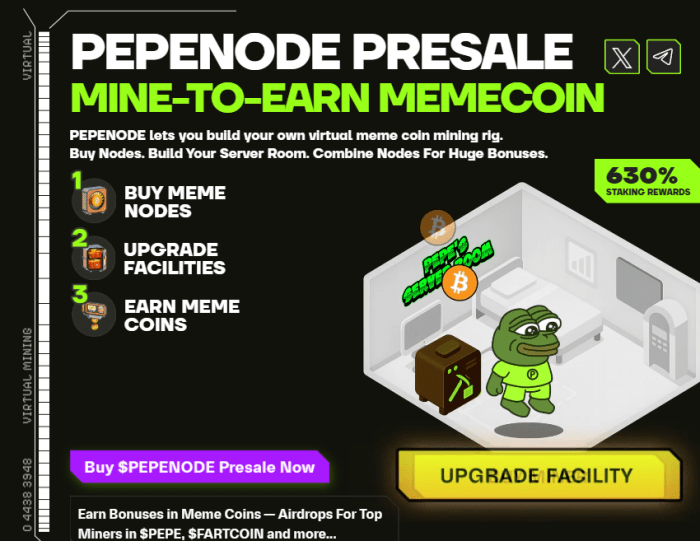
PepeNode presale, the mine-to-earn meme coin.

The gamification elements are introduced through purchasing and combining different mining nodes, each with its own unique properties. Different node combinations will mine at different rates; users can experiment to find the most efficient mining solution.

PepeNode isn’t just about mining its own token; mining bonuses include other popular meme coins, notably $PEPE and $FARTCOIN.

The mine-to-earn mechanism is more than a meme coin quirk; it’s a unique way to turn an up-and-coming project into a way to diversify meme coin earnings.

PepeNode’s potential to provide expanded exposure for the meme coin market helps explain why the project has already raised over $2M, with major whale buys including a $94K purchase.

Learn how to buy $PEPENODE, and see why our price prediction sees the token potentially reaching $0.0072 from its current price of $0.0011317 – a 536% increase.

Visit the PepeNode presale page to join in.

The Solana ETF wave underscores a shift from plain-vanilla exposure to structured instruments with yield. If $PEPENODE can position itself in a similar vein, with strong tokenomics, utility, and staking mechanics, it might well benefit from shifting crypto capital flows.

As always, do your own research; this isn’t financial advice.

Authored by Bogdan Patru at Bitcoinist — https://bitcoinist.com/solana-etfs-are-green-despite-hawkish-fed-pepenode-amp-up

Editorial Process for bitcoinist is centered on delivering thoroughly researched, accurate, and unbiased content. We uphold strict sourcing standards, and each page undergoes diligent review by our team of top technology experts and seasoned editors. This process ensures the integrity, relevance, and value of our content for our readers.

As a crypto writer, Bogdan’s responsibilities are split between researching and writing articles and entertaining the team with his humor bordering on the politically incorrect, an aspiring Bill Burr, if you will. Thanks to his 12+ years of writing experience in just as many fields, including tech, cybersecurity, modelling, fitness, crypto, and other topics-that-shall-not-be-named, he's become a genuine asset to the team. While his position as a senior writer at PrivacyAffairs thought him valuable lessons about the power of self-management, his entire writing career was and is an exercise in self-improvement. Now, he's ready to sink his teeth into crypto and teach people how to take control of their own money on the blockchain. With fiat as an eternally devaluing currency, Bitcoin and altcoins seem like the best-fitting alternative for Bogdan. Bogdan’s biggest professional accomplishment, aside from securing a position as a main writer for Bitcoinist, was his 5-year run as a writing manager at Blackwood Productions, where he coordinated a team of four writers. During that time, he learned the value of teamwork and that of creating a working environment that breeds efficiency, positivity, and friendship.

Related Reads

Uncovering the Truth About Agent Commerce, Payments, and Infrastructure

Decoding Agent Commerce, Payments, and Infrastructure: The Reality Over the past year, I've been building infrastructure for the Agent economy, engaging with major players like Stripe, Visa, Coinbase, Google, and dozens of startups. A clear conclusion emerges: true, large-scale demand does not yet exist. Startups face structural challenges. Data points illustrate this gap. Stripe's Agent commerce platform has over 1,000 merchants but only single-digit transacting agents. Visa's Agent payment token requires 9-month KYC and a $250M revenue threshold, accessible only to giants like Amazon. On-chain analysis reveals actual daily Agent transaction volume is around $17k, half of which are test transactions. The article analyzes four potential markets: **1. Agent-to-Merchant (A2M):** Current AI shopping UX is often inferior to traditional e-commerce for visual, comparison-heavy purchases (clothing, electronics). Chat interfaces are a step back. Real merchant interest is defensive "Agent Engine Optimization," fearing future obsolescence, not current demand. Potential exists in high-frequency, low-decision purchases (e.g., food delivery) or simplifying terrible UX (complex checkouts, non-native shoppers), but these require massive consumer distribution channels dominated by giants like DoorDash and Amazon. **2. Agent-to-API (A2A):** Developers already have subscriptions and billing for core APIs (compute, data). The argument for micro-payments via crypto for sub-dollar API calls is addressed by pre-paid balances today. The deeper issue is supplier resistance; major SaaS firms rely on enterprise contracts, not fractional cent pricing. Opportunity lies in the long tail of niche services, but this is a smaller market catering to developers, a historically low-paying group. **3. Agent-to-Agent (A2A):** This remains a theoretical long-term vision with near-zero current transaction volume. It involves unique challenges: discovery, trust, negotiation, dispute resolution. When it materializes, it will require a fundamentally new settlement infrastructure for high-speed, variable-value, multi-party transactions. It's a real long-term bet, but not the current market. **4. Agent-to-Finance (A2F):** This is the only category with existing, paying demand. Integrating AI into financial workflows (trading, portfolio management) is a natural evolution and enables new capabilities like autonomous rebalancing. However, competition favors incumbents with regulatory licenses, compliance infrastructure, and existing client relationships. **The Real Issue:** Why is infrastructure still being built? Incumbents can afford long-term bets, and payment companies see every problem as a nail for their payment hammer. However, payment is just one piece. The core challenge is *coordination*—orchestrating work between Agents and humans, verifying outcomes, and settling results. Payment is part of settlement, which is part of coordination. Companies that solve the coordination problem will subsume payments, not the other way around. Startups lack the infinite runway of giants and must find today's real market, which, after a year of exploration, lies outside these four categories—in an area with real, growing, and underserved activity.

marsbit18m ago

Uncovering the Truth About Agent Commerce, Payments, and Infrastructure

marsbit18m ago

Kalshi, MTS, and a16z's Ambition

The article "Kalshi, MTS, and a16z's Ambition" explores prediction markets as a focal point of excitement in 2025 for investors, crypto enthusiasts, and media. It traces their intellectual lineage from Friedrich Hayek's ideas on dispersed knowledge and market coordination to Robin Hanson's Logarithmic Market Scoring Rule (LMSR), which incentivizes truthful information sharing. The piece argues that a16z's significant investment in prediction market platform Kalshi (valued at $220B) transcends mere financial speculation. a16z frames prediction markets as a new form of "media" that provides "presence"—a way for individuals to actively engage with and influence world events through financial stakes, countering postmodern detachment. By wagering on outcomes, users become "super observers," and the market's aggregated probabilities gain authoritative power to define event truth and importance. The article uses media company MTS ("Monitoring The Situation") as a case study of a16z's "new media" strategy: rapidly producing high-intensity, multi-format content to "take over the timeline." However, prediction markets like Kalshi are presented as the ultimate piece in this media empire. Their real-money, crowd-sourced probabilities possess a unique "reality distortion field" and perceived objectivity, potentially swaying public opinion and granting a private company unprecedented interpretive power over reality. Ultimately, Kalshi's immense valuation is attributed not just to its exchange model, but to its role as a foundational component in a16z's envisioned new media landscape, where prediction markets define narrative and truth.

链捕手19m ago

Kalshi, MTS, and a16z's Ambition

链捕手19m ago

US Stocks Suffer Worst Plunge Since 2025: Three Triggers Ignite Tech Stock Valuation Reset

The US stock market experienced its most severe sell-off since the 2025 tariff crisis on June 5th, 2025. The Nasdaq Composite plummeted 4.18%, the S&P 500 fell 2.64%, and the Dow Jones dropped 695 points. The panic stemmed from three converging factors. First, Broadcom's earnings report ignited fears of a slowdown in AI growth. While its AI chip revenue surged 143% YoY to $10.8B, its Q3 AI revenue guidance of $16B fell short of the $17.2B consensus. This triggered a massive sector-wide sell-off, with the Philadelphia Semiconductor Index crashing 10.26% and semiconductor stocks losing roughly $1.3 trillion in market value in a single day. Second, a shockingly strong May jobs report crushed hopes for Federal Reserve rate cuts. Non-farm payrolls added 172,000 jobs, doubling expectations. This robust data, combined with persistently high oil prices above $92/barrel due to the ongoing Iran war and blockade of the Strait of Hormuz, drastically increased market expectations for a potential Fed rate hike instead of a cut. Higher interest rates compress the valuations of growth-heavy tech stocks. Third, the prolonged Iran conflict continues to fuel inflationary pressures, complicating the Fed's policy decisions and undermining the "inflation is tamed" narrative. Together, these events challenged the twin pillars of the market rally: the "limitless AI growth" story and expectations for imminent monetary easing. The sell-off spread globally, impacting Asian and European markets and cryptocurrencies. The article posits this is likely a severe "valuation repricing" rather than the end of the AI story. The underlying demand for AI remains strong, but investor expectations for growth speed and the prices they are willing to pay are being recalibrated. Key upcoming factors include the June FOMC meeting, future AI company earnings, and developments in the Iran conflict.

marsbit4h ago

US Stocks Suffer Worst Plunge Since 2025: Three Triggers Ignite Tech Stock Valuation Reset

marsbit4h ago

Trading

Spot
Futures

Hot Articles

How to Buy AMP

Welcome to HTX.com! We've made purchasing AMP (AMP) simple and convenient. Follow our step-by-step guide to embark on your crypto journey.Step 1: Create Your HTX AccountUse your email or phone number to sign up for a free account on HTX. Experience a hassle-free registration journey and unlock all features.Get My AccountStep 2: Go to Buy Crypto and Choose Your Payment MethodCredit/Debit Card: Use your Visa or Mastercard to buy AMP (AMP) instantly.Balance: Use funds from your HTX account balance to trade seamlessly.Third Parties: We've added popular payment methods such as Google Pay and Apple Pay to enhance convenience.P2P: Trade directly with other users on HTX.Over-the-Counter (OTC): We offer tailor-made services and competitive exchange rates for traders.Step 3: Store Your AMP (AMP)After purchasing your AMP (AMP), store it in your HTX account. Alternatively, you can send it elsewhere via blockchain transfer or use it to trade other cryptocurrencies.Step 4: Trade AMP (AMP)Easily trade AMP (AMP) on HTX's spot market. Simply access your account, select your trading pair, execute your trades, and monitor in real-time. We offer a user-friendly experience for both beginners and seasoned traders.

1.3k Total ViewsPublished 2024.03.29Updated 2026.06.02

How to Buy AMP

Discussions

Welcome to the HTX Community. Here, you can stay informed about the latest platform developments and gain access to professional market insights. Users' opinions on the price of AMP (AMP) are presented below.

活动图片