Pi Network Price Crash Concerns Rise as Investors Deposit 2M Tokens

CoingapePublished on 2025-05-27Last updated on 2025-05-27

Abstract

Explore why the Pi Network price may be at risk of a big dive as exchange inflows rise and it forms a bearish flag chart pattern.

Highlights

  • Pi Network price is at risk of a big crash as exchange inflows rise.
  • Investors moved a net 2 million Pi coins to exchanges in the last 24 hours.
  • Pi coin has formed a bearish flag pattern, pointing to further downside.

Pi Network price remains under intense pressure today, May 26, even as Bitcoin moved back above $110,000. The token trades at $0.7752, down by over 53% from its highest level this month, making it one of the worst-performing major coins. Pi Coin price is at risk of a big drop as investors move 2 million tokens to exchanges.

Pi Network Price Technical Analysis Points to a Deeper Dive

The eight-hour chart shows that the value of Pi has suffered a big reversal after soaring to a two-month high of $1.6692 on May 12. It has dropped by over 53% to the current $0.7773 even as Bitcoin hovers near its all-time high.

Pi Coin has moved slightly below the 50-period Exponential Moving Average (EMA) at 0.7910. It has also formed a bearish flag chart pattern, which happens after an asset crashes and then consolidates or moves upwards in a channel formation.

It has already moved below the lower side of the flag section of this pattern. Therefore, there is a risk that the coin will drop to $0.6584, its lowest point on May 17. A drop below that level will point to more downside, potentially to this month’s low of $0.5545, down by 30% below the current level.
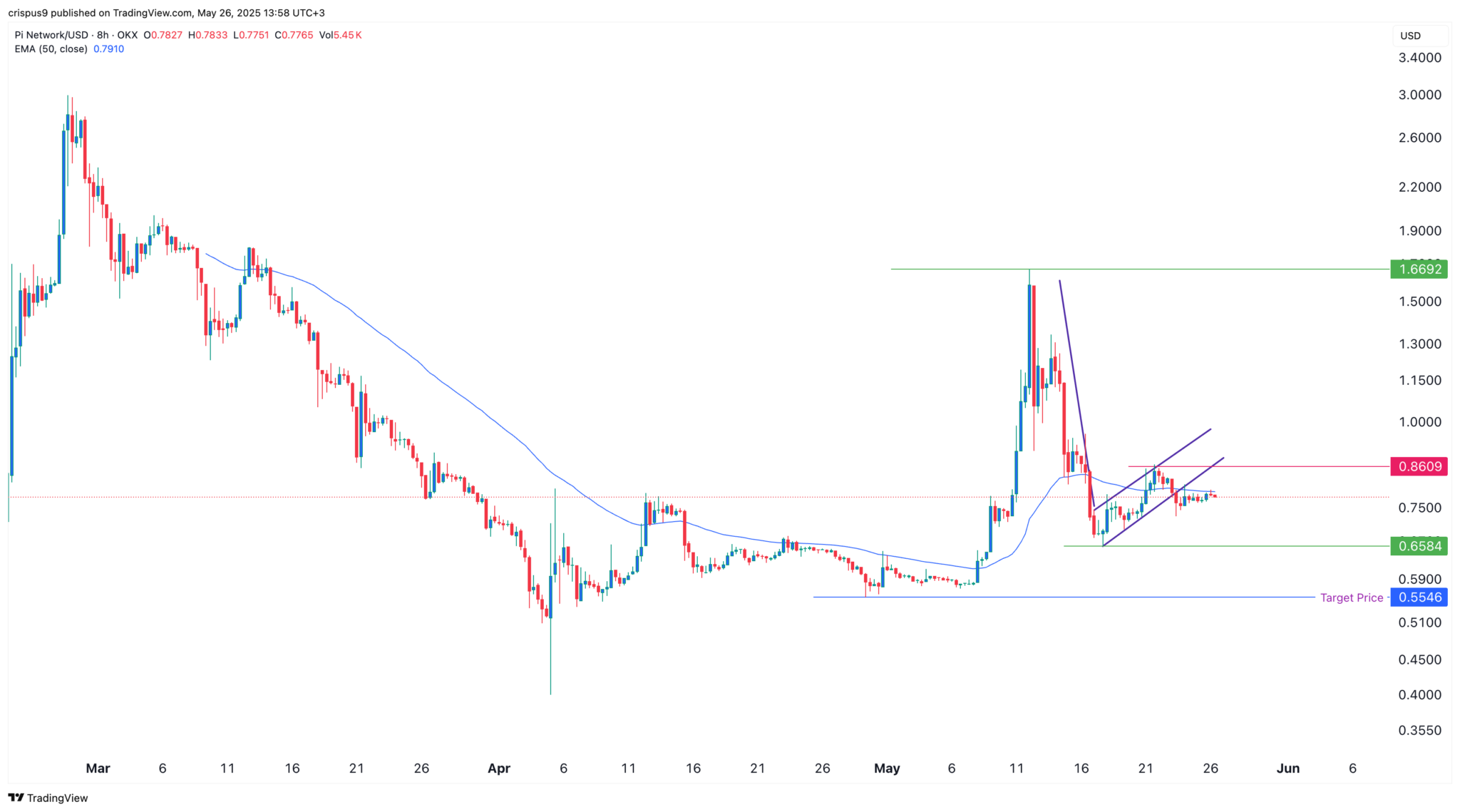
The bearish Pi Coin price forecast will become invalid if the coin rises above $0.8600, the highest point last week. A move above that level will point to more gains, potentially to the psychological point at $1.

Pi Coin Price Could Crash as Exchange Inflows Rise

PiScan data shows that Pi Network price may be at risk of a big crash as investors move tokens into exchanges. Investors moved 4.1 million coins into OKX in the last 24 hours, while withdrawals stood at 2.2 million, bringing the net flow to 1.88 million.

The netflow to Bitget was 712,097 coins, and on Pionex was 2,176. Only MEXC and Gate had net outflows in the past 24 hours. Altogether, the total inflows into exchanges stood at over 2.04 million.
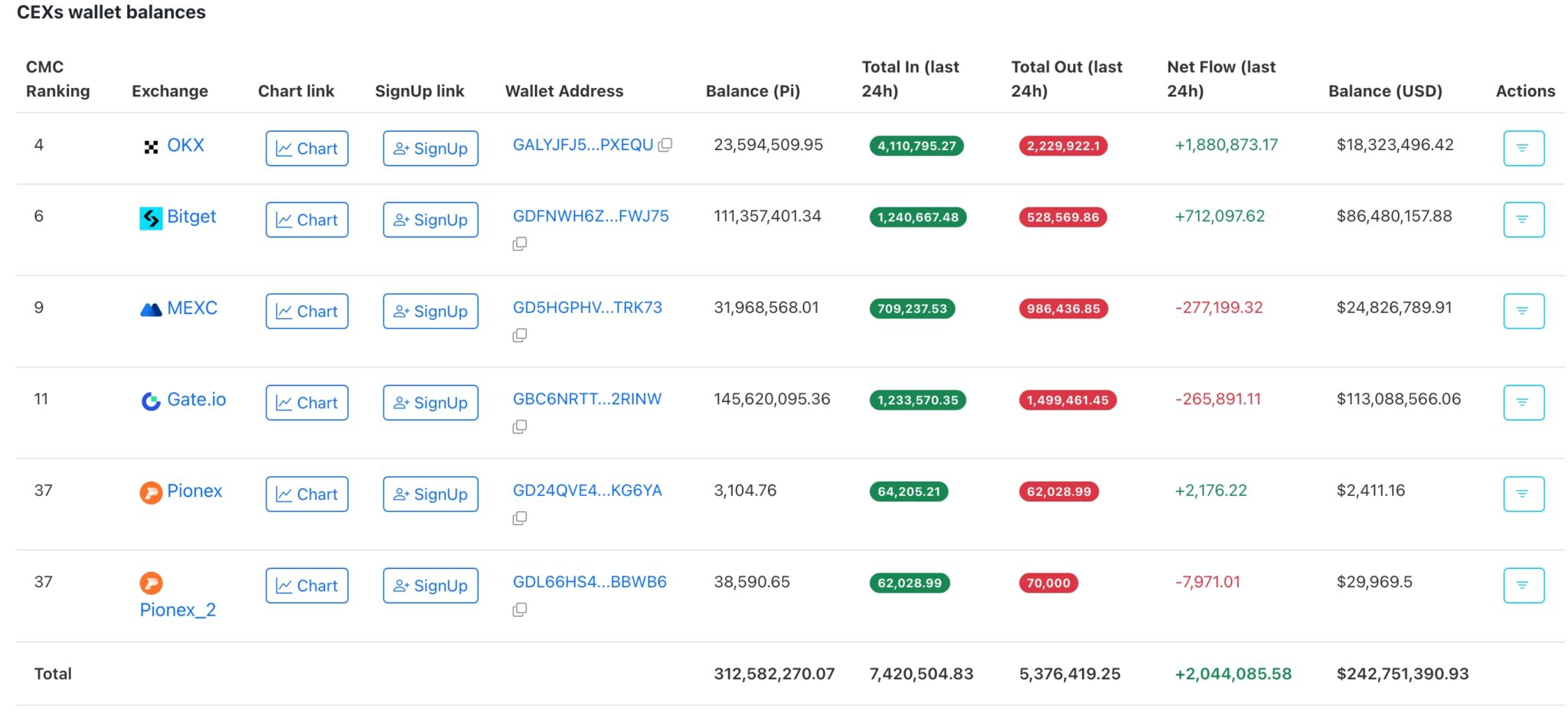
Exchange inflows are one of the top red flags in crypto analysis. That’s because they signal that investors are moving them from their self-custody wallets and selling them. This data is a sign that demand for the coin remains limited after its recent crash.

Pi Coin price crash could continue falling this week as more coins are set to be unlocked this week. 9.9 million coins will be unlocked today, while 12 million, 15.2 million, and 13.2 million will be unlocked in the next three days. Over 72 million coins valued at over $50 million will come online this week, and 280 million in the next 30 days.

This unlock trend will continue for a while since there are now 11.1 billion in circulation against a circulation cap of 100 billion. These unlocks may affect its price if there is no corresponding demand on the other side. For a detailed price prediction for Pi Coin 2025-2023 -


Related Reads

Arcus Chooses "Stepfather" Robinhood Chain, "Biological Father" dYdX Awkwardly Attempts to Salvage the Situation

Robinhood officially launched its own Layer 2 network, Robinhood Chain. In response, many major DeFi protocols like Uniswap and Chainlink announced integration. A key point of discussion was Arcus, a new decentralized exchange (DEX) developed by the dYdX team, which chose to launch on Robinhood Chain instead of the native dYdX Chain. Arcus offers 24/7, zero-fee trading of 95 tokenized stocks and perpetual contracts. This move sparked community concerns about dYdX Chain potentially being sidelined, causing DYDX token's price to drop over 12%. Critics questioned if dYdX Labs' focus is shifting to Arcus and how DYDX token holders would benefit from Arcus's future growth, especially as its founder mentioned a future Arcus token would allocate a portion to the dYdX community. dYdX founder Antonio Juliano clarified that dYdX Chain will continue operating, but acknowledged its deep decentralization involved trade-offs in performance and user experience. He stated Arcus is a separate product led by a new CEO, responding to market demands for faster, simpler platforms. The dYdX Foundation also confirmed DYDX's role remains unchanged for dYdX Chain governance and staking, with no plans for token migration. However, the core uncertainty remains: if Arcus succeeds, how will that value flow back to dYdX Chain and its DYDX token holders?

Odaily星球日报22m ago

Arcus Chooses "Stepfather" Robinhood Chain, "Biological Father" dYdX Awkwardly Attempts to Salvage the Situation

Odaily星球日报22m ago

High-Yield, No Debt, No Dilution: Why Bitcoin Treasury Companies Are Aggressively Promoting Preferred Stock Financing?

Bitcoin-backed preferred shares, led by companies like Strategy and followed by newer entrants such as Strive, have grown to a roughly $13 billion market in under two years. These instruments offer high yields, attracting significant capital. A 2026 report by BitcoinTreasuries.net and Apyx projects this segment could grow from nearly 1% to 3-5% of the global $1.3 trillion preferred share market by 2030, with long-term potential reaching 10%. This financial tool addresses a core dilemma for companies holding Bitcoin as a treasury asset. It allows firms like Michael Saylor's Strategy to raise long-term capital for purchasing more Bitcoin without diluting common shareholders or taking on debt with fixed repayment schedules. In exchange, preferred shareholders receive priority dividends, converting Bitcoin's volatility into a stable income product for yield-focused investors. Yields on these securities, ranging from 10.8% to 15.2%, far exceed traditional savings accounts. Strategy's issues dominate the market, with Strive's offering being a smaller player. The report identifies strong institutional demand, potentially reaching $10.9-$21.8 billion, but supply is constrained by the limited pool of corporate-held Bitcoin available as collateral—approximately 1.26 million BTC valued around $83 billion. A key safety feature is the high collateral coverage ratio of 3.8x to 4.5x, meaning each dollar of preferred equity is backed by $3.8-$4.5 in Bitcoin. Issuers require clean balance sheets and substantial scale. Risks are structural: companies like Strategy act as volatility amplifiers, and dividend sustainability relies on continued capital raises during Bitcoin price appreciation. However, both Strategy and Strive maintain cash reserves to cover at least 12 months of payments. The market is currently in a "0 to 1" phase where demand significantly outpaces supply, favoring early issuers.

marsbit42m ago

High-Yield, No Debt, No Dilution: Why Bitcoin Treasury Companies Are Aggressively Promoting Preferred Stock Financing?

marsbit42m ago

Robinhood Layer 2 integration fuels 14% Uniswap price jump

Uniswap has deployed its V2, V3, V4, and UniswapX protocols on the Robinhood Chain, a new Layer 2 network built by Robinhood Crypto, where Uniswap will serve as the automated market maker (AMM). The integration, aimed at programmatic and AI-driven ecosystems, sparked a 14.2% surge in the UNI token's price and an 81% increase in daily trading volume over 24 hours, buoyed by a broader 2.3% crypto market rally. Technical analysis reveals a contrasting long-term bearish trend. Despite the short-term bounce, the weekly chart shows UNI broke below the key $4 support level, which has now turned into resistance, with a recent swing low at $2.316 in early June. While the RSI has moved above 50, indicating momentum, the On-Balance Volume (OBV) has not recovered to June highs, suggesting a lack of sustained buying pressure. A Fibonacci retracement analysis places the current rally within a broader bearish structure. The liquidation heatmap shows a high concentration of leveraged short positions up to the $3.52 level, increasing the likelihood of a short-term price move towards $3.5. The analysis suggests traders could use a potential bounce to $3.5 or even $3.77 (the 78.6% retracement level) as a selling opportunity. The overall bearish bias remains intact unless UNI breaks above the $4.17 swing high. In summary, while the Robinhood news triggered a rally, it is viewed as a minor rebound within a dominant long-term downtrend.

ambcrypto49m ago

Robinhood Layer 2 integration fuels 14% Uniswap price jump

ambcrypto49m ago

Trading

Spot
活动图片