Solana Trader Makes Over $35 Million From ai16z And Fartcoin, Here’s What He’s Buying Now

bitcoinistPublished on 2025-01-08Last updated on 2025-01-09

Abstract

As noted by Lookonchain, a Solana trader has turned heads with profits of almost $20 million each from $ai16z and...

As noted by Lookonchain, a Solana trader has turned heads with profits of almost $20 million each from $ai16z and $Fartcoin, and with an 89.07% win rate over the past 30 days. As shown by on-chain data, these profits have been made through a strategy of buying very early into low market cap cryptocurrencies. Interestingly, on-chain movements in the past 24 hours show that the trader is now making more moves into other low market cap cryptocurrencies.

Solana Trader Makes 6,400x And 1,490x Returns On $ai16z And $Fartcoin

The crypto industry is home to millions of cryptocurrencies, and thousands more are created each day. Identifying the most promising cryptocurrencies to invest in out of the multitude is a daunting task for crypto investors. 

However, a few investors shoot up from time to time with crazy returns and make crypto investments look very easy. Such is the case of this Solana smart trader, who has made quite a return on crypto investments in the past few months. The most notable of these investments are $ai16z and $Fartcoin. 

The Solana trader’s success with $ai16z stands out as one of the most impressive returns in recent months. On October 25, 2024, he identified the token early and purchased 9.16 million $ai16z for just 18 SOL, roughly $3,000. Since then, the value of $ai16z has grown massively, and he has sold a portion of his holdings (1.32 million tokens) for $1.71 million, but he continues to hold 7.85 million $ai16z valued at $17.26 million. His total profit from this trade has reached $19 million, translating to a 6,400x return on his initial investment.

Another significant win for the trader came from $Fartcoin, where he invested $12,200 to acquire 17.31 million $Fartcoin at a market cap of $83,000. At the time of writing, $Fartcoin has a market cap of $1.02 billion, meaning the initial investment has yielded a total profit of more than $18 million. He has since sold 6.71 million tokens for $5.41 million while still holding 10.6 million $Fartcoin worth $12.83 million.

What’s Next? Low-Cap Tokens And A Major Bet On $OPAIUM

As noted by Lookonchain, the trader’s latest moves involve a series of small bets on low-cap tokens such as $eef, $DEAL, $GG, $SXBT, $FARTOLOGY, and $TBOO, which are relatively high-risk, high-reward opportunities. However, the most substantial recent investment is in $OPAIUM, where he has allocated 400 SOL, approximately $86,000.
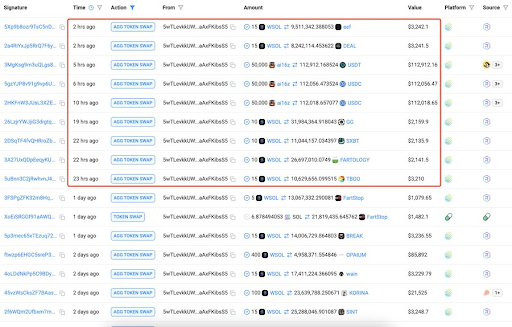
Solana
Source: Etherscan

Given the impressive track record of the Solana trader, these low marketcap cryptocurrencies are some to keep an eye on, especially $OPAIUM.

Solana price chart from Tradingview.com
SOL price struggles with bears | Source: SOLUSDT on Tradingview.com
Featured image created with Dall.E, chart from Tradingview.com
Scott Matherson

Scott Matherson

Scott Matherson is a leading crypto writer at Bitcoinist, who possesses a sharp analytical mind and a deep understanding of the digital currency landscape. Scott has earned a reputation for delivering thought-provoking and well-researched articles that resonate with both newcomers and seasoned crypto enthusiasts. Outside of his writing, Scott is passionate about promoting crypto literacy and often works to educate the public on the potential of blockchain.

Trending Cryptos

Related Reads

Government Intervention in the Bond Market: What Does It Mean?

On August 19, 2026, the U.S. Treasury unexpectedly announced it would at least double the size of its long-term Treasury buyback operations, starting September 9. The move triggered an immediate market reaction, with the 30-year yield falling 9 basis points. This intervention came against a backdrop of the 30-year yield hitting a 19-year high of 5.34% the previous day, driven by persistent inflation, high oil prices, deteriorating U.S. fiscal health with public debt surpassing $40 trillion, and a global "buyers' strike" for long-dated bonds. Treasury buybacks involve the government repurchasing older, less liquid bonds from the market via reverse auctions to improve market functioning, not to reduce overall debt. While the action provided tactical relief and signaled the Treasury's willingness to intervene, analysts caution it does not address core structural issues: massive fiscal deficits, high borrowing needs, and fading demand from traditional buyers like foreign central banks. For investors, the announcement offered short-term support for long-duration bond ETFs and boosted assets like gold, which rose 2.7%. However, it's unlikely to significantly lower mortgage rates or alter the challenging environment for long-term bonds. The key takeaway is the distinction between a tactical market operation and the unresolved structural pressures that continue to push yields higher, requiring close monitoring of upcoming economic data, Treasury auctions, and potential signals of more aggressive policy measures.

marsbit4m ago

Government Intervention in the Bond Market: What Does It Mean?

marsbit4m ago

After 'Bessent Put', How Far Is the U.S. from Restarting QE?

Following an unscheduled announcement from the U.S. Treasury Department on August 19th, investor discussions have intensified regarding the potential for future policy interventions in long-term bond markets. The Treasury increased the maximum size of its regular buyback operations for 10-to-30 year bonds from $2 billion to $4 billion, citing a desire to improve liquidity. This move came shortly after a surge in long-term yields, with the 30-year Treasury yield briefly touching 5.34%. Market analysts, rather than focusing on the modest operational size, have interpreted the timing—outside the normal quarterly communication window—as a significant signal. The move has been dubbed the "Bessent Put," implying the market's growing expectation that Treasury officials, led by Deputy Secretary Josh Bessent, may act to prevent a disorderly rise in long-term borrowing costs. This perception represents a potential shift in the market's view of the government's "policy reaction function." The underlying pressures on long-term bonds are multifaceted, including large fiscal deficits, increased Treasury supply, a rise in corporate debt issuance for AI infrastructure (creating a "crowding out" effect), and uncertainty around foreign holdings, particularly from Japan. Geopolitical risks in the Middle East further complicate the policy landscape, potentially creating conflicting pressures between fighting inflation and managing financing costs. However, the article clarifies that this Treasury buyback program is distinct from Quantitative Easing (QE). It is a debt management operation, not a Federal Reserve balance sheet expansion. While the announcement opens the door for market speculation about more forceful tools like Yield Curve Control (YCC) or a return to QE, analysts note that conditions would need to deteriorate significantly for such measures to be implemented. For now, the "Bessent Put" reflects a change in market expectations about possible policy boundaries, not an imminent launch of new monetary stimulus.

marsbit5m ago

After 'Bessent Put', How Far Is the U.S. from Restarting QE?

marsbit5m ago

Is Stablecoin Really Necessary for Cross-border Payments?

"Is Stablecoin Truly Necessary for Cross-Border Payments? While stablecoins are often praised as superior for cross-border transfers—especially if the recipient desires crypto—their advantage is less clear in traditional cross-currency scenarios (e.g., USD to Mexican Peso). The existing correspondent banking system is slow and costly (≈15% fees) due to multiple intermediaries. Modern fintech solutions like Wise have dramatically improved this by using a netting model: they hold local currency pools and settle payments domestically, avoiding actual cross-border fund movement. This offers near-instant transfers with low, transparent fees (averaging ~0.52%). The 'stablecoin sandwich' model (convert fiat to stablecoin, transfer on-chain, convert to local fiat) offers similar user experience but doesn't inherently provide major cost or speed advantages over fintech. Its on-chain transfer is cheap, but fiat conversion spreads remain. Stablecoin's real innovation is 'unbundling' the cross-border payment stack. Instead of requiring a proprietary global network like Wise, businesses only need reliable on- and off-ramps in specific corridors. This lowers market entry barriers, fosters competition among local providers, and can drive down costs, particularly for niche or underserved corridors (e.g., US to Africa). While vertical integration may reoccur, the open, permissionless nature of the underlying blockchain layer makes monopolistic pricing difficult. The long-term benefit is the potential redistribution of value—previously captured as intermediary rents—to consumers through lower costs."

marsbit9m ago

Is Stablecoin Really Necessary for Cross-border Payments?

marsbit9m ago

Ethereum Finally 'Bounces Back'! ETH Returns to the Golden Line, What's Different About This Rally?

Ethereum has surged above $2,300, a level not seen in over three months, marking a significant recovery and technical breakthrough by reclaiming key resistance levels, including the weekly EMA50 for the first time in the current bear market. The rally has been fueled by a combination of factors: improved market risk appetite, positive regulatory sentiment, and a major short squeeze where over 88% of recent ETH liquidations were short positions. The ETH/BTC ratio has also broken its long-term downtrend, indicating renewed strength for Ethereum relative to Bitcoin. Fundamentally, Ethereum spot ETFs have shown strong inflows, outperforming their Bitcoin counterparts in recent months. Wall Street institutions like Morgan Stanley and JPMorgan have notably increased their ETH exposure, while several banks have added or expanded positions in ETH ETFs. On-chain fundamentals remain robust, with the proportion of staked ETH reaching a new all-time high of nearly 33.7%. Data indicates long-term holding sentiment, as small wallet holdings increased while large outflows were often directed towards staking or contracts, not selling. However, potential headwinds include declining staking yields and community debate over proposals to adjust staking rewards at high participation levels. The upcoming Glamsterdam upgrade, featuring improvements to validator exit efficiency, could enhance liquidity and further attract institutional stakers. While the rebound is supported by sentiment, capital flows, and fundamentals, its sustainability hinges on continued positive developments.

marsbit9m ago

Ethereum Finally 'Bounces Back'! ETH Returns to the Golden Line, What's Different About This Rally?

marsbit9m ago

Trading

Spot

Hot Articles

How to Buy FARTCOIN

Welcome to HTX.com! We've made purchasing Fartcoin (FARTCOIN) simple and convenient. Follow our step-by-step guide to embark on your crypto journey.Step 1: Create Your HTX AccountUse your email or phone number to sign up for a free account on HTX. Experience a hassle-free registration journey and unlock all features.Get My AccountStep 2: Go to Buy Crypto and Choose Your Payment MethodCredit/Debit Card: Use your Visa or Mastercard to buy Fartcoin (FARTCOIN) instantly.Balance: Use funds from your HTX account balance to trade seamlessly.Third Parties: We've added popular payment methods such as Google Pay and Apple Pay to enhance convenience.P2P: Trade directly with other users on HTX.Over-the-Counter (OTC): We offer tailor-made services and competitive exchange rates for traders.Step 3: Store Your Fartcoin (FARTCOIN)After purchasing your Fartcoin (FARTCOIN), store it in your HTX account. Alternatively, you can send it elsewhere via blockchain transfer or use it to trade other cryptocurrencies.Step 4: Trade Fartcoin (FARTCOIN)Easily trade Fartcoin (FARTCOIN) on HTX's spot market. Simply access your account, select your trading pair, execute your trades, and monitor in real-time. We offer a user-friendly experience for both beginners and seasoned traders.

8.9k Total ViewsPublished 2024.10.23Updated 2026.06.02

How to Buy FARTCOIN

Discussions

Welcome to the HTX Community. Here, you can stay informed about the latest platform developments and gain access to professional market insights. Users' opinions on the price of FARTCOIN (FARTCOIN) are presented below.

活动图片