Cross The Ages: The Evolving Metaverse

MirrorPublished on 2024-05-28Last updated on 2026-06-25

Abstract

"Cross the Ages" (CTA) is a mobile collectible card game set in a dystopian world conflict, launched in 2020. CTA creates a metaverse that engages players in role-playing games (RPGs) and strategy games, while allowing them to trade and invest through the in-game economic system. In 2022, CTA migrated from the Polygon blockchain to Immutable X. The mainnet has been launched in 2023.

"Cross the Ages" (CTA) is a mobile collectible card game set in a dystopian world conflict, launched in 2020. CTA creates a metaverse that engages players in role-playing games (RPGs) and strategy games, while allowing them to trade and invest through the in-game economic system. In 2022, CTA migrated from the Polygon blockchain to Immutable X. The mainnet has been launched in 2023.

The Cross The Ages game is based on seven fantasy and science fiction novels that will be published over the next seven years. The first novel La Rune & le Code has been published, and its corresponding digital card series explores a world of high-tech machines as well as wildlife and monsters. The second part will be completed in June and will be available in the fourth quarter.

Basic Information

1. Financing Status

In 2021, CTA secured a $12 million seed round financing, with investors including the gaming-focused crypto investment company Animoca Brands, major game publisher Ubisoft, and Sebastian Borget, co-founder and COO of The Sandbox. Recently, on May 15th, CTA raised an additional $3.5 million in funding.

2. Team Composition

The CTA team currently comprises over 180 individuals, including artists, writers, developers, and business experts. Key members are disclosed, with Sami Chlagou serving as CEO. Sami has been the CEO and founder of five international game development studios (in France, Japan, Brazil, Hungary, and the UK) since 2015. These studios have produced over 50 video games across various platforms such as Nintendo, Sony, Xbox, Steam, and Android. Some of these games have annual downloads exceeding 1 million.

3. Relevant Data

CTA currently has a community of over 148,000 players, with game downloads surpassing 450,000 across major platforms. The Discord community has 26,137 members, with over 1,800 online concurrently. Daily active users of the game exceed 20,000, with monthly active users surpassing 148,000. Twitter followers number 265.3K, and there are over 240,000 followers on Instagram. These metrics illustrate the popularity of CTA and its user base.

Game Mechanics

CTA's first game is a free-to-play trading card game (TCG) where players earn while playing. There are over 400 available cards, illustrated by some renowned artists. The game was initially developed for mobile users. Currently, players can choose between adventure mode and arena mode. The second game, Arise, is currently in development, which is a multiplayer action RPG. The current roadmap is to launch the game demo in September 2024, followed by a series of NFTs and seasonal versions.

CTA's games feature the following four characteristics:

1. Mobile-first Approach

While most Web3 games are accessed through PC, and the mainstream direction of current Web2 games is mobile-oriented. Cross The Ages prioritizes mobile to engage players in the story, gameplay, and characters before transitioning them to PC/MAC blockchain-based applications.

2. IP-based

CTA is an intellectual property project that blends major literary genres such as fantasy, sci-fi, and post-apocalyptic, constructing a world full of conflict and imagination called Artellium, laying the groundwork for the connection between virtual and real.

3. Diverse Ecosystem

The CTA ecosystem spans across gaming, esports, animation, collectibles, and more, providing players with rich experiences. Additionally, CTA offers a blockchain-based NFT marketplace, enabling players to trade their digital collectibles and other valuable NFT assets. The GAMEFI ecosystem of Cross the Ages, along with the NFT marketplace, forms a comprehensive ecosystem containing in-game tokens, NFT assets, and decentralized exchanges.

4. Bridging Virtual and Physical World

CTA aims to break the boundaries between virtual and physical, offering players products related to the cross-century universe. In addition to novel publishing, CTA will also release a 1.5-hour animated film. Additionally, in Arise, players can purchase Cross the Ages land, which is a digital NFT plot where players can enhance their skills. These virtual lands can also be directly converted into physical land, giving players real ownership of land within the cross-century factory. Cross The Ages has acquired land to provide decarbonized energy from surplus production capacity. The clients of these factories include data centers, players in the artificial intelligence sector, Bitcoin miners, etc., all seeking low-cost green energy in a legally stable environment.

Tokenomics

All Cross the Ages games are supported by three currencies and specific mint passes. These include:

- CTA Tokens: CTA tokens are synchronized with project assets, aiding in game progression and exploration. Investors can also use them to purchase mint passes for exclusive drops.

- Pranah: Pranah is the exclusive digital currency within Cross The Ages products, obtained through purchases. It allows access to secondary features like cosmetics and accelerates content acquisition. Pranah is consistent and interoperable across all CTA products.

- Trisel: Trisel is the in-game digital currency within Cross The Ages (CTA) products, earned through player activities. It facilitates crafting functionalities and will soon enable players to sell their Trisel to others. Trisel remains consistent and interoperable across all CTA products.

- Mint Passes: CTA offers six types of Mint Passes, where players can lock CTA tokens to activate benefits.

CTA tokens serve as utility tokens within the game, granting primary game advantages and enabling users to transition from the digital space to the physical world. The total supply is 500,000,000 CTA tokens, with no future inflation. The token distribution is as follows:
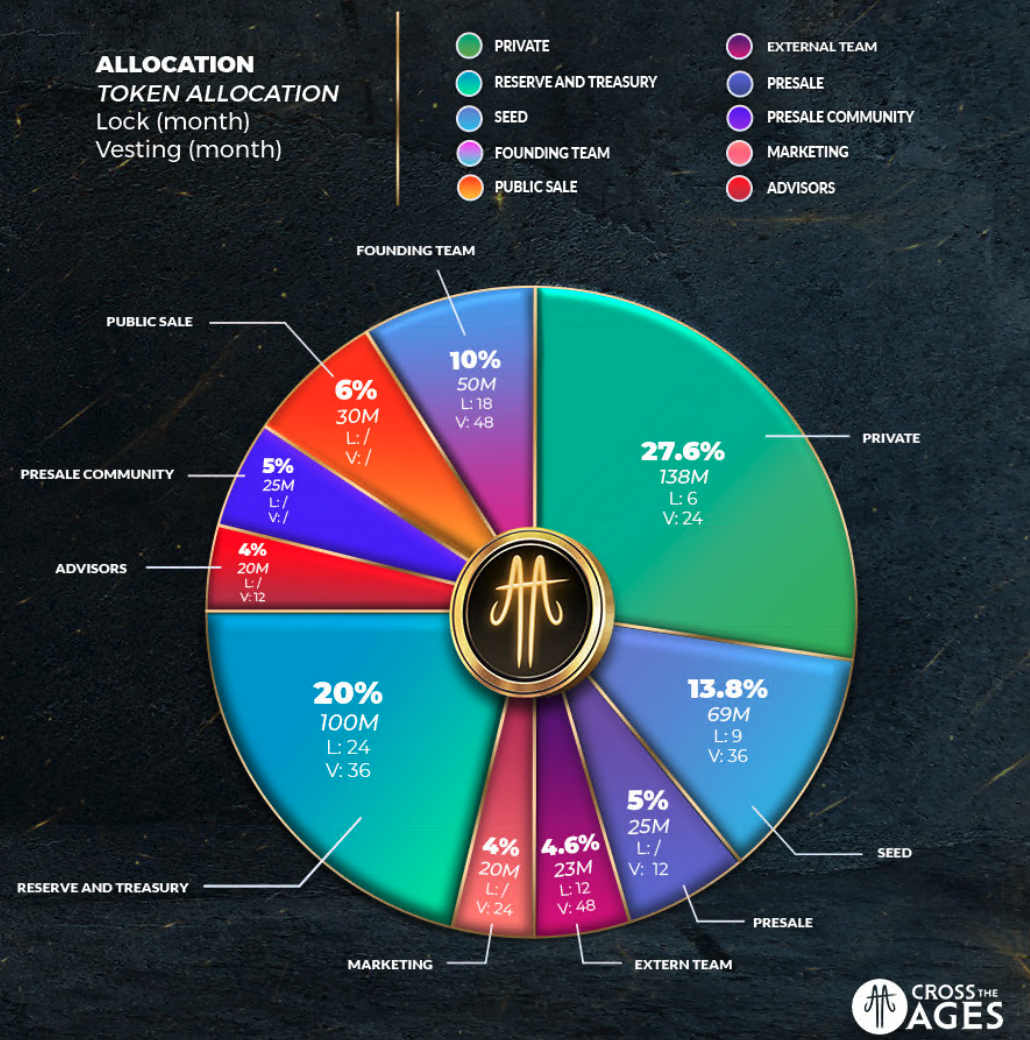
The CTA token plays a crucial role throughout the entire gaming ecosystem, with diverse use cases:

- Within the game environment, transactions for various commodities require holding CTA tokens.

- NFT minting, merging, lending, and other forms all necessitate holding CTA tokens. NFTs can also be bought and sold on the market in the form of CTA tokens.

- Staking—encouraging players to stake their CTA tokens to earn valuable assets and increase liquidity in the CTA pool. Additionally, stakers of CTA tokens will have exclusive access to Metaverse land sales during the initial issuance period.

- Primary in-game advantages—primary game advantages such as saving game progress, accessing valuable NFTs outside the series, special access to guild matches and tournaments, and accessing exclusive content.

- Governance—as the game progresses, the community engages in game development and metaverse construction through voting and governance participation.

In June, Pranah currency will be completely replaced by CTA tokens, using a single currency to make the players experience more convenient.

Future Development and Challenges

Currently, there are 1572 Web3 games, with an average of 3 million active users daily. The Web3 gaming industry is showing growth compared to 2023, with games being considered as the traffic entry point for Web3. Meanwhile, the competition among Web3 gaming projects is expected to intensify.

Cross the Ages has developed valuable IP for both Web2 and Web3 audiences, with products capable of generating multiple revenue streams, providing momentum for project development. The project has received support from major game publishers like Ubisoft, Animoca Brands, and Square Enix, which have provided solid marketing efforts and opportunities to enter mature communities for Cross the Ages. Cross the Ages has the potential to carve out a place in the Web3 gaming arena. However, CTA still needs to continually update its products to maintain the continuity of its IP and keep users engaged with fresh content.

Trending Cryptos

Related Reads

Deciphering the Ethereum Foundation's New Structure: Reaffirming Self-Sovereignty Amid Institutionalization Trends

Summary: The Ethereum Foundation (EF) has announced a major restructuring, laying off 20% of its staff and introducing a new five-layer operational framework. This move aims to clarify the EF's mission and reaffirm Ethereum's core principle of self-sovereignty amidst growing institutionalization in the crypto space. The five layers are: 1. **Protocol Layer**: Focuses on maintaining Ethereum's foundational "CROPS" values—Censorship-resistant, Robust, Open, Private, and Secure. This involves core technical work like secure hard forks and mitigating toxic MEV. 2. **Access Layer**: Ensures users can practically exercise self-sovereignty through actions like reading the chain and making transactions. A key principle is the "zero option," meaning a trusted, non-intermediated path must always exist as an alternative to any centralized service. 3. **User Layer**: Bridges the protocol and access layers by grounding EF's work in the real needs of users and organizations. This is seen as crucial for moving beyond a purely research-driven approach and ensuring development effectively serves the ecosystem. 4. **Community Layer**: Responsible for building and maintaining consensus around Ethereum's core values both internally and externally. This involves guarding against centralization, upholding technological neutrality, and preventing short-term commercial interests from undermining CROPS principles. 5. **Institutional Layer**: Manages EF's engagement with institutions, but with the precondition of self-sovereignty. The goal is not to make it easier for institutions to control users, but to demonstrate how Ethereum's technology can enable better integrations. The article argues that while institutional adoption brings legitimacy, it also risks diluting crypto's foundational ethos of decentralization. The new structure represents EF's effort to navigate this tension, upholding its core mission while actively engaging with a broader, more complex ecosystem.

marsbit18m ago

Deciphering the Ethereum Foundation's New Structure: Reaffirming Self-Sovereignty Amid Institutionalization Trends

marsbit18m ago

OpenRouter: How Did This 'AI Model Relay Station' Achieve a $10 Billion Valuation?

OpenRouter: The Model Router Building a $10B+ Company This article explores OpenRouter, a platform that aggregates access to over 400 AI models from 70+ providers (like OpenAI, Claude, Gemini) through a single API. It has grown into a unicorn with a $1.3B valuation by 2026, processing massive scale—reaching 100 trillion tokens monthly. Its core value isn't just being a "model supermarket." For developers building real-world AI applications, managing multiple models for different tasks (e.g., cheap models for titles, powerful ones for long articles) is complex. OpenRouter acts as a critical "model scheduling layer," handling routing, failover between providers, cost optimization, and enterprise features like zero-data-retention policies and budget controls. OpenRouter's business model is a "toll fee": it charges a small platform fee (5.5%) on purchased credits while passing model costs directly to users. Its revenue scales with the tokens flowing through its system, which saw explosive growth as AI apps evolved. Key growth drivers include: 1) The explosion of specialized models, increasing choice complexity; 2) AI apps shifting focus from performance to cost optimization; 3) The rise of AI agents that require more reliable, multi-step model calls. However, risks remain. Large enterprises or cloud providers (AWS, Google Cloud) could build similar internal gateways. Its position between model suppliers and developers could also create future tension over pricing and data control. To stay ahead, OpenRouter must deepen its enterprise features and prove it's more than just a request forwarder.

marsbit37m ago

OpenRouter: How Did This 'AI Model Relay Station' Achieve a $10 Billion Valuation?

marsbit37m ago

Bitcoin Falls Below $60,000 Again; After 20 Months, We've Reached a New Low

Bitcoin Drops Below $60,000, Hitting a 20-Month Low Bitcoin fell below the key $60,000 psychological level again, reaching a low of $59,023—its lowest point in approximately 20 months, dating back to October 2024. While it later recovered slightly to around $60,600, this marks its third significant breach of $60,000 this year. The downturn is attributed to two primary factors. First, U.S. spot Bitcoin ETFs are experiencing their longest streak of net outflows since launch, with nearly $5.94 billion withdrawn over 30 days. This creates sustained selling pressure as Authorized Participants sell Bitcoin to meet redemptions. Second, shifting macroeconomic expectations are adding pressure. Strong U.S. job data and hawkish remarks from Fed officials have increased market pricing for potential rate hikes, reversing the earlier liquidity-driven bullish sentiment and prompting a shift away from risk assets like Bitcoin. Analyst views are mixed. 21Shares maintains a bullish long-term outlook, expecting prices to recover towards $100,000, citing historical post-halving cycles and substantial ETF holdings as a base. In contrast, Arthur Hayes predicts a potential bottom around $40,000 within six months due to persistent Fed hawkishness. CryptoQuant suggests, based on on-chain data, that the market may not find a bottom until prices fall below the average investor cost basis around $53,000, potentially extending the bearish phase into late 2026 or early 2027. The immediate focus is on upcoming U.S. inflation data and Fed signals. Lower-than-expected CPI could offer relief, but confirmation of sticky inflation or continued ETF outflows may lead to further downside pressure. Bitcoin's ability to hold above $60,000 remains a critical test for the near-term market direction.

Odaily星球日报1h ago

Bitcoin Falls Below $60,000 Again; After 20 Months, We've Reached a New Low

Odaily星球日报1h ago

Trading

Spot
Futures

Hot Articles

How to Buy CTA

Welcome to HTX.com! We've made purchasing Cross The Ages (CTA) simple and convenient. Follow our step-by-step guide to embark on your crypto journey.Step 1: Create Your HTX AccountUse your email or phone number to sign up for a free account on HTX. Experience a hassle-free registration journey and unlock all features.Get My AccountStep 2: Go to Buy Crypto and Choose Your Payment MethodCredit/Debit Card: Use your Visa or Mastercard to buy Cross The Ages (CTA) instantly.Balance: Use funds from your HTX account balance to trade seamlessly.Third Parties: We've added popular payment methods such as Google Pay and Apple Pay to enhance convenience.P2P: Trade directly with other users on HTX.Over-the-Counter (OTC): We offer tailor-made services and competitive exchange rates for traders.Step 3: Store Your Cross The Ages (CTA)After purchasing your Cross The Ages (CTA), store it in your HTX account. Alternatively, you can send it elsewhere via blockchain transfer or use it to trade other cryptocurrencies.Step 4: Trade Cross The Ages (CTA)Easily trade Cross The Ages (CTA) on HTX's spot market. Simply access your account, select your trading pair, execute your trades, and monitor in real-time. We offer a user-friendly experience for both beginners and seasoned traders.

1.5k Total ViewsPublished 2024.05.15Updated 2026.06.02

How to Buy CTA

What Is Cross The Ages?

Cross The Ages (CTA) is an Intellectual Property and a blockchain-based NFT card game that is evolving towards a transmedia ecosystem.

26.6k Total ViewsPublished 2024.05.30Updated 2024.05.30

What Is Cross The Ages?

Discussions

Welcome to the HTX Community. Here, you can stay informed about the latest platform developments and gain access to professional market insights. Users' opinions on the price of CTA (CTA) are presented below.

活动图片