Author: Zhang Aila
Today, let's talk about relay stations.
Simply put, a model relay station connects different models like OpenAI, Claude, Gemini, DeepSeek, etc., behind a single entry point. It allows developers to use one set of interfaces, one account, and a unified bill to call upon multiple models, and to choose, switch, and set fallbacks between different models or suppliers.
Of course, for domestic users, the bigger reasons for using a relay station are to access overseas models and to get cheaper prices.
Everyone understands this without needing much explanation. We won't dwell on domestic relay stations today; our main focus is on OpenRouter.
By 2026, OpenRouter had already raised $113 million in its Series B round, with a valuation nearing $1.3 billion.
In other words, it has already become a unicorn company.
Let's analyze why a model relay station that 'doesn't build models' can be worth so much.
What exactly does OpenRouter do?
OpenRouter officially positions itself as: a unified interface for large language models.
OpenRouter currently supports over 400 models from more than 70 model suppliers.
Its website also discloses that the platform now processes 100 trillion tokens per month and has over 10 million global users.
Its Series B funding announcement in May 2026 also mentioned that over the past 6 months, OpenRouter's weekly processing volume grew from 5 trillion tokens to 25 trillion tokens, serving more than 8 million developers.
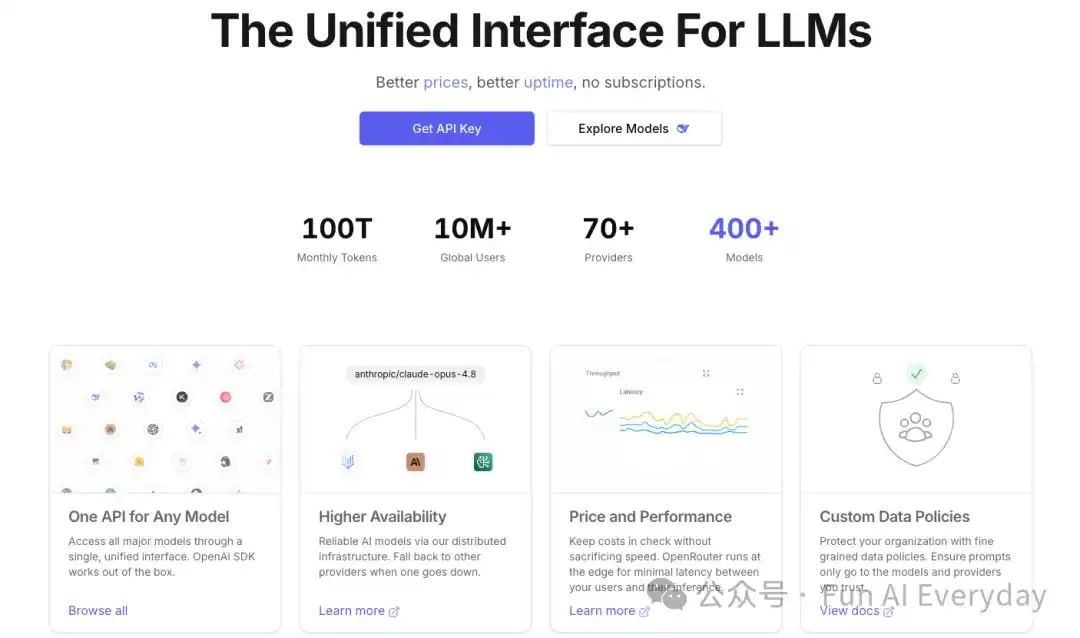
These numbers indicate one thing:
OpenRouter is no longer a niche developer tool; it's a major AI calling gateway.
The way developers use it is also very simple.
Previously, you had to connect separately to models from OpenAI, Anthropic, Google, DeepSeek, Mistral, xAI, etc.
For each one, you had to read documentation, apply for an API key, set up billing, handle interface differences, understand rate limits, and manage error handling.
With OpenRouter, developers can call different models through the same interface.
Often, code originally using the OpenAI interface only needs changes to the base URL, a different API key, and specifying the model name to call other models via OpenRouter.
This is also one reason for its rapid early growth: low migration cost.
Why don't developers connect directly to the model companies?
It seems developers could completely bypass OpenRouter and go directly to the model companies' websites to activate their APIs.
But in real-world development, it's not that simple.
If an AI product is just a demo, using only one model might suffice. But once it enters real business operations, it's very hard to rely on just one model.
For example, an AI writing tool might have several different types of tasks:
- Generating titles can be done with cheaper models;
- Writing long articles requires stronger text capabilities;
- Analyzing materials needs models with long context windows;
- Content moderation requires low-cost, highly stable classification capabilities;
- Enterprise clients might demand that data not be retained, forcing the choice of suppliers with compliant data policies;
- During peak times when a model is rate-limited, you need to automatically switch to a fallback model.
At this point, the problem is no longer just 'connecting to one API.'
The team needs to maintain a complete model calling system:
Which model handles which task, which model is cheaper, which supplier is faster, which has lower failure rates, how to switch if there's a problem, how to attribute costs to different bills, and how to isolate data for enterprise clients.
What's more troublesome is that the model market changes too quickly.
Today, Claude might be great for coding, tomorrow Gemini might have an advantage with long context, and the next day DeepSeek or some open-source model might slash prices.
Model capabilities, prices, context lengths, and supplier policies are constantly changing.
This is precisely where OpenRouter's value lies.
It doesn't build AI applications for developers; it manages the task of 'which model to use, how to call it, how to provide fallbacks, and how to control costs' for them.
More than just a model supermarket, it's a model orchestration layer
If you only understand OpenRouter as a 'model supermarket,' you underestimate it.
A model supermarket solves 'here are many models, you can pick.'
But OpenRouter's truly important capability is orchestrating between models and suppliers.
The same model might be offered as an inference service by different suppliers.
For example, an open-source model can be hosted by multiple cloud service providers or inference service providers. Different suppliers have varying prices, speeds, and stability.
OpenRouter's documentation mentions a capability called provider routing.
Developers can set conditions like price, latency, throughput, or supplier priority to automatically route requests to different suppliers.
It also supports fallback, meaning if a model or supplier fails, the system automatically switches to a backup option.
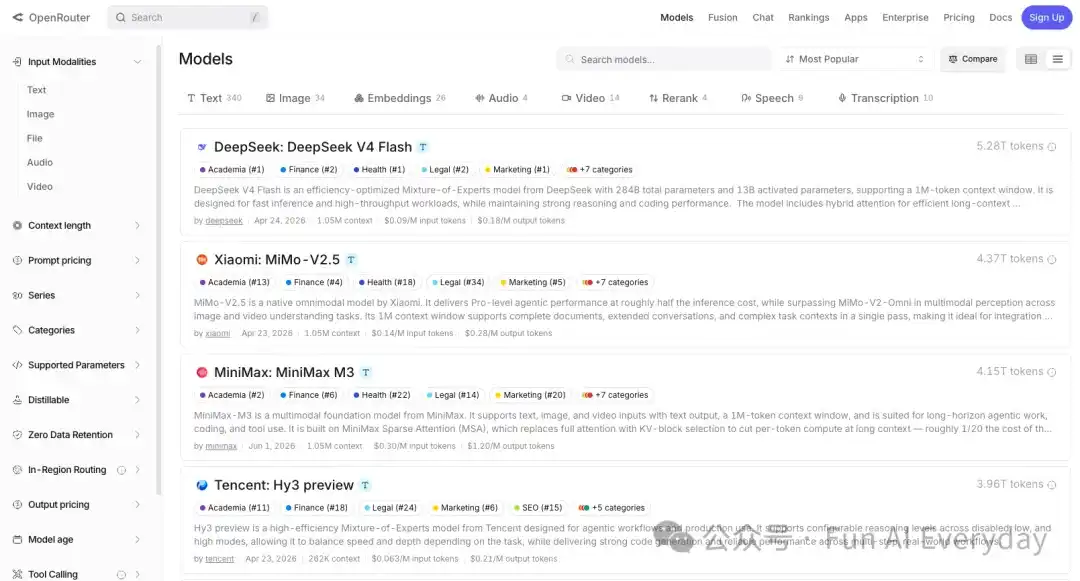
For developers, OpenRouter essentially extracts 'model selection' and 'failure handling' from the business code and hands it over to a dedicated platform.
Why would enterprises need this layer?
When enterprises adopt AI, the initial problem is often 'can we use it,' but it quickly becomes 'how do we manage it.'
Many different teams within a company might be using AI.
Marketing teams use it for content creation, customer service for replying to users, R&D for writing code, operations for data analysis, and legal for processing contracts.
If every team connects to models independently, problems multiply:
- Bills become unclear; model choices aren't unified;
- Data policies aren't transparent; different teams duplicate integration efforts;
- When problems occur, it's unclear which call caused it;
- It's difficult to coordinate system-wide adjustments when model suppliers change.
OpenRouter's features like workspaces, budget controls, call logs, supplier policies, and zero-data-retention routing address these very issues.
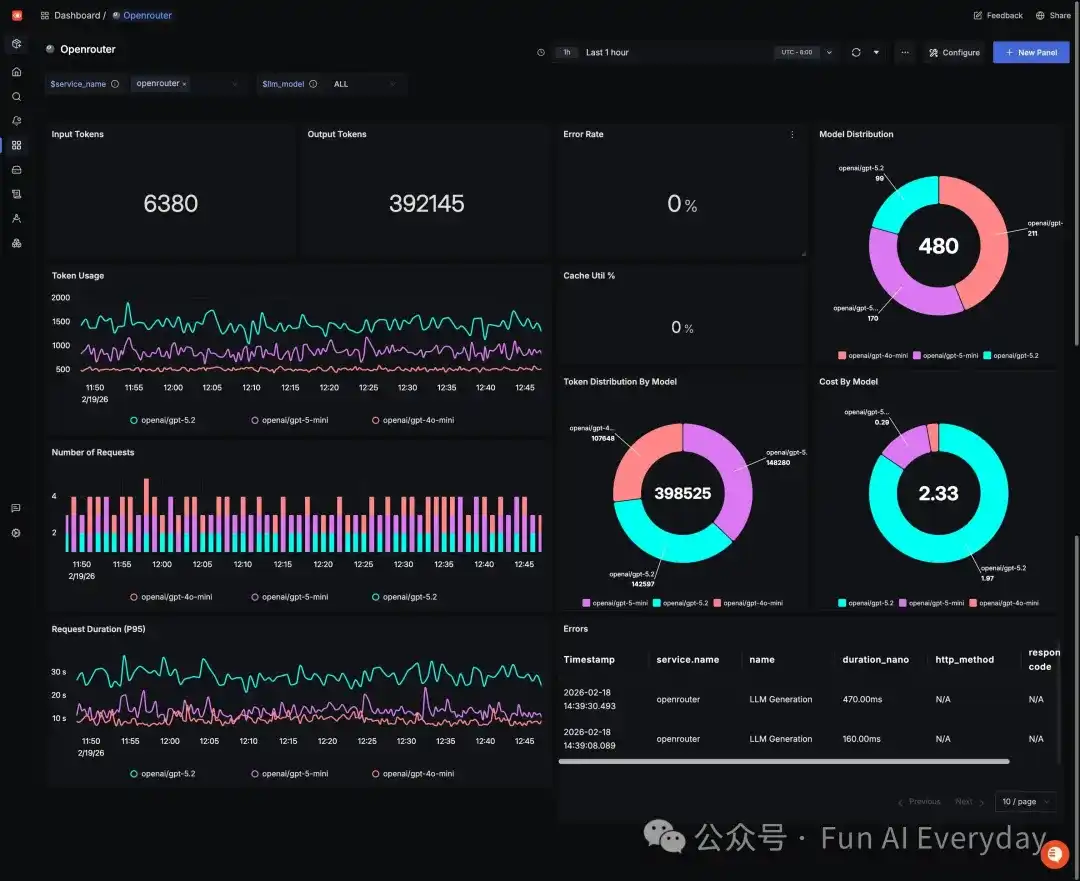
Take zero data retention, for example.
For many enterprises, not all requests can be sent to any model supplier. Customer information, contract details, medical data, and financial data may have strict requirements.
OpenRouter's documentation supports Zero Data Retention.
Developers can configure it to send requests only to suppliers that don't store data. This policy can be applied globally, per model group, via security rules, or per individual request.
Another example is prompt caching.
Many AI applications repeatedly use lengthy system prompts, knowledge base content, or context. Recalculating this every time is costly.
OpenRouter supports vendor affinity routing to increase cache hit rates, trying to send subsequent requests to the same supplier endpoint, thereby reducing the cost of repeated context.
These types of features might not sound sexy, but they're highly practical. The larger the scale of the AI application, the more significant the cost savings become.
How does OpenRouter make money?
OpenRouter's business model is clear: it earns money based on usage.
Developers first purchase platform credits, then pay for the actual models and tokens they call.
OpenRouter states it clearly:
The platform charges a 5.5% fee on credit purchases, with a minimum of $0.80. The prices from the underlying model suppliers are passed on to the user at cost, with no additional markup on the model inference pricing.
This is a classic 'toll road' or 'traffic fee' business.
The advantage of this model is that revenue is tied to usage.
The more developers call, the higher the platform's revenue; the more AI applications and token consumption, the bigger OpenRouter's business.
But it has one characteristic: the per-transaction take rate isn't high, so it must rely on scale.
This is why token processing volume is so important for OpenRouter.
Its core metric isn't registered users, but how many tokens flow through it weekly and monthly.
In 2025, OpenRouter's annual processing volume grew from about 10 trillion tokens to over 100 trillion tokens.
By 2026, OpenRouter had reached an annualized processing volume of approximately 1.5 quadrillion tokens.
This is the underlying logic of this business.
As long as more and more AI applications run on multi-model systems, OpenRouter can continuously collect service fees from those calls.
Why has growth accelerated recently?
OpenRouter's growth can be summarized as catching three major shifts.
The first shift is the proliferation of models.
In the past, when building AI applications, many teams defaulted to using OpenAI first. Now it's different.
Claude, Gemini, DeepSeek, Qwen, Mistral, Llama, Grok, plus numerous open-source and open-weight models, each have advantages in different scenarios.
This isn't a market of 'one completely replacing another.'
Some models are great for coding, some are cheap, some excel at long text, some are fast, some are good for role-playing, some suit enterprise documents, and some are better for multimodal tasks.
The more models there are, the higher the selection cost; the higher the selection cost, the more valuable the middle layer becomes.
The second shift is AI applications starting to focus on cost.
Many products use the most powerful models in the early stages to achieve the desired effect.
But once a product gains users, model costs quickly become an issue.
For a customer service chatbot, AI search product, code assistant, or content generation tool, if every request goes through the most expensive model, margins can easily be eaten up.
A more mature approach is to break down tasks:
- Use cheaper models for simple tasks;
- Use stronger models for complex tasks;
- Prioritize low-latency models for high-frequency tasks;
- Switch to a fallback model upon failure;
- When sensitive data is involved, only use suppliers with compliant data policies.
This is precisely OpenRouter's use case.
It might not help you find the 'strongest model,' but it can help you balance effectiveness, price, speed, and stability.
The third shift is AI applications moving from chatboxes to agents.
Agents call tools, read files, search the web, execute tasks, and also make continuous, multi-turn model calls.
Compared to simple chat, agents consume far more tokens and rely more heavily on stability.
This is beneficial for OpenRouter.
Because the more calls, the longer the chain, the more developers need routing, fallbacks, logging, cost control, and supplier management.
This is also why OpenRouter's funding announcement emphasizes that AI is moving from experimentation to critical production applications and agent scenarios.
Its growth fundamentally stems from the rise in AI call volume.
This business also has risks
OpenRouter is in a good position, but it's not secure.
It sits between model companies, cloud providers, and application developers. This position has value but is also prone to being squeezed.
The first risk is that large companies might build their own.
For small teams, OpenRouter is very convenient.
But for large enterprises, model routing, permissions, logging, and cost management can also be done in-house or handed over to cloud providers.
Especially for financial, healthcare, government, and enterprise clients who may care more about data control and on-premises deployment.
For OpenRouter to win these clients, it can't rely solely on 'having many models.' It must deepen its capabilities in permissions, auditing, data policies, supplier management, and enterprise support.
The second risk is that cloud providers will also build model gateways.
Cloud platforms like AWS, Google Cloud, and Azure already have enterprise clients, billing systems, permission systems, and compliance capabilities.
They could easily integrate multi-model calling, routing, monitoring, and cost management as part of their cloud services.
OpenRouter's advantages are openness and neutrality, broader model coverage, and faster integration.
But cloud providers' advantages lie in customer relationships and enterprise procurement processes. This is a long-term competition.
The third risk is relationships with model suppliers.
OpenRouter brings traffic to model companies but also adds a layer between them and the end developers.
As the platform grows, it gains more user relationships and data on model usage.
Model suppliers, while wanting distribution, may also worry about their bargaining power being weakened.
Such middle-layer platforms are often welcomed by suppliers early on; as they scale, the relationship becomes more delicate.
The fourth risk is that platform fees might be pressured downward.
OpenRouter's 5.5% platform fee seems low now.
But if similar services proliferate, developers will compare prices, stability, model coverage, and enterprise features.
If some competitors are willing to offer lower fees, or if cloud providers bundle such capabilities into existing services, OpenRouter needs to prove it's not just a 'request forwarder.'
It must continuously provide better routing, stronger model coverage, more transparent pricing, more stable service, and more comprehensive enterprise controls.