Yen Weakness Triggers Inflation Red Line: Bank of Japan May Be Forced to Raise Rates Early

marsbitPublished on 2026-01-16Last updated on 2026-01-16

Abstract

Japanese policymakers are increasingly concerned about the impact of the weak yen on inflation, which may force the Bank of Japan (BOJ) to consider earlier interest rate hikes. Although the BOJ is expected to keep rates unchanged at 0.75% in its upcoming January meeting, officials are closely monitoring how yen depreciation is amplifying price pressures, as businesses pass rising import costs to consumers. While the central bank recently raised rates in December and has no fixed timeline for further hikes, sustained yen weakness could accelerate the tightening cycle. Market expectations of a six-month hike interval may shift if the BOJ acts more promptly. The yen recently touched a 18-month low near 158.68 against the dollar, reflecting ongoing volatility and political uncertainty, including potential early elections. Business leaders have called for government intervention to curb excessive currency declines.

Bank of Japan officials are increasingly focusing on the potential impact of the weak yen on inflation, a trend that could substantially disrupt the future path of interest rate hikes. According to sources familiar with the matter who spoke to Bloomberg, although the Bank of Japan may keep interest rates unchanged at the upcoming policy meeting, exchange rate factors may prompt it to reassess the timing of rate hikes, and could even force it to act earlier than planned.

As reported by Bloomberg, Bank of Japan officials believe that the influence of the weak yen on prices is strengthening, particularly as companies are increasingly inclined to pass rising input costs on to consumers, which could further intensify inflationary pressures. Although the Bank of Japan just raised its benchmark interest rate last month and has not set a predetermined path for borrowing costs, if the yen continues to weaken, policymakers may consider moving forward with rate hikes that were originally expected to occur later.

Currently, the general expectation among private economists is that the Bank of Japan will raise rates at a pace of about once every six months, meaning the next move could occur this summer. However, sources told Bloomberg that officials prefer to execute policy adjustments in a timely manner rather than being excessively cautious, suggesting that the previously market-expected pace of hikes is now facing uncertainty. Affected by this news, the yen briefly fell to around 158.68 against the U.S. dollar before rebounding to 158.33. As of the time of writing, the yen has fallen to 158.55 against the dollar.
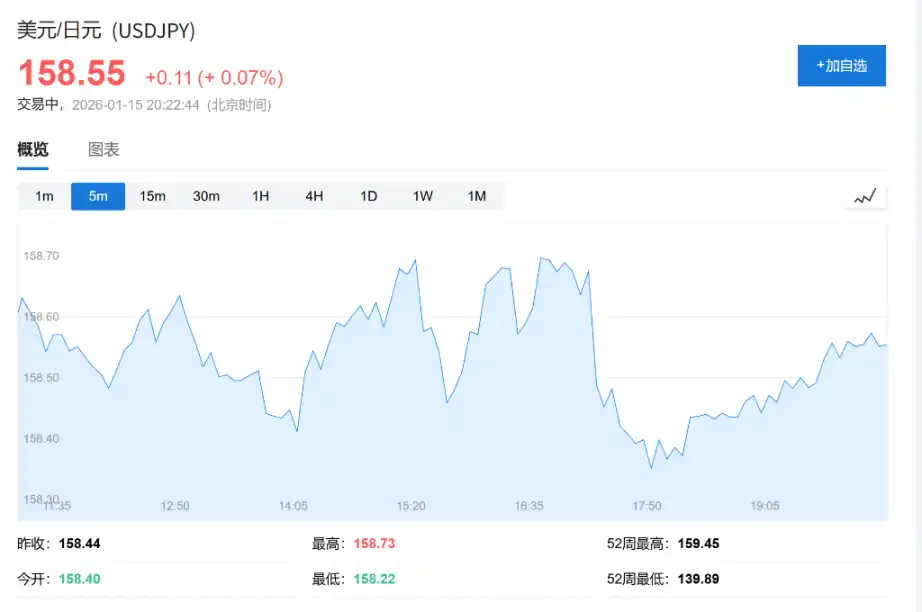
January Meeting Expectations: Rates to Remain Unchanged

The Bank of Japan will announce its latest policy decision on January 23. Sources told media that officials currently view maintaining the interest rate at 0.75% as appropriate, a level that has reached a three-decade high. Although the overall inclination is to hold steady, the committee will continue to monitor economic data and financial market developments up to the last moment to make a final decision.

The focus of this meeting will be on how the central bank assesses the impact of the yen on potential inflation. Sources told Bloomberg that, given that inflation trends are already close to the bank's 2% target, officials will closely watch how exchange rate fluctuations alter the price expectations of households and businesses.

Exchange Rate Transmission Mechanism Under Scrutiny

Yen depreciation typically increases inflationary pressures by raising import costs, while also boosting exporters' profits. However, some officials point out that as the yen remains weak, its negative impact on the economy may be increasing. Officials believe the Bank of Japan still has room to continue raising rates, with the key being to time the policy adjustments correctly.

The Japanese business community is also speaking out more frequently on the exchange rate issue. Yoshinobu Tsutsui, head of Keidanren (Japan Business Federation), the country's largest business lobby group, made rare comments this week calling for government currency measures to prevent excessive yen depreciation, describing recent yen movements as "a bit too much."

Market Background and Political Factors

Although the Bank of Japan raised its benchmark interest rate on December 19, the yen remained weak against the U.S. dollar. The yen slid further to a new 18-month low this week, affected by news that Prime Minister Takaichi Sanae will call a snap election next month.

Data compiled by Bloomberg shows that the 10-year average exchange rate for the yen against the U.S. dollar is 123.20, while over the past two-plus years, the yen has generally fluctuated between 140 and 161.95. Although it rebounded slightly after hitting an 18-month low earlier this week as monetary authorities stepped up warnings, the overall depreciation trend continues to put persistent pressure on the central bank's decision-making.


Trending Cryptos

Related Questions

QWhy is the Bank of Japan considering an earlier interest rate hike than previously expected?

AThe Bank of Japan is considering an earlier interest rate hike because officials are increasingly concerned that the weak yen is amplifying inflationary pressures. As companies are more inclined to pass on rising import costs to consumers, sustained yen weakness could force the central bank to reassess and accelerate its policy tightening timeline.

QWhat is the current market expectation for the Bank of Japan's next interest rate move?

APrivate economists generally expect the Bank of Japan to raise interest rates approximately once every six months, which would place the next hike around this summer. However, this expected pace is now facing uncertainty due to the yen's persistent weakness.

QWhat decision is the Bank of Japan expected to make at its January policy meeting regarding interest rates?

AThe Bank of Japan is widely expected to maintain its current benchmark interest rate of 0.75% at the January policy meeting. This level represents a three-decade high, and officials currently view holding rates steady as appropriate, though they will continue monitoring economic data and market conditions until the last moment.

QHow does a weak yen typically affect the Japanese economy and inflation?

AA weak yen typically increases inflationary pressures by raising the cost of imports, which can then be passed on to consumers. It also boosts profits for export-oriented companies. However, some officials note that the negative economic impacts may be increasing as the yen's weakness persists.

QWhat recent political development has contributed to further weakness in the Japanese yen?

AThe Japanese yen weakened further this week, hitting an 18-month low, following news that Prime Minister Takaichi Sanae will call an early election next month. This political uncertainty added downward pressure on the currency.

Related Reads

human.tech Launches Clean SDK for Privacy-First Web3 Apps

human.tech has launched the Clean SDK, a toolkit enabling developers to build privacy-first Web3 applications with transparent accountability. Released alongside Aztec's version 5, the SDK provides components for integrating zero-knowledge identity verification, sanctions screening, and private transactions, without developers handling sensitive user data or building compliance infrastructure from scratch. It uses zero-knowledge proofs and programmable verification to allow apps to confirm user legitimacy and sanctions compliance while keeping identities confidential. The first application built on the SDK, Shield, a privacy bridge to Aztec, also launched. It allows users to transfer assets privately while proving a unique human is behind each transfer and that funds have passed sanctions checks, as verified by a May 2026 audit. The SDK offers three core verification techniques: Proof of Innocence (sanctions screening against 23 sources), Proof of Personhood (simpler verification via Human Passport), and Proof of Clean Hands (higher-assurance zero-knowledge government ID checks). This allows apps to authenticate users and transactions without exposing personal data. Designed for Aztec builders, the SDK lets developers add programmable privacy to decentralized apps, eliminating the need to create their own verification and ZK infrastructure. Shield demonstrates its practical use for private bridges, but the SDK aims to enable a wider ecosystem of private, accountable financial apps and services. The launch addresses growing demand for infrastructure that balances privacy and accountability. The SDK avoids traditional identity databases, storing encrypted data off-chain, screening at both entry and exit points, and including a gated disclosure mechanism for legal requests. human.tech's products, including the Clean SDK, focus on using zero-knowledge technology to enable verifiable personhood and privacy in digital systems.

TheNewsCrypto4m ago

human.tech Launches Clean SDK for Privacy-First Web3 Apps

TheNewsCrypto4m ago

Unlocking $100 Million in Liquidity? Pump.fun's New Policy Tests the 5-Minute Pump Technique

Pump.fun, a popular meme coin launchpad, has introduced a new standard mechanism called BOOST. It aims to address a significant capital efficiency issue: when a newly launched token graduates from its initial bonding curve to a liquidity pool (LP), roughly 20% of its liquidity becomes permanently locked as "dead liquidity," estimated to waste over $100 million annually. Instead of locking these funds permanently, BOOST repurposes them. Upon a token's migration, approximately 20% of the settlement funds (e.g., 17.6 SOL or ~$2516 USDC) are used to buy back the token on the open market over a 5-minute period via a Time-Weighted Average Price (TWAP) mechanism. All purchased tokens are immediately burned. This creates a brief, systematic buy pressure immediately after migration, potentially generating a short-term price surge ("pump") while permanently reducing the token's circulating supply. The goal is to enhance the immediate post-launch trading experience, potentially increasing trader retention and sustainable protocol revenue, which funds ongoing token buybacks. However, concerns exist that this artificial 5-minute boost could lower the barrier for launching low-quality tokens and lead to steeper price crashes once the buy pressure stops, if followed by large sell-offs. The feature automatically applies to tokens migrating after July 21, 2024, but not to previously migrated tokens or those launched via the Mayhem AI Agent lab.

marsbit11m ago

Unlocking $100 Million in Liquidity? Pump.fun's New Policy Tests the 5-Minute Pump Technique

marsbit11m ago

Podcast Notes | Conversation with GSR Asset Management Head: To Determine if This Crypto Rally is Real, Just Watch the Lending Rates on Aave

Podcast Summary: Dialogue with GSR's Head of Asset Management: To Determine if This Crypto Rally is Real, Just Check Lending Rates on Aave Andy Baehr, Managing Director of Asset Management at GSR, discusses the current crypto market, characterizing it as stuck in a state of "ambivalence" with short-lived, unsustainable rallies. He outlines a simple framework: the market moves between "ambivalence" and "conviction" (sustained upward momentum). Currently, every rally resembles a single-stage rocket booster that quickly fizzles out. Baehr identifies three key signals to watch: 1) DeFi lending rates, 2) the potential passage of the CLARITY Act, and 3) the market forming a consensus on the "Fed hawkish peak." He emphasizes that the most immediate indicator for the sustainability of the recent CPI-triggered rally is the USDC borrowing rate on Aave, currently around 3.75%—close to U.S. Treasury yields. The absence of a credit spread indicates low leverage demand and a lack of market energy. He explains that a healthy, sustained rally requires layered buying pressure. Last year's rally progressed from an ETH short squeeze to crypto-native trader influx and finally to ETF inflows. Currently, this structure is missing. Other potential structural buyers like Digital Asset Treasury (DAT) companies are absent, and ETF flows have proven transient. Baehr notes that while small-cap crypto tokens outperformed large caps in Q2—a potential sign of capitation in major assets—capital is also flowing to more exciting opportunities like AI stocks and tech IPOs, leaving crypto sidelined. Regarding DeFi, he highlights that platforms like Aave provide a clear, real-time signal of leverage demand through their supply/demand-driven interest rates. A significant, sustained rate increase would signal genuine market conviction. He also observes the quiet emergence of fixed-income-like products and vaults in DeFi. On regulation, the probability of the CLARITY Act passing before the August 7th deadline has dropped linearly from 75% to below 40% on Polymarket. Baehr suggests its passage would be treated as a bullish surprise, a potent driver for price movement. However, political hurdles, including ethical clause debates and disclosures about the First Family's crypto profits, remain significant obstacles. Ultimately, the market awaits clarity on the Fed's terminal rate under Chair Warsh. Until the "Fed Solstice"—the point where the market collectively understands the peak of hawkish policy—sustained conviction will be difficult to achieve.

marsbit42m ago

Podcast Notes | Conversation with GSR Asset Management Head: To Determine if This Crypto Rally is Real, Just Watch the Lending Rates on Aave

marsbit42m ago

Trading

Spot

Hot Articles

What is $BANK

Bank AI: A Revolutionary Step in the Future of Banking Introduction In an era marked by rapid advancements in technology, Bank AI stands at the intersection of artificial intelligence (AI) and banking services. This innovative project seeks to redefine the financial landscape, enhancing operational efficiency, security measures, and customer experiences through the power of AI. As we embark on this exploration of Bank AI, we will delve into what the project entails, its operational dynamics, its historical context, and significant milestones. What is Bank AI? At its core, Bank AI represents a transformative initiative aimed at integrating artificial intelligence into various banking operations. This project harnesses the capabilities of AI to automate processes, improve risk management protocols, and enhance customer interaction through personalised services. The primary objectives of Bank AI include: Automation of Banking Functions: By leveraging AI technologies, Bank AI aims to automate routine tasks, reducing the burden on human resources and enhancing efficiency. Enhanced Risk Management: The project utilises AI algorithms to predict and identify risks, thereby fortifying security measures against fraud and other threats. Personalisation of Banking Services: Bank AI focuses on offering tailored financial products and services by analysing customer data and behaviours. Improving Customer Experience: The implementation of AI-driven solutions, such as chatbots and virtual assistants, aims to provide users with more human-like interactions, revolutionising the way customers engage with banks. With these goals, Bank AI positions itself as a crucial player in rendering banking more efficient, secure, and user-centric. Who is the Creator of Bank AI? Details regarding the creator of Bank AI remain unknown. As such, no specific individual or organisation has been identified in the available information. The anonymity surrounding the project's inception raises questions but does not detract from its ambitious vision and objectives. Who are the Investors of Bank AI? Similar to the project's creator, specific information regarding the investors or supporting organisations of Bank AI has not been disclosed. Without this information, it is challenging to outline the financial backing and institutional support that might be propelling the project forward. Nevertheless, the importance of having a robust investment foundation is pivotal for sustaining development in such an innovative field. How Does Bank AI Work? Bank AI operates on several innovative fronts, focusing on unique factors that differentiate it from traditional banking frameworks. Below are key operational features: Automation: By applying machine learning algorithms, Bank AI automates various manual processes within banks. This results in reduced operational costs and allows human workers to redirect their efforts towards more strategic activities. Advanced Risk Management: The integration of AI into risk management practices equips banks with tools to accurately predict potential threats such as fraud, ensuring that customer information and assets remain secure. Tailored Financial Recommendations: Through continuous learning from customer interactions, the AI systems develop a nuanced understanding of user needs, enabling them to offer tailored advice on financial decisions. Enhanced Customer Interactions: Utilizing chatbots and virtual assistants powered by AI, Bank AI enables a more engaging customer experience, allowing users to have their queries resolved quickly, thus reducing wait times and improving satisfaction levels. Together, these operational features position Bank AI as a pioneer in the banking sector, establishing new benchmarks for service delivery and operational excellence. Timeline of Bank AI Understanding the trajectory of Bank AI requires a look at its historical context. Below is a timeline highlighting important milestones and developments: Early 2010s: The conceptualisation of AI integration into banking services began to gain attention as banking institutions recognised the potential benefits. 2018: A marked increase in the implementation of AI technologies occurred when banks started using AI tools like chatbots for basic customer service and risk management systems for improved security handling. 2023: The sophistication of AI continued to advance, with generative AI being introduced for more complex tasks such as document processing and real-time investment analysis. This year marked a significant leap in the capabilities afforded to banks by AI technology. 2024-Current Status: As of this year, Bank AI is on an upward trajectory, with ongoing research and developments poised to further enhance capabilities in banking operations. Continued exploration of AI applications hints at exciting developments yet to come. Key Points About Bank AI Integration of AI in Banking: Bank AI focuses on adopting artificial intelligence to streamline banking processes and improve user experiences. Automation and Risk Management Focus: The project strongly emphasises these areas, aiming to shift the burden of routine tasks while enhancing security frameworks through predictive analytics. Personalised Banking Solutions: By harnessing customer data, Bank AI enables tailored banking services that cater to individual user needs. Commitment to Development: Bank AI remains committed to ongoing research and development efforts, ensuring its adaptability and ongoing relevance as technology continues to evolve. Conclusion In summary, Bank AI exemplifies a crucial step forward in the banking industry, leveraging artificial intelligence to reshape operational paradigms, enhance security, and promote customer satisfaction. Despite gaps in information surrounding the creator and investors, the clear objectives and functional mechanisms of Bank AI provide a strong foundation for its ongoing evolution. As AI technology continues to advance and merge with the banking sector, Bank AI is well-positioned to significantly impact the future of financial services, enhancing the way we understand and interact with banking.

208 Total ViewsPublished 2024.04.06Updated 2024.12.03

What is $BANK

Discussions

Welcome to the HTX Community. Here, you can stay informed about the latest platform developments and gain access to professional market insights. Users' opinions on the price of BANK (BANK) are presented below.

活动图片