YC Partner Reveals: Building an AI-Native Company from Scratch

marsbitPublished on 2026-05-15Last updated on 2026-05-15

Abstract

"YC Partner Reveals: Building an AI-Native Company from Scratch" YC partner Diana Hu argues that true AI-native companies operate 1000x faster than incumbents, not by using AI for mere efficiency, but by making it the company's core operating system. This requires a fundamental shift: companies must become "queryable" to AI, with all workflows and communications generating data for AI to learn from, creating a "closed-loop" system for continuous optimization. For example, an AI agent with access to tickets, code, meetings, and customer feedback can analyze past performance and autonomously plan future engineering cycles, dramatically increasing output. In product development, the new paradigm is the "AI software factory": humans write specifications and tests, while AI agents generate the code. This transparent, data-driven model renders traditional middle management obsolete. Future AI-native companies will consist of three roles: Independent Contributors (who build/operate with AI), Directly Responsible Individuals (who own outcomes), and the AI Founder who leads by example. The critical shift is maximizing token usage over headcount. A small, AI-augmented team can outperform large traditional teams. Startups have a key advantage: they can design their entire culture and systems around AI from day one, unburdened by legacy processes. The core takeaway: Founders must personally experience AI's transformative power. The future belongs to those who embed AI into their com...

Source: Y Combinator

In Silicon Valley, Y Combinator (YC) is widely recognized as the "philosopher's stone" for global startups.

As the world's premier startup incubator, since its founding in 2005, YC has incubated over 5,600 companies, giving birth to tech giants such as Airbnb, Stripe, Dropbox, Reddit, and Coinbase. Even OpenAI's CEO Sam Altman once served as YC's President.

It can be said that YC's perspective represents the cutting-edge trends in tech entrepreneurship. Recently, YC partner Diana Hu proposed a striking assertion in the podcast "How To Build A Company With AI From The Ground Up": The operating speed of an AI-native startup could be up to 1000 times faster than existing industry giants.
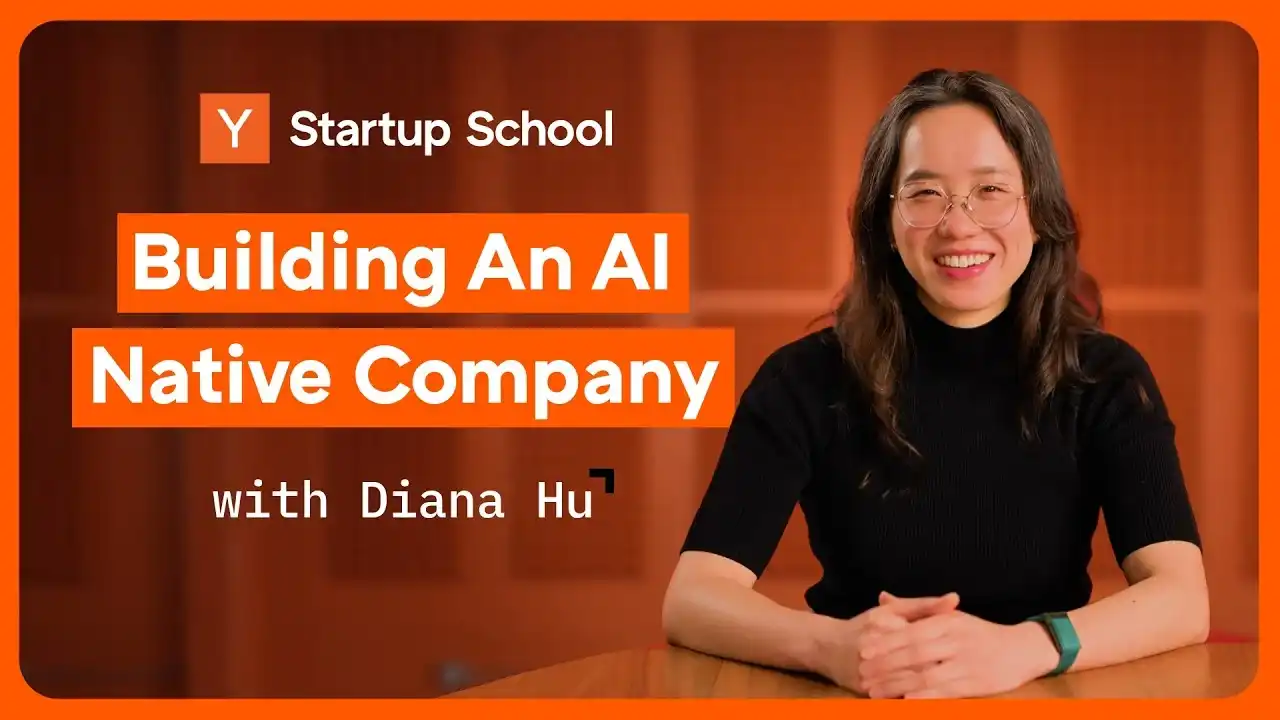
TinTinLand has compiled the key insights from the original video. Let's explore, from YC's perspective, how a truly AI-native company should operate.

Not "Using AI," but "Running on AI"

Currently, most discussions about AI still revolve around "increasing efficiency," such as "AI can make engineers more efficient" or "we need to add a Copilot to our existing workflow." This mindset is fundamentally misguided.

The true transformation is not about productivity gains, but the emergence of entirely new capabilities.

A true AI-native company should not merely treat AI as a tool, but rather see it as the company's operating system (OS). In this model, every workflow, every decision, and every process should be handled through an intelligent layer that continuously learns and improves.

With the support of AI tools, a single capable individual can now build features that previously required an entire team, or even things that were previously impossible.

Making the Entire Company AI-Queryable

Building a Closed-Loop System

Diana introduced the "Closed Loop" concept from control systems to describe the ideal AI company.

  • Open Loop System: This is how traditional companies operate. Management makes decisions, employees execute, but results often cannot be measured and fed back systematically, with significant information loss throughout the process.

  • Closed Loop System: The system continuously monitors outputs, captures information, and feeds it back to the AI, thereby constantly optimizing processes over time.

The Prerequisite for a Closed Loop: Queryability

To achieve such a closed loop, it is necessary to make the company completely transparent and queryable to AI.

This means that all actions within the company must produce "digital artifacts" that AI can learn from:

👉 Use AI assistants to record meetings throughout, reduce the use of private messages and emails, embed AI agents in all communication channels, and build a company-wide real-time dashboard covering revenue, sales, engineering, hiring, and operations.
Specific Case: Revolutionizing Engineering Management

Diana gave a concrete example from engineering management: Suppose you have an AI Agent with access to Linear tickets, Slack channels, GitHub repositories, Notion docs, customer feedback emails, and daily standup meeting recordings.

Then, this Agent can genuinely analyze what was actually delivered in the last sprint and how well it matched customer needs—rather than relying on the distorted information from multiple layers of reporting.

Building on this, the Agent can go a step further: automatically propose engineering plans for the next sprint, making them more predictable and accurate. Diana mentioned that she has seen teams adopting this approach halve their engineering timelines while accomplishing nearly ten times more work.

The core principle behind this is: To gain the full capabilities of AI, you need to provide the model with the same level of context as your employees.

Software Factory: Humans Define Specs, AI Writes Code

At the product development level, a new paradigm is emerging—the AI Software Factory. This is an evolution of Test-Driven Development (TDD):

  • Humans Define Success: Humans write requirement specifications (Specs) and test cases defining success criteria.

  • AI Handles Implementation: AI Agents generate the code implementation and iterate until all tests pass.

  • Shift in Human Role: Humans define what to build and judge the output; writing the code itself is the Agent's job.

Diana noted that some leading companies have already achieved codebases with no handwritten code at all, only Specs and test suites.

This is also how the "10x engineer" envisioned by software engineer Steve Yegge can be realized: surround a single engineer with a systematic cluster of Agents, enabling them to build things that would have been impossible to achieve alone before.

Flat 2.0: A New Organizational Structure

When a company becomes queryable and information flow becomes transparent and driven by an AI layer, the traditional pyramid management structure becomes obsolete.

Traditionally, we needed middle managers to convey information up and down the organization. But in the new world, the AI intelligent layer takes on this role. If your company is queryable and highly digitized, you should need almost no "human middleware."

Every layer of human routing you eliminate is a direct speed gain.

The Three Types of Employees in Future Companies

Diana referenced a point by Block (formerly Square) founder Jack Dorsey: If you keep your old organizational structure and management practices, you're completely missing out on this wave.

Future AI-native companies will consist of the following three types of employees:

  • Type 1: Independent Contributors (ICs). These are the people directly creating and operating things. In an AI-native company, this isn't limited to engineers—operations, support, sales—everyone brings a working prototype to meetings, not just a PowerPoint.

  • Type 2: Directly Responsible Individuals (DRIs), focusing on strategy and customer outcomes. This isn't a manager in the traditional sense, but someone with clear accountability for a specific result.

  • Type 3: AI Founders, at the forefront, leading by example to show the team the capability gains brought by AI, not delegating AI strategy to others.

Key Shift: Maximizing Token Usage

👉 The most critical shift for an AI-native company is not maximizing headcount, but maximizing Token usage.

  • Leaner Teams: A single employee working with AI tools can produce output equivalent to what previously required a large engineering team.

  • Restructured Budget: Founders should be willing to pay very high API bills. Because these bills replace extremely expensive and bloated personnel costs.

In this model, startups can generate enormous impact with a very small scale.

The "Dimensionality Reduction" Advantage for Startups

Why is now the best time for startups to surpass giants?

Diana pointed out that large incumbent companies face serious "path dependency." They must maintain existing businesses while undoing years of accumulated standard operating procedures (SOPs) and core assumptions. For them, changing core processes is extremely risky.

In contrast, AI-native startups hold a massive advantage:

You can design the entire system, workflow, and company culture around AI from day one. The result is that AI-native startups can operate potentially 1000 times faster than existing industry giants.

Conclusion: The Non-Outsourcable Belief

Finally, Diana offered a crucial admonition: Do not outsource your belief in the power of AI tools; you must experience it firsthand yourself.

You must personally sit at the computer and work with programming Agents until you witness with your own eyes how they shatter your perception of "what is possible."

For early-stage founders, this is the best of times: no legacy systems to bind you, no thousand-person team to retrain, no entrenched organizational structure. You have the freedom to build the company right from the start.

The future winners will be those who dare to embed AI into the soul of their company from day one.


Related Questions

QWhat is the core difference between an AI-native company and a traditional company using AI tools, according to the article?

AThe core difference is that a true AI-native company treats AI as the operating system (OS) of the entire company, integrating it into every workflow, decision, and process as a continuous learning intelligent layer. In contrast, traditional companies often treat AI merely as a tool for improving efficiency ('giving our process a Copilot').

QWhat does Diana Hu mean by a 'Closed Loop' system in an AI-native company?

AA 'Closed Loop' system is one that continuously monitors outputs, captures information, and feeds it back to the AI, allowing the processes to be optimized over time. This contrasts with an 'Open Loop' system typical of traditional companies, where decisions are made and executed but results are not systematically measured and fed back, leading to significant information loss.

QWhat key principle must be followed to achieve a full AI-powered closed-loop system within a company?

ATo achieve a full AI-powered closed-loop system, the company must be made completely transparent and queryable to the AI. This means all internal actions must produce 'digital artifacts' for the AI to learn from, and the AI must be provided with the same level of contextual information as human employees.

QHow does the article describe the concept of an 'AI Software Factory' and the changing role of engineers?

AThe 'AI Software Factory' is an evolution of Test-Driven Development (TDD). In this paradigm, humans define the specifications (Specs) and write test cases to define success criteria. AI Agents then generate the code to meet these specs and iterate until all tests pass. The engineer's role shifts from writing code to defining what to build and judging the output; the act of coding itself becomes the work of the AI Agent.

QAccording to the article, what is the fundamental budget and resource shift for an AI-native startup compared to a traditional one?

AThe fundamental shift is from maximizing headcount to maximizing token usage. Founders should be willing to pay very high API bills, as these costs replace the far more expensive and cumbersome costs of large human teams. A lean team empowered by AI tools can achieve output equivalent to a much larger traditional engineering team.

Related Reads

Apple Also Has to Pay Rent Now

Apple Pays Rent Too: The Two-Way Flow of "Traffic Tax" and "AI Capability Rent" Between Tech Giants For over two decades, Google has paid Apple an estimated $20 billion annually to remain the default search engine on Safari, a "traffic tax" for a critical user entry point. However, in 2026, the direction of this cash flow partially reversed. Apple agreed to pay Google roughly $1 billion per year to license its Gemini AI models, as Apple's own models reportedly struggled with complex tasks. This creates a unique dynamic: Apple acts as the "landlord" in the established search ecosystem, collecting rent from Google for access. Simultaneously, in the emerging AI arena, Apple becomes the "tenant," paying Google for access to cutting-edge AI capabilities it cannot currently match internally. While Apple claims its new models are "distilled" from Gemini outputs and contain "not a drop" of Google's original code, core dependencies remain. Its knowledge base is refined using Gemini's outputs, and its most powerful cloud model runs on Google's infrastructure. Apple has structured the deal as non-exclusive, allowing it to theoretically switch AI suppliers—a hedge against over-reliance. The future hinges on whether advanced AI models become a commodity (cheap and abundant) or remain a concentrated, scarce resource (expensive and controlled by few). Apple is betting on the former, leveraging its massive device ecosystem to be a powerful, choosy customer. If the latter proves true, its bargaining power could erode. This power dynamic is extending to developers. Apple, Google, and WeChat are all pushing for apps to expose their core functions as standardized "actions" or "intents" that their respective AI assistants (Siri, Gemini, WeChat AI) can directly call. The new scarce resource is no longer just app store visibility, but "being selected by the AI." The currency of "rent" has changed from a 30% revenue share to ceding control over how users interact with an app's functions.

marsbit1h ago

Apple Also Has to Pay Rent Now

marsbit1h ago

Missed the SpaceX IPO? WEEX's "First Trade Protection" Lets You Experience US Stock Trading Risk-Free.

With the excitement around SpaceX's recent public listing reigniting interest in the US stock market, Chinese investors face significant challenges accessing compliant and convenient trading channels following regulatory actions against major online brokers. This article explores the available options, highlighting their risks and limitations. Traditional paths for US stock investments remain problematic. Qualified Domestic Institutional Investor (QDII) and Listed Open-Ended Fund (LOF) products, while compliant, suffer from high fees, significant purchase premiums, and a very limited selection of assets. Small, unregulated offshore brokers pose substantial risks, including potential insolvency. While secure, VIP accounts at banks in Hong Kong or Singapore require high minimum deposits (often 1-2 million RMB) and in-person visits, placing them out of reach for most retail investors. The article positions cryptocurrency exchanges, specifically their TradFi (traditional finance on-chain) offerings, as a compelling alternative. Platforms like WEEX are noted for providing access to a wide range of US stocks and ETFs, including SpaceX (SPCXON), through tokenized assets. This method offers advantages such as a single account for both crypto and traditional assets, USDT-based settlement avoiding fiat complexities, flexible leverage, and robust risk management. To attract users, WEEX is promoting a "First Trade Guarantee" campaign. Running from June 15 to July 8 (UTC+8), it features a $30,000 prize pool. Users who trade $500 worth of US stock contracts can qualify for a guarantee on their first eligible trade: 100% loss coverage up to $30 or a 20% bonus on profits up to $30. The campaign is presented as a low-risk opportunity for both crypto natives and traditional investors to experience US stock trading.

marsbit1h ago

Missed the SpaceX IPO? WEEX's "First Trade Protection" Lets You Experience US Stock Trading Risk-Free.

marsbit1h ago

How Difficult is Chip Making? A Division Error Costs 475 Million Dollars

How Hard Is It to Make a Chip? A Division Error Cost $475 Million Chip expert Shi Kan, a researcher at the Chinese Academy of Sciences and a popular tech creator, explains the immense challenges of chip development. Chips are foundational to modern technology, but their creation is extraordinarily difficult. The journey from sand to a functional chip involves complex design and manufacturing, but a critical bottleneck is verification—ensuring the design works flawlessly before costly production. A single, undetected bug can have catastrophic consequences, as illustrated by the infamous 1994 Intel Pentium FDIV bug. A flaw in the floating-point division unit forced a recall costing $475 million. Unlike software, chips cannot be easily patched after manufacture, making "first-time success" paramount. However, industry surveys show only 24% of chip projects achieve this; over three-quarters require at least one costly re-spin due to design flaws. Verification has thus become the dominant phase, consuming up to 70% of the design cycle. The core challenge is a "verification impossible triangle" between high performance, good debuggability, and low cost. Exhaustively verifying a modern CPU core could take 15,000 years with software simulation, or 30 years with advanced hardware emulation—timeframes utterly impractical for development. Despite being essential, verification is often seen as unglamorous "dirty work," receiving less academic attention than fields like AI. Shi and his team are tackling this by developing an agile verification research framework called ENCORE, based on FPGA technology, to improve verification efficiency and debug capability. Beyond research, Shi engages in public science communication through long-form video content, aiming to demystify chip technology, AI, and computer science. He argues for the value of pursuing "hard and long-term" endeavors, whether in the meticulous world of chip verification or in creating substantive educational content, believing such sustained effort is likely the right path forward.

marsbit1h ago

How Difficult is Chip Making? A Division Error Costs 475 Million Dollars

marsbit1h ago

Trading

Spot
Futures

Hot Articles

Discussions

Welcome to the HTX Community. Here, you can stay informed about the latest platform developments and gain access to professional market insights. Users' opinions on the price of AI (AI) are presented below.

活动图片