XRP Sees Major Liquidity Expansion Across Daily Trading Activity – Here’s What Could Play Out Next

bitcoinistPublished on 2026-03-10Last updated on 2026-03-10

Abstract

XRP is experiencing a significant expansion in daily trading liquidity despite its current bearish price action below $1.4. Market expert Bird highlights a large cluster of short positions, with liquidation levels stacked up to $4+. Two potential outcomes are outlined: if the price rises, traders may manually close shorts, buying back XRP and pushing the price higher, or a cascade of liquidations could trigger a violent upward squeeze. Concurrently, activity on the XRP Ledger has surged, with daily transactions reaching around 2.5 million, indicating renewed network usage. The market awaits a catalyst, which could rapidly accelerate these dynamics.

The XRP price has shifted deeply into a bearish state following the weekend sideways performance, and its market dynamics are starting to experience a similar change. Amid persistent downside action, significant liquidity is evident around key levels and across the market.

Rising Liquidity Levels Put XRP In Focus

With the highly bearish and uncertain market landscape, XRP’s price is struggling below the $1.4 level. Despite waning price action, the leading altcoin is experiencing a major buildup in daily liquidity, which hints at a notable change in its market dynamics and investor activity.

Trading activity and order book depth have expanded across major cryptocurrency exchanges, an indication of the growing daily liquidity. Bird, a developer and market expert, points to a massive cluster of contracts stacked all the way up toward $4+, as indicated by heavy red liquidation lines on the chart.

According to the expert, those lines on the chart represent short positions from traders who are betting that XRP will continue to drop. Many of these investors are currently opening their short positions using leverage. At this point, two scenarios are highlighted by Bird to likely play out if the price begins to rise.

The trend could lead to some traders closing their short positions manually to take a small loss. When these traders close their shorts, they are required to buy back XRP, which might bolster the price higher. Meanwhile, the second scenario is where others experience robust liquidations.
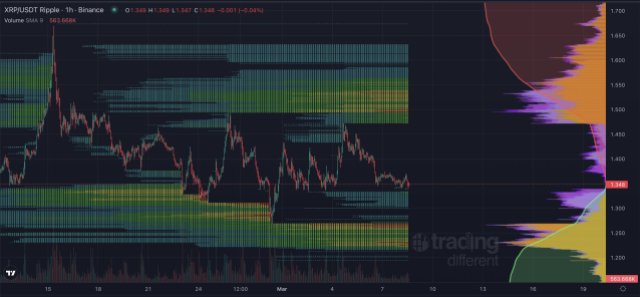
Source: Chart from Cryptoinsightuk on X

If the price reaches their liquidation level, the crypto exchange closes its positions. Thus, these investors will buy XRP at a much higher price, forcing them to wipe out their positions. However, when this kicks off, the possibility of it creating a chain reaction becomes high.

Here, liquidations will trigger more buying, allowing the price to move higher and liquidate more shorts, which in the end forces even more buying. “That’s how you get those violent, fast XRP moves where the price suddenly explodes upward,” Bird added.

Currently, the chart shows that liquidity above appears large, implying it could create a massive squeeze toward new highs. However, this is likely if momentum starts and those levels start to get taken out. Furthermore, the market appears to be just waiting for the catalyst to turn things around, and when that happens, these moves tend to happen very fast.

Activity Rising Across The Network

Within this period, activity on the XRP Ledger seems to have picked up pace, recording significant transactions. Diana’s report shows that transaction activity on the ledger is rising again, with daily volume now sitting at around 2.5 million, suggesting that real network usage is coming in again.

The recent figure represents a sharp increase from recent baselines on the monthly timeframe. As seen on the chart, this marks a more than 40% rise from early February, over 25% from early January, and more than double the 2025 slowdown lows.

An interesting part of this development is the statement from Flare Network, saying the platform might have something to do with the heightened XRP Ledger activity.

XRP trading at $1.34 on the 1D chart | Source: XRPUSDT on Tradingview.com

Trending Cryptos

Related Questions

QWhat is the current state of the XRP price and its market dynamics according to the article?

AThe XRP price has shifted deeply into a bearish state and is struggling below the $1.4 level, while its market dynamics are experiencing a major buildup in daily liquidity.

QWhat do the heavy red liquidation lines on the chart represent, as explained by the expert Bird?

AThe heavy red liquidation lines represent a massive cluster of short positions from traders who are betting that the XRP price will continue to drop, many of which are opened using leverage.

QWhat are the two scenarios that could play out if the XRP price begins to rise, as highlighted by Bird?

AThe first scenario is traders manually closing their short positions, which requires buying back XRP and could bolster the price. The second scenario involves traders being liquidated if the price reaches their liquidation level, forcing them to buy back XRP at a higher price and potentially creating a chain reaction of buying.

QWhat recent on-chain activity suggests a change in the XRP Ledger's network usage?

ATransaction activity on the XRP Ledger is rising again, with daily volume sitting at around 2.5 million, representing a sharp increase of over 40% from early February and more than double the 2025 slowdown lows.

QAccording to the article, what could a large amount of liquidity above the current price level potentially create?

AThe large amount of liquidity above the current price level could create a massive short squeeze that drives the price toward new highs if momentum starts and those levels begin to get taken out.

Related Reads

From South Korea to the United States: Blue-Collar Jobs Are Becoming Increasingly Popular, Thanks to AI

AI is reshaping the labor market's value proposition. The traditional four-year college degree is losing its appeal as a guaranteed career path, while skilled blue-collar trades like electricians, welders, and plumbers are experiencing historic demand and wage premiums. This shift is driven by dual pressures: AI's displacement of certain white-collar roles and a booming need for physical infrastructure and data center construction. Data confirms the trend. In the U.S., vocational school revenue surged, and a significant portion of recent layoffs are AI-related. Surveys show a majority of Gen Z adults plan to pursue blue-collar work, citing better job security against AI automation. Vocational education interest has exploded recently. Experts cite a psychological shift as younger generations seek tangible, AI-resistant careers and avoid high student debt. In many cases, salaries for skilled trades now match or exceed those requiring a bachelor's degree. In South Korea, semiconductor vocational high schools boast near-total employment, with graduates securing high-paying roles at companies like Samsung. The shortage is structural, exacerbated by a retiring baby boomer workforce and massive infrastructure projects. Companies like JPMorgan Chase, Meta, and Lowe's are investing heavily in training programs. However, overcoming historical stigma and a "perception gap" around trade careers remains a key challenge to closing the talent gap.

marsbit47m ago

From South Korea to the United States: Blue-Collar Jobs Are Becoming Increasingly Popular, Thanks to AI

marsbit47m ago

Qualcomm: AI Hype Subsides, When Will Smartphones Emerge from the Gloom?

Qualcomm reported its Q3 FY2026 results (ending June 2026), with revenue of $9.95B, down 4% YoY but above expectations. Gross margin declined to 53.1%, pressured by rising costs across manufacturing and memory. Key business segments showed mixed performance: Handset revenue fell 19.6% YoY to $5.09B, dragged by an 11% decline in non-Apple Android shipments and weaker high-end mix. Conversely, Automotive revenue surged 61% to $1.59B, and IoT grew 9% to $1.83B. Core operating profit dropped 41% YoY due to margin compression and higher expenses. Management's Q4 FY2026 guidance projects revenue of $9.7B-$10.5B, in line with consensus, but Non-GAAP EPS guidance of $2.05-$2.25 fell short of expectations. Amidst persistent weakness in its core handset market, Qualcomm is pursuing growth in AI, focusing on Edge AI (smartphones, PCs, automotive) and Data Center AI. Its data center strategy includes four pillars: AI accelerators (e.g., AI200), commercial CPUs (Dragonfly C1000), custom silicon, and connectivity solutions. While these initiatives initially boosted its stock, concerns over AI capital expenditure sustainability have since erased those gains. The company targets $5B in data center revenue for FY2027 and $15B for FY2029. The report concludes that with the traditional handset business still under pressure, the data center opportunity is currently viewed as a longer-term option, and a more conservative valuation based on core operations may be warranted until AI contributions materialize.

marsbit51m ago

Qualcomm: AI Hype Subsides, When Will Smartphones Emerge from the Gloom?

marsbit51m ago

From TPU to Self-Evolving Agents: How Jeff Dean Predicts the Next Step in AI

At the 2026 YC Startup School, Jeff Dean outlined his vision for AI's next phase, shifting focus from simply scaling models to building intelligent, autonomous systems. He believes AI's progress is no longer just about creating smarter models, but about integrating them into systems capable of long-term, iterative work, automated experimentation, and continuous learning. This evolution moves the competition from "who has the bigger model" to "who can best organize intelligence." Dean suggests AI capabilities are now comparable to a junior engineer, enabling the automation of complex workflows. However, the true challenge and opportunity lie in managing these AI "workers" at scale. He emphasizes the importance of **context engineering**—structuring tools, memory, and feedback loops—over raw model power. For startups, this means building deep expertise in niche domains where general models currently fail (near 0-1% success rates), leveraging proprietary data, specialized tools, and domain-specific evaluators. A recurring theme is re-examining fundamental constraints. Dean's past work, like moving Google's search index to memory or creating the TPU, stemmed from questioning outdated assumptions about hardware and cost. He sees similar inflection points today, particularly in **specialized inference hardware** to drastically reduce latency and energy consumption for real-time Agent operation. Notably, he points out that in modern AI systems, the dominant cost is often not computation but **data movement**. Reliable, long-running Agents require robust system design, borrowing concepts from distributed computing like checkpointing, state management, and parallel exploration to handle failures and maintain progress over days or weeks. As AI automates execution, the scarcest human skills will shift to **defining clear specifications**, **judging what problems are worth solving** (taste), and designing effective feedback loops. Ultimately, Dean's framework prioritizes understanding the problem deeply, identifying the true bottlenecks, and systematically building closed-loop systems where AI can not only perform tasks but also improve AI itself.

marsbit51m ago

From TPU to Self-Evolving Agents: How Jeff Dean Predicts the Next Step in AI

marsbit51m ago

Trading

Spot

Hot Articles

What is XRP 2.0

XRP 2.0: A New Frontier in the Cryptocurrency Landscape Introduction to XRP 2.0 In the ever-evolving realm of cryptocurrency, new projects continuously emerge, vying for attention and adoption. One such promising initiative is XRP 2.0, a novel cryptocurrency project designed to leverage advanced blockchain technology and robust encryption methodologies. While the name draws parallels with Ripple’s XRP, it’s crucial to note that XRP 2.0 operates independently, focusing on enhancing transaction security, privacy, and scalability. As the digital financial landscape increasingly embraces decentralized solutions, XRP 2.0 aims to contribute meaningfully to web3 and the overall expansion of crypto projects. What is XRP 2.0? At its core, XRP 2.0 is a cryptocurrency project that aims to create a secure and decentralized digital currency ecosystem. Its foundational technology integrates sophisticated blockchain principles with cutting-edge encryption techniques. The overarching goal of XRP 2.0 is to establish itself as a reliable and efficient platform enabling swift transaction execution while prioritizing enhanced privacy protections for its users. The project is promoted as a solution to many limitations faced by existing cryptocurrencies, proposing a system that can handle a higher volume of transactions with improved speed and privacy. This versatility positions XRP 2.0 as a significant contender in a marketplace riddled with various digital currencies. Who is the Creator of XRP 2.0? The identity of the creator behind XRP 2.0 has been flagged as ‘Wilbur.’ However, comprehensive details regarding Wilbur or their associated entity remain elusive. The anonymity of many cryptocurrency creators is not an uncommon phenomenon in the industry, often designed to maintain a degree of privacy and security. Who are the Investors of XRP 2.0? As of now, specific information related to the investment foundations or organizations supporting XRP 2.0 is not publicly available. In the cryptocurrency sector, the backing by reputed investors can significantly influence a project's credibility and success, yet the transparency regarding the financial supporters of XRP 2.0 has not been established. How Does XRP 2.0 Work? XRP 2.0 stands out by employing a combination of blockchain technology and advanced encryption algorithms that ensures secure and decentralized transactions. Its innovative structure includes unique features designed to foster user engagement and broaden functionalities beyond conventional cryptocurrency transactions. Among these features, XRP 2.0 incorporates AI-powered capabilities, such as text-to-image and text-to-speech functionalities. These additions are designed to enhance the interactive experience for users, promoting broader applicability across various sectors. By bridging technological advancements with user-centered design, XRP 2.0 aims to capture the attention of a diverse range of individuals and enterprises looking to integrate cryptocurrency solutions into their operational frameworks. Timeline of XRP 2.0 Understanding XRP 2.0 requires examining the milestones that have defined its journey thus far: July 23, 2023: XRP 2.0 is introduced as a novel cryptocurrency project, aiming to revolutionize secure and decentralized transaction capabilities in the blockchain domain. September 8, 2023: The launching of another project, XRP20, occurs, marking the emergence of an ERC-20 token on the Ethereum blockchain that remains unrelated to XRP 2.0. November 13, 2023: The XRP Ledger undergoes a significant update with the release of rippled server software version 2.0.0. It is essential to note that this development is disconnected from the XRP 2.0 cryptocurrency project. Key Points About XRP 2.0 To distill the essence of XRP 2.0, several critical factors emerge: Unique Features: The inclusion of features like AI-powered text-to-image and text-to-speech further diversifies the potential applications of XRP 2.0. Blockchain Technology: The framework utilizes advanced blockchain mechanisms and encryption protocols, ensuring a secure and decentralized environment for transactions. Scalability and Privacy: XRP 2.0 prioritizes enhanced privacy protections in transaction processes and the scalability necessary to accommodate a growing user base. No Affiliation with Ripple: Importantly, despite its name, XRP 2.0 does not have any allegiance or collaboration with Ripple’s XRP, distinguishing its operational framework and objectives within the cryptocurrency ecosystem. Conclusion XRP 2.0 represents an ambitious venture into the cryptocurrency sphere, aiming to offer a combination of security, privacy, and efficiency in digital transactions. By integrating sophisticated technologies and user-friendly features, the project sets out to broaden the horizons of what cryptocurrency can achieve in today's digital economy. While the anonymity of its creator and lack of disclosed investors might raise questions for some, XRP 2.0's focus on advanced functionalities and decentralisation enhances its appeal amidst an increasingly crowded crypto market. As the cryptocurrency landscape continues to evolve, XRP 2.0 may yet emerge as a pivotal player in the expansion of secure and scalable blockchain solutions.

1.3k Total ViewsPublished 2024.04.01Updated 2024.12.03

What is XRP 2.0

Discussions

Welcome to the HTX Community. Here, you can stay informed about the latest platform developments and gain access to professional market insights. Users' opinions on the price of XRP (XRP) are presented below.

活动图片















