XRP Realized Profit-To-Loss Ratio Plunges – What The Market Should Be Expecting

bitcoinistPublished on 2026-06-10Last updated on 2026-06-10

Abstract

XRP's Realized Profit-to-Loss Ratio has plunged sharply to 0.38, indicating that for every dollar of loss realized, only 38 cents of profit is being taken. This deep drop below 1 signals a market where most moving coins are sold at a loss, reflecting intense capitulation amid ongoing bearish price pressure below $1.2. Despite the weak price performance, spot trading activity is increasing, led predominantly by large whale investors who often dominate during accumulation phases. Concurrently, XRP reserves on major exchanges like Upbit are showing a slight decline—a trend historically associated with subsequent price rallies. Analysts suggest these dynamics could potentially set the stage for a market bounce if the withdrawal trend continues.

Several key metrics of XRP are starting to change course, falling drastically along with the ongoing bearish performance of the altcoin’s price. As the downside pressure mounts, the Realized Profit to Loss Ratio has experienced a sharp decline to levels that reflect the intensity of the current bear market phase.

Investor Profitability On XRP Takes A Hit

The price of XRP is still trapped below $1.2, as bearish pressure returns to the market following a brief upswing. Investors are still feeling the impact of the persistent downside action of the leading altcoin, which is triggering a shift in market dynamics.

In light of this significant price decline, the XRP’s Realized Profit to Loss Ratio is notably dropping to negative levels. As seen in the chart shared by Glassnode, a popular on-chain data analytics platform, the metric on the 90-day time frame has fallen to 0.38, indicating a decrease in profitability among investors.

Furthermore, a change in market mood and investor behavior is reflected in the drop as an increasing number of transactions are being completed at a loss compared to those realized in profit. During this period, an inflection or more selling pressure is highly likely, which will be vital for the possible next major move.

According to the platform, for every dollar of loss being realized in the market, only 38 cents of profit are being taken. At the 2025 peak, this ratio reached level 50, implying that profit-takers were overwhelming loss sellers by a factor of 50x, but that key dynamic has completely inverted.
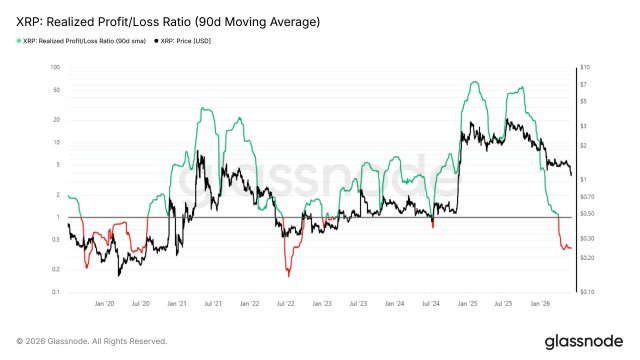
Source: Chart from Glassnode on X

Glassnode highlighted that when a ratio drops deep below 1, it reflects a market where the majority of participants who are moving coins are doing so at a loss. This trend is a clear indication of a hallmark of intense capitulation.

Despite the waning price performance, XRP spot trading is picking up pace. Data shows that this rise in spot trading is being led by large investors or big whales, and has maintained this dominance since July 2022.

An important aspect of this development is that these traders often lead the spot market trading in periods of accumulation phases rather than making significant orders during the uptrend phases. In addition, Glassnode highlighted that the cohort has been leading spot trading very actively since October last year.

Withdrawal Ongoing On Crypto Exchanges

XRP investors’ sentiment and behavior are experiencing a key shift as the altcoin is starting to leave cryptocurrency exchanges. One of the major exchanges where this trend is being spotted is the Korea-based leading trading platform, Upbit.

The reserves appear to be slightly declining, but subtly. CW noted that in periods when XRP’s reserves on Upbit grow, it has generally coincided with bearish trends. Meanwhile, when the reserves decrease on the platform, the altcoin has displayed notable rallies. As a result, the data analyst believes that a bounce could be on the horizon if this trend continues.

XRP trading at $1.11 on the 1D chart | Source: XRPUSDT on Tradingview.com

Related Questions

QWhat is the current trend of XRP's Realized Profit to Loss Ratio according to the article?

AXRP's Realized Profit to Loss Ratio has plunged sharply to negative levels, falling to 0.38 on the 90-day timeframe. This indicates that for every dollar of loss realized, only 38 cents of profit is being taken, reflecting intense selling pressure and capitulation.

QHow does the article describe the behavior of large investors (whales) in the XRP spot market currently?

AThe article states that XRP spot trading is being led by large investors or whales, a dominance they have maintained since July 2022. These traders are typically more active in accumulation phases rather than during uptrends, and have been leading spot trading very actively since October last year.

QWhat is the significance of XRP reserves declining on exchanges like Upbit, as mentioned in the article?

AA decline in XRP reserves on exchanges like Upbit is seen as a potentially bullish signal. Historically, decreasing reserves on this platform have coincided with notable rallies for XRP, while growing reserves have aligned with bearish trends. The data analyst believes a price bounce could be imminent if this withdrawal trend continues.

QWhat does a Realized Profit to Loss Ratio dropping deep below 1 signify for the market?

AWhen the Realized Profit to Loss Ratio drops deep below 1, it signifies a market where the majority of participants moving coins are doing so at a loss. This is a clear hallmark of intense capitulation, indicating widespread selling pressure and a negative shift in investor sentiment.

QWhat was the peak level of the Realized Profit to Loss Ratio mentioned for XRP in 2025, and how does it compare to the current level?

AAt the 2025 peak, the Realized Profit to Loss Ratio for XRP reached level 50, meaning profit-takers were overwhelming loss sellers by a factor of 50x. This has completely inverted to the current level of 0.38, showing a dramatic shift from a strong profit-taking environment to one dominated by loss realization.

Related Reads

12.9 Million Candidates: The First Summer of Fate in the Hands of AI

The 2026 Chinese college entrance exam, or Gaokao, saw a novel phenomenon: AI aggressively entering the college application advice arena before results were even released. Major tech companies like Alibaba, Tencent, Baidu, and others launched free AI-powered "agents" and tools designed to generate personalized university and major recommendations for over 12.9 million candidates. For years, a lucrative industry thrived on the "information gap" in college applications, with personalized consulting services costing families thousands of dollars. AI is now disrupting this by providing similar, data-driven analysis for free. These tools process standardized data—scores, rankings, historical admission trends—to create tailored application strategies, offering a form of information parity previously unavailable, especially to students from rural or less-resourced backgrounds. This shift represents more than just a marketing trend; it signifies AI's first large-scale entry into a critical, high-stakes life decision for millions of Chinese families. The Gaokao application, with its clear inputs and outputs, is an ideal scenario for AI. Its involvement begins to level the informational playing field, potentially reducing the advantage held by families with greater social capital or access to expensive consultants. However, the article raises a profound question: while AI can optimize choices for employability and financial return based on cold data, it risks promoting a homogenized, utilitarian path. It might steer a passionate student away from a less lucrative field like literature or archaeology toward supposedly "safer" options like computer science. The core dilemma remains: as AI flattens information disparities, does it also flatten the diversity of life choices and the freedom to make—and learn from—mistakes? Ultimately, 2026 may be remembered not for exam questions, but as the year AI began formally influencing the life trajectories of ordinary Chinese people. The real test lies not in the algorithm's recommendations, but in whether individuals will retain the courage to make their own choices and bear the consequences in an increasingly algorithmic age.

marsbit28m ago

12.9 Million Candidates: The First Summer of Fate in the Hands of AI

marsbit28m ago

IC3 Top Universities Collaborative Analysis: Is AI x Crypto the Real Future or Just a Narrative Bubble?

IC3 researchers from leading universities analyze the convergence of AI and crypto. They argue meaningful integration is still nascent, with hype often outstripping progress. The report frames AI as a "translation middleware" making blockchain accessible, while crypto serves as a "trust middleware" via tools like ZK proofs and TEEs for integrity, availability, and confidentiality. Two main directions are examined: 1) **Crypto x AI**: Using AI to enhance blockchain via analysis (fraud detection), algorithmic design, and AI oracles (with accuracy varying by task). New risks include AI-driven malicious smart contracts. 2) **AI x Crypto**: Using crypto to enhance AI via decentralized infrastructure (DePIN), data markets, agent micropayments, governance, and securing AI pipelines (training/federated learning, secure inference). The "Protected Pipeline" (Props) framework combines oracles and trusted computation for secure use of private data. Key challenges are highlighted: The industry must rigorously prove decentralized AI's cost competitiveness and crypto's utility for agent payments. Major research gaps include providing systemic security for autonomous agents and addressing novel threats like unstoppable AI agents. The report concludes by debunking five common misconceptions: blockchain cannot inherently detect AI content, solve algorithmic bias, grant true AI autonomy, ensure AI trustworthiness through mere transparency, or guarantee that decentralization is always cheaper for AI tasks. The field remains in an early, evidence-seeking phase.

marsbit1h ago

IC3 Top Universities Collaborative Analysis: Is AI x Crypto the Real Future or Just a Narrative Bubble?

marsbit1h ago

Anthropic Released the "Most Powerful Model," But Most People Can't Use It

In April, Anthropic launched a preview of its "Mythos" model, which was not publicly released due to its exceptional ability to autonomously discover high-risk zero-day vulnerabilities, posing a security threat if misused. It was restricted to a trusted group of security partners under "Project Glasswing." On June 10, Anthropic officially released Fable 5 and Mythos 5. They share the same underlying model but are distributed under different rules. Fable 5 is for general users, while Mythos 5 remains locked for trusted security partners. Benchmarks show Fable 5 leading in software engineering and long-task execution, with significant improvements in generating production-ready code. However, Fable 5 includes a safety classifier that automatically downgrades requests related to cybersecurity, biochemistry, or model distillation to the weaker Opus 4.8 model. This mechanism, while intended for safety, can affect the user experience and has faced criticism for being overly conservative. Pricing is another key point. Fable 5's API costs are double that of Opus 4.8. Furthermore, after a free trial period ending June 23, it will be removed from standard subscription plans, requiring users to purchase additional credits for access. This shift signals a move towards pay-as-you-go pricing for the most advanced capabilities. The strategy highlights a growing divergence in the AI industry: while some players like DeepSeek are drastically cutting prices, Anthropic is increasing them for its top-tier model, using cost as a filter for high-value users. The article suggests the AI market is stratifying, with commoditized capabilities becoming cheaper while premium, cutting-edge models command a significant price premium.

marsbit1h ago

Anthropic Released the "Most Powerful Model," But Most People Can't Use It

marsbit1h ago

Trading

Spot
Futures

Hot Articles

What is XRP 2.0

XRP 2.0: A New Frontier in the Cryptocurrency Landscape Introduction to XRP 2.0 In the ever-evolving realm of cryptocurrency, new projects continuously emerge, vying for attention and adoption. One such promising initiative is XRP 2.0, a novel cryptocurrency project designed to leverage advanced blockchain technology and robust encryption methodologies. While the name draws parallels with Ripple’s XRP, it’s crucial to note that XRP 2.0 operates independently, focusing on enhancing transaction security, privacy, and scalability. As the digital financial landscape increasingly embraces decentralized solutions, XRP 2.0 aims to contribute meaningfully to web3 and the overall expansion of crypto projects. What is XRP 2.0? At its core, XRP 2.0 is a cryptocurrency project that aims to create a secure and decentralized digital currency ecosystem. Its foundational technology integrates sophisticated blockchain principles with cutting-edge encryption techniques. The overarching goal of XRP 2.0 is to establish itself as a reliable and efficient platform enabling swift transaction execution while prioritizing enhanced privacy protections for its users. The project is promoted as a solution to many limitations faced by existing cryptocurrencies, proposing a system that can handle a higher volume of transactions with improved speed and privacy. This versatility positions XRP 2.0 as a significant contender in a marketplace riddled with various digital currencies. Who is the Creator of XRP 2.0? The identity of the creator behind XRP 2.0 has been flagged as ‘Wilbur.’ However, comprehensive details regarding Wilbur or their associated entity remain elusive. The anonymity of many cryptocurrency creators is not an uncommon phenomenon in the industry, often designed to maintain a degree of privacy and security. Who are the Investors of XRP 2.0? As of now, specific information related to the investment foundations or organizations supporting XRP 2.0 is not publicly available. In the cryptocurrency sector, the backing by reputed investors can significantly influence a project's credibility and success, yet the transparency regarding the financial supporters of XRP 2.0 has not been established. How Does XRP 2.0 Work? XRP 2.0 stands out by employing a combination of blockchain technology and advanced encryption algorithms that ensures secure and decentralized transactions. Its innovative structure includes unique features designed to foster user engagement and broaden functionalities beyond conventional cryptocurrency transactions. Among these features, XRP 2.0 incorporates AI-powered capabilities, such as text-to-image and text-to-speech functionalities. These additions are designed to enhance the interactive experience for users, promoting broader applicability across various sectors. By bridging technological advancements with user-centered design, XRP 2.0 aims to capture the attention of a diverse range of individuals and enterprises looking to integrate cryptocurrency solutions into their operational frameworks. Timeline of XRP 2.0 Understanding XRP 2.0 requires examining the milestones that have defined its journey thus far: July 23, 2023: XRP 2.0 is introduced as a novel cryptocurrency project, aiming to revolutionize secure and decentralized transaction capabilities in the blockchain domain. September 8, 2023: The launching of another project, XRP20, occurs, marking the emergence of an ERC-20 token on the Ethereum blockchain that remains unrelated to XRP 2.0. November 13, 2023: The XRP Ledger undergoes a significant update with the release of rippled server software version 2.0.0. It is essential to note that this development is disconnected from the XRP 2.0 cryptocurrency project. Key Points About XRP 2.0 To distill the essence of XRP 2.0, several critical factors emerge: Unique Features: The inclusion of features like AI-powered text-to-image and text-to-speech further diversifies the potential applications of XRP 2.0. Blockchain Technology: The framework utilizes advanced blockchain mechanisms and encryption protocols, ensuring a secure and decentralized environment for transactions. Scalability and Privacy: XRP 2.0 prioritizes enhanced privacy protections in transaction processes and the scalability necessary to accommodate a growing user base. No Affiliation with Ripple: Importantly, despite its name, XRP 2.0 does not have any allegiance or collaboration with Ripple’s XRP, distinguishing its operational framework and objectives within the cryptocurrency ecosystem. Conclusion XRP 2.0 represents an ambitious venture into the cryptocurrency sphere, aiming to offer a combination of security, privacy, and efficiency in digital transactions. By integrating sophisticated technologies and user-friendly features, the project sets out to broaden the horizons of what cryptocurrency can achieve in today's digital economy. While the anonymity of its creator and lack of disclosed investors might raise questions for some, XRP 2.0's focus on advanced functionalities and decentralisation enhances its appeal amidst an increasingly crowded crypto market. As the cryptocurrency landscape continues to evolve, XRP 2.0 may yet emerge as a pivotal player in the expansion of secure and scalable blockchain solutions.

942 Total ViewsPublished 2024.04.01Updated 2024.12.03

What is XRP 2.0

Discussions

Welcome to the HTX Community. Here, you can stay informed about the latest platform developments and gain access to professional market insights. Users' opinions on the price of XRP (XRP) are presented below.

活动图片














