XRP Holders More Educated Than Bitcoiners? Bank Of International Settlements Report Shares Revelation

bitcoinistPublished on 2026-03-18Last updated on 2026-03-18

Abstract

A Bank of International Settlements (BIS) report from 2021, as highlighted by crypto analyst Cool Breeze, suggests that XRP holders are more educated and wealthier than the average cryptocurrency investor. The report ranked XRP and Ethereum holders as the most educated, while Litecoin holders were considered the least educated, with Bitcoin investors falling in the middle. It also noted that crypto holders generally have higher household incomes, with Ethereum, Stellar, and XRP investors being the wealthiest. The report emphasized that long-term ownership plays a key role in these findings, and XRP holders, in particular, have shown strong loyalty—even during Ripple’s lengthy legal battle with the SEC. Recent on-chain data from Santiment shows that the number of XRP holders has grown to over 7.7 million, a record high since the network’s launch. The XRP Ledger also saw a spike in activity, with active addresses reaching a five-week high. Despite criticism from some community members, XRP’s performance has remained relatively strong. At the time of writing, XRP is trading around $1.52.

Crypto pundit Cool Breeze has drawn attention to a Bank of International Settlements (BIS) report that praised XRP holders as being more educated than Bitcoiners. The report also highlighted these XRP holders as being wealthier than the average crypto holders.

XRP Holders Said To Be More Educated Than Bitcoiners

In an X post, Cool Breeze highlighted the BIS report, which claimed that XRP holders were more educated than Bitcoiners. Specifically, the report ranked XRP and Ethereum as the most educated among crypto holders. In contrast, LTC holders were said to be the least educated, with Bitcoin owners ranking in the middle.

Furthermore, the report noted that crypto holders have higher-than-average household incomes, with Ethereum, Stellar, and XRP holders said to be the wealthiest. It is worth noting that this report was released in 2021, and so, the research findings may be different this time around. The report suggested that long-term crypto ownership played a key role in reaching some of these findings.
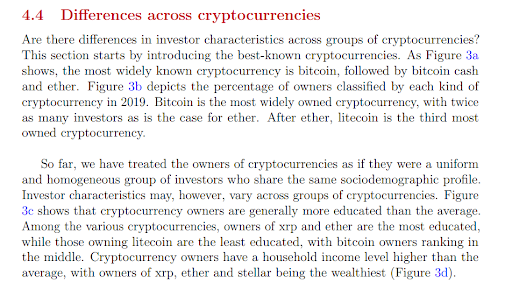
Source: Chart from Cool Breeze on X

The BIS report estimated that owning a crypto in one year increases the probability, on average, of owning a crypto in the following year by 50%. Notably, XRP holders, famously known as the ‘XRP Army,’ have gained a reputation for their long-term belief in the altcoin. These crypto holders held their tokens even during the SEC’s multi-year lawsuit against Ripple, which negatively impacted the XRP price.

Pro-XRP lawyer John Deaton had notably praised these XRP holders for playing a key role in Ripple’s case against the SEC. These holders, alongside Deaton, had filed an amicus brief in which they provided the court with information in favour of Ripple explaining why XRP wasn’t a security, as the SEC alleged. The court eventually ruled that XRP wasn’t a security.

XRP Holders Are On The Rise

On-chain analytics platform Santiment revealed that XRP holders are on the rise, with the XRP Ledger (XRPL) now having more than 7.7 million holders for the first time since its launch. This comes as the network’s usage continues to grow, especially with more real-world assets being tokenized.

The XRP Ledger also reached a 5-week high of 46,767 active addresses earlier this week, as the XRP price spiked 14% and climbed above $1.60. Interestingly, this feat for the XRPL comes just as Chainlink community member Zach Rynes (Chainlink God) described the network as a ‘ghost chain.’

Commenting on this, Cool Breeze urged XRP holders not to fall for the ‘hate campaign’ by Link God, claiming that they simply wanted to shake them out. The pundit further highlighted how XRP has performed better against Bitcoin than Chainlink has against the leading crypto.

At the time of writing, the XRP price is trading at around $.152, down in the last 24 hours, according to data from CoinMarketCap.

XRP trading at $1.52 on the 1D chart | Source: XRPUSDT on Tradingview.com

Trending Cryptos

Related Questions

QAccording to the BIS report mentioned in the article, which cryptocurrency holders were ranked as the most educated?

AThe BIS report ranked XRP and Ethereum holders as the most educated among crypto holders.

QWhat did the BIS report say about the household income of crypto holders compared to the average?

AThe report noted that crypto holders have higher-than-average household incomes, with Ethereum, Stellar, and XRP holders being the wealthiest.

QWhat key role did long-term crypto ownership play in the findings of the BIS report?

AThe report suggested that long-term crypto ownership played a key role in its findings, estimating that owning a crypto in one year increases the probability of owning a crypto in the following year by 50% on average.

QHow many holders does the XRP Ledger (XRPL) now have, as revealed by Santiment?

AThe XRP Ledger now has more than 7.7 million holders for the first time since its launch.

QWhat was the court's decision regarding the SEC's allegation that XRP was a security?

AThe court eventually ruled that XRP was not a security.

Related Reads

Must-Watch Events Next Week|CLARITY Act Could Face Senate Vote; SpaceX, Circle to Report Earnings (8.3-8.9)

**Summary: Key Events and Developments to Watch (August 3-9)** The upcoming week is marked by significant financial disclosures, key legislative deadlines, and notable product updates. **Major Financial Events:** Several companies are scheduled to release their Q2 2026 earnings. American Bitcoin (ABTC) will report on August 3, followed by SpaceX and Hut 8 Mining Corp. on August 4, and Circle on August 5. Notably, a significant portion of SpaceX shares (up to 12% of total shares) will be unlocked on August 6 following their earnings release. **Key Legislative Deadline:** The U.S. Senate faces an August 7 deadline to secure 60 votes for the CLARITY Act, a bipartisan bill aiming to establish a federal regulatory framework for cryptocurrencies. The Senate may hold a full vote on the bill during the week. **Economic Data:** The U.S. July Non-Farm Payrolls report will be released on August 7, providing crucial labor market data. **Technology & Product Updates:** * **Shutdowns:** DeFi portfolio tracker Zapper and wallet app Ctrl Wallet will cease operations on August 3. * **Upgrades:** LayerZero will deprecate its v1 relayers on August 3. XRP Ledger's new version 3.3.0, featuring five new functions, is expected next week. * **AI:** Elon Musk announced that the advanced Grok 4.6 AI model is set for release around August 7. * **Bitcoin:** The BIP-110 forced signaling for a potential Bitcoin network change is scheduled to begin around August 8. **Other Notable Events:** Chinese robotics firm Unitree Tech has set its preliminary price inquiry for its IPO for August 5. South Korean exchange Upbit will delist AQT and AERGO tokens on August 3.

marsbit59m ago

Must-Watch Events Next Week|CLARITY Act Could Face Senate Vote; SpaceX, Circle to Report Earnings (8.3-8.9)

marsbit59m ago

Stocks Are Plummeting More Sharply Than Cryptocurrencies. Where Has the Money Gone?

Stock Markets Plunge Deeper Than Cryptocurrencies: Where Did the Money Go? In late July, Seoul's Kospi index triggered circuit breakers for two consecutive days, plummeting over 40% from its June high. The collapse was led by heavyweight stocks like SK Hynix, whose record profits still disappointed investors, and devastating leveraged ETFs, with one major product losing over 83% of its value. This signaled a global, forced deleveraging targeting the most crowded trades. Interestingly, while stocks exhibited extreme volatility akin to crypto markets, Bitcoin rose nearly 15% in July after a prior steep drop. Analysis shows the money fleeing equities did not flow into Bitcoin. Instead, Bitcoin had already absorbed its sell-off in May-June, when U.S. spot Bitcoin ETFs saw historic outflows. The true safe-haven beneficiary was gold, whose price rose over 20% year-on-year, highlighting a decoupling between Bitcoin and gold as "digital gold." The sell-off was a targeted unwinding of leveraged positions in tech and semiconductors, accelerated by broker-dealer risk management and shifts in the AI narrative, including new competition from Chinese memory chipmakers. The retreat path was clear: from high-valuation tech stocks to cash and U.S. Treasuries, then to gold. For Bitcoin to attract sustained institutional inflows, conditions like eased global liquidity pressure, a "soft-landing" Fed rate cut, and U.S. regulatory clarity via legislation like the stalled CLARITY Act are needed. Currently, Bitcoin is not a safe haven but an already-cleared asset. Its low correlation with tech stocks, however, makes it a potential diversification play for institutional portfolios once the storm passes. The money isn't here yet, but the positioning is underway.

marsbit59m ago

Stocks Are Plummeting More Sharply Than Cryptocurrencies. Where Has the Money Gone?

marsbit59m ago

In Conversation with Ray Dalio: We Are Currently in an AI Bubble, with 1% of My Portfolio in Bitcoin

Ray Dalio, founder of Bridgewater Associates, warns in an interview that the current AI boom shows classic bubble characteristics, which could lead to significant economic downturns as seen in past cycles like 1929 or 2000. He explains that speculative enthusiasm, fueled by debt and overvaluation, often precedes a crash when rising rates or taxation force asset sales, causing widespread losses and recession. Dalio also outlines his "Big Cycle" theory, describing an approximate 80-year pattern where widening wealth gaps, massive government deficits, and shifting geopolitical power (like China's rise) create internal conflict and global instability. He emphasizes that we are in a late-cycle, transitional phase where traditional powers like the US and UK face decline. For personal wealth protection, Dalio advises diversification beyond cash into assets like stocks, bonds, real estate, and particularly gold, which he prefers over Bitcoin. While he holds about 1% of his portfolio in Bitcoin as a non-printable hard asset, he views gold as more secure from technological or governmental threats. Regarding AI's impact, Dalio believes it will disproportionately benefit capital owners, worsening inequality by replacing both physical and cognitive labor. He suggests that human intuition and emotional intelligence, combined with AI, will be key for future workers. On taxation, Dalio argues that wealth taxes are impractical and risk triggering asset sell-offs, reducing productive investment. He points to the UK as a cautionary example of debt, low productivity, and political strife. Geopolitically, Dalio foresees a more regionalized world, with the US showing weakness in prolonged conflicts like with Iran, akin to past imperial declines. The ideal outcome, he suggests, is coexisting powerful blocs (e.g., Americas, China-Asia Pacific) without major war.

marsbit4h ago

In Conversation with Ray Dalio: We Are Currently in an AI Bubble, with 1% of My Portfolio in Bitcoin

marsbit4h ago

Trading

Spot

Hot Articles

What is $BANK

Bank AI: A Revolutionary Step in the Future of Banking Introduction In an era marked by rapid advancements in technology, Bank AI stands at the intersection of artificial intelligence (AI) and banking services. This innovative project seeks to redefine the financial landscape, enhancing operational efficiency, security measures, and customer experiences through the power of AI. As we embark on this exploration of Bank AI, we will delve into what the project entails, its operational dynamics, its historical context, and significant milestones. What is Bank AI? At its core, Bank AI represents a transformative initiative aimed at integrating artificial intelligence into various banking operations. This project harnesses the capabilities of AI to automate processes, improve risk management protocols, and enhance customer interaction through personalised services. The primary objectives of Bank AI include: Automation of Banking Functions: By leveraging AI technologies, Bank AI aims to automate routine tasks, reducing the burden on human resources and enhancing efficiency. Enhanced Risk Management: The project utilises AI algorithms to predict and identify risks, thereby fortifying security measures against fraud and other threats. Personalisation of Banking Services: Bank AI focuses on offering tailored financial products and services by analysing customer data and behaviours. Improving Customer Experience: The implementation of AI-driven solutions, such as chatbots and virtual assistants, aims to provide users with more human-like interactions, revolutionising the way customers engage with banks. With these goals, Bank AI positions itself as a crucial player in rendering banking more efficient, secure, and user-centric. Who is the Creator of Bank AI? Details regarding the creator of Bank AI remain unknown. As such, no specific individual or organisation has been identified in the available information. The anonymity surrounding the project's inception raises questions but does not detract from its ambitious vision and objectives. Who are the Investors of Bank AI? Similar to the project's creator, specific information regarding the investors or supporting organisations of Bank AI has not been disclosed. Without this information, it is challenging to outline the financial backing and institutional support that might be propelling the project forward. Nevertheless, the importance of having a robust investment foundation is pivotal for sustaining development in such an innovative field. How Does Bank AI Work? Bank AI operates on several innovative fronts, focusing on unique factors that differentiate it from traditional banking frameworks. Below are key operational features: Automation: By applying machine learning algorithms, Bank AI automates various manual processes within banks. This results in reduced operational costs and allows human workers to redirect their efforts towards more strategic activities. Advanced Risk Management: The integration of AI into risk management practices equips banks with tools to accurately predict potential threats such as fraud, ensuring that customer information and assets remain secure. Tailored Financial Recommendations: Through continuous learning from customer interactions, the AI systems develop a nuanced understanding of user needs, enabling them to offer tailored advice on financial decisions. Enhanced Customer Interactions: Utilizing chatbots and virtual assistants powered by AI, Bank AI enables a more engaging customer experience, allowing users to have their queries resolved quickly, thus reducing wait times and improving satisfaction levels. Together, these operational features position Bank AI as a pioneer in the banking sector, establishing new benchmarks for service delivery and operational excellence. Timeline of Bank AI Understanding the trajectory of Bank AI requires a look at its historical context. Below is a timeline highlighting important milestones and developments: Early 2010s: The conceptualisation of AI integration into banking services began to gain attention as banking institutions recognised the potential benefits. 2018: A marked increase in the implementation of AI technologies occurred when banks started using AI tools like chatbots for basic customer service and risk management systems for improved security handling. 2023: The sophistication of AI continued to advance, with generative AI being introduced for more complex tasks such as document processing and real-time investment analysis. This year marked a significant leap in the capabilities afforded to banks by AI technology. 2024-Current Status: As of this year, Bank AI is on an upward trajectory, with ongoing research and developments poised to further enhance capabilities in banking operations. Continued exploration of AI applications hints at exciting developments yet to come. Key Points About Bank AI Integration of AI in Banking: Bank AI focuses on adopting artificial intelligence to streamline banking processes and improve user experiences. Automation and Risk Management Focus: The project strongly emphasises these areas, aiming to shift the burden of routine tasks while enhancing security frameworks through predictive analytics. Personalised Banking Solutions: By harnessing customer data, Bank AI enables tailored banking services that cater to individual user needs. Commitment to Development: Bank AI remains committed to ongoing research and development efforts, ensuring its adaptability and ongoing relevance as technology continues to evolve. Conclusion In summary, Bank AI exemplifies a crucial step forward in the banking industry, leveraging artificial intelligence to reshape operational paradigms, enhance security, and promote customer satisfaction. Despite gaps in information surrounding the creator and investors, the clear objectives and functional mechanisms of Bank AI provide a strong foundation for its ongoing evolution. As AI technology continues to advance and merge with the banking sector, Bank AI is well-positioned to significantly impact the future of financial services, enhancing the way we understand and interact with banking.

236 Total ViewsPublished 2024.04.06Updated 2024.12.03

What is $BANK

Discussions

Welcome to the HTX Community. Here, you can stay informed about the latest platform developments and gain access to professional market insights. Users' opinions on the price of BANK (BANK) are presented below.

活动图片













