Why LAB crypto’s 34% crash has traders watching THIS support

ambcryptoPublished on 2026-07-02Last updated on 2026-07-02

Abstract

LAB crypto experienced a sharp 34% crash to $9.00, driven by the unwinding of excessive leverage and concerns over upcoming token unlocks and concentrated ownership. Despite a 121% surge in daily trading volume to $58.71 million, market activity was dominated by position closures, with Open Interest falling 23% to $130.39 million, indicating a broad reduction in speculative exposure without significant new buying. The price is now testing a crucial support level at $7.65, with the MACD indicating strong bearish momentum. A breakdown below this support could target the next major level near $4.00. Persistent negative funding rates confirm that short sellers remain in control of the derivatives market, sustaining the bearish pressure. The token's near-term outlook hinges on whether buyers can successfully defend the $7.65 support zone.

LAB recorded one of its sharpest daily declines after excessive leverage unwound and tokenomics concerns weighed heavily on sentiment. At the time of writing, the token traded at $9.00, down 34% over the past 24 hours, while its market capitalization declined to $3.88 billion.

Despite the sell-off, trading activity accelerated as daily volume climbed 121% to approximately $58.71 million, showing that market participation increased during the decline. Reports highlighting upcoming token unlocks and concerns over concentrated token ownership added further pressure, prompting participants to reassess LAB’s valuation.

As a result, leveraged positions closed rapidly, while heightened uncertainty encouraged additional selling across both spot and derivatives markets.

Leverage rapidly disappeared from LAB’s market

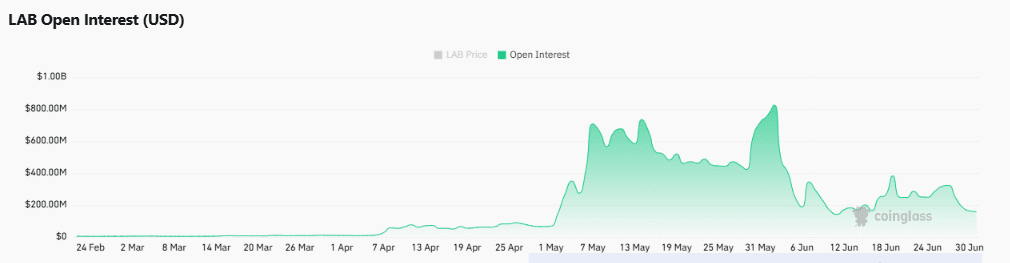
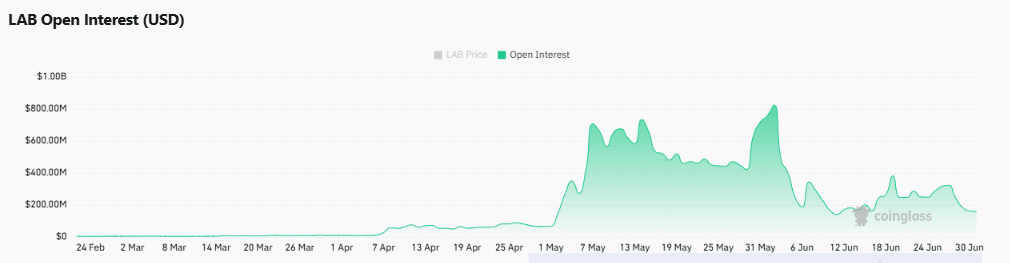
During the decline, derivatives activity reflected a broad reduction in speculative exposure rather than fresh risk-taking.

At press time, Open Interest (OI) fell 23.01% to $130.39 million, indicating that traders closed positions instead of adding new leverage during the decline. The contraction suggests that long positions absorbed most of the selling pressure as the market reacted to deteriorating sentiment.

Trading volume remained elevated despite the decline in OI, reinforcing the view that position unwinding dominated market activity. However, the absence of rising OI alongside heavy volume showed that new buyers had not stepped in aggressively.

Instead, capital exited leveraged positions while participants reduced exposure amid growing uncertainty surrounding LAB’s near-term outlook.
Source: CoinGlass

Can LAB defend its final support zone?

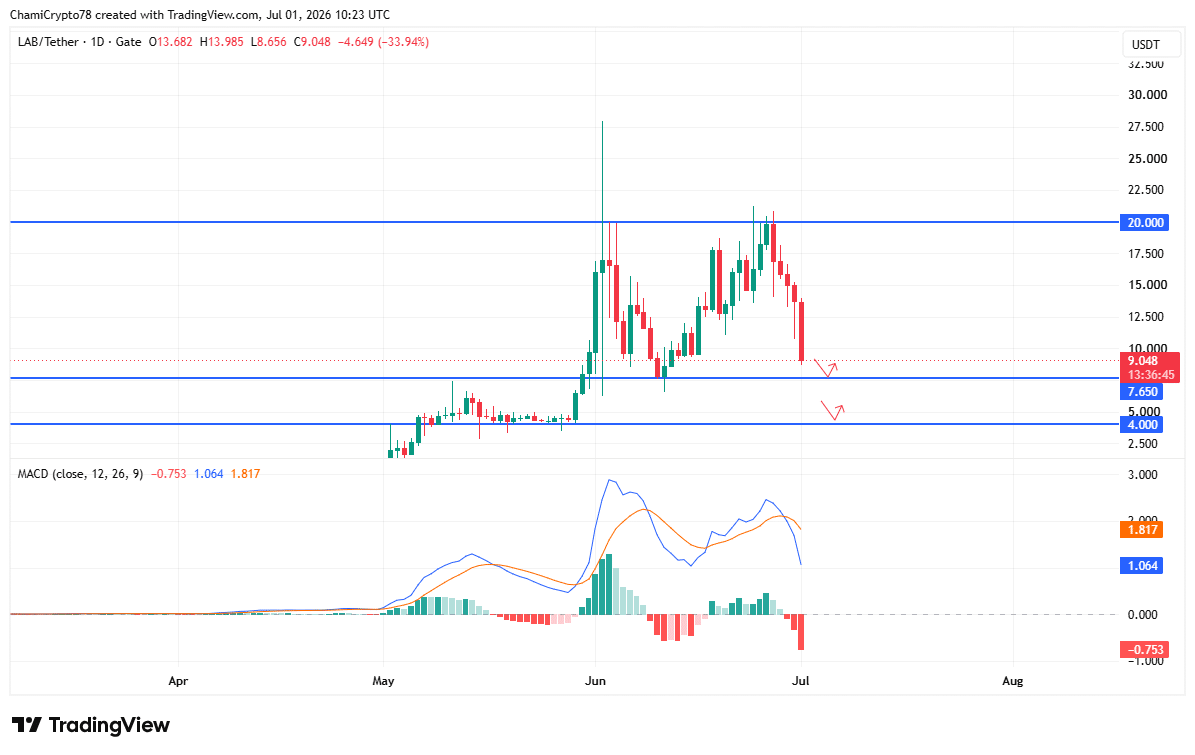
LAB approached the $7.65 support after a sharp rejection from the $20 resistance area, leaving sellers firmly in control of the broader trend.

Price closed near $9.04, placing the token only a short distance above this key demand level. At the time of writing, the MACD remained bearish as the MACD line stayed below the signal line.

The histogram continued expanding deeper into negative territory, confirming that downside pressure had strengthened throughout the latest decline. A decisive loss of $7.65 would expose the next major support near $4.00, where buyers previously emerged.

However, if buyers defend the current zone successfully, LAB could attempt a relief rebound toward $7.65 before challenging higher resistance levels, although confirmation would still require improving technical strength.
Source: TradingView

Why are short sellers still in control?

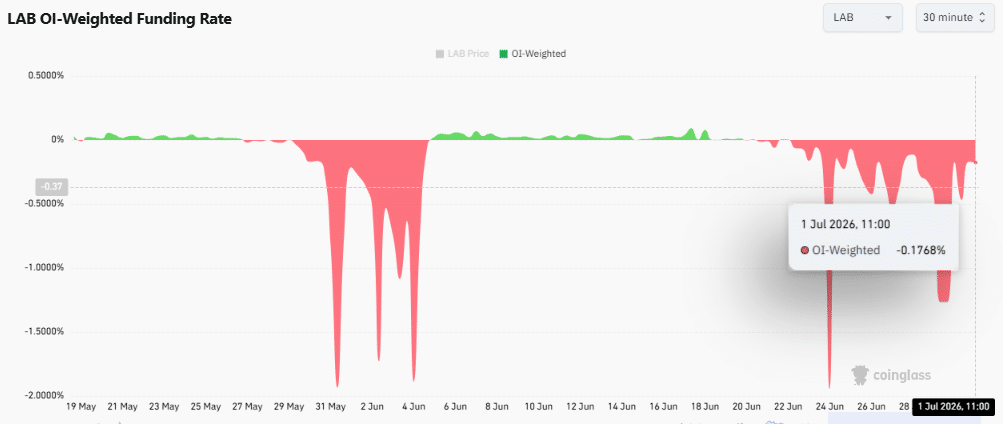
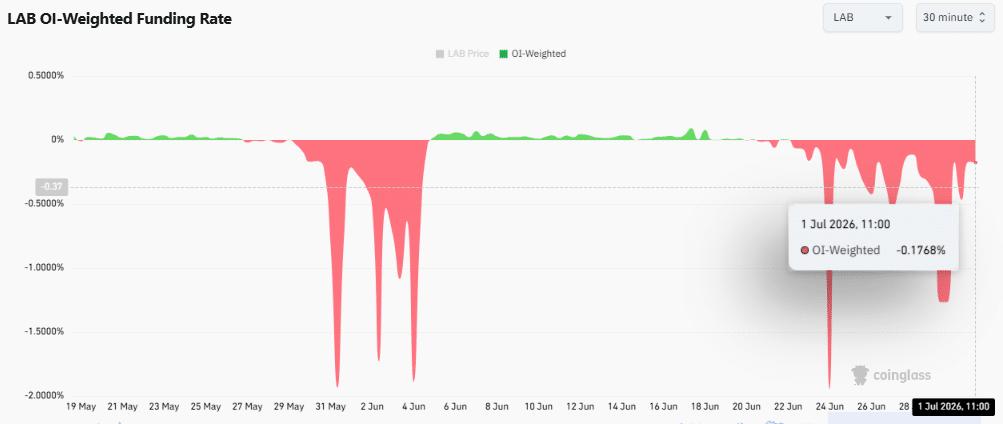
Funding data continued supporting the bearish derivatives outlook as the OI-Weighted Funding Rate remained below zero throughout the recent decline. The latest reading stood at approximately -0.1768%, showing that short sellers continued paying to maintain their positions.

Persistent negative funding reflected sustained bearish conviction despite the sharp correction. Unlike temporary funding dips, this trend extended across several sessions and aligned with the decline in OI, reinforcing the broader risk-off environment.

Although funding had not reached the extreme levels seen earlier in June, it still indicated that bearish positioning dominated the derivatives market. Until funding recovers toward positive territory, sellers would likely retain the upper hand.
Source: CoinGlass

If buyers defend the $7.65 support, the token could stabilize and attempt a recovery.

However, a confirmed breakdown below that level would likely shift attention toward the $4.00 support as bearish pressure remained dominant.


Final Summary

  • LAB trading volume surged while leverage rapidly exited, highlighting aggressive risk reduction across derivatives.
  • Bearish funding and weakening technical structure kept sellers firmly in control near critical support.


Trending Cryptos

Related Questions

QWhat were the main reasons for LAB crypto's 34% price crash mentioned in the article?

AThe main reasons were the unwinding of excessive leverage and concerns over tokenomics, specifically upcoming token unlocks and concentrated token ownership, which weighed heavily on sentiment.

QAccording to the article, what key support level is LAB approaching after its decline?

ALAB is approaching the $7.65 support level after a sharp rejection from the $20 resistance area.

QWhat does the decline in Open Interest (OI) for LAB derivatives indicate about trader behavior?

AThe 23.01% decline in Open Interest indicates that traders were closing existing leveraged positions rather than adding new leverage, showing a broad reduction in speculative exposure and risk-taking during the decline.

QWhat does the persistently negative OI-Weighted Funding Rate suggest about market sentiment?

AThe persistently negative OI-Weighted Funding Rate suggests sustained bearish conviction, with short sellers paying to maintain their positions. It indicates that sellers retain the upper hand and bearish positioning dominates the derivatives market.

QWhat are the potential price targets mentioned if LAB loses the $7.65 support level?

AIf LAB decisively loses the $7.65 support level, it would expose the next major support near $4.00.

Related Reads

Blood Loss of $55 Million Selling 3,588 BTC, Strategy Becomes a Literal Scumbag

On July 6th, Strategy (formerly MicroStrategy) disclosed in an SEC filing that it sold 3,588 Bitcoin (BTC) between June 29th and July 5th for approximately $216 million, at an average price of ~$60,200. This marked the company's largest net sale since initiating its Bitcoin strategy in 2020 and its first institutionalized reduction of its core holding. The sale resulted in a realized loss of about $54.8 million, as the selling price was below its average cost basis of ~$75,476 per BTC. The proceeds were used to pay preferred stock dividends and replenish USD reserves. This move follows a new "Digital Credit Capital Framework" approved on June 29th, authorizing the sale of up to $1.25 billion in Bitcoin. The sale consumes roughly 17% of this authorized amount in its first week. Strategy's foundational narrative, built by founder Michael Saylor, was a commitment to "never sell" Bitcoin. The recent institutionalized selling framework and these substantial sales represent a significant shift from that original promise. While the amount sold is only 0.4% of Strategy's total holdings of 843,775 BTC, the action challenges the premium at which its stock (MSTR) trades relative to its Bitcoin holdings. Investors had priced in the "never sell" narrative. The company now faces a contradiction: it sells Bitcoin at a loss to pay dividends on the preferred stock it issued to fund Bitcoin purchases. Saylor has framed selling as a tool for future strategic purchases, but each sale erodes the credibility of the original commitment, potentially threatening the premium valuation of MSTR shares.

Foresight News54m ago

Blood Loss of $55 Million Selling 3,588 BTC, Strategy Becomes a Literal Scumbag

Foresight News54m ago

Dialogue with Yihui Capital, SoundAI Technology, Ling Universe, and Zhongbo Jili: Opportunities and Challenges in the AI Smart Hardware Track

On June 28, 2026, an event titled "New Opportunities in AI Hardware: The Battle for Interactive Entry Points Begins" was held in Beijing. It featured a report from ITJuzi and discussions with experts from SoundAI, Ling Universe, One Reed Capital, and Zhongbo Juli on the opportunities and challenges in China's AI hardware sector. Key report findings highlight the sector's intense activity: 327 out of 431 startups founded post-2023 have secured funding, with 179 investments in H1 2026 alone. The landscape is dominated by embodied intelligent robots, while wearable tech like smart rings and AI glasses shows rapid growth. Geographically, Shenzhen leads, leveraging its superior hardware supply chain, followed by Beijing and Shanghai. The overarching trend is for companies to focus on micro-innovations within specific scenarios rather than reinventing foundational technology. Industry leaders shared several critical insights: 1. **Balancing Innovation & Market Readiness**: Entrepreneurs face the "hammer looking for a nail" dilemma. Success requires balancing technical capability with user acceptance, cost control, and incremental design improvements rather than chasing disruptive innovation. 2. **Competitive Landscape**: The future interactive entry point may not be a single super-device but a mix of universal terminals and specialized, scenario-specific hardware. While large companies have ecosystem advantages, startups can win by deeply targeting vertical markets and specific user groups. 3. **Core Challenges & Business Models**: Key hurdles include deep understanding of AI models and navigating non-transparent hardware supply chains. Viable business models may involve selling hardware at cost and generating revenue through software subscriptions, but this requires tight control over both hardware BOM and model inference costs. 4. **The Road to Commercialization**: The ultimate test is market validation—achieving sales growth and sustainable cash flow. Companies must find the right application scenario, use edge computing effectively, and close the loop from technology to commercial success. 5. **The Future of Interaction**: Proactive, context-aware interaction is the next frontier, though it's currently limited by issues like model hallucinations and environmental perception. The near-term focus should be on identifying target users and creating a coherent experience in specific domains, such as health wearables. In summary, to succeed in the competitive AI hardware arena, companies must strategically choose their niche, build a team with the right geographical advantages (e.g., leveraging Shenzhen's supply chain), and most importantly, execute a flawless commercialization strategy that translates technology into market-accepted products and sustainable business growth.

marsbit1h ago

Dialogue with Yihui Capital, SoundAI Technology, Ling Universe, and Zhongbo Jili: Opportunities and Challenges in the AI Smart Hardware Track

marsbit1h ago

Trading

Spot

Hot Articles

How to Buy ONE

Welcome to HTX.com! We've made purchasing Harmony (ONE) simple and convenient. Follow our step-by-step guide to embark on your crypto journey.Step 1: Create Your HTX AccountUse your email or phone number to sign up for a free account on HTX. Experience a hassle-free registration journey and unlock all features.Get My AccountStep 2: Go to Buy Crypto and Choose Your Payment MethodCredit/Debit Card: Use your Visa or Mastercard to buy Harmony (ONE) instantly.Balance: Use funds from your HTX account balance to trade seamlessly.Third Parties: We've added popular payment methods such as Google Pay and Apple Pay to enhance convenience.P2P: Trade directly with other users on HTX.Over-the-Counter (OTC): We offer tailor-made services and competitive exchange rates for traders.Step 3: Store Your Harmony (ONE)After purchasing your Harmony (ONE), store it in your HTX account. Alternatively, you can send it elsewhere via blockchain transfer or use it to trade other cryptocurrencies.Step 4: Trade Harmony (ONE)Easily trade Harmony (ONE) on HTX's spot market. Simply access your account, select your trading pair, execute your trades, and monitor in real-time. We offer a user-friendly experience for both beginners and seasoned traders.

4.2k Total ViewsPublished 2024.03.29Updated 2026.06.02

How to Buy ONE

Discussions

Welcome to the HTX Community. Here, you can stay informed about the latest platform developments and gain access to professional market insights. Users' opinions on the price of ONE (ONE) are presented below.

活动图片