Why Bitcoin Still Acts Like A Risk Asset Despite Safe-Haven Claims

bitcoinistPublished on 2026-04-26Last updated on 2026-04-26

Abstract

Bitcoin possesses inherent qualities of a safe-haven asset, such as being portable and censorship-resistant. However, it continues to trade like a risk asset, correlating with indices like the NASDAQ during periods of uncertainty. Analysts attribute this to its lack of widespread acceptance by large capital pools, a process that may take another decade. Currently, Bitcoin is showing technical weakness with a bearish market structure shift and a rejection from a monthly fair value gap, suggesting a higher probability of a breakdown and a potential move lower. The broader downside thesis remains intact unless BTC breaks out of its current pattern with strength.

Bitcoin was built with many of the qualities typically associated with a safe-haven asset: it is portable, censorship-resistant, and independent of traditional financial systems. In theory, those characteristics make a compelling case for BTC as a refuge in times of instability, particularly in a world facing geopolitical tensions, inflation risks, and growing uncertainty around legacy institutions.

How Long It Might Take For Bitcoin To Be Widely Accepted

The idea that most Bitcoiners believe Bitcoin is already a full-fledged safe-haven asset misses an important nuance. Crypto analyst Willy Woo has mentioned on X that when an asset is independent of the system and thrives even if the system collapses, there are certain properties that should be expected of a true safe-haven asset. Meanwhile, BTC clearly carries these properties.

In extreme scenarios, such as war, a seed phrase can preserve wealth across borders. Despite its characteristics, Bitcoin still tends to trade like a risk asset during periods of uncertainty and war. BTC is sensitive to uncertainty, trading like the NASDAQ Composite.

Willy explained that this is because the large capital pools don’t acknowledge their properties, and BTC is considered new and untested. It will take another decade for BTC to gain market acceptance as a safe-haven. When BTC does, it will compete with gold market capitalization as a dominant store of value in the modern financial system.
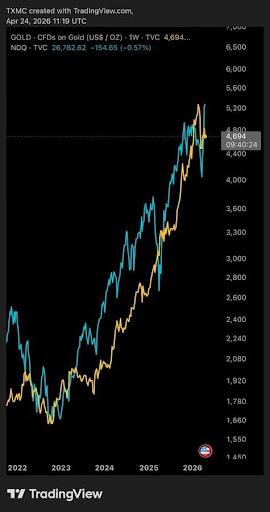
Source: Chart from Willy Woo on X

Bitcoin is showing clear signs of weakness after forming a bearish market structure shift (MSS) at the highs. Instead of continuing its uptrend, the price has now broken back into its previous range, marking it the first real loss of momentum since the rally began. According to ctm_trader, this shift clearly shows that the price is losing its strength and has now turned to a potential retest of the lower boundary of the channel.

However, with the MSS at the highs, most liquidity is sitting below the current price levels, while long positions heavily outweigh shorts. The probability of a breakdown is much higher than the probability of continuation. For market makers, this is a perfect opportunity for a long squeeze as there is a massive market imbalance right now.

What The Monthly FVG Rejection May Be Signaling

A similar trade setup that has repeated multiple times throughout this bear market may be setting up once again. Crypto trader Minga highlighted that BTC price is still trading inside the bear-flag rising wedge structure and currently rejecting from the monthly fair value gap (FVG).

As long as BTC remains within this pattern and continues to reject the FVG, the broader downside thesis remains intact. Every push into resistance has looked more like a relief rally than true strength.

With momentum shifting back toward the downside, the market is likely preparing for another leg lower. Meanwhile, this structure setup will remain clean until BTC breaks out of the formation and reclaims resistance with strength.

BTC trading at $77,784 on the 1D chart | Source: BTCUSDT on Tradingview.com

Trending Cryptos

Related Questions

QWhat are the key characteristics that make Bitcoin theoretically a safe-haven asset?

ABitcoin is portable, censorship-resistant, and independent of traditional financial systems.

QAccording to Willy Woo, why does Bitcoin currently trade like a risk asset instead of a safe-haven?

ABecause large capital pools do not acknowledge its safe-haven properties, and it is still viewed as new and untested.

QWhat is the significance of the bearish market structure shift (MSS) mentioned in the article?

AIt signals a loss of momentum, a break back into the previous price range, and a higher probability of a price breakdown than continuation.

QWhat does the rejection from the monthly Fair Value Gap (FVG) indicate for Bitcoin's price?

AIt suggests that the broader downside thesis remains intact and that pushes into resistance are more like relief rallies than true strength.

QHow long does analyst Willy Woo estimate it will take for Bitcoin to be widely accepted as a safe-haven asset?

AHe estimates it will take another decade for Bitcoin to gain market acceptance as a safe-haven asset.

Related Reads

Strategy's Loss in the Second Quarter Reaches $8.22 Billion Amid Bitcoin Decline

Strategy, the largest corporate holder of Bitcoin, reported a net loss of $8.22 billion for the second quarter. This loss was primarily driven by an $8.32 billion unrealized loss on its Bitcoin holdings due to a decline in the asset's price during the period. Despite these paper losses, the company increased its Bitcoin holdings to 843,775 BTC, a 25% growth since the start of the year. As part of a new monetization strategy, Strategy sold approximately $218.4 million worth of Bitcoin, mainly to fund dividends for preferred shareholders, with $216 million of that sold after Q2 ended. The company also built a $3.75 billion cash reserve, which it claims is sufficient to cover over two years of dividend and interest payments, aiming to insulate itself from Bitcoin's volatility while meeting obligations. Following the earnings release, Strategy's stock (MSTR) rose 4.7% in regular trading but corrected slightly after-hours. This pattern reflects how the company's accounting results are heavily tied to Bitcoin's price swings, even as its long-term strategy remains unchanged. The report indicates that Strategy is maintaining its core strategy of accumulating Bitcoin while building a financial buffer. This quarterly loss follows a recognizable pattern, with the company posting significant unrealized losses in previous quarters (e.g., $12.4 billion in Q4 2025 and ~$12.5 billion in Q1 2026) due to fair-value accounting. A key technical shift is its new monetization program, which introduces periodic selling pressure on the market, transitioning Strategy from a pure accumulator to a participant that occasionally adds supply. A critical question remains: how long can the cash reserve cover dividend obligations if a Bitcoin price downturn persists beyond two years?

cryptonews.ru21m ago

Strategy's Loss in the Second Quarter Reaches $8.22 Billion Amid Bitcoin Decline

cryptonews.ru21m ago

Will Terrorist Durov Ban Russian Officials?

Telegram founder Pavel Durov publicly reacted to being labeled a "terrorist" by Russian authorities, stating the designation came after he refused demands for mass surveillance and censorship on the platform. In a Telegram post, he highlighted that this status formally bans him from "publishing information online." Durov concluded with a statement widely circulated: Russian officials "clearly don't understand who can ban whom on the internet." This remark suggests Durov could potentially restrict official Russian government and officials' channels on Telegram, which continue to operate on the platform despite its formal blocking in Russia. The situation parallels previous, slow-moving state directives, like switching officials to domestic cars, contrasted with the current push to migrate all government communication to the Russian-made messenger MAX by 2030. However, reports indicate many officials still use Telegram via workarounds, fearing surveillance on MAX, while alternatives like BiP and KakaoTalk recently became inaccessible in Russia without a VPN. Durov has not specified any immediate actions against state channels. His statement is an initial response, with further developments depending on the authorities' reaction. The dynamic differs from 2020 when Russian regulators lifted a block on Telegram; now, Durov implies control from within the platform itself over the official accounts that persisted through that earlier blockade.

cryptonews.ru21m ago

Will Terrorist Durov Ban Russian Officials?

cryptonews.ru21m ago

DeepSeek V4 Official Version Arrives, New Capabilities Emerge, Value-for-Money King Enters the Fray

On July 31st, DeepSeek officially launched the public API beta for its DeepSeek-V4-Flash model. A key highlight is its performance on multiple Agent benchmark tests, reportedly nearing or even surpassing the level of the V4-Pro preview version from three months ago. Notably, the Flash model achieves this with significantly smaller scale (130B active parameters vs. Pro's 490B), suggesting that post-training optimization and data quality may be as crucial as raw model size. DeepSeek emphasized that the V4-Flash-0731 uses the same model architecture and size as its preview version, with improvements attributed solely to "re-trained post-training." The update also marks the official debut of DeepSeek's self-developed Agent framework, "Harness." The move signals DeepSeek's strategic push to position its cost-effective Flash model as a competitive base for Agent applications—scenarios requiring autonomous planning, tool usage, and complex task execution—where inference speed and cost are critical. By natively supporting OpenAI's Responses API format and adapting for code-generation scenarios, DeepSeek aims not just to be a cheaper alternative but to establish its own ecosystem in the Agent era. This release follows DeepSeek's record-breaking ~$50 billion fundraising round roughly two months prior, underscoring market confidence in its technology and commercialization prospects. The company is reportedly preparing for another funding round at a valuation of approximately $71 billion. The Flash model's advancement represents a step in fulfilling the high expectations that come with this valuation, setting the stage for the impending release of the V4-Pro official version and intensifying competition in the global Agent landscape.

marsbit26m ago

DeepSeek V4 Official Version Arrives, New Capabilities Emerge, Value-for-Money King Enters the Fray

marsbit26m ago

Trading

Spot

Hot Articles

What is $BITCOIN

DIGITAL GOLD ($BITCOIN): A Comprehensive Analysis Introduction to DIGITAL GOLD ($BITCOIN) DIGITAL GOLD ($BITCOIN) is a blockchain-based project operating on the Solana network, which aims to combine the characteristics of traditional precious metals with the innovation of decentralized technologies. While it shares a name with Bitcoin, often referred to as “digital gold” due to its perception as a store of value, DIGITAL GOLD is a separate token designed to create a unique ecosystem within the Web3 landscape. Its goal is to position itself as a viable alternative digital asset, although specifics regarding its applications and functionalities are still developing. What is DIGITAL GOLD ($BITCOIN)? DIGITAL GOLD ($BITCOIN) is a cryptocurrency token explicitly designed for use on the Solana blockchain. In contrast to Bitcoin, which provides a widely recognized value storage role, this token appears to focus on broader applications and characteristics. Notable aspects include: Blockchain Infrastructure: The token is built on the Solana blockchain, known for its capacity to handle high-speed and low-cost transactions. Supply Dynamics: DIGITAL GOLD has a maximum supply capped at 100 quadrillion tokens (100P $BITCOIN), although details regarding its circulating supply are currently undisclosed. Utility: While precise functionalities are not explicitly outlined, there are indications that the token could be utilized for various applications, potentially involving decentralized applications (dApps) or asset tokenization strategies. Who is the Creator of DIGITAL GOLD ($BITCOIN)? At present, the identity of the creators and development team behind DIGITAL GOLD ($BITCOIN) remains unknown. This situation is typical among many innovative projects within the blockchain space, particularly those aligning with decentralized finance and meme coin phenomena. While such anonymity may foster a community-driven culture, it intensifies concerns about governance and accountability. Who are the Investors of DIGITAL GOLD ($BITCOIN)? The available information indicates that DIGITAL GOLD ($BITCOIN) does not have any known institutional backers or prominent venture capital investments. The project seems to operate on a peer-to-peer model focused on community support and adoption rather than traditional funding routes. Its activity and liquidity are primarily situated on decentralized exchanges (DEXs), such as PumpSwap, rather than established centralized trading platforms, further highlighting its grassroots approach. How DIGITAL GOLD ($BITCOIN) Works The operational mechanics of DIGITAL GOLD ($BITCOIN) can be elaborated on based on its blockchain design and network attributes: Consensus Mechanism: By leveraging Solana’s unique proof-of-history (PoH) combined with a proof-of-stake (PoS) model, the project ensures efficient transaction validation contributing to the network's high performance. Tokenomics: While specific deflationary mechanisms have not been extensively detailed, the vast maximum token supply implies that it may cater to microtransactions or niche use cases that are still to be defined. Interoperability: There exists the potential for integration with Solana’s broader ecosystem, including various decentralized finance (DeFi) platforms. However, the details regarding specific integrations remain unspecified. Timeline of Key Events Here is a timeline that highlights significant milestones concerning DIGITAL GOLD ($BITCOIN): 2023: The initial deployment of the token occurs on the Solana blockchain, marked by its contract address. 2024: DIGITAL GOLD gains visibility as it becomes available for trading on decentralized exchanges like PumpSwap, allowing users to trade it against SOL. 2025: The project witnesses sporadic trading activity and potential interest in community-led engagements, although no noteworthy partnerships or technical advancements have been documented as of yet. Critical Analysis Strengths Scalability: The underlying Solana infrastructure supports high transaction volumes, which could enhance the utility of $BITCOIN in various transaction scenarios. Accessibility: The potential low trading price per token could attract retail investors, facilitating wider participation due to fractional ownership opportunities. Risks Lack of Transparency: The absence of publicly known backers, developers, or an audit process may yield skepticism regarding the project's sustainability and trustworthiness. Market Volatility: The trading activity is heavily reliant on speculative behavior, which can result in significant price volatility and uncertainty for investors. Conclusion DIGITAL GOLD ($BITCOIN) emerges as an intriguing yet ambiguous project within the rapidly evolving Solana ecosystem. While it attempts to leverage the “digital gold” narrative, its departure from Bitcoin's established role as a store of value underscores the need for a clearer differentiation of its intended utility and governance structure. Future acceptance and adoption will likely depend on addressing the current opacity and defining its operational and economic strategies more explicitly. Note: This report encompasses synthesised information available as of October 2023, and developments may have transpired beyond the research period.

1.1k Total ViewsPublished 2025.05.13Updated 2025.05.13

What is $BITCOIN

Discussions

Welcome to the HTX Community. Here, you can stay informed about the latest platform developments and gain access to professional market insights. Users' opinions on the price of BTC (BTC) are presented below.

活动图片