White House Ignites, BSC Spreads Like Wildfire: A Meme Carnival Bidding Farewell to the 'Imperial Decree Model'

Odaily星球日报Published on 2026-01-21Last updated on 2026-01-21

Abstract

White House Ignites, BSC Rallies: A Meme Carnival Moving Beyond the "Imperial Decree" Model The meme market witnessed another sensational surge when the White House official account on X posted about "victory, eviction operations, and memes" on January 21. Within minutes, meme tokens named "memes" were launched on both Solana and BSC chains, sparking a race between the two ecosystems. Contrary to expectations that Solana’s earlier launch and active ecosystem would dominate, the BSC version outperformed in market cap and holder engagement. At its peak, the BSC meme reached a market cap of $28 million with 7,300 holders, while Solana’s version capped at $3.6 million with 3,900 holders. Real-time user data from GMGN also showed significantly higher engagement on BSC. This outcome challenges the long-standing perception that BSC memes rely heavily on endorsements from figures like CZ and He Yi—a pattern often mocked as "crypto Shandong style." In fact, both CZ and He Yi have recently expressed caution against "wordplay memes" created by parsing their social posts. CZ explicitly warned users against buying tokens based on his tweets, while He Yi discouraged the community from treating such meme creation as meaningful contribution. The success of the BSC-based "memes" token—inspired by the White House rather than internal figures—suggests a possible shift in BSC’s meme culture. He Yi’s now-deleted retweet of the White House post may have contributed to its visibility, though th...

Original | Odaily Planet Daily (@OdailyChina)

Author | Golem (@web 3_golem)
The meme market today once again witnessed a "golden dog" legend.

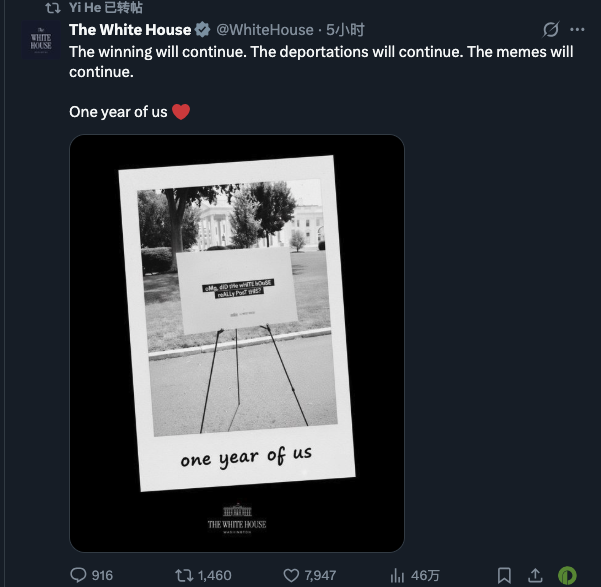
On January 21 at 11:10, the official White House account posted on X platform mentioning "victory, eviction operations, and memes". One minute later, a Meme coin named memes quickly appeared on the Solana chain; 20 minutes later, the BSC chain version was also born. A Meme race between the two chains officially began.

According to empiricism, the Solana version should have the advantage—not only is the ecosystem active, but it also conforms to the consensus of "First is first". However, the result was unexpected: the BSC chain's memes surpassed in market capitalization. According to GMGN data, the BSC version's market cap reached a high of $28 million, with 7,300 holding addresses; while the Solana version's peak was only $3.6 million, with 3,900 holding addresses.

The new feature of GMGN also reveals where players' attention lies: 3 hours after the token's birth, the number of simultaneous online users for the Solana version remained below 1,000, while the BSC version once approached 3,000.

Although some questioned whether the BSC version's market cap was due to "whales pumping, aiming to harvest", the real market attention does not lie—this time, BSC indeed won.

The community often joked that BSC's Meme model was "Shandong Study in the crypto circle", where only projects related to CZ and He Yi had a way out, which once raised concerns about the ecosystem's sustainability. However, BSC's victory in this Meme race not only caused a wave of "slapping thighs" regret for missing out but also prompted the community to rethink the evolution of its Meme model. As GMGN founder Haze said: "The BSC 3.0 era has arrived." (Odaily Note: Haze holds 1.93% of BSC chain memes, ranking second on the holdings list.)

CZ and He Yi Publicly State They Do Not Support "Word-Picking Memes"

I once expressed my thoughts on the BSC Meme model at an Odaily editorial tea party, believing that CZ and He Yi were actually already "kidnapped" by the community. The current BSC Meme model, which relies on "imperial decrees" for cold start, deceives continuous interaction, gets listed on Binance Alpha, and finally gets "poured out", is actually a consensus of the BSC community. Although this model started with CZ's unintentional actions in early 2025, they actually don't like it. However,发展到如今, CZ and He Yi are also powerless to reverse the situation.

When I published this view, it was merely a conjecture, but recent public statements from CZ and He Yi have proven this to be a fact. On January 13, CZ posted saying that although he likes Meme coins, if players blindly follow the trend and buy Meme coins "picked" from his tweets, they are almost destined to lose money.

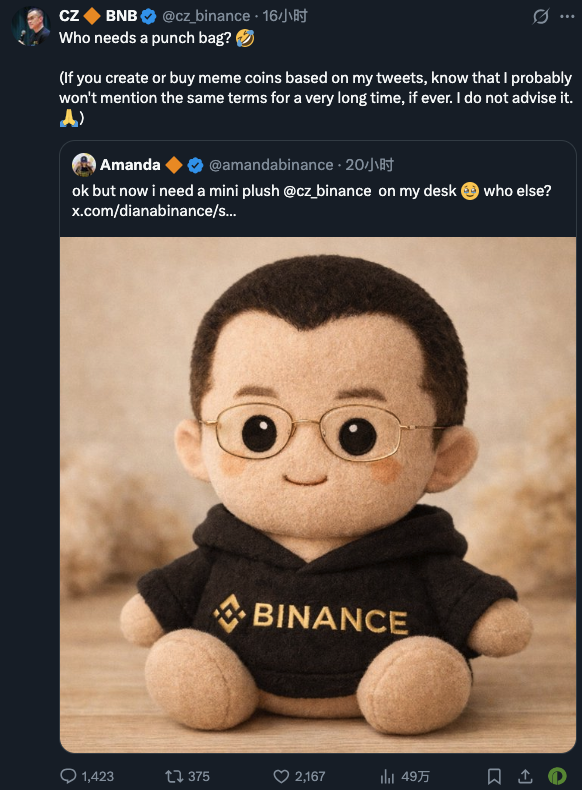
To prevent everyone from blindly chasing these "word-picking Memes", CZ's tweets have started to become cautious. Yesterday, CZ reposted a plush toy created by a user based on his image, which was an ordinary matter, but CZ still specifically noted: If you create or buy Meme coins based on my tweets, please note that I may not mention the same words again for a long time, maybe never. I do not recommend you do this. He even added a 🙏 icon at the end, showing CZ's concern for the community.
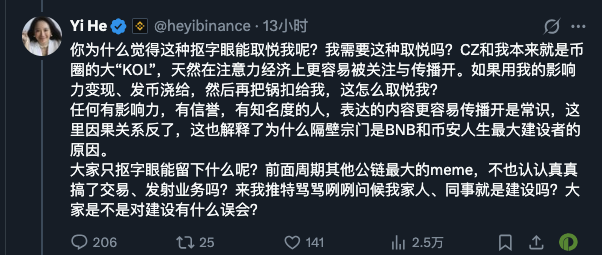
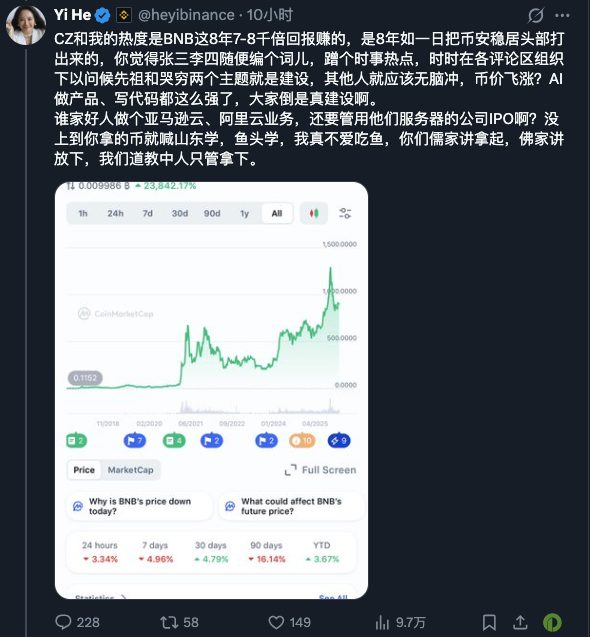
Compared to CZ's euphemism, He Yi's attitude towards the community's "word-picking Memes" is more straightforward. In the early morning of January 21, under a user's post, He Yi not only said that she would severely punish all internal Binance insider trading and bribery, but also "domineeringly" stated that she does not need to rely on Binance Alpha listing Memes that pick words from her tweets to gain pleasure, and also advised the community to focus on real building, not to regard "word-picking and flattery" as real building and be moved by themselves. He Yi also stated that she does not like eating fish, and players should not call it Shandong Study just because Binance Alpha did not list the tokens she supported.
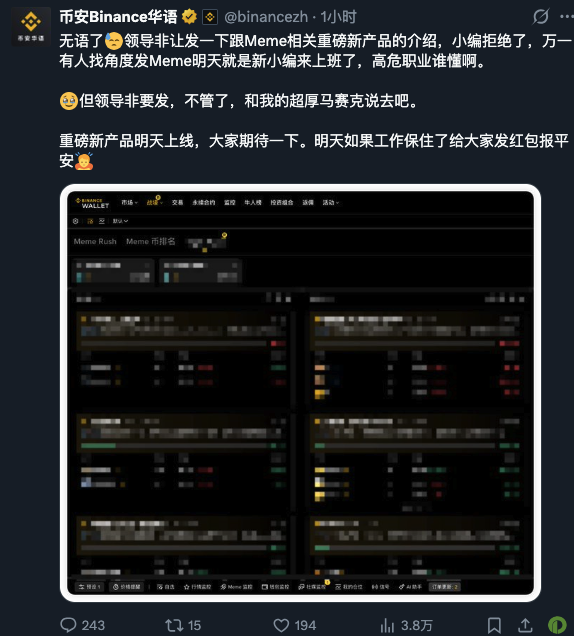
Under the influence of CZ and He Yi's public statements not supporting "word-picking Memes", Binance's official announcements about Memes have also started to become cautious. On January 21, Binance's Chinese account posted that it will launch a new Meme product feature, but to prevent the community from finding angles to issue Meme coins, the editor特意打了超厚马赛克 (specifically applied a very thick mosaic). Although somewhat戏谑 (mockingly), it is enough to see the cautious attitude of the entire Binance team, whether towards Meme coins that pick words from CZ and He Yi's tweets, or those that pick words from Binance's official announcements.
Is BSC Meme Finally Going to Be Different?

Outsiders watch the热闹 (excitement), insiders watch the门道 (tricks). He Yi's remarks not only feel very "alive", but experienced Meme players have realized that the previous BSC Meme model is collapsing from the top down. The successfully outperforming BSC chain memes on the morning of January 21 might be an appetizer. Ironically, memes was also born from the art of "word-picking", but this time it was the White House.

Additionally, after the White House posted, He Yi reposted it (now deleted). This repost, which was unrelated to Binance and He Yi, seemed slightly突兀 (abrupt) in her homepage timeline, and the community was also confused about the reason for He Yi's repost. How much credit He Yi's repost deserves for the BSC's memes, launched 20 minutes later, outperforming Solana's memes is also worth a question mark.
Finally, we might still have to ask that unchanging question, will BSC really be different this time?


Trending Cryptos

Related Questions

QWhat was the unexpected outcome in the meme coin race between Solana and BSC following the White House's post?

AContrary to the expectation that the Solana version would dominate due to its active ecosystem and the 'first is first' consensus, the BSC version of the 'memes' token surpassed it in market capitalization, reaching a high of $28 million compared to Solana's $3.6 million.

QHow did the founders of Binance, CZ and He Yi, publicly express their stance on 'wordplay Meme' coins?

ACZ stated that while he likes meme coins, he warned that blindly buying coins created from words in his tweets would almost certainly lead to losses and explicitly advised against it. He Yi was more direct, stating she does not need to rely on such coins for pleasure and advised the community to focus on real development instead of 'wordplay and flattery'.

QWhat new cautious behavior did the official Binance account demonstrate regarding meme-related announcements?

AThe official Binance Chinese account posted about launching a new meme product feature but added very thick mosaics to the announcement to prevent the community from finding angles to create new meme coins, showing a cautious attitude towards both coins based on CZ/He Yi's words and those based on official Binance announcements.

QWhat does the article suggest the success of the BSC 'memes' token might indicate about the future of BSC's meme model?

AThe article suggests that the success of the BSC 'memes' token, which was sparked by an external source (the White House) rather than internal figures like CZ or He Yi, might signal a shift away from the top-down 'edict model' and the beginning of a new, more sustainable 'BSC 3.0' for meme coins on the chain.

QWhat metric from GMGN highlighted the difference in user attention between the Solana and BSC versions of the 'memes' token?

AGMGN data showed that the number of simultaneous online users for the Solana version remained below 1,000 three hours after launch, while the BSC version一度接近 (once approached) nearly 3,000, indicating significantly higher market attention on the BSC chain.

Related Reads

The Verdict in Choi Tae-won's Divorce Case: Revealing the Inheritance Undercurrent Behind SK Hynix's Trillion-Won Empire

SK Group Chairman Chey Tae-won's high-profile divorce case, involving a record 1.38 trillion won settlement, has drawn attention to the succession plans for Korea's second-largest conglomerate, especially its crown jewel, SK hynix. Unlike traditional chaebol scripts centered on the eldest son, Chey's three children from his marriage to former President Roh Tae-woo's daughter, Roh Soh-yeong, are carving distinct, non-traditional paths. Eldest daughter Chey Yun-jung (b. 1989) is seen as the most evident successor. With a scientific and consulting background, she holds executive roles at SK bioscience and SK Inc.'s growth support department, focusing on future strategy and biopharma. Her marriage is to an AI infrastructure entrepreneur, not a traditional business alliance. Second daughter Chey Min-jung (b. 1991) took a unique route, voluntarily serving as a South Korean naval officer, including an anti-piracy deployment. She later worked on policy and strategy for SK hynix in Washington D.C. before co-founding an AI-driven healthcare startup. She married a former U.S. Marine Corps officer, connecting her to U.S. defense and policy circles—networks crucial for a global semiconductor giant. The only son, Chey In-geun (b. 1995), who studied physics like his father, worked briefly at SK E&S before joining McKinsey. Despite fitting the traditional "heir" profile as the eldest son, he remains silent and holds no public position or shares in SK, suggesting the old succession playbook is obsolete. As SK hynix's valuation soars, becoming a geopolitical asset in the AI era, the heirs' legitimacy is no longer automatic. They must prove themselves in fields like AI biotech, global policy, and strategic consulting. Their marriages also reflect new elite networks in tech and defense, not old political alliances. Their inheritance is the complex challenge of navigating a globalized, tech-driven world, not just a corporate throne.

marsbit11h ago

The Verdict in Choi Tae-won's Divorce Case: Revealing the Inheritance Undercurrent Behind SK Hynix's Trillion-Won Empire

marsbit11h ago

From OpenSea to OpenRouter: Is Alex Atallah Repeating His 'Exit at the Peak' Playbook?

From OpenSea to OpenRouter: Is Alex Atallah Repeating His "Exit at the Peak" Playbook? According to the Wall Street Journal, payments giant Stripe is in talks to acquire the AI model aggregation platform OpenRouter in a potential deal valuing the company near $100 billion. This would mark founder Alex Atallah's second creation of a company reaching a $100 billion valuation, following his co-founding of NFT marketplace OpenSea. OpenRouter, founded just over three years ago, has grown rapidly by acting as a unified gateway for developers to access over 400 AI models. It currently has about 10 million users and processes over 200 trillion tokens monthly. While the platform's annualized revenue is around $50 million, its valuation has skyrocketed from $1.3 billion in March 2026. The potential acquisition by Stripe, a company OpenRouter's founder once likened it to, represents a major expansion into AI infrastructure for the payments leader. This move echoes Atallah's previous timing with OpenSea, where he departed before the NFT market's significant downturn. For OpenRouter, selling now may be strategic. Despite its scale, its business model—charging a 5-5.5% fee on AI inference calls—faces pressure from competition, open-source models, and potential price wars among model providers, limiting its profitability narrative for an IPO. A key asset for potential acquirers like Stripe is OpenRouter's vast repository of real-world AI usage data, which offers unique insights into model performance and developer preferences that are difficult to replicate. Whether this potential deal signifies a new valuation benchmark for AI infrastructure or another market peak signal remains to be seen.

链捕手11h ago

From OpenSea to OpenRouter: Is Alex Atallah Repeating His 'Exit at the Peak' Playbook?

链捕手11h ago

Trading

Spot

Hot Articles

Discussions

Welcome to the HTX Community. Here, you can stay informed about the latest platform developments and gain access to professional market insights. Users' opinions on the price of MEME (MEME) are presented below.

活动图片