When AI Companies Are Frantically Hiring Asian Girls, Attention Is Winning the World

marsbitPublished on 2026-01-31Last updated on 2026-01-31

Abstract

In the attention economy, AI startups are racing to hire "ABG" (Asian Baby Girl) marketers—young Asian women skilled at creating viral social media content—as Chief Marketing Officers. The trend highlights a shift where viral reach and engagement often trump traditional metrics. Venture capital increasingly chases "traffic signals" over financials, fueling a feedback loop: more attention brings more funding, raising marketing standards, and pushing talent toward content creation. The controversial startup Cluely exemplifies this. It mastered narrative (a founder’s “cheat everything” backstory), built a viral machine with 700+ performance-paid editors, and used a formulaic mix of provocative content, lifestyle flexes, and platform-specific strategies. Results included billions of views at low cost—but without a real product. Cluely became a symbol of marketing-first, product-last ventures. The core insight: attention is the new currency. The best product won’t win; the best story will. Founders must be their own CMOs, and the next wave of successful startups will be built by those who can both code and market.

"If your startup isn't a YC-backed B2B SaaS + GPT wrapper company, and you haven't hired an ABG as your Chief Marketing Officer, then you're basically doomed."
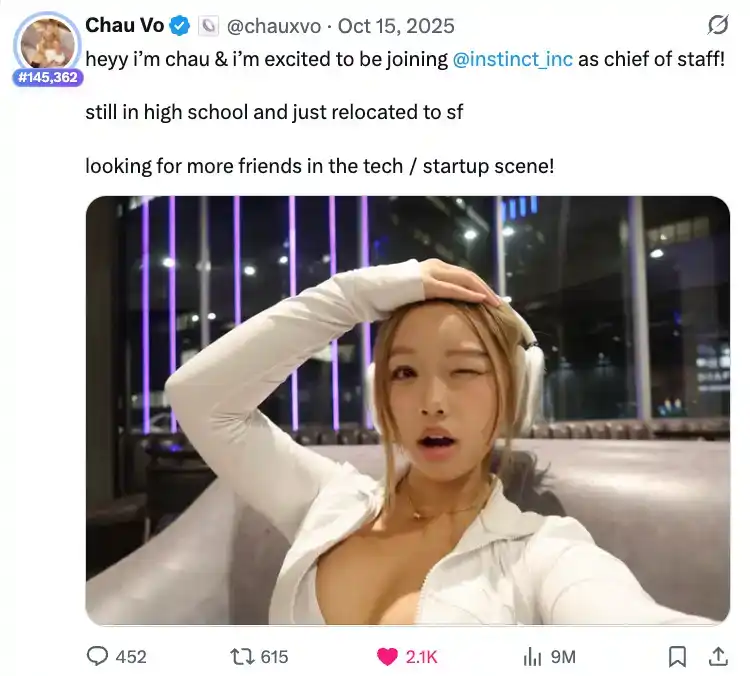
I've heard similar statements from countless AI company founders, each dreaming of finding the next Cluely: effortlessly gaining millions of views, always staying in the spotlight with buzz. (Editor's Note: Cluely is a highly controversial AI startup that pioneered a new paradigm of 'viral marketing,' detailed later.)

ABG = Asian Baby Girl. In Silicon Valley, it has become a term for young Asian women who are savvy at social media marketing. They are particularly skilled at creating eye-catching content, publishing viral posts, and marketing in a highly personalized way. Suddenly, all AI startups are scrambling to hire them as Chief Marketing Officers.

Why? Because one viral post can be more effective than a $50,000 advertising campaign.

Months of painstakingly building a 'thought leader' persona on LinkedIn can garner less attention and engagement than one sharp commentary or a selfie posted on X.
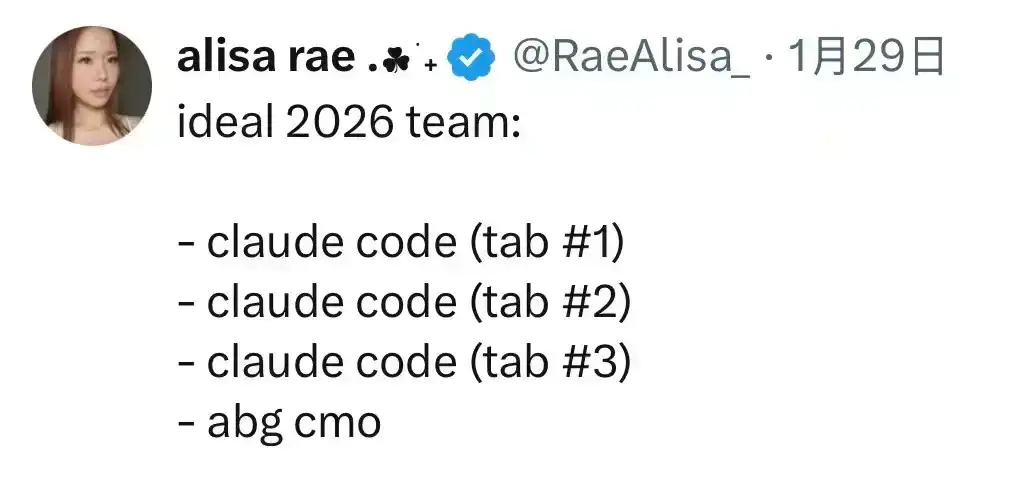
Are Asians naturally good at marketing?

No, and I want to clarify: this has nothing to do with race (people of every race are equally capable). This reveals some deeper issues in the evolution of the startup market.

The Feedback Loop in the Tech Market

Looking at past viral success stories (like @cluely), we can see that VCs chasing 'traffic signals' has surpassed traditional financial metrics, leading more capital to flow into more personality-driven, social-first projects.

Now, more college students are choosing to be content creators rather than taking $200,000 salaried jobs at big tech companies. Consequently, more startups are hiring "ABGs" for marketing, raising the overall standard of tech marketing, and thus creators gain access to better market resources.

Social media engagement data has become the sole standard for marketing effectiveness.

And this feedback loop is accelerating: more attention means more funding, which raises the bar higher, attracting more talent to shift careers, until it forms a stronger monopoly on attention.

Likes, views, and reposts are no longer just vanity metrics; they have become the new standards for investment due diligence.

The core issue isn't ABG; it's the attention economy.

How to Capture Hearts and Minds? Cluely Submitted the Perfect Answer Sheet

· Narrative: "Cheat on Everything" — perfectly aligned with founder @im_roy_lee's story (expelled from Columbia University/Harvard). This wasn't just a slogan; it was a carefully crafted origin story.

From "a complete loser" to "using AI to cheat his way into big tech, Y Combinator, and A16Z." This underdog-to-top-dog narrative often ignites both aspiration and outrage simultaneously.

· Industrial-Grade Viral Machine: They recruited over 700 "editors" — mostly micro-creators from TikTok/Instagram. The model was: pay-for-performance. $1 per thousand views. Zero upfront cost.

· Formulaic Content: Nonsense tweets + attractive looks/borderline content + lifestyle flexing. Party videos (like the shutdown "$1.5 million rager"), the "genius Intern" persona of founder Roy Lee, flaunting wealth, scoffing at traditional education. This marketing makes you think: "I really want to join these cool kids."

· Full-Platform Domination: X for building the thought leader persona (150k+ followers), TikTok/Instagram as the main battleground, LinkedIn/Reddit for generating native controversy.

The result? Over 10 million daily views, garnering 1 billion views in 3 months, at a cost far lower than traditional advertising. Traditional CPM (Cost Per Mille) is around $4; they only needed about $1.

But the fatal flaw was: The investment in marketing far exceeded the product; they essentially didn't develop a decent, market-ready product. Viral spread wasn't a byproduct; it was their only product.

When Cluely pivoted to an "AI note-taking tool," the entire web mocked them. People wondered where all that money had gone.

Some even suggested: since they're so good at this, why not just become a marketing agency for other AI companies?

But the most incredible part is: They did capture a certain truth. In an era of scarce attention, "any publicity is good publicity."

The irony: Everyone laughs at Cluely, everyone wants to be Cluely.

(If you hate me but still keep up with my updates, then you're my fan)

What Is the Truth, Really?

Attention is winning the world.

Capital flows to companies that capture consumer mindshare, not just market share. Nowadays, the best product doesn't necessarily win; the product with the best story does.

Every founder must also be their own CMO, building their own IP. The product is important, but if you neglect marketing, no one will know about your product.

The next wave of successful startups won't be built by the best engineers. They will be created by those who "can code and market."

Welcome to the new game.

Related Questions

QWhat does ABG stand for in the context of AI startups, and why are they being hired?

AABG stands for 'Asian Baby Girl,' a term used in Silicon Valley to refer to young Asian women who are skilled in social media marketing. They are being hired by AI startups because they excel at creating eye-catching content, generating viral posts, and conducting personality-driven marketing, which often yields better results than traditional advertising campaigns.

QWhat is the core reason behind the trend of hiring ABGs, according to the article?

AThe core reason is not about race but the attention economy. The trend reflects a shift where venture capitalists prioritize 'traffic signals' over traditional financial metrics, leading to more funding for personality-driven, social-first projects. Attention and engagement on social media have become new standards for investment due diligence.

QHow did Cluely achieve viral marketing success, and what were its key strategies?

ACluely achieved viral marketing success through a compelling narrative (e.g., 'Cheat on Everything' tied to the founder's backstory), an industrial-scale viral machine (hiring 700+ micro-creators paid per thousand views), formulaic content (combining provocative posts, lifestyle炫耀, and controversy), and multi-platform dominance (X, TikTok, Instagram, LinkedIn, and Reddit). This resulted in over 1 billion views in three months at a low cost.

QWhat was the major flaw in Cluely's approach, as highlighted in the article?

ACluely's major flaw was that their investment in marketing far exceeded their product development. They did not created a viable, market-ready product; viral marketing was their only product. When they attempted to pivot to an 'AI note-taking tool,' they faced widespread ridicule and questions about their spending.

QWhat does the article suggest about the future of successful startups in the attention economy?

AThe article suggests that successful startups will be built by individuals who 'both code and market,' rather than just the best engineers. Founders must act as their own CMOs and build their personal IP, as capturing consumer attention through storytelling and marketing is crucial, even if the product itself is not the best.

Related Reads

Casper Network Publishes the Casper Manifest, a Multi-Year Roadmap to Power Regulated Real-World Assets and the Machine Economy

The Casper Association has published "The Casper Manifest," a multi-year technical roadmap for Casper Network. Introduced at the Digital Finance Forum in Bermuda, the roadmap outlines nine coordinated initiatives designed to position the layer-1 blockchain as the infrastructure for regulated real-world asset (RWA) tokenization and the machine-to-machine economy. Key initiatives focus on: 1. **Developer Access:** Adding full Ethereum Virtual Machine (EVM) compatibility alongside its existing WebAssembly (Wasm) execution layer. 2. **User Experience:** Implementing gasless transactions, batch operations, and smart accounts with biometric authentication. 3. **Institutional Compliance & Privacy:** Building compliant security tokens aligned with the ERC-3643 standard and a multi-phase roadmap for confidential transactions with built-in audit tools. 4. **Machine Economy:** Implementing the X402 open payment standard to enable AI agents and machines to make autonomous, programmatic micropayments. 5. **Token Infrastructure:** Creating a Native Token Registry to give all tokens protocol-level status with fixed, predictable costs. 6. **Quantum Safety:** Developing hybrid accounts with both classical and quantum-resistant keys. The first initiative, X402 micropayments, is expected within weeks. Subsequent releases through 2026 and 2027 will include EVM compatibility, compliant security tokens, the Native Token Registry, gasless transactions, and quantum-safe features. The goal is to create a blockchain that is frictionless for users, trusted by institutions, and native for machines.

TheNewsCrypto39m ago

Casper Network Publishes the Casper Manifest, a Multi-Year Roadmap to Power Regulated Real-World Assets and the Machine Economy

TheNewsCrypto39m ago

TechFlow Intelligence: Trump-Linked Companies Transfer $12 Million in Assets Before China Visit, 'The Big Short' Protagonist Warns of Stock Market Bubble Again

The article reports multiple developments across tech, crypto, and finance. In AI, Mozilla used AI for large-scale code review, Google confirmed hackers used AI to find zero-day exploits, and OpenAI deployed GPT-5.5 to find errors in math benchmarks. A court ruled Anthropic's scanning and destroying books for AI training as fair use, while its Claude platform launched on AWS. Google's new video model 'Omni' was leaked. In crypto/Web3, Trump-linked companies transferred $12M in crypto assets before a China visit. BlackRock chose Ethereum for tokenized funds, and a hacker stole $174k via a malicious NFT that tricked an AI. Jack Dorsey's first tweet NFT plummeted from $2.9M to under $5. In chips/hardware, TSMC approved an additional $20B for its Arizona plant. Apple's Tim Cook and Elon Musk will accompany Trump to China, while Nvidia's Jensen Huang is notably absent. For markets, Michael Burry warned of parabolic stock rises and suggested near-total sell-offs, with online discussions comparing current sentiment to the 1999 bubble. Other notes include WTI oil surpassing $100, a 20% price hike for Beijing-Shanghai high-speed rail, and new products like Unitree's $26.9k humanoid robot. The underlying theme suggests AI is becoming infrastructure, creating pressure on old systems while a new order is not yet ready, leaving investors anxious.

marsbit1h ago

TechFlow Intelligence: Trump-Linked Companies Transfer $12 Million in Assets Before China Visit, 'The Big Short' Protagonist Warns of Stock Market Bubble Again

marsbit1h ago

Trading

Spot
Futures

Hot Articles

Discussions

Welcome to the HTX Community. Here, you can stay informed about the latest platform developments and gain access to professional market insights. Users' opinions on the price of AI (AI) are presented below.

活动图片