What’s next as GENIUS Act misses first major rulemaking deadline?

ambcryptoPublished on 2026-07-18Last updated on 2026-07-18

Abstract

The GENIUS Act, the U.S. stablecoin framework passed in July 2027, has missed its first major rulemaking deadline. Regulators, including the Federal Reserve, were required to finalize rules by July 18, 2027, but none of the 10 related proposals have been officially completed. Six are past the comment period, while four remain open. Federal Reserve Chairman Kevin Warsh indicated final rules could be issued imminently. The banking industry has expressed concerns about the legislation creating an uneven playing field. Despite the regulatory delay, the stablecoin market has responded positively, with total supply growing from $250 billion to over $300 billion since the law's passage, and firms like Fidelity launching new offerings. Senator Bill Hagerty, a co-sponsor, hailed the act as a "watershed moment" for U.S. leadership in digital assets.

The U.S. stablecoin framework, the GENIUS Act, has hit the initial deadline of the 18th of July. Passed into law on the 18th of July 2027, the framework set multiple milestones for its progressive enactment.

For the first year after passage, regulators, including the Federal Reserve and the OCC, were mandated to finalize rulemakings for the GENIUS Act by the 18th of July, 2027.

In 18 months, or by January 2027, the framework should begin taking effect after the regulators publish final rules.

Finally, the transition period will end after three years, by mid-2028. After this, there will be no firm allowed to offer or handle stablecoins in the U.S. without GENIUS Act compliance.

Why are the final rules delayed?

Six regulators have issued 10 rulemaking proposals related to the law. But none of the proposals have been officially completed, at least as of writing. Only six of the proposals have closed their comment period, meaning the regulators could issue final rulings for them.


Source: Paradigm

Still, four other proposals, including Bank Secrecy Act and sanction compliance for FDIC-supervised stablecoin issuers, are still open for comment.

In other words, despite hitting the rulemaking deadline, the GENIUS Act was still far from finalizing key rules.

What’s next for the GENIUS Act?

However, it’s worth noting that in a recent Congress hearing, Kevin Warsh, the chairman of the Federal Reserve, said that the final rules could be issued soon.

We’re racing to put that out (GENIUS Act final rules) by this deadline, this Saturday.

For the banking industry, which has opposed the legislation due to the stablecoin yield loophole, it called for a review of the proposed rules to avoid.

Uneven playing field or opportunities for regulatory arbitrage, unintended policy consequences, or unworkable or incongruous requirements.

How has the stablecoin market responded?

The GENIUS Act is the first formal stablecoins framework in the U.S that aims to advance innovation and protect consumers. To achieve this, it has reserve requirements and anti-money laundering provisions.

Commenting on the legislation, Senator Bill Hagerty, who co-sponsored it, said,

The United States has the first comprehensive federal framework for payment stablecoins, positioning America not just to participate in the digital asset economy, but to lead it. It was a watershed moment, and it’s only the beginning.
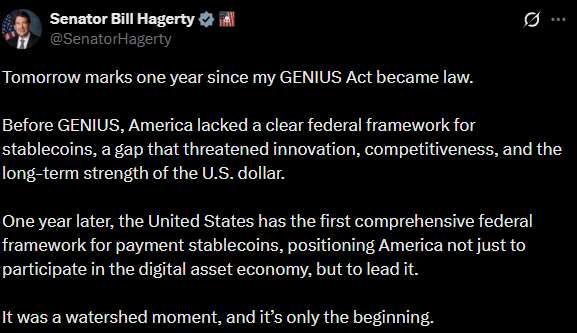
Source: X

Since the law, the stablecoin market supply surged from $250B to over $300B. Even several firms like Fidelity have begun their stablecoin offerings.

Additionally, some crypto platforms like Phantom recorded a 20% increase in stablecoin balance from $2.33B to $2.82B since the GENIUS Act was passed.

It remains to be seen how the growth will accelerate when regulators publish final rules as the legislation enters its second year.


Final SummaryThe

  • GENIUS Act has entered its second year, but final rules will likely stretch beyond the rulemaking deadline
  • Stablecoin market supply increased by over $50B after legislation became law, with Sen. Hagerty calling ‘watershed moment’


Trending Cryptos

Related Questions

QWhat is the first major rulemaking deadline that the GENIUS Act has missed, and who was responsible for meeting it?

AThe first major rulemaking deadline was July 18, 2027. Regulators, including the Federal Reserve and the OCC, were mandated to finalize rules for the GENIUS Act by this date, but none of the proposals have been officially completed.

QAccording to the article, what are two key reasons why the final rules for the GENIUS Act have been delayed?

ATwo reasons for the delay are: 1) Only six out of ten rulemaking proposals have closed their comment period, meaning regulators could only potentially issue final rules for those. 2) Four proposals, including those on Bank Secrecy Act and sanction compliance for FDIC-supervised issuers, are still open for comment.

QWhat specific market impact has the passage of the GENIUS Act had on the stablecoin sector?

ASince the GENIUS Act became law, the stablecoin market supply has surged from $250 billion to over $300 billion, an increase of over $50 billion. Firms like Fidelity have launched stablecoin offerings, and platforms like Phantom saw a 20% increase in stablecoin balances.

QWhat did Federal Reserve Chairman Kevin Warsh recently indicate about the timing of the final rules for the GENIUS Act?

AIn a recent Congress hearing, Federal Reserve Chairman Kevin Warsh said that the final rules could be issued soon, stating, "We're racing to put that out (GENIUS Act final rules) by this deadline, this Saturday."

QWhat is the banking industry's primary concern regarding the GENIUS Act, as mentioned in the article?

AThe banking industry opposes the legislation due to the stablecoin yield loophole. They have called for a review of the proposed rules to avoid an uneven playing field, opportunities for regulatory arbitrage, unintended policy consequences, or unworkable requirements.

Related Reads

Chainlink Tests Support As CCIP Moves From Hype To Usage

Chainlink's LINK token is testing key support levels as market focus shifts from the hype around its Cross-Chain Interoperability Protocol (CCIP) to assessing its real-world usage and adoption. While Chainlink maintains a strong position as core crypto infrastructure—providing oracles, data feeds, and automation—the market is increasingly demanding measurable evidence that its services, particularly CCIP, are gaining sustained traction. CCIP is central to Chainlink's long-term value proposition, aiming to solve critical cross-chain messaging and asset transfer challenges for institutions, DeFi, and multi-chain applications. The protocol's narrative is strong, but traders are now looking beyond announcements and integrations to metrics like transaction volume, value transferred, and developer adoption in production environments. Despite its utility, LINK's price action remains influenced by broader altcoin market cycles. The current support test blends technical factors with fundamental questions about CCIP's growth. If LINK holds support alongside clear evidence of increasing CCIP usage, it could reinforce its status as a leading infrastructure play. However, if support fails without corresponding usage growth, trader caution may persist. The key for Chainlink is transitioning CCIP from a promising concept into a widely used standard, turning its established market role into consistent token demand.

bitcoinist2h ago

Chainlink Tests Support As CCIP Moves From Hype To Usage

bitcoinist2h ago

Trading

Spot

Hot Articles

How to Buy GENIUS

Welcome to HTX.com! We've made purchasing Genius (GENIUS) simple and convenient. Follow our step-by-step guide to embark on your crypto journey.Step 1: Create Your HTX AccountUse your email or phone number to sign up for a free account on HTX. Experience a hassle-free registration journey and unlock all features.Get My AccountStep 2: Go to Buy Crypto and Choose Your Payment MethodCredit/Debit Card: Use your Visa or Mastercard to buy Genius (GENIUS) instantly.Balance: Use funds from your HTX account balance to trade seamlessly.Third Parties: We've added popular payment methods such as Google Pay and Apple Pay to enhance convenience.P2P: Trade directly with other users on HTX.Over-the-Counter (OTC): We offer tailor-made services and competitive exchange rates for traders.Step 3: Store Your Genius (GENIUS)After purchasing your Genius (GENIUS), store it in your HTX account. Alternatively, you can send it elsewhere via blockchain transfer or use it to trade other cryptocurrencies.Step 4: Trade Genius (GENIUS)Easily trade Genius (GENIUS) on HTX's spot market. Simply access your account, select your trading pair, execute your trades, and monitor in real-time. We offer a user-friendly experience for both beginners and seasoned traders.

3.7k Total ViewsPublished 2026.04.29Updated 2026.06.02

How to Buy GENIUS

Discussions

Welcome to the HTX Community. Here, you can stay informed about the latest platform developments and gain access to professional market insights. Users' opinions on the price of GENIUS (GENIUS) are presented below.

活动图片