What The Current Dogecoin Momentum Means For The Meme Coin’s Price

bitcoinistPublished on 2026-03-23Last updated on 2026-03-23

Abstract

Despite surface-level weakness, a new technical analysis reveals a hidden bullish divergence in Dogecoin's price structure. Crypto analyst Javon Marks notes that while DOGE's price has been forming higher lows since early 2026, its momentum indicators have been making lower lows—a classic bullish signal. This suggests sellers are losing control. DOGE has held above the key $0.09 support for over a month, maintaining its higher-low sequence. The RSI has declined to levels similar to those seen before its 2023-2024 rally. If the $0.09 support holds, this divergence could potentially trigger a 350% rally, pushing DOGE above $0.44.

A new technical reading shows that Dogecoin’s price structure is not as weak as the surface-level price action might imply. In a recent post on X, crypto analyst Javon Marks pointed to a hidden bullish divergence forming on Dogecoin’s chart. The idea comes at a time when DOGE has been creating interesting low structures since the beginning of the year and momentum indicators are at multi-year lows across the altcoin market.

A Divergence Hidden in Plain Sight

While Dogecoin’s price has been carving lows since early 2026, its momentum oscillator has been registering lower lows over the same period. This split behavior, which was noted by crypto analyst Javon Marks, where price and momentum move in opposing directions, is the definition of hidden bullish divergence.

The chart is showing that even though momentum readings look weaker on paper, Dogecoin itself has not broken down in the same way. That disconnect can suggest that sellers are losing control beneath the surface. The 8-day candlestick price chart below shows that DOGE has been holding above a broad support zone around the $0.09 region for the past five or six weeks, maintaining a sequence of higher lows.

Below that price action are the oscillator and RSI panels, which are both showing descending lows, marked out as a bearish-looking momentum trend that has not translated into a matching collapse in price. That mismatch is what gives the divergence its bullish interpretation, and the outlook in this case is a bullish run to yearly highs.

The RSI has declined into the high 30s to low 40s range, a region shaded in pink on the chart, which aligns with levels seen during the accumulation phase of 2023 and early 2024 before Dogecoin’s major rally
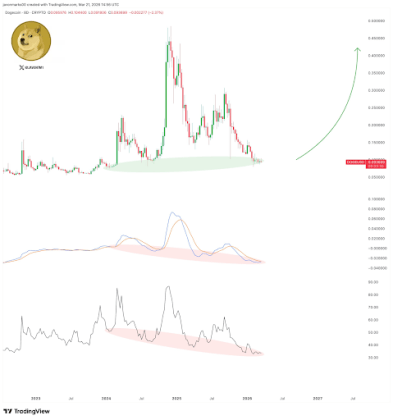
Dogecoin Price Chart. Source: @JavonTM1 On X

Room For A Move Above $0.44

The chart above also shows why the current area around $0.09 matters so much. Dogecoin has spent recent months bleeding from its late-2024 and early-2025 highs, but that descent has now slowed into a tight cluster of candles near the same support shelf at $0.09.

The Dogecoin price is no longer falling in the same way seen during the first two months of 2026 but is now stabilizing. As long as Dogecoin continues to defend that $0.09 range and avoids losing its higher-low structure, the case for a continuation move will still be alive.

The most ambitious part of the analysis is the upside projection. According to Marks, the continuation implied by this hidden bullish divergence could send Dogecoin on a rally of more than 350%. Projecting this percentage gain would see the Dogecoin price breaking above $0.44.

DOGE bears keep pushing price down | Source: DOGEUSDT on Tradingview.com

Related Questions

QWhat does the hidden bullish divergence on Dogecoin's chart indicate according to crypto analyst Javon Marks?

AIt indicates that while Dogecoin's price has been holding above a key support level and forming higher lows, its momentum oscillator has been making lower lows. This divergence suggests sellers are losing control and a potential bullish run to yearly highs is possible.

QWhat is the critical price support level that Dogecoin has been holding above, as mentioned in the analysis?

ADogecoin has been holding above a broad support zone around the $0.09 region for the past five or six weeks.

QWhat does the current RSI level for Dogecoin align with, based on its historical performance?

AThe RSI has declined into the high 30s to low 40s range, which aligns with levels seen during the accumulation phase of 2023 and early 2024 before Dogecoin's major rally.

QWhat is the potential price target for Dogecoin if the bullish continuation move occurs?

AAccording to the analysis, the continuation could send Dogecoin on a rally of more than 350%, projecting a price break above $0.44.

QHow has Dogecoin's price action changed in 2026 compared to its previous trend?

AWhile Dogecoin was bleeding from its late-2024 and early-2025 highs initially in 2026, its descent has now slowed and it is stabilizing, no longer falling in the same way as it did during the first two months of the year.

Related Reads

Will the Next Crypto Bull Run Start with On-Chain Trading of SpaceX?

This article presents a scenario-based forecast for the crypto industry from 2026 to 2029, arguing that the next major cycle will be driven not by technological narratives but by legal access to real-world assets. The author predicts that by mid-2026, pre-IPO perpetual contracts for top private companies like SpaceX, OpenAI, and Anthropic on platforms like Hyperliquid will become the primary gateway for accessing quality assets, as most crypto-native tokens fail to capture real value. The much-hyped AI x Crypto intersection largely fails except for prediction markets, which thrive on betting on AI model supremacy. By 2027, public blockchain foundations are forced to choose between catering to retail speculation or building compliant infrastructure for institutions, with many opting for the latter. Growth in stablecoins and tokenized private credit/equity hits a "triple ceiling" due to regulatory and political uncertainty rather than market demand. The pivotal shift is forecast for 2028. A major liquidation event in pre-IPO perpetuals exposes the structural flaw of synthetic markets lacking a real underlying asset anchor. In response, regulatory changes finally allow the public solicitation of private securities resales to verified accredited investors. This creates a legitimate secondary market for real company equity, which then becomes the core asset class of the new bull market, relegating synthetic perps to a niche role. By 2029, the industry becomes "boring" but foundational. Tokens without claims on real cash flows or assets cease trading. Stablecoin growth is steady but politically capped. Crypto infrastructure fades from view as it gets absorbed into traditional finance backends. The article's central thesis is that the key bottleneck for crypto's next phase is legal and regulatory channels for real asset ownership, not technology.

marsbit40m ago

Will the Next Crypto Bull Run Start with On-Chain Trading of SpaceX?

marsbit40m ago

The Value Distribution of Stablecoins

**Summary: The Value Distribution of Stablecoins** The article argues that stablecoins are evolving from mere trading tools into broader channels for dollar access. It divides the stablecoin ecosystem into four layers to analyze how value is distributed: 1. **Issuance Layer:** Mints stablecoins, holds reserve assets, and captures the spread between reserve yield and user costs (e.g., Tether, Circle). This layer currently earns the largest profit margin. 2. **Infrastructure Layer:** Connects stablecoins to the traditional financial system, handling fiat on/off-ramps, banking integration, compliance (KYC/AML), and asset management (e.g., Bridge, BVNK). This is the "unglamorous" but critical work, building the essential bridges between crypto and real-world finance. 3. **Acquiring/Distribution Layer:** Integrates stablecoins into merchant systems, manages payment flows, and provides enterprise financial software (e.g., Stripe, Coinbase). They act as the access point for businesses. 4. **Application Layer:** The end-users and businesses that ultimately use stablecoins for payments, settlements, or as a store of value. They benefit from convenience but have little pricing power. The core thesis is that while the issuance layer currently dominates profits, the often-overlooked **infrastructure layer holds significant long-term potential**. The real challenge and barrier to mass adoption is not the on-chain transfer of stablecoins (which is simple), but the complex "last mile" integration into existing business workflows, banking systems, and regulatory frameworks across different countries. Companies in this layer are currently in a "land grab" phase, investing heavily to build networks, secure bank partnerships, and establish compliance pathways. While their position is currently pressured by the profitable issuers above and distribution platforms below, the article suggests that if stablecoins become a default financial rail for businesses, the infrastructure providers who have done the hard work of integration will ultimately gain strong pricing power and become entrenched, essential players.

marsbit7h ago

The Value Distribution of Stablecoins

marsbit7h ago

The Value Distribution of Stablecoins

The Value Distribution of Stablecoins The article argues that stablecoins are evolving from a mere trading tool into a broad "dollar channel." It analyzes the industry's value chain through four layers: 1. **Issuance Layer (e.g., Tether, Circle):** The top layer that mints stablecoins, holds reserve assets, and captures the thickest interest rate spread. 2. **Infrastructure Layer (e.g., Bridge, BVNK):** Connects stablecoins to the traditional financial system, handling critical but complex "dirty work" like fiat on/off-ramps, banking integration, compliance (KYC/AML), and cross-border settlement. 3. **Acquiring/Distribution Layer (e.g., Stripe, Coinbase):** Embeds stablecoins into merchant systems, manages payment flows, and integrates with enterprise software. 4. **Application Layer:** End-users and businesses that ultimately use stablecoins for payments, settlement, or storing value. The author posits that while the issuance layer currently captures the most profit, the most overlooked and potentially critical layer is infrastructure. The core challenge for stablecoin adoption isn't the on-chain transfer (which is simple), but bridging the gap between blockchain and the real-world financial system. This involves solving practical problems for businesses: fiat conversion, reconciliation, tax handling, and user onboarding. Infrastructure companies are currently in a difficult "land-grab" phase—building networks, securing banking relationships, and achieving compliance country-by-country. They face pressure from both the profitable issuance layer above and distribution platforms below. However, the author suggests this layer is building a crucial moat. Once stablecoins become a default business rail, the infrastructure players who have done the hard work of integration may gain significant, durable value and pricing power.

链捕手7h ago

The Value Distribution of Stablecoins

链捕手7h ago

Trading

Spot
Futures

Hot Articles

Discussions

Welcome to the HTX Community. Here, you can stay informed about the latest platform developments and gain access to professional market insights. Users' opinions on the price of MEME (MEME) are presented below.

活动图片