What? Lighter Won't Airdrop Today

Odaily星球日报Published on 2025-12-29Last updated on 2025-12-29

Abstract

Rumors and market sentiment around a potential LIT token airdrop from the decentralized exchange Lighter have shifted dramatically, with prediction platform Polymarket showing the probability of an airdrop on December 29 plummeting from 87% to 25% in just four days. Despite earlier expectations, Lighter team has not released a detailed tokenomics model, and no official TGE or airdrop announcement has been made. Market uncertainty is compounded by Lighter’s aggressive anti-Sybil campaign, which has removed a significant number of suspected bot and wash-trading accounts—reportedly up to 70-90% of studio addresses—sparking community backlash. The lack of transparency in the screening process and unclear appeal mechanisms have further eroded trust. Additionally, concerns are rising over Lighter’s valuation. Pre-launch FDV estimates around $3.3 billion have been met with skepticism due to potential sell pressure from the airdrop (reportedly 25% of total supply, unlocked) and limited initial exchange listings. Despite this, some large traders remain bullish, with open interest on Hyperliquid showing balanced whale activity.

Original | Odaily Planet Daily (@OdailyChina)

Author | Golem (@web3_golem)

Data from the prediction platform Polymarket shows that the expected probability of "Lighter will airdrop on December 29" has plummeted from 87% four days ago to 25%, nearly halving.

Although the drop in probability does not directly equate to the cancellation of the airdrop, market sentiment has clearly cooled. As of the time of writing, Lighter has still not announced a detailed token economic model, which doesn't feel at all like the atmosphere leading up to a TGE and airdrop. Interestingly, LIT spot trading is already be seen on the Lighter Staging page today, but no one knows how long this testing phase will last.(Odaily Note: Staging is a pre-release environment in the product development process, situated between the Testing environment and the Production (live) environment, generally seen as the final rehearsal before a product's official launch.)

It is important to note that the Polymarket prediction regarding the Lighter airdrop uses Eastern Time (ET) for settlement. Therefore, for investors in the UTC+8 time zone, for the "Lighter will airdrop on December 29" market to settle as "no," Lighter must not airdrop before 13:00 on December 30. Investors in other time zones should convert the time accordingly.

Although Lighter's Head of Market, Pilla.eth, had previously clearly stated in an AMA that both the TGE and airdrop would occur in 2025, under the influence of panic sentiment, the probability on Polymarket for "Lighter will airdrop before December 31, 2025" has dropped from 94% to 64%. The highly-upvoted analyses from players betting "No" below lack reasonable analysis or insider information, mostly consisting of emotional bets or focusing on semantics:

  • "It's confirmed that the airdrop will be in 2026"
  • "I still can't understand why these fools didn't mention TGE at all, and the probability actually reached 94%. This was the worst AMA of my life, wasted 45 minutes listening to a bunch of nonsense, not a single useful piece of information."
  • "TGE is not the same as an airdrop; they are two different things. There are many examples of this. Read the rules clearly first."
  • "According to the settlement rules, locked tokens or non-tradable tokens do not qualify as conditions for a 'Yes' outcome. Even if the project releases an airdrop checker and shows your allocation, as long as the tokens cannot be freely traded on the market, the result is 'No'."

Of course, besides the unclear airdrop date, Lighter also faces concerns such as anti-sybil questioning and a valuation trap, with several dark clouds looming. Coinciding with the overall market cooling down at the end of the year, any movement from any project will attract extra attention from the community—Lighter's current动向 is可谓 "born at the right time".

The Strictest Anti-Sybil Measures of 2025

Lighter has caught the tailwind of two of the hottest narratives of 2025 (Pre-DEX and RWA), so investors quite看好 it. In early December, market whispers suggested that Lighter would conduct its TGE and airdrop within 2025, further boosting investor enthusiasm. Some users with high积分 even began "popping the champagne halfway through the game" on social media.
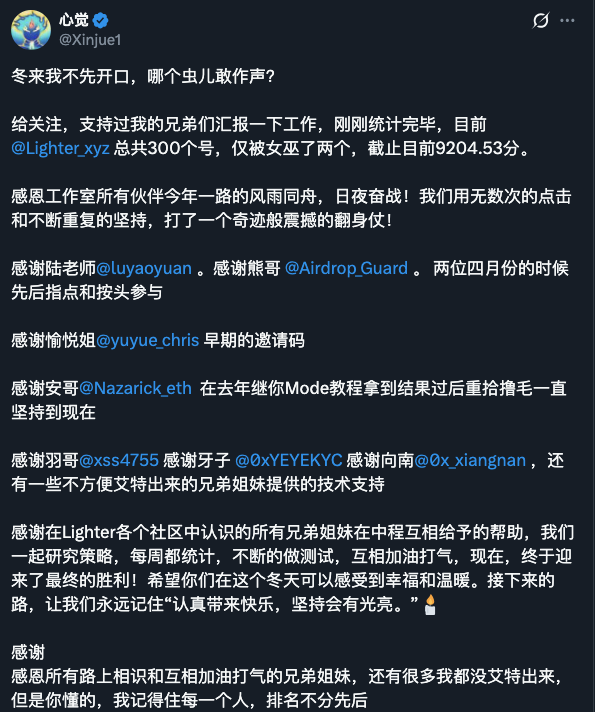
Lighter points leader提前发布获奖感言 (pre-releasing a victory speech)

But as the old saying goes, success comes from secrecy, failure from leakage. Many blamed the subsequent stringent sybil screening launched by Lighter on these boastful users (although this might not be the事实).

On December 23, Lighter announced in its official Discord the commencement of a massive sybil screening, removing积分 obtained by sybil addresses, wash trading, and volume manipulation. However, these deducted积分 (including portions already removed) would be redistributed to the community.

The community instantly in an uproar. After Lighter began its sybil screening, large numbers of studio accounts had their积分 deducted. Some bloggers claimed that Lighter's anti-sybil measures were extremely strict, with an estimated 70-90% of studio accounts being caught. Ordinary airdrop farmers were not spared either, with social media filled with "wails of grief".

Some even compared Lighter to the LayerZero of 2025. In 2024, LayerZero identified over 800,000 wallet addresses before its airdrop. Although the number of sybil addresses for Lighter might not be as high as LayerZero's, the severity might be comparable.

Such stringent anti-sybil actions undoubtedly put Lighter at odds with the community.

According to some users flagged as sybils, the reason given by Lighter was simply "abnormal trading," with no further explanation. The sybil rules were not transparent, meaning users didn't even know how they "died."

However, facing community质疑, Lighter's founder and CEO, Vladimir Novakovski, remained confident in this rather arbitrary sybil screening and stated that the anti-sybil algorithm would not be made public. His explanation was "to avoid targeted optimization," and he also mentioned an appeals mechanism was in place, but so far, the number of appeals was much lower than expected.

But some community members didn't believe Vladimir's excuses, suspecting that Lighter's harsh anti-sybil measures were to protect their own insider (rat)仓, and that even the off-market积分 price might have been secretly pumped by the Lighter team.

After all, since ancient times in the crypto world, the principle has been that the biggest airdrops are simple. The more complex the interaction requirements and the stricter the anti-sybil measures, the more likely something fishy is going on. Even peers in the same赛道 as Lighter, like Hyperliquid and Aster, were not this tedious and "stingy" during their airdrops.

The Lighter community currently resembles students checking their exam results after the gaokao (college entrance exam). Every day Lighter continues its sybil screening is another day of煎熬 (agony) for them.

Is the FDV Overvalued?

Amid the already depressed market environment and fueled by negative community sentiment, the market也开始思考 (began to ponder), is Lighter already overvalued?

On Polymarket, the probability for "Lighter's FDV will be greater than $1 billion on the first day of trading" has dropped from 90% to 72%, and the probability for "Lighter's FDV will be greater than $2 billion on the first day of trading" has also fallen from 87% to 68%. This indicates declining market confidence in Lighter's valuation.

Referring to the first-day market capitalizations of the other two major Pre-DEXs (Hyperliquid and Aster), Hyperliquid's FDV was approximately $3.6 billion at its opening on November 29, 2024, while Aster's opening FDV was around $10.8 billion on September 17, 2024. According to Binance Pre-Market data, Lighter's current pre-market FDV is approximately $3.3 billion, having previously peaked at $4.3 billion.

From this perspective, the valuation for Lighter on Polymarket seems reasonable, so why is market confidence still falling?

One reason is that the selling pressure from the airdrop cannot be ignored, especially after Lighter's widespread sybil screening has damaged community goodwill. Most users will likely sell immediately upon receiving the airdrop. According to the Lighter team, the airdrop ratio might be 25% of the total token supply, with no lock-up restrictions. Therefore, the selling pressure from the airdrop will undoubtedly pose significant resistance to any increase in Lighter's market cap.

The second reason is that for a period after the token launch, LIT will only be traded on its own platform and will not主动上线 (actively list on) other exchanges. The Lighter team has also stated that they have not paid listing fees to any trading platform. This means that for some time after launch, Lighter will not have access to the full liquidity of CEXs, thereby limiting the upside potential for the LIT token post-launch.

Nevertheless, some whales remain confident in Lighter. On Hyperliquid, the long-short forces for Lighter are still relatively balanced. Since the pre-market contracts went live, 10 whales with positions exceeding $1 million have entered the market, equally split between longs and shorts.

Andy, founder of The Rollup, also stated that although Lighter's open interest (OI) would likely drop by more than 20% and trading volume could decline by over 30% after the initial token volatility subsides, he would still choose to buy if LIT's fully diluted valuation (FDV) is around $2 billion.


Related Questions

QWhat is the current probability on Polymarket for Lighter conducting an airdrop on December 29th, and how has it changed?

AThe probability for 'Lighter conducting an airdrop on December 29th' on Polymarket has dropped sharply from 87% four days ago to 25%.

QWhat major action has the Lighter team taken that has caused significant community backlash?

AThe Lighter team has initiated a very strict Sybil screening process, removing points from addresses identified as Sybils, self-trading, and volume farming, which has caused widespread complaints and backlash from the community.

QAccording to the article, what are the two main reasons for the declining market confidence in Lighter's valuation?

AThe two main reasons are: 1) The significant selling pressure expected from the airdrop, especially after the Sybil screening damaged community sentiment. 2) The token will initially only be traded on its own platform, lacking liquidity from centralized exchanges (CEXs), which limits its upside potential.

QWhat is the Fully Diluted Valuation (FDV) of Lighter in the pre-market on Binance, according to the article?

AAccording to Binance's pre-market data, Lighter's current pre-market FDV is approximately $3.3 billion, having previously reached a high of $4.3 billion.

QHow did the Lighter team's CEO, Vladimir Novakovski, justify the decision not to make the anti-Sybil algorithm public?

ACEO Vladimir Novakovski justified the decision by stating that they did not want the algorithm to be 'targetedly optimized' by others, and he expressed confidence in the process, noting that the number of appeals has been lower than expected.

Related Reads

Should You Buy SpaceX Stock at $1.7 Trillion? Here's What the Market Is Worried About

SpaceX is preparing for a massive IPO aiming to raise around $75 billion at a valuation of approximately $1.75 trillion. While its achievements in reusable rockets and the profitable Starlink satellite internet service are clear, the market is concerned about the aggressive valuation. Key issues include: the current $1.75 trillion valuation, which is about 94 times 2025 revenue, seems to price in not just existing businesses but also unproven future ventures like AI infrastructure and orbital data centers. Financially, while Starlink is profitable, the AI division, bolstered by the acquisition of xAI, is incurring massive losses and consuming the majority of capital expenditures. This acquisition also introduced complex related-party financing arrangements and debt onto SpaceX's balance sheet. Furthermore, corporate governance poses a challenge. SpaceX's dual-class share structure ensures founder Elon Musk retains absolute control, limiting ordinary shareholders' influence over high-risk, long-term strategic decisions. The future success of ambitious projects like the Starship rocket—critical for lowering costs and enabling new services—remains a significant variable for the valuation. In summary, the market's apprehension (FUD) centers not on doubting SpaceX's past technological triumphs but on questioning how much premium public investors should pay for a future that combines proven profits with highly speculative and capital-intensive new ventures, all under a governance structure that offers limited shareholder oversight.

marsbit38m ago

Should You Buy SpaceX Stock at $1.7 Trillion? Here's What the Market Is Worried About

marsbit38m ago

Breaking the DeFi Cascading Liquidation Curse: Vitalik Proposes a New Solution

Vitalik Buterin has proposed a new DeFi design to eliminate the automatic liquidation mechanism that causes market instability during sharp downturns. The current system, used by protocols like Aave, triggers forced sales when collateral value falls below a threshold, often exacerbating price drops and creating systemic selling pressure. Buterin's alternative model is based on splitting an asset like ETH into two synthetic option-like tokens, P and N, pegged to a price index. Their combined value always equals one ETH. Instead of sudden liquidation, a position's value gradually drifts from its target peg if the market moves. Users must proactively rebalance their holdings to maintain their desired exposure, transferring the management burden from the protocol to the user or automated tools. A key advantage is the reduced reliance on real-time oracles. Pricing decisions are deferred until contract expiry, allowing for more robust, fault-tolerant oracle designs. This removes a clear liquidation threshold that speculators can target for manipulation or MEV extraction. However, significant challenges remain. Frequent rebalancing could incur high slippage and transaction costs, necessitating new liquidity provider models. The design is better suited for hedging instruments than for stablecoins requiring a rigid 1:1 peg. While not an immediate replacement for existing systems, the proposal challenges the foundational assumption that instantaneous forced liquidation is an unavoidable necessity in DeFi, opening the door for fundamentally different risk management architectures.

marsbit42m ago

Breaking the DeFi Cascading Liquidation Curse: Vitalik Proposes a New Solution

marsbit42m ago

The End of Single-Factor Cryptography

The article "The End of Single-Factor Crypto" posits a fundamental shift in the cryptocurrency ecosystem. It argues the era where crypto asset valuations were predominantly driven by, and correlated with, Bitcoin's price is ending. The space is bifurcating into two distinct economies: endogenous and exogenous. The endogenous economy represents traditional crypto, where token and project values are directly tied to crypto market prices. The emerging exogenous economy comprises projects and businesses that may utilize blockchain technology or tokens but derive their fundamental value from external, non-crypto factors like consumer demand, subscription revenue, or real-world utility. Examples include AI inference platforms like Venice, fintech lenders using blockchain for efficiency, and stablecoin/payment infrastructure companies acquired by giants like Mastercard and Stripe. This shift means investment analysis must change. For exogenous assets, evaluating traditional business fundamentals—such as revenue streams, unit economics, and competitive moats—becomes more critical than tracking Bitcoin charts. While endogenous assets like Bitcoin remain relevant, the growth of the exogenous category is driven by measurable demand independent of crypto price cycles, paving the way for a new, more diversified market phase. Consequently, crypto is evolving from a single-factor, reflexive asset class into a multifaceted ecosystem with varied drivers and investment theses.

marsbit43m ago

The End of Single-Factor Cryptography

marsbit43m ago

Morning Post | Bitmine Plans to Raise $300 Million Through Preferred Stock Issuance; Polymarket Accuses Kalshi of Commercial Espionage

ChainCatcher's Daily Crypto Brief: Key developments from the past 24 hours include significant funding moves, regulatory actions, and market predictions. Bitmine announced a $300 million preferred stock fundraising. Polymarket accused rival prediction platform Kalshi of corporate espionage, citing numerous suspicious coincidences in product launches, a claim Kalshi strongly denied. The U.S. Department of Justice, in a joint "Disruption Week" anti-fraud operation with companies like Coinbase and Meta, froze over $3.8 million in cryptocurrency linked to scams. In infrastructure news, Macau completed its integration with the multi-central bank digital currency bridge, mBridge, aiming to build efficient cross-border payment channels. Cosmos Labs acquired the block explorer Mintscan. Market-wise, Geoffrey Kendrick, Standard Chartered's Head of Digital Assets Research, stated Bitcoin is nearing a bottom around $63,000, maintaining a year-end target of $100,000. He noted stability in U.S. spot Bitcoin ETF holdings. Ahead of SpaceX's anticipated IPO, internal insiders at Rocket Lab (RKLB) sold over $18.41 million in stock. In tokenization, Goldman Sachs partnered with Apex and Archax to launch a tokenized real estate fund. The meme token tracker GMGN reported the top trending tokens: on Ethereum, HEX, SHIB, LINK, PEPE, mUSD; on Solana, TROLL, swarms, WORLDCUP, neet, Buttcoin; and on Base, PEPE, toby, ODDS, ELSA, SKI.

链捕手57m ago

Morning Post | Bitmine Plans to Raise $300 Million Through Preferred Stock Issuance; Polymarket Accuses Kalshi of Commercial Espionage

链捕手57m ago

Trading

Spot
Futures

Hot Articles

How to Buy T

Welcome to HTX.com! We've made purchasing Threshold Network Token (T) simple and convenient. Follow our step-by-step guide to embark on your crypto journey.Step 1: Create Your HTX AccountUse your email or phone number to sign up for a free account on HTX. Experience a hassle-free registration journey and unlock all features.Get My AccountStep 2: Go to Buy Crypto and Choose Your Payment MethodCredit/Debit Card: Use your Visa or Mastercard to buy Threshold Network Token (T) instantly.Balance: Use funds from your HTX account balance to trade seamlessly.Third Parties: We've added popular payment methods such as Google Pay and Apple Pay to enhance convenience.P2P: Trade directly with other users on HTX.Over-the-Counter (OTC): We offer tailor-made services and competitive exchange rates for traders.Step 3: Store Your Threshold Network Token (T)After purchasing your Threshold Network Token (T), store it in your HTX account. Alternatively, you can send it elsewhere via blockchain transfer or use it to trade other cryptocurrencies.Step 4: Trade Threshold Network Token (T)Easily trade Threshold Network Token (T) on HTX's spot market. Simply access your account, select your trading pair, execute your trades, and monitor in real-time. We offer a user-friendly experience for both beginners and seasoned traders.

11.9k Total ViewsPublished 2024.03.29Updated 2026.06.02

How to Buy T

Discussions

Welcome to the HTX Community. Here, you can stay informed about the latest platform developments and gain access to professional market insights. Users' opinions on the price of T (T) are presented below.

活动图片












