Bitcoin mining is a race with no referee watching the finish line in real time. A new block must physically propagate (i.e., 'hop' from node to node) across the global network before all participants agree on where the current tip of the chain is. This process takes a few seconds, and over a congested connection—sometimes longer.
If a second miner finds its own valid block before the first block has reached it, it continues working on the last version it saw (usually the previous block) and broadcasts its own competing block. For a short period of time, two equally valid blocks exist at the same height, each with its own set of confirmed transactions and its own proposal for what comes next.
Neither block is 'incorrect,' as both satisfy all protocol rules; the only thing separating them is timing and which nodes randomly learned about which one first. Roughly half the network ultimately mines on one candidate, the other part mines on the other, and Bitcoin briefly has two honest, simultaneous versions of itself.
How a Tie Is Actually Resolved
Bitcoin resolves this issue not through voting, authority, or who technically found their block first. It resolves it the same way it resolves everything else: the chain that accumulates more proof-of-work becomes the one all nodes switch to, and the block(s) from the other side are discarded.
'Discarding' does not mean that history has been rewritten or destroyed, but means that this block, called an 'orphan' or 'stale' block, ceases to be part of the chain recognized by everyone. Any transactions within it that were not also confirmed on the winning side simply return to the mempool to be included in a future block.
In most cases, the situation is resolved after just one additional block appears, and no one outside of circles connected to mining infrastructure even notices. A genuine two-block race (where the tie somehow persists through an entire extra round, preventing either side from pulling ahead) happens so rarely that it makes news headlines when it does, precisely because it requires the odds of a coin toss to come out the same twice in a row.
The March 2026 Case: When the Coin Toss Repeated
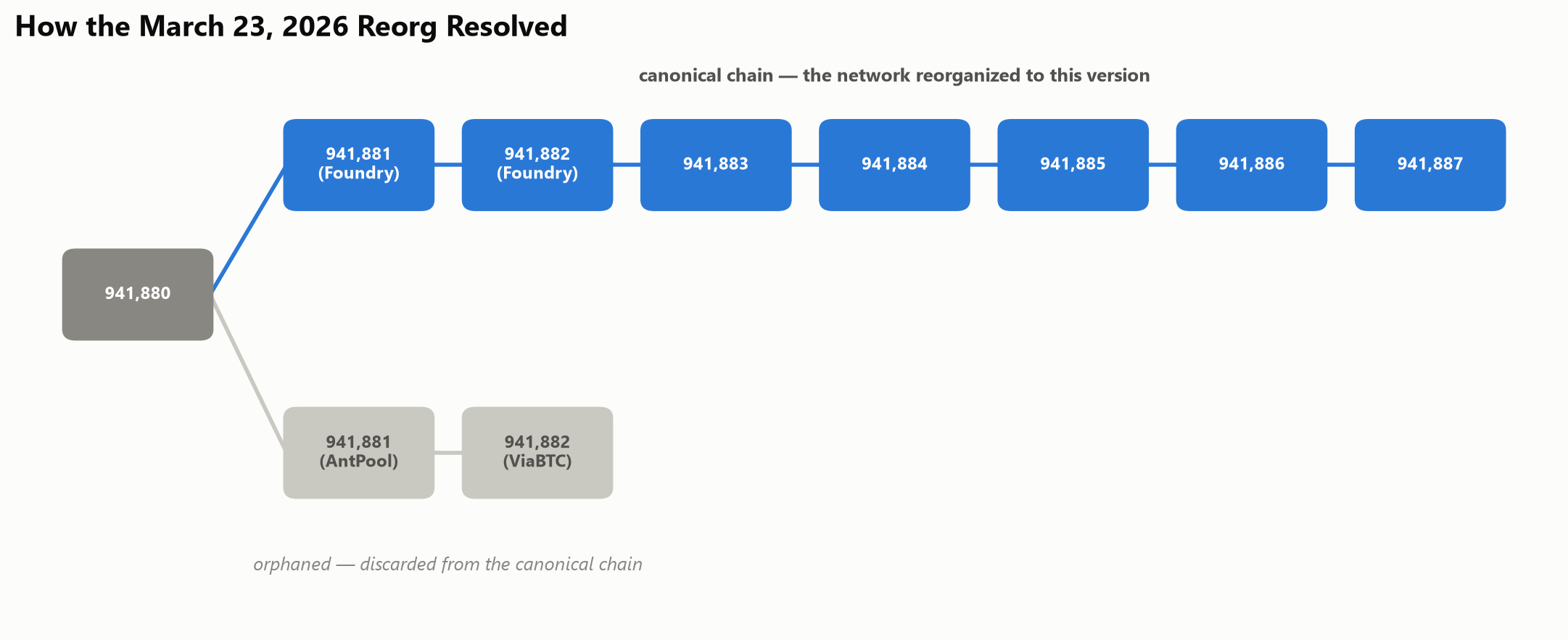
This is exactly what happened on March 24, 2026. After Antpool and Foundry USA each released their version of block 941,881 with a twelve-second interval, ViaBTC continued AntPool's chain with block 941,882, while Foundry, working on its own fork, also continued its version. For one block, the network was genuinely split in half between two valid chains. Then Foundry pulled ahead, mining blocks 941,883 through 941,886 consecutively (six blocks in a row on its branch), until its chain became, in the words of one Bitcoin developer monitoring the event, 'the heaviest by a wide margin.'
All nodes switched to Foundry's version, and the blocks mined by AntPool and ViaBTC became 'orphans'; their miners lost the block reward and fees for that work, although the transactions themselves returned to the mempool and were reconfirmed shortly thereafter.
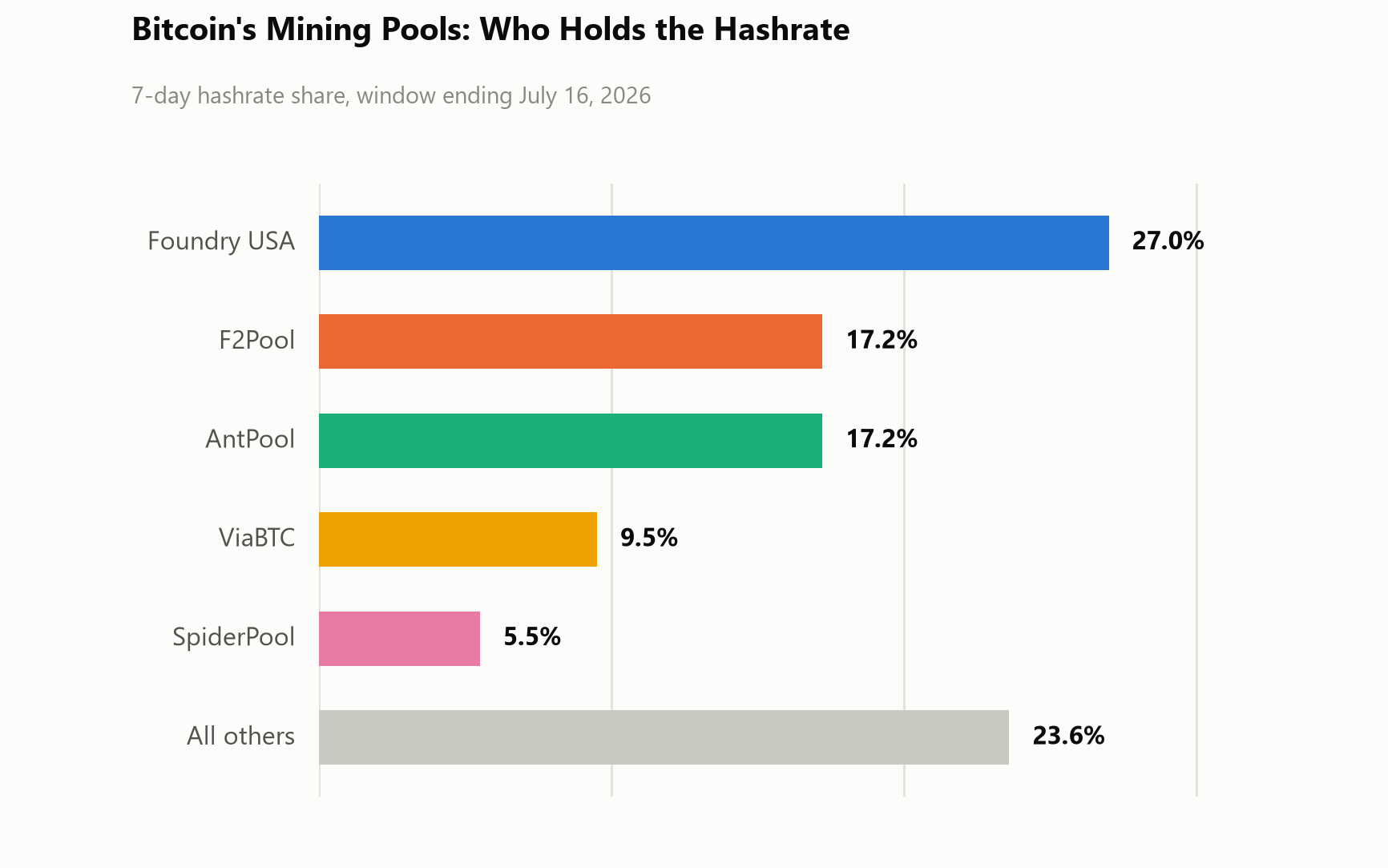
Bitcoin analyst b10c, who first publicly highlighted this event, called it a 'fairly rare case of a two-block fork/reorganization between Foundry and AntPool+ViaBTC.' 'Rare' is true, but the event also drew attention to a less pleasant trend: for a pool that already controls a significant share of the network's hash rate, stringing six blocks together is easier than it is for others. Coverage of the event noted that shrinking margins are squeezing out smaller miners and leading to a concentration of hash power in fewer, larger pools.
A more concentrated network doesn't make one-block races more common, but it noticeably increases the chances of a well-resourced pool winning any particular race (and stringing together the subsequent blocks that finish it) compared to the chances of a smaller miner.
The Boring Version Is Normal, and That's the Point
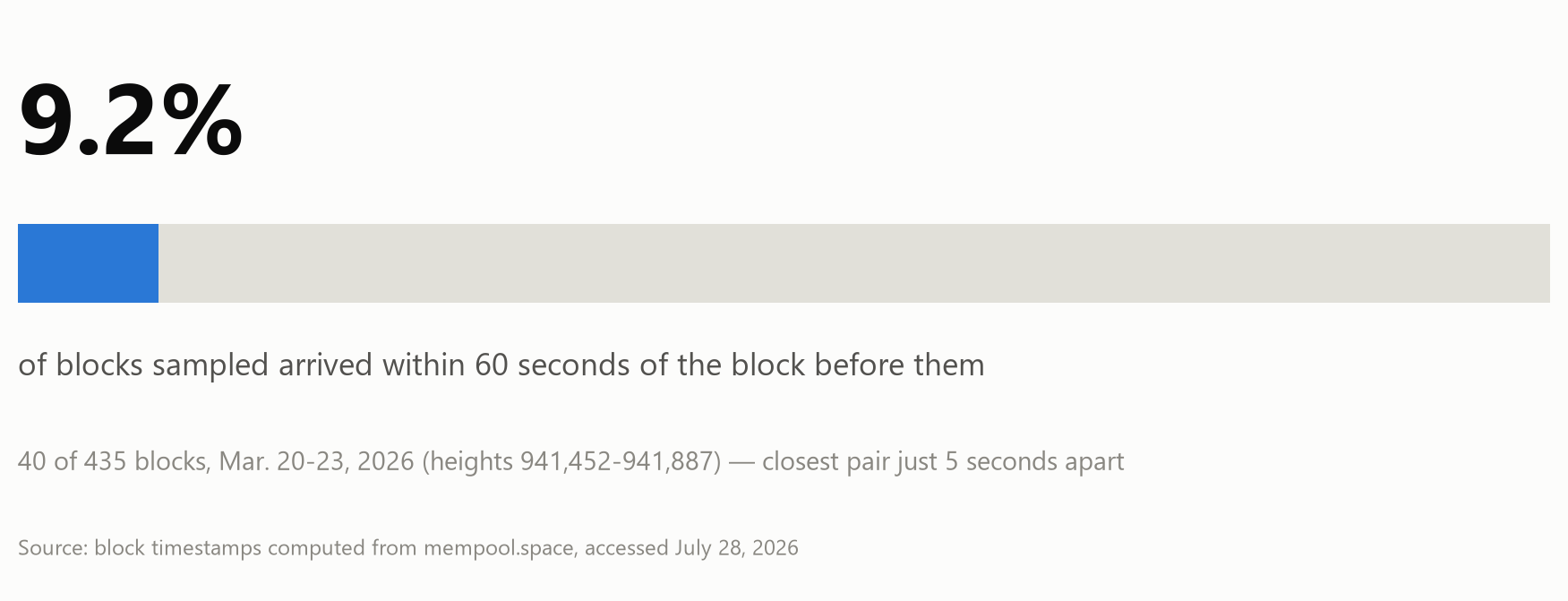
Two-block reorganizations are the exception; the underlying condition of a race is not. Looking at real block timestamps directly from mempool.space for the three days preceding the reorganization (heights 941,452 to 941,887), 40 of the 435 intervals between successive blocks (about 9.2%) were within 60 seconds of each other, including one pair with only a 5-second difference. Each of these cases where the difference was minimal is a moment when a genuine race condition existed in the network, albeit briefly.