Western Union launches USDPT on Solana: March rally for SOL?

ambcryptoPublished on 2026-03-05Last updated on 2026-03-05

Abstract

Western Union has launched a new stablecoin, USDPT, on the Solana blockchain, signaling strong institutional confidence in the network’s capabilities. This partnership enhances Western Union’s position in the stablecoin market by enabling efficient cross-border transactions. The development comes amid growing stablecoin ecosystem on Solana, with Grayscale reporting a record $650 billion in stablecoin volume in February—even as SOL’s price declined. Increased stablecoin activity, including Circle minting $1 billion USDC on Solana, points to strong underlying liquidity and on-chain demand. This liquidity surge may position Solana for a potential rally in March, especially if market sentiment remains positive. The network’s deepening capital flows and institutional backing strengthen its long-term fundamentals despite regulatory and competitive pressures.

No doubt, over the years, stablecoins have bridged TradFi and DeFi by enabling banks to process payments faster and at lower cost, directly improving efficiency and the overall user experience.

In this context, the critical factor is the Layer-1 network chosen to facilitate this bridge. Notably, Solana [SOL] appears to be strategically positioning itself to capitalize on this opportunity through another key partnership.

Western Union, a global financial services company, has launched USDPT, a new stablecoin on Solana, clearly signaling its confidence in the network’s capability to deliver stablecoin services to users.

At a macro level, the partnership structurally strengthens Western Union’s competitive position in the expanding stablecoin market, as leveraging blockchain infrastructure enables seamless cross-border transactions.

The more consequential question, however, is what this development means for Solana. As stablecoin regulations tighten and competition among Layer-1 networks intensifies, does this partnership reinforce confidence in its long-term fundamentals?

Considering how a recent report by Grayscale highlighted Solana’s growing stablecoin market, USDPT’s launch could not have come at a better time, positioning the network at the forefront of a potential March rally.

Stablecoin surge fuels renewed bullish case for Solana

High liquidity directly drives a network’s long-term growth.

The reasoning is simple. The more liquid a chain is, the easier it becomes to move capital across different sectors like NFTs, RWAs, and staking. This naturally increases on-chain activity and overall network strength.

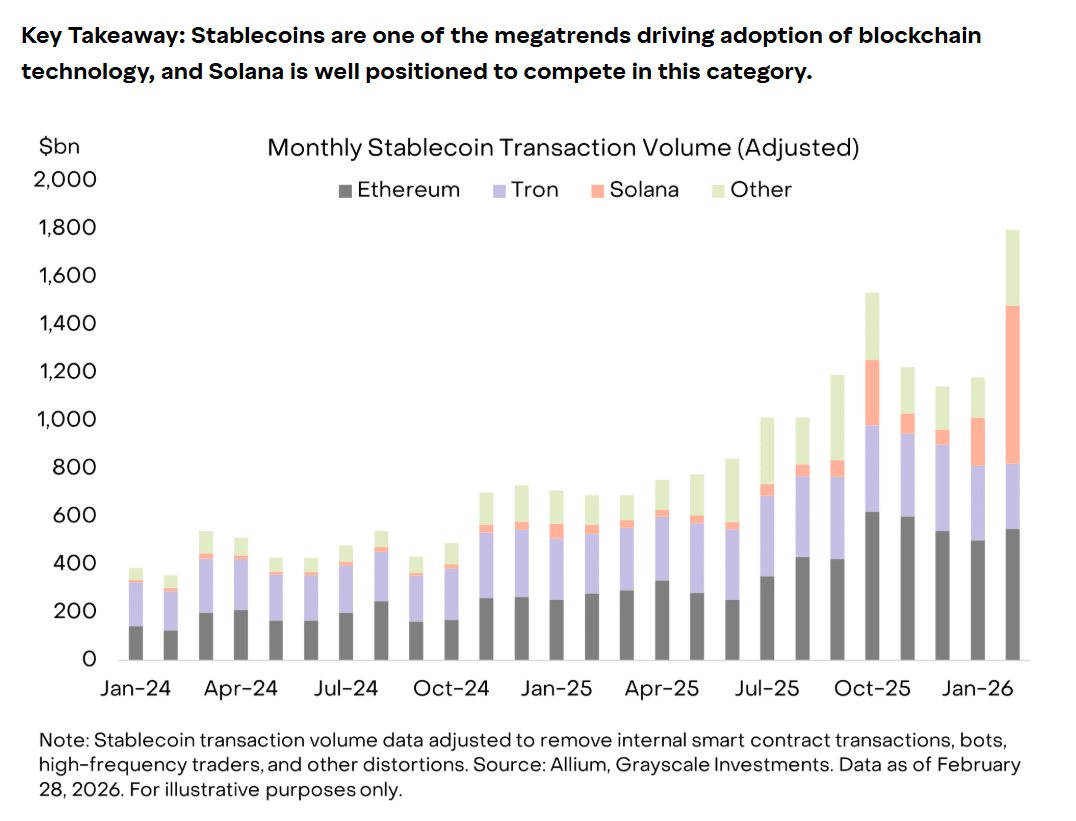
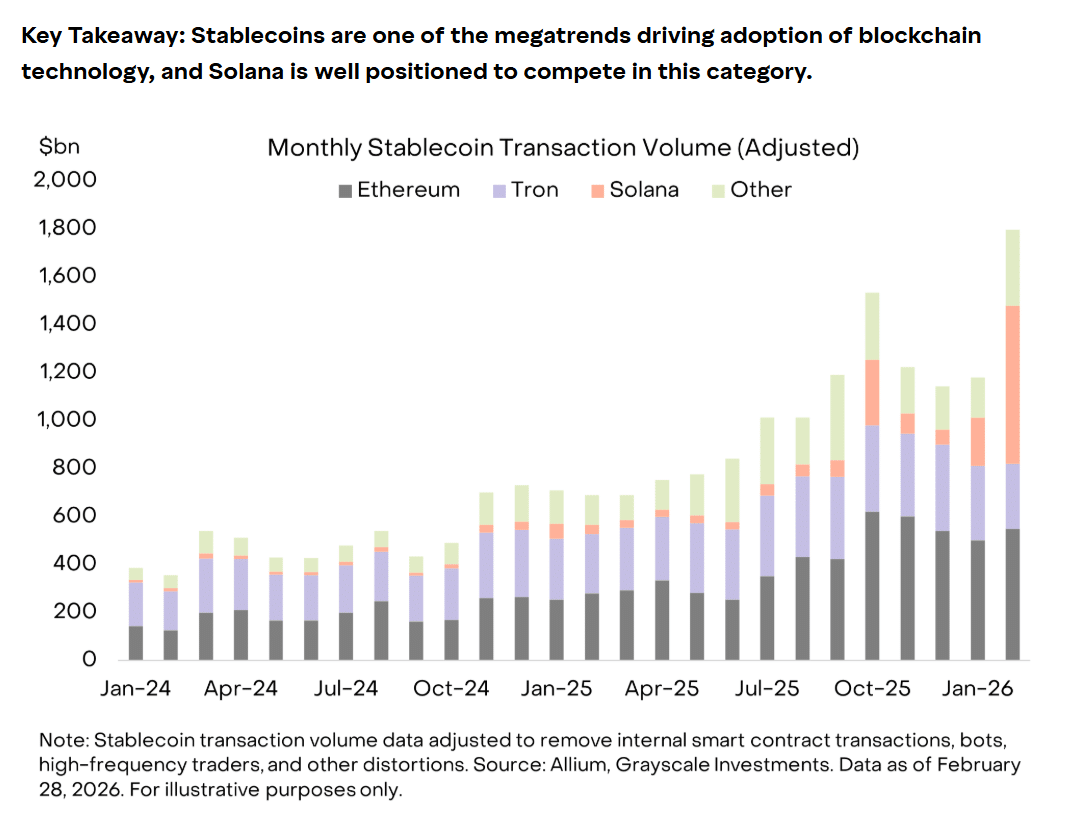
Grayscale’s statement that February was a record month for stablecoins on Solana carries weight in this context. The report noted that stablecoin volume on Solana hit an all‐time high of $650 billion.
Source: Grayscale

Notably, this expansion occurred while SOL saw its weakest monthly run of the year, closing February down 19.98%. This divergence suggests that underlying transactional activity persisted despite price weakness.

Within this context, Circle minting $1 billion in USDC on Solana following the Middle East conflict carries structural importance. Elevated stablecoin issuance during a risk-off phase increases on-chain liquidity depth.

When you add the USDPT launch to the mix, the added liquidity boosts Solana’s capital flows. With Grayscale highlighting strong underlying demand, the setup points to a potential liquidity‐driven repricing.

In this context, SOL’s breakout above $90 may only mark the beginning. With deeper stablecoin liquidity and steady on‐chain activity, Solana appears well‐positioned to lead in March if risk‐on sentiment persists.


Final Summary

  • Solana is seeing stronger liquidity and institutional backing, with moves from Western Union and Circle boosting on-chain activity.
  • Record stablecoin volume, highlighted by Grayscale, shows solid demand, which could support further upside if market sentiment improves.


Trending Cryptos

Related Questions

QWhat is the significance of Western Union launching USDPT on Solana?

AWestern Union's launch of the USDPT stablecoin on Solana signals strong institutional confidence in the network's capability to handle stablecoin services, strengthens its competitive position in cross-border transactions, and adds significant capital flow and liquidity to the Solana ecosystem.

QHow did Solana's stablecoin volume perform in February according to Grayscale?

AGrayscale reported that February was a record month for stablecoins on Solana, with stablecoin volume hitting an all-time high of $650 billion, indicating robust underlying demand despite SOL's price decline of 19.98% that month.

QWhy is the partnership with Western Union and Circle's USDC minting important for Solana?

AThe partnership with Western Union and Circle's minting of $1 billion USDC on Solana during a risk-off phase structurally enhances on-chain liquidity depth, boosts capital flows, and positions Solana at the forefront of potential growth, reinforcing long-term fundamentals.

QWhat does high liquidity mean for a blockchain network like Solana?

AHigh liquidity on a blockchain network like Solana facilitates easier movement of capital across various sectors such as NFTs, RWAs, and staking, which increases on-chain activity, strengthens the network, and supports long-term growth and potential price repricing.

QHow might Solana's position in the stablecoin market affect its performance in March?

AWith record stablecoin volumes, increased liquidity from new partnerships and USDC minting, and strong underlying demand, Solana is well-positioned to lead a potential March rally if risk-on sentiment persists, possibly extending its breakout above $90.

Related Reads

Global Stock Market's Storm Center: South Korea's Stock Market De-leveraging Is Largely Complete

Storm's Eye: South Korean Market De-leveraging Nears Completion The recent sharp correction in South Korean equities, with the KOSPI index dropping 32% from its June high, has been a key trigger for global tech stock volatility. The core driver was not a fundamental shift but a forced de-leveraging process within the market's unique structure, which is now largely complete. Two main leverage channels amplified the sell-off: 1. **Leveraged ETFs:** Their size, proportionally four times larger than in the U.S., peaked near $50 billion. Their mandatory daily rebalancing mechanism created a vicious cycle of "price drop → forced selling → further drop." Approximately 75% of this excess has been unwound, shrinking to $26 billion, with regulatory curbs now blocking new inflows. 2. **Hedge Fund Leverage:** Using swaps to magnify exposure, hedge funds saw their net long positioning fall by over 50% from peak levels. The most intense phase of this institutional de-leveraging is over. In contrast, **retail margin debt** poses minimal systemic risk. At 0.5% of market cap, it is far lower than in the U.S. or China, lacks automatic triggers, and is concentrated in smaller stocks. The conclusion: the high-leverage structures most prone to "chain-reaction selling" have been substantially cleared. The market is transitioning from a liquidity-driven crash to one priced more on fundamentals. The article argues that the AI trend—centered on Korean memory chips—remains intact. This episode represents a painful but necessary clearing of crowded trades, not the end of the AI revolution. For investors, the key question is conviction in the long-term AI direction; if the trend is real, current volatility is a cost of entry, not a terminal risk.

链捕手2h ago

Global Stock Market's Storm Center: South Korea's Stock Market De-leveraging Is Largely Complete

链捕手2h ago

Trading

Spot

Hot Articles

Discussions

Welcome to the HTX Community. Here, you can stay informed about the latest platform developments and gain access to professional market insights. Users' opinions on the price of SOL (SOL) are presented below.

活动图片














